Colossal

The best of art, craft, and visual culture since 2010.

Through Fictional Self-Portraits, Tang Shuo Visualizes an Ancestral Archive

Through Fictional Self-Portraits, Tang Shuo Visualizes an Ancestral Archive

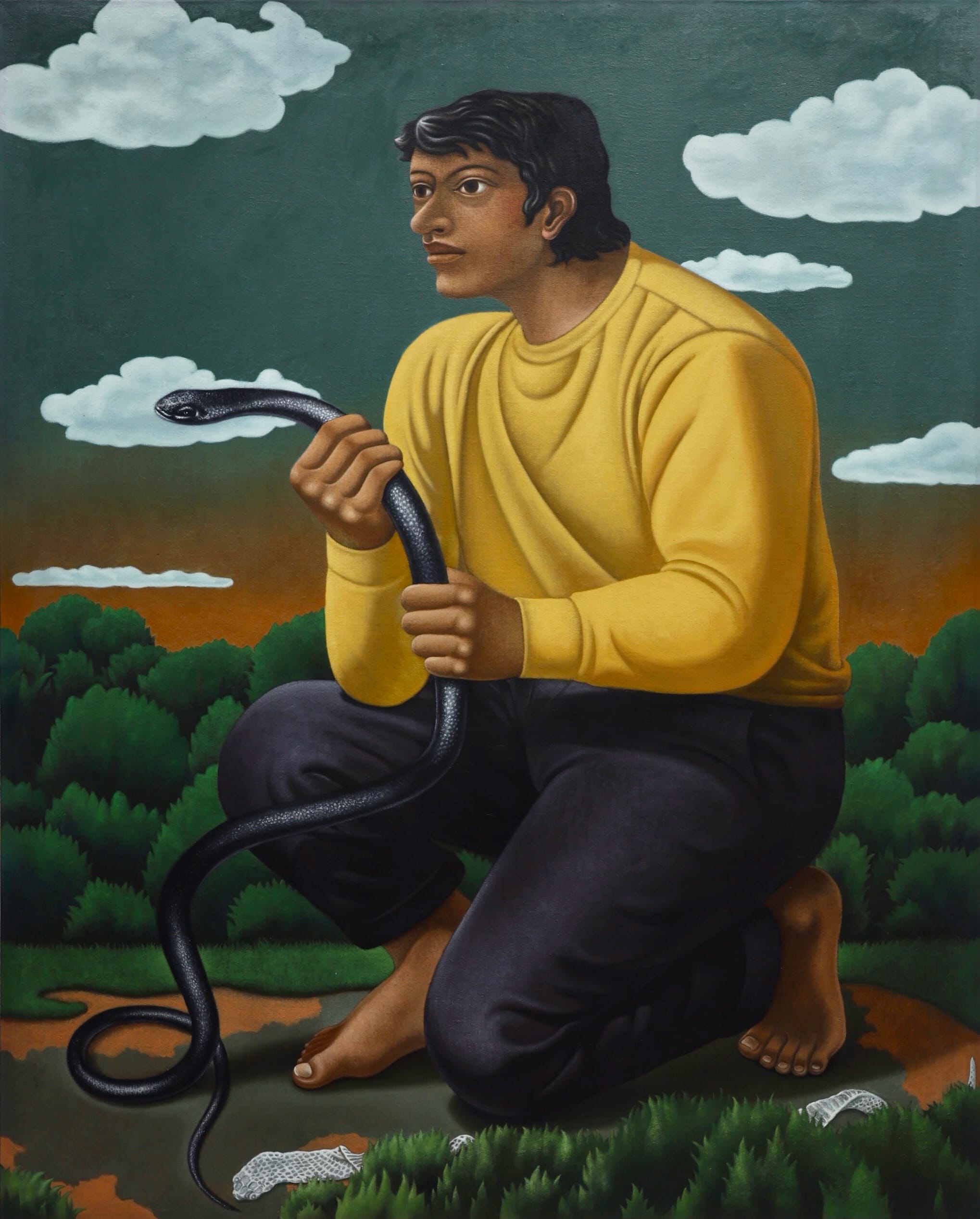
As a child in Dashishan Village in southern China, Tang Shuo was afraid of snakes. He and several generations of the Tang family lived together in a small community and farmed the land, tending to crops and sheep and encountering the occasional reptile. In a vivid new painting on linen, the artist confronts this adolescent fear as he envisions himself grasping a sleek, black serpent, its recently shed skin lying beneath them.

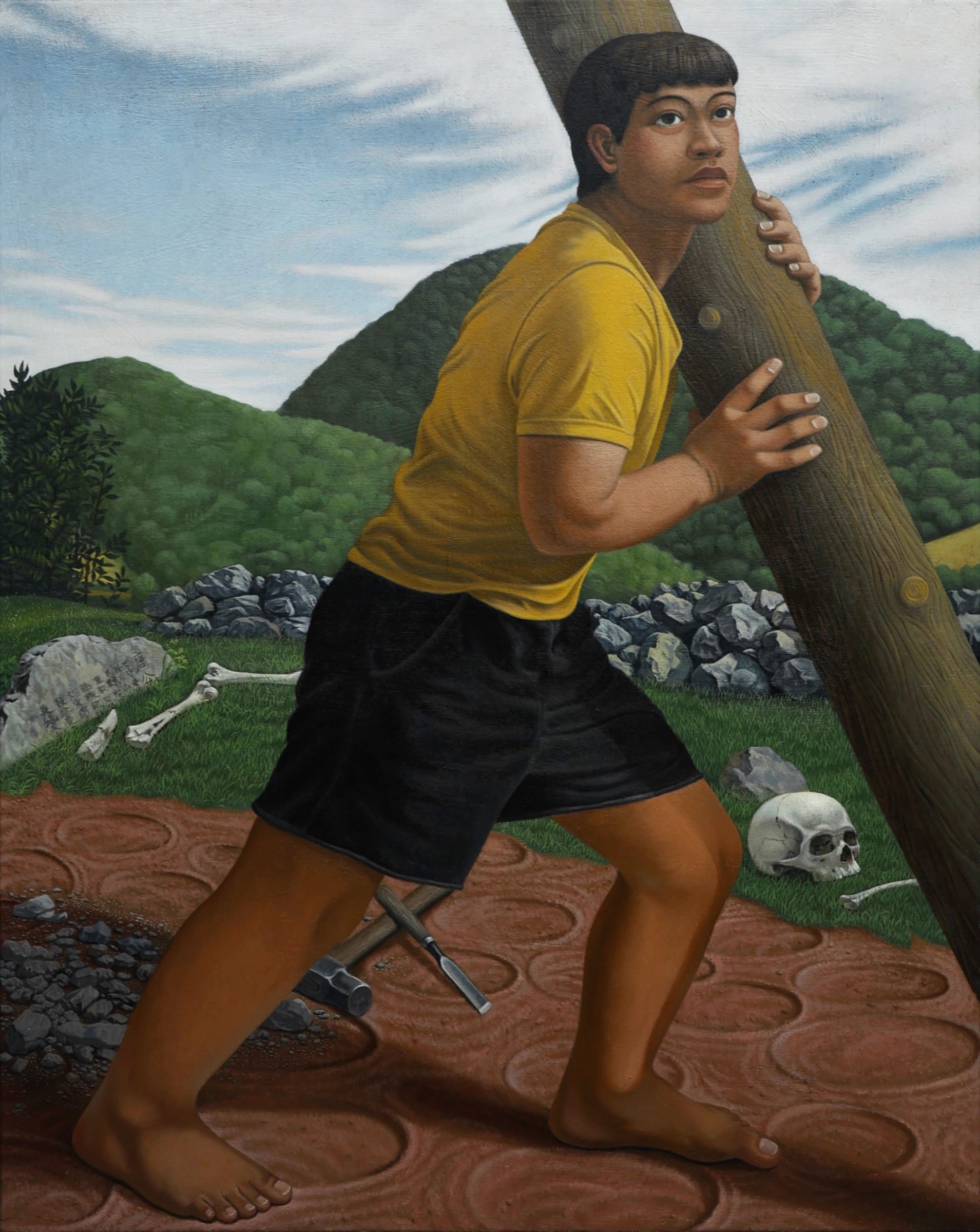
Long interested in his ancestry and familial connection to the land, Tang once again journeys to his home territory for Borrowed History, his first solo exhibition in New York. This body of work extends the artist’s approach to questioning how our heritage informs our understanding of who we are and how we got here. Working from photographs of himself, Tang renders his likeness in a variety of positions he envisions his kin having occupied. There’s “The Migrant” carrying a small sack slung over his back, for example, and “The Settler” hoisting a tree trunk with tools and bones scattered in the background.

a painting by Tang Shuo of a walking figure wearing a green shirt and brown pants holding a white sack and walking stick. the figure is outdoors with trees in the background and a white dog at its side
“The Migrant” (2026), oil on linen, 100 x 80 centimeters

Tinged with magical realism—Tang cites Gabriel García Márquez’s One Hundred Years of Solitude as an influence—the paintings reach backward to imagine the lives of the artist’s ancestors. Lush forests and candy-colored clouds envelop the scenes as a way to connect eras and generations. Nature and the terrain occupied, the artist suggests, is the throughline that tethers him to those who came before.

Although the specific scenes are fictional, Tang also considers his practice to be one of archiving “a world that is disappearing,” a statement says. “When he was a child, more than two hundred people lived in Dashishan; today, only a dozen or so remain. He continues to document the inhabitants and stories of the village and will eventually publish a book recording its history, which he describes as his ‘own bible.'”

Borrowed History is on view from October 8 to November 7 at Plato Gallery. Explore more of Tang’s works on Instagram.

a painting by Tang Shuo of a figure wearing a yellow shirt and black shorts pushing a large tree trunk. the figure is outdoors with trees in the background
“The Settler” (2026), oil on linen, 100 x 80 centimeters
a painting by Tang Shuo of a seated figure wearing a white shirt and black pants holding a red cord. the figure is outdoors with trees in the background
“The Tree Hollow I” (2026), oil on linen, 150 x 120 centimeters
a painting by Tang Shuo of a figure with a yellow shirt lying with their head on their arm in the grass
“Waiting” (2026), oil on linen, 61 x 50.5 centimeters
a painting by Tang Shuo of a foot vase holding a plant with white heads
“Vessel” (2026), oil on linen, 70 x 50 centimeters

Do stories and artists like this matter to you? Become a Colossal Member today and support independent arts publishing for as little as $7 per month. The article Through Fictional Self-Portraits, Tang Shuo Visualizes an Ancestral Archive appeared first on Colossal.

The Register

Biting the hand that feeds IT — Enterprise Technology News and Analysis

Altman-backed Volantis reveals plan to vault the memory wall by baking photonics into AI accelerators

Sam Altman-backed AI chip startup Volantis has a plan to break through the memory wall using light, and this time it's not just an IP play. Founded in 2022, the San Francisco-based startup is developing an AI accelerator that will use a photonic interposer to dramatically increase memory bandwidth without compromising on capacity. Volantis believes it can pack upwards of 10 TB of memory at speeds up to 240 TB/s onto a single massive package. This, it claims, should be enough to serve a 20 trillion parameter model at 10,000 tok/s per user. To do this, Volantis is taking a somewhat unusual approach. Rather than developing some novel compute architecture or memory technology, the company is focusing its efforts on the optical interposer. Everything else it plans to license from IP providers. "The differentiation is primarily coming from the optical interposer. So why don't we license absolutely everything we possibly can, even if it's not the highest performance in the world, because we're already biting off a lot of risk with the interposer and the integration," CEO Tapa Ghosh tells El Reg. The basic idea behind the chip, which Volantis is calling A-1, is that by using optical wave guides rather than electrical interconnects it can dramatically increase the amount of high-bandwidth memory per package. Because of the speeds at which most AI accelerator memory, like HBM, operate, and the size and number of data pins used, it needs to be as close to the compute as possible to minimize power consumption and maximize signal integrity. As a result the maximum capacity and bandwidth of modern GPUs is limited by the compute die's shoreline. That's the physical perimeter around the chip. For now, that means the cap is right around 432 GB on AMD's MI455X. Photonic interconnects can extend that much farther. Instead of a few millimeters the memory can be located a few centimeters away, eliminating the shoreline as a bottleneck. While HBM is useful as an example, we'll note Volantis hasn't said what memory tech its chip will use just yet. Volantis aims to achieve this using optical waveguides integrated into an interposer. Compute and memory designed or supplied by its partners will be packaged on top. If any of this sounds familiar, Volantis isn't the first to propose using silicon photonic interposers in this manner. As our sister site Next Platform has previously reported, both Lightmatter and Celestial AI have toyed with the idea in the past. In fact, we strongly suspect the idea of HBM-at-a-distance contributed to Marvell's decision to acquire Celestial for $5.5 billion. However, unlike either Celestial or Lightmatter, Volantis isn't trying to license its tech to other chipmakers. At least not yet. Instead it aims to develop a fully fledged inference chip. "It is, at least on day one, a way easier problem to demonstrate a solution that ships," Ghosh says. Another differentiator is the technology on which the startup's interposer is based. Rather than relying on external lasers, Volantis' design uses micro vertical-cavity surface-emitting lasers — micro-VCSELs for short — and means the light source is integrated directly into the interposer. VCSELs aren't new by any means, but have faced criticism over their reliability. However, Volantis CTO Roy Meade tells us the technology has come a long way in recent years and by giving up some speed, significantly higher reliability can be achieved, a philosophy he describes as wide and efficient. "People are still constrained to this, what I would call a fat pipe point-to-point mentality, and naturally, if that's the case, you're going to go towards SerDes," he says. "If we were to go back and take a look at the benefits of a wide-and-efficient approach. HBM for example. Taking that same playbook makes a lot of sense." What Meade is getting at is that interconnects can achieve higher bandwidth in a couple different ways. The first is by increasing the link speed, and the second by using more links. For example an 800 Gbps link can be achieved using four 200 Gbps links or eight 100 Gbps links. In his example of HBM, higher bandwidth is achieved by using an extremely-wide bus but slower data rate per pin relative to other memory technologies. The same concept applies to Volantis' optical interposer-based accelerator. Power efficiency remains an open question that's dogged many photonics startups, but this may be less of a problem for Volantis because it's not trying to license its first-gen interposer tech. For its first product the company is targeting 1 picojoule per bit per 24 Gbps lane and a total system power of around 20kW. Volantis still has a ways to go before it tapes out its first production-ready chip, and will need to raise a fair bit more in venture capital to do that — far more than the $88 million it raised this week with the help of Lachy Groom, Abstract Ventures, and others. Ghosh is well aware of this. He says the funding will enable the company to scale from small-scale optical demonstrators to something more closely resembling the final product. The interposer alone is challenging enough, but then there is the complexity of actually integrating the IP they license. "Aggressively, we should aim for an MVP product in 12 to 18 months as our target," he tells us, noting that's to have a working prototype not volume production. ®

Found Photograph

Thomas Hawk posted a photo:

Found Photograph

Rex Null's

Thomas Hawk posted a photo:

Rex Null's

yungyi0925.tw has added a photo to the pool:

巷弄深處的微光漫步 | Strolling the Alley Glow | 路地裏、光の散歩

yungyi0925.tw has added a photo to the pool:

巷弄深處的微光漫步 | Strolling the Alley Glow | 路地裏、光の散歩

出差的空檔,給了自己一場久違的東京深夜散策。
獨自穿梭在熟悉的巷弄深處,冰冷的牆面映著微溫的霓虹光影。那一瞬間,時間彷彿倒流,將我拉回了過去在這裡生活的日子。空氣裡的味道、街角的寂靜都沒有變,變的是心境——那些曾經匆忙的日常,如今沉澱成最溫柔的鄉愁。漫步,是在找回心裡的那片風景。
--------------------------------------------------------------------------------
出張の合間、久しぶりの東京の夜をひとりで歩く。
見慣れた路地裏の奥へと足を踏み入れれば、冷たい壁に柔らかなネオンの光がにじむ。その瞬間、時が巻き戻されたかのように、かつてここで暮らしていた日々の記憶が鮮やかによみがえる。空気の匂いも、街角の静けさもあの頃のまま。ただ違うのは、かつての慌ただしい日常が、今は愛おしい郷愁へと変わっていること。歩くことは、自分自身の物語の一片に触れる時間。
--------------------------------------------------------------------------------
A break from business travel turned into a long-overdue midnight stroll through Tokyo.
Wandering alone through familiar alleyways, the cool concrete met the gentle, fading glow of neon lights. In that single moment, time seemed to reverse, pulling me right back to the days I used to call this place home. The chill in the air and the quiet corners remained unchanged, yet my perspective had shifted—what used to be a hurried routine has settled into a tender nostalgia. A stroll, simply to reconnect with a piece of my own story.

Rijnmond - Nieuws

Het laatste nieuws van vandaag over Rotterdam, Feyenoord, het verkeer en het weer in de regio Rijnmond

Auto kantelt op snelweg, lange file lost snel op

Door een ongeval op de A29 tussen Barendrecht en afrit Numansdorp stond maandagavond richting het zuiden een flinke file. Een auto kantelde en blokkeerde enige tijd de rijbanen. Automobilisten werden zodoende via de vluchtstrook geleid.

Auto kantelt op snelweg, meer dan uur file richting zuiden

Door een ongeval op de A29 tussen Barendrecht en afrit Numansdorp staat richting het zuiden meer dan een uur file. Een auto is gekanteld en ligt nog altijd op de rijbaan. De rijbaan is afgesloten.

Bestuurder zegt lijnbus waarmee hij botste en waarin Naomi (15) overleed niet te hebben gezien

Bestuurder C.H. is na de fatale botsing bij Zwartewaal teruggegaan naar de plek van het ongeluk. “Ik wilde weten: hoe kon dit nou gebeuren? Mijn conclusie is dat ik de bus niet heb gezien, omdat hij in een flauwe bocht zat. Het spijt me verschrikkelijk.”

VK: Voorpagina

Volkskrant.nl biedt het laatste nieuws, opinie en achtergronden

‘Ik vind het draconisch om Margo Reuten (Da Vinci), zo’n voorbeeld in de Nederlandse gastronomie, na 26 jaar haar ster af te pakken’

‘Ik vind het draconisch om Margo Reuten (Da Vinci), zo’n voorbeeld voor de Nederlandse gastronomie, na 26 jaar haar ster af te pakken’

Nederlander benoemd tot minister in omstreden schaduwregering van Soedan

Veroordeling hoofdpersoon documentaire Verstoten vaders laat zien hoe complex het is om intieme terreur aan te pakken

Hoewel Armand S. wegens stalking en valsheid in geschrifte tot veertien maanden celstraf is veroordeeld, toont de uitspraak van de rechtbank Rotterdam dat het moeilijk is om intieme terreur en dwingende controle aan te pakken.

Een alg die extreem snel op licht reageert leidde tot een revolutie in de hersenwetenschap

Drie wetenschappers kregen de langverwachte prijs voor hun bijdrage aan „het ontrafelen van een van de grootste mysteries van de mens: hoe het brein werkt”. Zij ontdekten hoe je hersencellen kunt in- en uitschakelen door er licht op te schijnen.

kottke.org

Jason Kottke's weblog, home of fine hypertext products

O Superman, Laurie Anderson

O Superman by artist Laurie Anderson from 1981. Some of the lyrics:

‘Cause when love is gone
There’s always justice
And when justice is gone
There’s always force
And when force is gone
There’s always Mom
Hi, Mom

So hold me, Mom
In your long arms
So hold me, Mom
In your long arms
In your automatic arms
Your electronic arms
In your arms
So hold me, Mom
In your long arms
Your petrochemical arms
Your military arms
In your electronic arms
Ah, ah, ah, ah

60 Minutes did a profile of Anderson a few years ago and she explained the meaning of the song (to her):

This is a song about how basically technology cannot save you. It’s about a lot of things: justice, safety, power.

As a kid growing up in rural Wisconsin, this kind of music wasn’t available to me, so I only actually heard this for the first time fairly recently. So I thought I’d post it in case you hadn’t really heard it either — that and the message & meaning it carries is relevant these days.

I also liked this rendition of it, slowed down and reverbed. There are also several O Superman remixes on Soundcloud of varying quality.

Tags: interviews · Laurie Anderson · music · video

The Guardian

Latest news, sport, business, comment, analysis and reviews from the Guardian, the world's leading liberal voice

A former poet laureate and a Pulitzer winner lead TS Eliot prize shortlist

10 poets are in the running for the prestigious £25,000 prize, with collections that ‘remind us why it’s to poetry we turn to reorient ourselves’

The former poet laureate Andrew Motion and Pulitzer prize winner Jorie Graham are among the 10 poets shortlisted for this year’s £25,000 TS Eliot prize, the UK and Ireland’s most prestigious award for a single volume of poetry.

Motion has been selected for Gravity Archives, while Graham, who was previously shortlisted in 2012, is on the list for Killing Spree.

Continue reading...

Norway plans temporary ban on smart glasses in some public places

Camera-enabled Meta spectacles are already restricted in UK and US because of fears about covert recording

Norway is planning a temporary ban on smart glasses in some public places, amid rising global concern at the spread of the AI-enabled recording devices.

The Oslo government is planning a bill to prevent the use of the camera-enabled spectacles in parks, beaches, museums, shopping centres, schools, daycare centres, healthcare facilities, gyms and public events, although private use would still be allowed.

Continue reading...

Is the US becoming a nation of cat lovers?

Dogs have long been more popular, but for the first time more households own kittens than puppies. Some believe it’s all down to economics

Name: The kitten index.

Age: The debate has probably raged since animals have been domesticated.

Continue reading...

Flávio Bolsonaro poised to win Brazilian presidency after shock first-round victory

Progressive voters and supporters of incumbent president Luiz Inácio Lula da Silva left reeling after far-right surge

Flávio Bolsonaro is in pole position to win Brazil’s presidential election, after a far-right tsunami propelled him to a shock first-round victory over the incumbent, Luiz Inácio Lula da Silva, leaving progressive voters reeling.

The 45-year-old rightwing candidate received 56.1m votes to Lula’s 53.8m – 47.03% to 45.16% – meaning the 80-year-old leftwinger has a mountain to climb if he is to bounce back in the second round on 25 October. Never, since the return of democracy to Brazil in 1985, has the first-round runner-up managed to turn the game around and win the second ballot.

Continue reading...

MetaFilter

The past 24 hours of MetaFilter

Once upon a time, insects had 24 legs

Once upon a time, insects had 24 legs. This ancient oddball fills a major gap in the fossil record. Insects are famous for their six-legged body plan, but that wasn't always the rule. A 324-million-year-old fossil dug up from a shale bed in West Texas had a markedly different setup, sporting a whopping 18 extra legs along its belly — a body plan unlike that of any living insect.