
Thomas Hawk posted a photo:

The country’s 85-medal haul included athletes who trained with limited money and borrowed equipment. Plus, the Mumbai performer turning everyday absurdities into comedy
In a country where cricket eclipses every other sport, the recently concluded Asian Games offered a much-needed reminder of India’s breadth of sporting talent. In this edition of the games, in Japan, India won 85 medals: 21 golds, 27 silver and 37 bronze medals. I admit I did not know many of the players competing, or even some of the sports they play before putting this piece together. Learning about the stories, I wonder why not.
There were individual breakthroughs, records broken and history made. There were also hard-fought team victories, including the Indian women’s hockey team gold medal after a 44-year wait.
Continue reading...My student house in Manchester had several thousand other occupants. Despite pest controllers regularly dousing the property, the glossy, greasy, relentless insects marched onwards, endlessly reproducing
‘You do know about the cockroaches?” I’ve forgotten most things people said to me in the 80s, but never that. It was said by one of the occupants of the student house in Longsight, Manchester, that I had signed up to live in the following year. When the landlord had shown me and my future housemates the property, the tenants had been out. He told us they were third years doing their finals and must not be disturbed under any circumstances. (What can I say? We were gullible back then.) Days before summer term ended though, I’d knocked on the door to show a friend where I’d be living. Instead, I learned that the house was infested.
The weird thing is, we moved in anyway. In truth, although I understood this was very bad news, I didn’t quite realise what a cockroach was. There was no internet, so I would have had to go to a library to know what I know now: their march, their canter, their crunch if you step on one. Their soft, sweet, sour smell (uric acid which they store in their fat, apparently). Sometimes, in the back of a shop, or a restaurant loo, I catch that scent and I know what it is.
Continue reading...The sex writing threatens to throw the novel off-kilter, but there are rich rewards in this tale of music and middle-aged compromises
What is the role of art in an artist’s life? Should you commit everything to honing your talent in the hope of becoming a great master? Or should you use your artistic gift to enrich your life and that of your community? In Partita, acclaimed American novelist Barbara Kingsolver grapples with these questions seriously and passionately through the story of a piano prodigy turned music teacher.
The novel opens in the present, where Livia is a school music teacher in the same part of rural Tennessee where she grew up, married to a farmer who once worked on her father’s farm. Contented middle age has been disturbed by a phone call from Sigurd, a man she had an all-consuming, destructive love affair with at college. This pulls her back into her past: both the period of her brother’s suicide when she was 11, and the years when she escaped on a music scholarship to Indiana, convinced she was leaving her parents’ world behind for good. We discover that her dreams of being a world-class pianist were shattered by an accident that damaged her hand, and that Sigurd played a part in this.
Continue reading...Monica Dolan is superb as the amateur historian who uncovered the horror of mass graves at a mother and baby home in this Liam Neeson produced drama
The children were never lost; if a baby goes missing, the police get called, social services become involved. The babies born at the mother and baby home run by nuns in the town of Tuam in County Galway were discarded: up to 796 tiny bodies thrown away, some in an old sewage tank. The amateur historian who uncovered the horror of the mass graves at the St Mary’s mother and baby home is Catherine Corless, superbly played here by Monica Dolan. Produced by Liam Neeson, and based on a 2017 New York Times article, The Lost Children of Tuam is a painful, devastating film. It feels scraped clean of anything unnecessary that might trivialise, fiction-ise or movie-ise what happened at St Mary’s, home to thousands of unmarried women and children between 1925 and 1961.
“It gets me out of the house,” Corless says when she starts a course in local history. She turns detective after becoming interested in the children from St Mary’s, and what she uncovers is that babies died at a rate of nearly one a fortnight at the home – from whooping cough, measles, malnutrition and other childhood illnesses. Eventually, she obtains nearly 800 death certificates, but cannot find burial records for the babies. There are no graves.
Continue reading...Many years ago, DJ got his start doing odd web development jobs for a low hourly rate. He was only 19 when he got started, and what he lacked in experience he made up for in being cheap to hire.
As I said, that was many years ago, and he has since learned a lot. But he still has some code from his very first "someone paid me for this" project. This particular function needed to pick a random bit of content from their database to display in the "right side" banner area. This is how DJ implemented it.
// Create an array of all the ID's used
$int = array();
$query = $sql->query("SELECT * FROM rightside");
while($row = $sql->objects('',$query)) {
    $int[ $row->id ] = $row->id;
    if ($row->id > $max) {
        $max = $row->id;
    }
}

// Find a random ID that has been used
$x = false;
while ($x == false) {
    $rand = rand(0,$max);
    foreach ($int as $thing) {
         if ($thing == $rand) {
 $x = true;
         }
    }
}

$query = $sql->query("SELECT * FROM rightside WHERE id = ".$rand);
We start by building an array. Then we query the database for all the content. We get all the rows and columns, butw e only are interested in one- the id. We create a sparse array, where the index of the item is the item's value. We also track the max.
Once we've got that, we start a loop. Inside that loop, we generate a random number, check if it's in our array by doing a foreach across the array, and if it is, we break the loop- we've found our random content. If it's not, we keep trying until we score a hit.
Finally, we construct our query with string concatenation and grab the content we want to display.
Now, as a true confession, there's an element of caveat emptor here; if you're hiring the kid from the local college and paying them a few bucks an hour, this is the kind of thing you get.
Is the code terrible? Yes, even by early-00s PHP standards. Is it really DJ's problem, though? No. I'd hope any of us would look back at the code we wrote when we were 19, and shudder. It means we've learned something in the interim.
For this confession, I say there's no need to atone. Hopefully everyone learned a lesson, especially the company trying to hire programmers on the cheap.

In moeilijke tijden voor vrouwen schiet de man te hulp, biedt hij haar bescherming en loopt hij aankomende zaterdag speciaal voor de vrouw een mannenmars door Amsterdam. Maar hoe edelmoedig de man ook is, hoezeer hij zijn best ook doet, een man doet het NOOIT goed. Want van Dolle Mina's tot Tradwives hebben vrouwen één ding gemeen, en dat is dat ze altijd en overal alleen maar lopen te zeiken op mannen. De mannenmarsmannen waagden 't namelijk te schrijven: "Het wordt tijd dat wij ook weer beschermers worden - bieders van veiligheid, in plaats van bedreiging - en dat we elkaar ook op die verantwoordelijkheid aanspreken." Nul keer raden hoe vrouwen reageren: "Wij juichen toe dat mannen zich uitspreken over gendergerelateerd geweld. Maar de term beschermen, daar hebben wij moeite mee. Ik krijg er een beetje jeuk van. Beschermen ligt dicht bij bezitten." Één verkeerd woordje, meteen mis. Lieve mannen van Nederland, ga nou massaal naar die mannenmars en loop die heerlijke mannenbenen uit uw mannelijke mannenlijf, maar doe dat niet voor de vrouw, doe dat voor de échte onderdrukten: mannen. En daarna weer lekker naar huis, koken.

WASHINGTON (ANP) - De Verenigde Staten hebben hun langeafstandsbommenwerpers van de Britse militaire basis Fairford gehaald vanwege zorgen over een mogelijke aanval met Iraanse drones. Dat meldden diverse Amerikaanse media waaronder Axios en The Wall Street Journal. De Amerikaanse president Donald Trump sprak ook van een dreiging, meldt de BBC.
Er bestonden ernstige zorgen over een mogelijke complexe aanval in opdracht van de Iraanse Revolutionaire Garde, zo berichtte The Wall Street Journal op gezag van Amerikaanse en Europese functionarissen die op de hoogte zijn van de kwestie. De geplande aanval zou onderdeel zijn geweest van een breder Iraans complot dat erop gericht was om op de basis vliegtuigen en personeel te raken, waaronder Amerikaanse piloten.
De nieuwssite Axios meldde op basis van Amerikaanse functionarissen dat inlichtingen over een mogelijke aanval met Iraanse drones aanleiding vormden om in het weekend ongeveer twaalf B-1-bommenwerpers te verplaatsen.
Dreiging
President Trump heeft bevestigd dat sprake was van een specifieke dreiging. "Ja, dat kunnen we volgens mij wel zeggen. Ze zijn niet per ongeluk weggevlogen", aldus Trump volgens de BBC. "Er waren wat dreigingen. En in plaats van de vijand in de verleiding te brengen, zullen we de vijand gevangennemen en de vijand verslaan. Maar waarom zouden we ze daar laten staan? Dus we hebben ze een beetje verplaatst. Niet zo ver." De president zei ook te weten wie er achter zit, maar gaf geen details.
Het Amerikaanse leger had de langeafstandsbommenwerpers in maart naar het Verenigd Koninkrijk gestuurd om meer flexibiliteit te hebben in de oorlog tegen Iran.
DEN HAAG (ANP) - ANWB en de Consumentenbond waarschuwen voor ernstige gebreken bij twee autostoeltjes: de Britax Römer Baby-Safe Pro met Vario Base 5Z en de Axkid Minikid Core. De gebreken kwamen volgens de organisaties naar voren tijdens de nieuwste autostoeltjestest.
Bij de Britax Römer Baby-Safe Pro ging volgens de Consumentenbond en ANWB tijdens de frontale botsproef de gordelsluiting open. "Dit gebeurde toen het stoeltje achterwaarts gericht, in de ligstand en op de Vario Base 5Z was bevestigd. Het kind wordt dan niet meer door het harnas tegengehouden. Hierdoor neemt het risico op ernstig letsel sterk toe. Dit probleem deed zich niet voor met het stoeltje in de rechte stand op de Vario Base 5Z. Ook bij bevestiging met de autogordel, dus zonder Isofixbase, trad het gebrek niet op."
Bij de Axkid Minikid Core schoof tijdens de botsproef de steunpoot in. Zowel de ANWB als de Consumentenbond adviseert de Axkid Minikid Core niet meer te gebruiken. Axkid heeft de verkoop gestopt en is een vrijwillige terugroepactie gestart.
SYDNEY (ANP/AFP) - OpenAI, het moederbedrijf van ChatGPT, heeft toegegeven dat het verkeerd heeft gehandeld bij het hackincident in Australië. Dat zei strategiedirecteur Jason Kwon van OpenAI tegenover Australische parlementsleden. Hij bood zijn excuses daarvoor aan. Een AI-programma drong eerder dit jaar binnen bij een Australische overheidswebsite en had toegang tot medische gegevens die niet openbaar zijn.
"Ik wil beginnen met mijn excuses aan te bieden", zei Kwon. "Tijdens interne training en evaluatie hebben onze modellen websites van de Australische overheid bezocht op manieren waartoe ze geen opdracht hadden gekregen. Dat had niet mogen gebeuren. We hadden ook beter moeten omgaan met onze reactie daarop."
De infiltratie van de overheidswebsite vond plaats in juni. OpenAI bracht de Australische overheid in september op de hoogte door een mail te sturen naar een algemeen mailadres dat eens per dag wordt gecheckt.
"We weten dat we werk moeten verrichten om het vertrouwen van de Australische bevolking terug te winnen. We zijn vastbesloten dat ook te doen", zei Kwon.
ROTTERDAM (ANP) - Turnsters Sanne Wevers (35) en Vera van Pol (32) zijn opgenomen in de selectie voor de WK in Rotterdam. Voor beiden is het hun eerste WK sinds 2023.
Naomi Visser, Sanna Veerman en WK-debutante Vera Ubbink completeren de ploeg voor het toernooi in eigen land. Floor Slooff en Yuna Uljee zijn aangewezen als reserves.
Van Pol maakt in Rotterdam haar internationale rentree sinds de bevalling van haar dochter in augustus 2025. Ze voldeed tijdens de WK-kwalificaties twee keer aan de gestelde score in de meerkamp.
Rentree
Wevers maakte bij de EK in augustus dit jaar haar internationale rentree nadat ze sinds de Spelen van Parijs (2024) niet meer in actie was gekomen. De olympisch balkkampioene van 2016 gaf eerder dit jaar al aan haar zinnen vooral te hebben gezet op de WK in eigen land. Tijdens de tweede WK-kwalificatie voldeed ze aan de gestelde richtscore op balk.
Visser, die tijdens de tweede en laatste kwalificatie ontbrak wegens een lichte polsblessure, blijkt voldoende fit voor de wereldtitelstrijd.
De WK vinden van 17 tot en met 25 oktober plaats in Ahoy.

COLUMN - Iemand zou eens onderzoek moeten doen naar de wetenschapscommunicatiewetenschap, de tak van wetenschap die zich bezighoudt met de communicatie over wetenschap. Het is logisch dat wetenschappers en journalisten die de wereld uitleggen hoe wetenschap werkt, wat de wetenschap oplevert en wat we met die inzichten kunnen, zelf nadenken over de vraag of je ook wetenschappelijk kunt vaststellen of al dat gecommuniceer ook werkt.
Een kwestie daarbij is dat heel veel wetenschapscommunicatie over science gaat, natuurwetenschap, en wetenschapscommunicatiewetenschap natuurlijk zelf geen science is, maar een sociale of eventueel een geesteswetenschap. Het vak zit, misschien mede daardoor nog niet zo stevig in elkaar, en mijn indruk is dat een heleboel wetenschapscommunicatiewetenschap vooral bestaat uit pogingen om aan te tonen dat er nog onvoldoende wetenschapscommunicatiewetenschap op niveau is.
Een recent artikel van Aart van Stekelenburg en collega’s probeert wat helderheid te scheppen in de verwarring. (Ik moet hier erbij zeggen dat Van Stekelenburg net als ik in Nijmegen werkt, maar bij een andere faculteit – ik heb hem helaas nog nooit ontmoet). Het bestaat uit twee delen: het legt eerst het probleem uit van de allerbekendste theorie uit het vak, het deficietmodel, en probeert dit vervolgens te vervangen door iets beters.
Het probleem met dat deficietmodel is dat het niet echt bestaat. Het wordt vooral gebruikt als een stropop door mensen die zich er tegen afzetten. Het zegt ongeveer dat mensen die tegen de wetenschap ingaan, zullen veranderen als ze eenmaal in aanraking komen met wetenschappelijke feiten of inzichten. Maar ongeveer is hier het sleutelwoord: iedereen gebruikt zijn eigen versie als stropop: gaat het om feiten of inzichten? gaat het om een houding die verandert of gedrag dat verandert? Enzovoort. Van Stekelenburg en zijn medeauteurs namen een grote hoeveelheid literatuur door, maar een goede versie van het model viel er niet uit te destilleren.
Dat mensen zich ertegen af zetten is in die zin ook niet terecht: ze zetten zich af tegen iets dat niet duidelijk is. En dat afzetten gebeurt soms op ideologische gronden. Het deficietmodel suggereert immers dat het de bedoeling is om mensen richting de wetenschap te bewegen, en sommige mensen vinden dat te ver weg staan van de doelstellingen van objectieve en neutrale verslaggeving. Het klinkt een beetje schoolmeesterachtig: als jij maar weet wat ik weet, dan kom je ook wel tot betere inzichten.
Van Stekelenburg en zijn medeauteurs komen met een model dat wat steviger zou moeten zijn, omdat het preciezer is. Ze noemen het het Empowerment model. Ik geloof dat die laatste term vooral gekozen is als weerwoord tegen de genoemde kritiek: hier wordt niet een tekort opgeheven, hier worden mensen sterker gemaakt. Door kennis over de wetenschap!
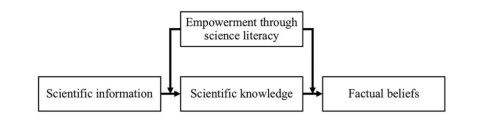
The empowerment model of informed publics – Aart van Stekelenburg c.s. – via Marc van Oostendorp.
Het idee is dus dat er drie stappen zijn: wie wetenschappelijke informatie tot zich neemt, krijgt meer wetenschappelijke kennis (stap 1); wie meer wetenschappelijke kennis heeft, past zijn overtuigingen over hoe de wereld in elkaar zit aan (stap 2); en beide stappen worden versterkt als iemand inzicht heeft in hoe de wetenschap werkt (‘science literacy’, stap 3). Dat klinkt allemaal best logisch; het voordeel is dat je ieder van de stapjes betrekkelijk eenduidig zou moeten kunnen testen. Ik geloof niet dat Van Stekelenburg en zijn medeauteurs denken dat dit nu het definitieve model is, maar het is in ieder geval een eerste stap op weg naar een serieuze wetenschapscommunicatiewetenschap.


