Sarah Pochin bought Anglesey property two days after writing to minister about impact of second home ownership on rural communities
A Reform UK MP bought an £800,000 second home on a picturesque Welsh island two days after raising concerns in parliament about the impact of second homes on rural communities.
Sarah Pochin completed the purchase of a Grade-II listed property on the southern coast of Anglesey (Ynys Môn).
Continue reading...Enlargement commissioner Marta Kos outlines proposed safeguards to protect EU from undemocratic leaders
The European Commission wants to ensure there is no repeat Viktor Orbán among the next generation of EU member states, as it set out plans to prepare for the bloc’s enlargement into eastern Europe in the next few years.
In an interview with the Guardian and other European newspapers, the EU commissioner for enlargement, Marta Kos, outlined proposals for special safeguards to protect the bloc from leaders who could flout democratic values and hold hostage decision making, a pattern of behaviour exemplified for many by the former Hungarian prime minister.
Continue reading...DEN HAAG (ANP) - Volt-fractievoorzitter in de Eerste Kamer Gaby Perin-Gopie heeft het kabinet uitgenodigd om voor een brede meerderheid te gaan samenwerken met haar partij en PRO. In de Algemene Politieke Beschouwingen in de senaat zei ze dat dit de beste en snelste oplossing is voor premier Rob Jetten.
"Waarom maakt het kabinet geen gebruik van de uitgestoken hand voor een stabiele meerderheid?" vroeg Perin-Gopie aan het kabinet. Het "shoppen voor verschillende meerderheden" levert volgens haar niets op.
PRO en Volt kunnen het kabinet een meerderheid geven in de Tweede en de Eerste Kamer.
Perin-Gopie vreest dat het kabinet alleen "de tijd uitzit tot een van de partijen er goed voorstaat in de peilingen". Zij noemt dat "doorstartpolitiek" en ze denkt dat Nederland daarmee "geen stap verder komt".
Je kat krijgt elke dag dezelfde brokjes uit de supermarkt en je denkt er verder niet over na. Toch zat er PFAS in de zalmbrokjes van alle vijf grote supermarkten die voor een nieuw onderzoek zijn getest. Eén huismerk springt eruit: daarin zat ook een veel giftigere variant. Hieronder lees je om welke zakken het gaat en wat het onderzoek wel en niet aantoont.
Het onderzoek werd gedaan in opdracht van Greenpeace en zaterdag 3 oktober naar buiten gebracht. Volgens Kassa gaat het om brokjes van Albert Heijn, Jumbo, Aldi, Lidl en PLUS. Het waren allemaal brokjes op basis van vis, en dit zijn de producten uit de steekproef:
In alle vijf de verpakkingen werd de PFAS-soort TFA gevonden. Kassa beschrijft TFA als de kleinste PFAS-variant: hij breekt moeilijk af en staat erom bekend dat hij zich opstapelt.
In het huismerk van Albert Heijn werd naast TFA ook PFNA aangetroffen. Greenpeace noemt dat een vorm van PFAS die tien keer giftiger is dan PFOA, en die stof is inmiddels verboden.
De labresultaten zijn beoordeeld door Jacob de Boer, emeritus hoogleraar en toxicoloog aan de Vrije Universiteit Amsterdam. Hij noemt de uitslag verontrustend. Volgens zijn analyse zat er in de AH-brokjes veel meer PFNA dan verantwoord is als je de normen voor mensen aanhoudt. Een kat die de hele zak opeet, krijgt zo'n 50 keer meer PFAS binnen dan de norm voor mensen.
Voor katten bestaat op dit moment helemaal geen PFAS-norm.
Die vergelijking met mensen is dus een hulpmiddel om de hoeveelheid te kunnen inschatten. Het is geen grens die voor dieren officieel is vastgesteld. Volgens De Boer laat de uitkomst wel opnieuw zien hoe wijdverspreid PFAS in voedsel is, en nu dus ook in voer voor huisdieren.
Namens de supermarkten reageerde brancheorganisatie CBL. Tegen Distrifood zei het CBL dat het voorop staat dat producten in de winkel veilig zijn, 'voor mens en dier', en dat het de signalen over PFAS serieus neemt. Volgens het CBL ligt de oorzaak wel ergens anders:
Mensen kunnen via voedsel en water PFAS binnenkrijgen, maar de verontreiniging van producten vindt een stuk eerder in de keten plaats.
Het CBL vindt daarom dat Europa samen de uitstoot van PFAS bij de bron moet aanpakken. Greenpeace legt de schuld ook niet bij de winkels. In een bericht over het onderzoek schreef de organisatie dat het supermarkten en voerfabrikanten zelf niet te verwijten valt. Volgens Greenpeace belandt PFAS via de chemische industrie in de grondstoffen. De organisatie gebruikt de uitkomst om opnieuw te pleiten voor een nationaal PFAS-verbod.
Ook de Dierenbescherming liet weten dat ze geschrokken is van PFAS in kattenvoer. Eerder schreven wij al over PFAS in mensen, in 'Zeven keer zoveel PFAS in je bloed? In deze Nederlandse regio's is de vervuiling het ergst'.
Het gaat om een steekproef: per supermarkt is één soort zalmbrokjes getest. Andere smaken, natvoer, brokjes zonder vis en merken van de dierenwinkel zijn niet onderzocht. Of die schoner of juist viezer zijn, blijkt dus niet uit dit onderzoek. Er is tot nu toe ook niets teruggeroepen.
Bronnen: Kassa (BNNVARA), Distrifood, Greenpeace Nederland, Greenpeace Nederland (LinkedIn), Greenpeace Nederland (PFAS in voeding), Dierenbescherming

BRUSSEL (ANP) - De Europese Commissie wil normen voor Europese producten of diensten bij uitzondering ook buiten de EU kunnen laten vaststellen, meldt ze dinsdag in een voorstel.
Een norm is een soort document waarin de technische details staan waaruit een product of dienst bestaat. Dat verschilt van het formaat van een vel A4-papier tot de veiligheid van kinderspeelgoed of welke oplader op welk apparaat past. Die normen zijn niet automatisch verplicht, maar het vaststellen van een EU-norm zorgt ervoor dat een product of dienst makkelijker binnen de interne markt te verhandelen is.
Binnen de EU zijn er drie officiële organisaties die die normen kunnen vaststellen. De Commissie wil nu voor bepaalde sectoren, zoals AI, cyberveiligheid en batterijen, ook zo'n soort norm buiten de EU kunnen laten vaststellen. Dit omdat snelheid geboden is in dit soort sectoren. Dit mag alleen met instemming van de lidstaten, staat in het voorstel.
Wachttijd
"Dit zou innovatieve oplossingen helpen sneller de markt te bereiken", aldus de Commissie. De gemiddelde wachttijd voor een norm zou kunnen worden verlaagd van zes naar vier jaar, verwacht het dagelijks bestuur van de EU.
Met name kleine en middelgrote bedrijven hebben hier voordeel van, verwacht de Commissie. Die zijn vaak afhankelijk van een normstelling om te kunnen doorgroeien binnen de interne markt van de EU.
DEN BOSCH (ANP) - Sponsor Essent heeft zich tot en met 2030 verbonden aan de schaatsploeg van coach Jac Orie en commercieel directeur Sven Kramer. Dat heeft Team Essent dinsdag tijdens de teampresentatie in Den Bosch bekendgemaakt.
Essent is sinds 2024 sponsor van het schaatsteam waar onder anderen Joep Wennemars, Suzanne Schulting, Beau Snellink en Angel Daleman rijden.
"Het is mooi dat we nu kunnen verkondigen dat we een fantastisch traject hebben tot 2030", zei Kramer in Den Bosch. "Het is heel fijn dat we kunnen bouwen aan de toekomst en een stip aan de horizon hebben en tijd hebben met z'n allen."
In 2030 vindt het langebaanschaatsen van de Olympische Spelen, georganiseerd in de Franse Alpen, plaats in Thialf in Heerenveen.
SINGAPORE (ANP/RTR) - Formule 1-coureur George Russell start komende zondag in de Grote Prijs van Singapore achteraan. De Brit van Mercedes incasseert een gridstraf omdat hij een motorwissel moet doorvoeren. Het is zijn vijfde en daarmee heeft hij zijn maximale aantal van vier krachtbronnen per seizoen overschreden, bevestigde het team van Mercedes.
Russell viel afgelopen zondag uit in de Grote Prijs van Bahrein in Maleisië. Hij lag op de derde plaats toen zijn motor ermee ophield. De nummer twee in het kampioenschap zag zijn achterstand op zijn teamgenoot en WK-leider Kimi Antonelli groeien naar 84 punten.
Russell won vorig jaar de GP van Singapore, die vanwege de hitte en hoge luchtvochtigheid als een van de zwaarste in de Formule 1 geldt.
AMSTERDAM (ANP) - Naar schatting voelen 442.000 bi+ mensen in Nederland zich psychisch ongezond. Dat stelt Bi+ Nederland op basis van een eigen omrekening van cijfers uit de nieuwe lhbtiqa+-monitor. Ook hebben bi+ mensen vaker dan homoseksuele en lesbische mensen in het afgelopen jaar een suïcidepoging gedaan.
Bi+ is een verzamelterm voor mensen die zich tot meer dan één gender aangetrokken kunnen voelen, zoals biseksuele en panseksuele mensen. De groep is vaak onzichtbaar: 37 procent is nooit of soms open over de seksuele oriëntatie.
De organisatie zegt "geschrokken" te zijn van het aantal. "Toch zijn bi+ mensen bij hulpverleners, gemeenten en beleidsmakers nog nauwelijks in beeld", zegt directeur Barbara Oud van Bi+ Nederland.
Bi+ Nederland wijst ook op negatieve opvattingen over de groep. Bijna een kwart neemt het niet vanzelfsprekend serieus als iemand vertelt bi+ te zijn. De organisatie pleit voor meer kennis over bi+ mensen bij hulpverleners en voor aandacht voor de groep in beleid en dienstverlening.
europeanspaceagency posted a photo:
NASA/ESA/CSA James Webb Space Telescope has unveiled numerous stars formerly hidden by clouds of dust in a stellar nursery known as NGC 7129 – a cauldron of cosmic creation, 3300 light-years from Earth. Webb captured infrared light, which pierces through the dense matter that scatters or absorbs other types of light. This region, rife with stellar objects in different stages of their lives, offers an opportunity to explore how stars shape their surroundings.
The stars from this cluster are in different stages of their development, as the more massive stars form and evolve the fastest. The most massive (and the most mature) is the region’s luminous central star, LkH(alpha) 234. This star, which sports the image’s most prominent diffraction pattern weighs around 5 to 8 times our Sun. So-called pre-main-sequence stars like these have mostly finished gathering mass and have begun contracting under the force of gravity, causing their temperatures to rise. In time, this star will fuse its own hydrogen like our Sun.
The cavity to its left, which appears in gold and spans about 3.5 light-years, is the largest demonstration of the central star’s impact. Outflows from an earlier stage of the star’s life cycle carve into the dense molecular cloud of hydrogen. Both the outflows and the star’s light energise the gas, causing it to glow. While much of this hydrogen gas is blown away, a large amount is also compressed, creating the conditions for even more stars to form.
A few of these young stars are visible within the cavity. Several of these are also pre-main-sequence and generate stellar winds. The nearby bow shocks, the curved compressed gas that appears near the stars, are created as those winds push into the energetic gas and form their own, smaller cavities.
Together, the central star and the embedded stars create a hot environment that pushes against the colder and denser molecular gas, and form a boundary known as a photodissociation region. In this region, the molecules of hydrogen break down into atoms. By influencing the heating, cooling, and chemistry of the region, this collection of stars offers insight into how these molecular clouds will gradually erode over millions of years.
The region to the right of the central star narrates a different, but equally chaotic tale. This clumpy matter represented in red hides much younger objects than those on the left: protostars. The protostar stage is earlier than the pre-main-sequence stage and occurs after molecular clouds of gas and dust initially compress and fragment.
As the protostars accumulate matter and increase their mass, they eject outflows of superheated material. These outflows interact with the dense, gray matter that the protostars are wrapped within, creating shocks that cause the textured appearance. The red glow is also the result of the interaction, just like the outflows of the central pre-main-sequence star on the golden cavity to the left of the region. Multiple overflows from multiple stars overlap from our point of view, leading to the chaotic appearance.
[Image description: A cluster of many stars that display Webb’s unique eight-pronged diffraction pattern. At its center is a yellow star with the largest diffraction pattern. To the left of the star, there is a region filled with yellow dust and gas that extends from the star to the left border of the image, covering about two-thirds of the image. Several blue stars of different sizes are embedded within this region. The top third, which lies outside of the yellow region, holds a few bright protostars, within dense gray gas. Those stars illuminate the gas, making it appear blue. To the right of the central star, there is a clumpy, flame-like plume of red dust and gas with protostars that emit a soft white light within. The plume is surrounded by more dense gray gas and dust. There are several background galaxies strewn throughout the image]
Credits: NASA, ESA, CSA, STScI; Image Processing: A. Pagan (STScI); CC BY 4.0
europeanspaceagency posted a photo:
ESA astronaut and NASA's SpaceX Crew-12 mission specialist Sophie Adenot poses for a portrait while wearing the pressure suit she will wear when she departs the International Space Station inside the SpaceX Dragon spacecraft.
Follow Sophie’s mission on the εpsilon page and on her social media platforms, such as X, Facebook, Instagram, LinkedIn.
Credits:ESA/NASA – Anil Menon
europeanspaceagency posted a photo:
NASA's SpaceX Crew-12 members gather for a portrait in the pressure suits they will wear when they depart the International Space Station inside the SpaceX Dragon spacecraft.
From left, Roscosmos cosmonaut and mission specialist Andrey Fedyaev, NASA astronauts Jack Hathaway and Jessica Meir, Crew-12 pilot and commander respectively, and ESA (European Space Agency) astronaut and mission specialist Sophie Adenot.
Follow Sophie’s mission on the εpsilon page and on her social media platforms, such as X, Facebook, Instagram, LinkedIn.
Credits:ESA/NASA – Anil Menon
europeanspaceagency posted a photo:
The European Space Agency (ESA) and the Institute of Atmospheric Physics at German Aerospace Center, DLR, teamed up to measure rocket emissions on a sub-orbital launch that flew on 1 October. Ground-based measurements were combined with measurements recorded from a chaser aircraft that flew through the exhaust plume of a rocket launched from Esrange in Sweden, for the Mapheus-17 mission. The operations show what is possible to record and better understand rocket emissions in the lower atmosphere as space agencies work towards more sustainable space transportation.
Mapheus is a regular series of DLR rocket flights, this mission housed multiple experiments in materials and life sciences, as well as testing technology in microgravity. Mapheus-17 flew almost 300 km upwards before landing back on Earth 16 minutes after liftoff – around 70 km downrange from the launch pad.
The ‘Firewall’ project aims to develop a concept to measure rocket emissions. To learn by doing, Firewall used DLR’s Mapheus-17 solid-propellant sounding rocket mission as a first test case.
The Firewall campaign relied on DLR’s Falcon 20E research aircraft that is equipped with instruments to measure gases and particles in the rocket’s exhaust plume. The Falcon 20E aircraft took off around 20 minutes before the rocket launch and then flew through the region where the plume drifted at altitudes between 2 and 6 km. As the plume disperses just minutes after liftoff it becomes invisible, adding to the challenge of taking measurements.
A custom-made container packed with an array of scientific measurement systems near the launch site also recorded the emissions at the launch pad, complementing what the aircraft measured.
The project offered the team important real-world experience in coordinating air-traffic control, flight instruments, the teams working on the rocket operations and how to combine them in a joint campaign. The operations went well, the rocket concluded its flight and the Falcon 20E observation aircraft landed safely after flying through the rocket exhaust. Researchers at ESA and DLR will now analyse the data recorded to see if the setup worked as intended. If so more rocket-sniffing flights could follow.
Credits: ESA
europeanspaceagency posted a photo:
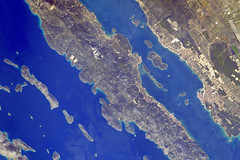
This picture was published on social media by ESA astronaut Sophie Adenot with the following caption: Day 234, orbit 3627 — I’ll soon have my feet back on Earth, but even from the ground, I definitely plan to keep sharing the beauty of our planet with you. I still have a few photos in store…
This heart is the small Croatian island of Galešnjak, in the Adriatic Sea.
Sending you lots of love from orbit!
Follow Sophie’s mission on the εpsilon page and on her social media platforms, such as X, Facebook, Instagram, LinkedIn.
Credits: ESA/NASA – S. Adenot

"De Europese Commissie wil het toetredingsproces van kandidaat-lidstaten versnellen. Daarvoor moet onder andere het vetorecht van de huidige lidstaten worden beperkt, zo staat in een plan van Commissievoorzitter Ursula von der Leyen." Ursula is de chauffeur van een uitdijende moloch. Cruisend door Europa, zoekend naar armetierige landen om toe te voegen aan het rijk. Handje uit het raam en zwaaien naar uw soevereiniteit. Broederlanden to be: Oekraïne, Noord-Macedonië, Servië en meer van deze atypische vakantiebestemmingen. Een soort wachtkamer met bedelaars die hopen op een lidmaatschap met slechts voordelen. Voetballen zonder bardienst én zonder contributie. Wanneer Noord-Macedonië nu lid wil worden, gaat dat via een lang proces. Bij elke stap is dan unanimiteit noodzakelijk. Als nettobetaler best prettig, dat je kunt bepalen naar wie je geld gaat. Maar de moloch moet en zal bestuurbaar zijn. Wel zo prettig als je de eindbestemming al kent.