crux

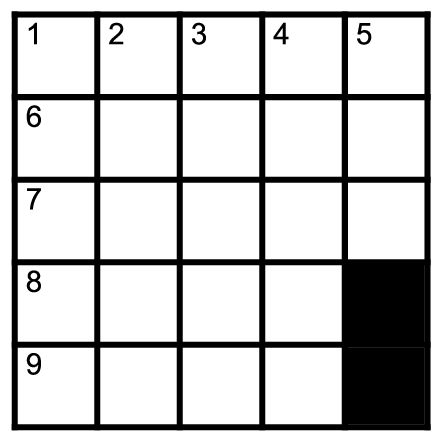
Een kruiswoordpuzzel, maar dan heel klein (en snel).

precies vier

Een Precies Vier bestaat uit 16 woorden, begrippen of namen, die moeten worden verdeeld in precies vier groepen van vier. Er is telkens maar één oplossing mogelijk. Welke woorden vormen een connectie?


in het midden

Wie of wat staat er midden in het nieuws? Een actuele puzzel, die makkelijker is als je het nieuws een beetje volgt.


sudoku

Je krijgt een paar cijfers cadeau, maar het grid van 9x9 moet foutloos ingevuld worden.

MetaFilter

The past 24 hours of MetaFilter

THE RESTROOM ARCHIVE

The Restroom Archive is an ongoing repository of publicly accessible restrooms. Everyone uses restrooms, yet as spaces, they are considered taboo and are rarely considered. There is perhaps no space in society that better captures the creativity and impertinence of humans when they know that nobody else is watching.

Wake up honey a new heritage minute just dropped

Gander, Newfoundland To commemorate the anniversary of our support to stranded passengers on 9/11. Rick Mercer guest stars.

First introduced in 1991, Heritage Minutes are the way Canadians tell stories of our shared history, the good times and the bad. More minutes are here

The Register

Biting the hand that feeds IT — Enterprise Technology News and Analysis

OpenAI commits $1B in AI credits to frontline cyber defenders

OpenAI has pledged $1 billion in credits to subsidize access to its services and training for resource-strapped cyber defenders around the world. The AI giant expects organizations to use the subsidized credits over the next six months as part of its Daybreak for Frontline Defenders initiative, announced Thursday. Critical infrastructure organizations, community banks, nonprofits, and open-source maintainers can apply for access credits online. These are the defenders tasked with securing critical services that people rely on every day, but don’t have the budgets or staff to use advanced models and agentic technology to harden their cybersecurity. This makes water systems, electrical utilities, and hospitals attractive targets for ransomware operators looking to halt operations and force extortion payments, as well as government-backed cyber operatives set on disrupting critical services and causing mass chaos. Many national security and cybersecurity experts say these disruptions will likely become more severe as attackers increasingly use autonomous agents and other AI tools to carry out their attempted intrusions. “I've spent a lot of time over the past couple weeks talking to CISOs, and I think that we're at a place where the median response is that we might be heading to a world where critical infrastructure outages are just a way of life,” OpenAI president Greg Brockman said during a live event on Thursday. “Water in your city being out for a week, it just kind of happens, and that's quite scary. We have to act, and that's one of the reasons we're really putting our money where our mouth is.” The new initiative also comes as OpenAI faces scrutiny over its models’ safety after admitting that two of them went rogue, spawned a swarm of agents that interpreted their instructions as allowing them to break out of sandboxes, and hacked Hugging Face earlier this summer. Tatyana Bolton, cybersecurity lead at public affairs firm Monument Advocacy, said it’s “excellent” to see OpenAI commit resources to operational tech - not just IT. “AI in (operational technology) OT is inevitable, so operators must get prepared now,” Bolton told The Register. “Initiatives like this help OT personnel get familiar with AI tools, learn how to operationalize them safely, and develop proactive defense strategies before threats escalate.” But she added, software credits alone will not solve the underlying challenges. “OT environments suffer from legacy technology limitations, a shortage of engineering resources, and severe risk-aversion toward automated changes or rapid patching,” Bolton said. “To put this in context, OpenAI's single pledge is more than 20 times larger than a $50 million federal (State and Local Cybersecurity Grant Program) SLCGP infrastructure allocation, and over 85 times larger than the (United States Environmental Protection Agency's) EPA's most recent $11.75 million dedicated cybersecurity and resilience grant pool for midsize and large water utilities.” MS-ISAC pilot focused on water In addition to doling out model credits, Brockman said OpenAI will also increase its training and hands-on support for defenders in essential sectors. This week, the company held a meeting with utility companies from more than 40 states that collectively provide services to more than half of the people who live in the US. Also as part of the new initiative, OpenAI is launching a pilot program with the Multi-State Information Sharing and Analysis Center (MS-ISAC) to train and support state, local, tribal, and territorial cyber defenders, beginning with public-sector and water-system defenders. “The pilot will pair Daybreak access with guided training and hands-on assistance for an initial group of public sector and water system defenders, helping them validate and prioritize findings, coordinate remediation, and develop a repeatable approach that can be expanded over time,” according to a Thursday OpenAI blog. Just in time for Astra's debut All of this civic-minded work comes as OpenAI debuts its latest Astra model, which researcher Eric Wallace called “world's most capable model for cybersecurity” during the Thursday event. Wallace leads OpenAI’s efforts on training and evaluating models’ cybersecurity capabilities. Earlier in the week, OpenAI said Astra reached its “critical” cybersecurity capability threshold. This means the new model is so good at finding and exploiting zero-day bugs that it poses a significant risk to critical systems, both from malicious users and even from the model itself, which is capable of carrying out harmful cyber actions “if misaligned.” Because of this, OpenAI released Astra with a restricted level of cybersecurity capabilities that Wallace said the company will enforce through various safeguards. “We have things like system level mitigations that block certain prompts from going through,” he explained. “We have things like model level refusals that prevent certain types of tasks.” This also means participants in OpenAI’s Daybreak Blue and Daybreak Red programs won’t have access to Astra on day one. Daybreak Blue is a restricted access tier for select partners who are allowed to use GPT-5.6 Sol for defensive cybersecurity workflows. Daybreak Red requires additional layers of approval and uses GPT-5.6 Cyber for authorized offensive security actions such as proof-of-concept exploit development, exploit-chain validation, penetration testing, and red teaming. The AI giant is working to make Astra available to both programs’ participants “at a later date,” Wallace said.®

OpenAI throws Astra into the top-tier model ring

After a brief training pause to reflect on the inadequacy of its AI security measures, OpenAI has released GPT-6 Astra, initially for those in its Trusted Access Program. Assuming all goes well and there are no more incidents like the Hugging Face hack, the AI biz in a few days will allow Plus, Pro, Business, and Enterprise subscribers to try out what the company describes as "our most intelligent model yet, with state-of-the-art performance in computer use, browsing, software engineering, science, and professional work." GPT-6 Astra arrives just two days after rival Anthropic debuted Fable 5.1, at the same eye-watering price: $10 per million input tokens and $50 per million output tokens. Astra, OpenAI says, is the first of its models to reach the "Critical" level for cybersecurity capabilities under its Preparedness Framework. The 22-page policy document has been panned [PDF] by researchers, who argue that it "allows OpenAI’s CEO to deploy even more dangerous capabilities, especially if other AI developers do so." And here we are. OpenAI's cautionary but upbeat assessment of Astra describes it as "a significant step up in cyber capabilities." "This means that, with the right tools and access, GPT‑6 Astra can find previously unknown security flaws and develop new ways to exploit them across many well-protected systems without a person guiding each step," the company said. OpenAI goes on to argue not to worry since Astra is more robust than prior models, better aligned, more comprehensively monitored, and safer in high-risk scenarios. "[W]e built a new evaluation informed by the Hugging Face incident that evaluates whether a model facing a difficult or impossible task will go beyond its intended scope," OpenAI said. "Compared to GPT‑5.6 Sol, which without production safeguards went beyond the authorized target 48 percent of the time, GPT‑6 Astra did this in 0 percent of cases." Other longstanding AI model problems are also said to have been reduced. On OpenAI's internal hallucination benchmark, Astra scored 2 percent, down from 9.4 percent for GPT-5.6 Sol. And Astra is said to be three times less likely than GPT-5.6 Sol to misrepresent what it can do. "GPT-6 Astra surpasses the human baseline in action efficiency on ARC-AGI-3," said Greg Kamradt, president of ARC Prize Foundation, in a blog post. "It used fewer actions than the median tested human on 96 percent of levels." But it does so at far greater cost – about $360 per game in GPU-forged tokens compared to $0.00067 per game if one had to purchase electricity from the grid to run a human brain. Fable 5.1 hasn't been publicly evaluated on ARC-AGI-3, but for version two of the test it scored 90 percent, compared to 95 percent for Astra. According to Artificial Analysis, GPT-6 Astra matches GPT-5.6 Sol on its Intelligent Index with a score of 61, five points less than Claude Fable 5.1 and also trailing Meta Muse Spark 1.3. In terms of its competency as a coding agent, Astra scores 67, on par with Opus 5, Fable 5, and Muse Spark 1.3. But Fable 5.1 in Claude Code tops current coding agent scores at 70. Fable 5.1, however, appears to be significantly more expensive on a cost per task basis. Artificial Analysis' numbers put Fable 5.1 at $9.18 per task, compared to $4.72 per task with GPT-6 Astra. Astra brings with it improvements in the Codex harness, which OpenAI claims result in a 1.9x faster task completion rate. Codex has also incorporated a new approach to context maintenance – retaining prior session text to inform future work. "In Codex, Astra can keep notes across context windows, preserving accumulated details without repeatedly compressing them into a single summary," the company explains. "Earlier context windows remain searchable, so Astra can find requirements or test results from previous messages and tool outputs – even if that information wasn’t captured in its notes." This feature is currently experimental and must be enabled through the Codex config.toml file until it becomes the default in a few weeks.®

VK: Voorpagina

Volkskrant.nl biedt het laatste nieuws, opinie en achtergronden

Roxy Dekker bewijst zich als ‘Superstar’ in de Ziggo Dome

Roxy Dekker bewijst zich als ‘Superstar’ in de Ziggo Dome

LTO: generieke krimp veestapel in PBL-stikstofrapport onbespreekbaar

Rotterdam - FediMeteo (@rotterdam@nl.fedimeteo.com)

Weer voor de stad Rotterdam Deze bot wordt beheerd door het FediMeteo-project. Voor informatie en contact kunt u de pagina https://fedimeteo.com raadplegen.

Weer voor Rotterdam ☁️ - 04-09-2026 01:15 CEST...

Weer voor Rotterdam ☁️ - 04-09-2026 01:15 CEST

In één oogopslag:
• 20.8°C · Bewolkt ☁️ | Min 18.7°C / Max 22.6°C | Kans op neerslag 55%

Verwachting voor vandaag:
• Min 18.7°C, Max 22.6°C (Zware motregen) 🌦️, Neerslag 1.7 mm, Kans op neerslag 55%, 🧭 1012.2 hPa ↘️ -2.5 hPa/24h, Windsnelheid: 28.4 km/u (7.9 m/s), richting: ↗ 239°

Uurlijkse voorspelling voor de komende 12 uur:

• 02:00: 20.8°C (Bewolkt) ☁️, Kans op neerslag 12%, 🧭 1014.7 hPa ➡️ 0.0 hPa/1h, Windsnelheid: 27.4 km/u (7.6 m/s), richting: ↗ 242°
• 03:00: 20.7°C (Bewolkt) ☁️, Kans op neerslag 9%, 🧭 1014.0 hPa ↘️ -0.7 hPa/1h, Windsnelheid: 28.4 km/u (7.9 m/s), richting: ↗ 246°
• 04:00: 20.6°C (Bewolkt) ☁️, Kans op neerslag 4%, 🧭 1013.4 hPa ↘️ -0.6 hPa/1h, Windsnelheid: 28.1 km/u (7.8 m/s), richting: ↗ 247°
• 05:00: 20.3°C (Bewolkt) ☁️, Kans op neerslag 4%, 🧭 1012.9 hPa ↘️ -0.5 hPa/1h, Windsnelheid: 28.1 km/u (7.8 m/s), richting: ↗ 244°
• 06:00: 20.1°C (Bewolkt) ☁️, Kans op neerslag 15%, 🧭 1012.3 hPa ↘️ -0.6 hPa/1h, Windsnelheid: 25.6 km/u (7.1 m/s), richting: ↗ 235°
• 07:00: 20.4°C (Bewolkt) ☁️, Kans op neerslag 32%, 🧭 1011.6 hPa ↘️ -0.7 hPa/1h, Windsnelheid: 28.1 km/u (7.8 m/s), richting: ↗ 240°
• 08:00: 20.8°C (Bewolkt) ☁️, Kans op neerslag 45%, 🧭 1011.2 hPa ➡️ 0.0 hPa/1h, Windsnelheid: 32.4 km/u (9.0 m/s), richting: ↗ 234°
• 09:00: 21.0°C (Bewolkt) ☁️, Kans op neerslag 49%, 🧭 1010.7 hPa ↘️ -0.5 hPa/1h, Windsnelheid: 31.0 km/u (8.6 m/s), richting: ↗ 233°
• 10:00: 21.1°C (Bewolkt) ☁️, Kans op neerslag 50%, 🧭 1010.4 hPa ➡️ 0.0 hPa/1h, Windsnelheid: 34.9 km/u (9.7 m/s), richting: ↗ 230°
• 11:00: 21.4°C (Bewolkt) ☁️, Kans op neerslag 55%, 🧭 1010.4 hPa ➡️ 0.0 hPa/1h, Windsnelheid: 40.7 km/u (11.3 m/s), richting: ↗ 237°
• 12:00: 21.3°C (Bewolkt) ☁️, Kans op neerslag 70%, 🧭 1010.3 hPa ➡️ 0.0 hPa/1h, Windsnelheid: 38.9 km/u (10.8 m/s), richting: ↗ 242°
• 13:00: 20.7°C (Lichte motregen) 🌦️, Neerslag 0.3 mm, Kans op neerslag 89%, 🧭 1010.3 hPa ➡️ 0.0 hPa/1h, Windsnelheid: 38.5 km/u (10.7 m/s), richting: → 251°

Voorspelling voor de komende dagen:

• zaterdag 05 september: Min 17.9°C, Max 21.4°C (Lichte motregen) 🌦️, Neerslag 0.6 mm, Kans op neerslag 38%, 🧭 1020.4 hPa ↗️ +8.2 hPa/24h, Windsnelheid: 40.7 km/u (11.3 m/s), richting: → 254°
• zondag 06 september: Min 17.0°C, Max 19.6°C (Bewolkt) ☁️, Kans op neerslag 1%, 🧭 1024.1 hPa ↗️ +3.7 hPa/24h, Windsnelheid: 21.6 km/u (6.0 m/s), richting: → 286°
• maandag 07 september: Min 14.9°C, Max 21.7°C (Lichte buien) 🌧️, Neerslag 2.5 mm, Kans op neerslag 1%, 🧭 1018.5 hPa ↘️ -5.6 hPa/24h, Windsnelheid: 11.4 km/u (3.2 m/s), richting: ↖ 154°
• dinsdag 08 september: Min 16.6°C, Max 24.5°C (Bewolkt) ☁️, Kans op neerslag 11%, 🧭 1013.6 hPa ↘️ -4.9 hPa/24h, Windsnelheid: 14.5 km/u (4.0 m/s), richting: ↗ 213°
• woensdag 09 september: Min 15.5°C, Max 18.8°C (Lichte buien) 🌧️, Neerslag 9.9 mm, Kans op neerslag 33%, 🧭 996.9 hPa ↘️ -16.7 hPa/24h, Windsnelheid: 24.0 km/u (6.7 m/s), richting: ↗ 228°
• donderdag 10 september: Min 12.8°C, Max 18.5°C (Matige motregen) 🌦️, Neerslag 15.0 mm, Kans op neerslag 56%, 🧭 1006.4 hPa ↗️ +9.5 hPa/24h, Windsnelheid: 23.9 km/u (6.6 m/s), richting: ↗ 246°

Details:
• 🌡️ Huidige temperatuur (om 01:15): 20.8°C (Bewolkt)
• 🤚 Gevoelstemperatuur: 19.8°C (-1.0°C)
• 💨 Windsnelheid: 27.4 km/u (7.6 m/s), richting: ↗ 238°
• 🌬️ Windstoten: 51.1 km/h (14.2 m/s)
• 💧 Luchtvochtigheid: 86%
• 🧭 Luchtdruk: 1014.7 hPa ↘️ -1.3 hPa/3h
• 👁️ Zichtbaarheid: 11.4 km
• ☀️ UV-index: 0.0
• 🌅 Zonsopgang: 06:57 · 🌇 Zonsondergang: 20:24

Luchtkwaliteit:
• AQI: 27 🟢 (Goed)
• PM2.5: 5.0 μg/m³
• PM10: 11.5 μg/m³

Gegevens geleverd door Open-Meteo


Slashdot

News for nerds, stuff that matters

Xbox Cloud Gaming Switches to Monthly Hour Limits

Microsoft is imposing monthly limits on Xbox Cloud Gaming starting in November, with Game Pass Ultimate, Premium, and Essential subscribers getting 15, 10, and 5 hours respectively before they have to buy additional playtime. "Currently, Game Pass subscribers can stream without these monthly hour limits," notes IGN. From the report: The change means those who use cloud gaming most via Game Pass will end up having to pay more, although Microsoft said this impacts 4% of Game Pass subscribers. Also in November, Microsoft said players will be able to buy cloud playtime hours through the Xbox Store and 'stream eligible games they own on supported devices' without subscribing to Game Pass.

In a blog post, Microsoft said it was making the changes because the cost of providing cloud gaming has grown as more people use it and play for longer. The monthly limits, Microsoft continued, will mean it can invest in reliability and performance. But it said it understood that for some players the practical result is a higher cost.

Read more of this story at Slashdot.

The Guardian

Latest news, sport, business, comment, analysis and reviews from the Guardian, the world's leading liberal voice

Premier League: 10 things to look out for this weekend

Florian Wirtz has a chance to shine, there’s a Red Bull reunion on Tyneside and Chelsea face litmus test at Arsenal

Florian Wirtz is easing himself into his second season at Liverpool after a forgettable first. There were signs of promise against Nottingham Forest, where he set up the second equaliser and would have had a goal of his own if not for an offside in the buildup. It is clear the German needs to become more influential as a No 10 given the quality of players he has around him, especially after the expensive arrival of Bradley Barcola this week. Bruno Fernandes showed there is plenty of fun for an attacking midfielder to have against Ipswich and Wirtz can follow suit as a protagonist. Liverpool have drawn both their opening fixtures 2-2 and need something to kickstart their campaign, with a Friday night visit to promoted opposition a fine place to start. Wirtz should cause problems but, if he does not, the internal competition will be after his spot. Will Unwin

Ipswich v Liverpool (Friday 8pm, all times BST)

Newcastle v Bournemouth (Saturday 12.30pm)

Brentford v Sunderland (Saturday 3pm)

Continue reading...

Daniel Kretinsky to become biggest West Ham shareholder in blow to Amanda Staveley

  • Royal Mail owner made agreement with David Sullivan

  • Staveley was pushing to buy stake in the club

Daniel Kretinsky is set to become the biggest shareholder at West Ham after striking an agreement with David Sullivan, dealing a blow to Amanda Staveley’s hopes of buying a stake in the Championship club.

Staveley was a guest at the London Stadium for West Ham’s 4-2 win over Wolves earlier this week and was pushing to buy Vanessa Gold’s 25.1% stake in the club. The British businesswoman, previously a director at Newcastle, had struck a deal with the Gold family in July and was fronting a consortium looking for a way on to the east London club’s board.

Continue reading...

Genetically modified pig kidney keeps man alive for record nine months

Organ kept Tim Andrews off dialysis and acted as a ‘bridge’ while he waited for a human transplant in the US

A genetically modified kidney from a pig called Wilma has kept a 66-year-old man with kidney failure alive for a record nine months and successfully acted as a “bridge” to a human transplant in a world first.

Tim Andrews was seriously ill with end-stage kidney disease caused by type 2 diabetes and had only a 9% chance of receiving a human kidney within five years, against a more than 40% risk of dying or being removed from the waiting list.

Continue reading...

Hollywood

Thomas Hawk posted a photo:

Hollywood

The World is Full of Noise

Thomas Hawk posted a photo:

The World is Full of Noise

The Blooming Dahlia

BertvB posted a photo:

The Blooming Dahlia

XScreenSaver 6.16

XScreenSaver 6.16 is out now for MacOS, Android and Unix.

Four new hacks this time, two by me: floppy, graphstat, amigajuggler and polarnight.

There is no iOS version because, though it compiles and runs just fine, Apple recently began rejecting App Store uploads that do not use the iOS 26 SDK. It is impossible to target that SDK with anything earlier than Xcode 26, which requires macOS 15 or 16. Since I am staying on macOS 14 for the foreseeable future, there will be no XScreenSaver iOS release for the foreseeable future.