mikeleonardvisualarts posted a photo:

mikeleonardvisualarts posted a photo:
Thomas Hawk posted a photo:

Minister Rianne Letschert (Onderwijs, Cultuur en Wetenschap) is van plan om de erkenning van de aspirant-omroep Ongehoord Nederland in te trekken, meldt ON!-directeur Peter Vlemmix na met haar te hebben gesproken op het ministerie. RTL Nieuws, AD en De Telegraaf meldden eerder op dinsdag al dat Letschert de eerste formele stap zet. ON! kan nog mondeling reageren en vervolgens wordt tien dagen later het definitieve besluit genomen.
Nog snel al je Instagram-foto's op privé zetten voor je gaat solliciteren? Niet per se nodig. Uit nieuw onderzoek blijkt dat werkgevers zich veel minder druk maken om je festivalfoto's dan je misschien denkt. Maar op andere vlakken kun je jezelf wél flink in de vingers snijden.
Uit onderzoek van vacaturesite Indeed blijkt dat ruim de helft van de hr-professionals tijdens een sollicitatieprocedure weleens de social media van kandidaten bekijkt. Bijna een kwart doet dat zelfs standaard.
En dat blijft niet zonder gevolgen: 26 procent van de ondervraagde hr-professionals zegt dat socialmediacontent weleens negatief heeft meegewogen bij de beoordeling van een kandidaat of zelfs tot een afwijzing heeft geleid.
Toch hoef je niet meteen in paniek je hele feed te wissen. Slechts 5 procent van de hr-professionals geeft aan dat vakantie- of festivalfoto's weleens negatief meewegen bij de beoordeling van een kandidaat.
Waar werkgevers wél op letten, is wat je online gedrag zegt over je normen en waarden. Discriminerende of haatdragende uitingen worden door 71 procent genoemd als mogelijke reden om iemand negatief te beoordelen. Bij gewelddadige berichten gaat het om 67 procent en respectloze communicatie wordt door 61 procent genoemd.
Dat werkgevers meekijken, kan niet op veel enthousiasme rekenen. Van de werkenden vindt 76 procent dat wat zij privé op social media doen hun werkgever niets aangaat. Bijna de helft, 48 procent, vindt het screenen van socialmediaprofielen door werkgevers een stap te ver gaan.
Toch beseft 87 procent van de ondervraagde werkenden dat berichten op platforms als Instagram en X gevolgen kunnen hebben voor hun kansen op de arbeidsmarkt.
Ook als de baan eenmaal binnen is, houden veel mensen liever afstand: meer dan de helft, 53 procent, zou een vriendschapsverzoek van een toekomstige leidinggevende niet accepteren.
Een openbaar profiel is niet alleen maar risico. Van de hr-professionals zegt 16 procent dat online gedeelde content ook positief kan uitpakken tijdens een sollicitatie. Denk aan een kapper die kapsels deelt op Instagram of een kok die gerechten laat zien op TikTok.
“Een online profiel speelt steeds vaker een rol in het sollicitatieproces, blijkt uit de onderzoekscijfers. Juist daarom is het belangrijk dat sollicitanten zich bewust zijn van wat zij publiekelijk online delen”, zegt Alvera Lubbers, carrière-expert bij Indeed Benelux tegen Metro.
Ze benadrukt dat de verantwoordelijkheid niet alleen bij sollicitanten ligt: “Tegelijkertijd vraagt dit ook om zorgvuldigheid van werkgevers: alleen informatie die relevant is voor de functie hoort een rol te spelen en de vraag is of organisaties zich hier voldoende van bewust zijn.”
Kortom: die vakantiefoto mag gerust blijven staan. Let liever op de toon van je reacties en posts. Dat is waar HR echt op let.
Bron: Metro

DEN HAAG (ANP) - Demonstranten hebben dinsdagmiddag het gebouw van de Tweede Kamer beklad. Daarvoor zijn twee personen aangehouden, meldt de politie. XR Justice Now! meldt dat zij achter de actie zitten.
Op sociale media worden beelden gedeeld van een groep mensen voor de hoofdingang van de Tweede Kamer. Op het glas en de deuren van de ingang is in rode letters onder meer 'boycott Israel' gespoten.
Eerder op de middag werd de publieke tribune van de plenaire zaal ontruimd, omdat pro-Palestijnse demonstranten de vergadering verstoorden. Volgens een ANP-fotograaf zijn de ingangen van het Tweede Kamergebouw gesloten.
DEN HAAG (ANP) - Medewerkers van veel grote werkgevers in Nederland hebben woensdag de optie om thuis te werken, volgt uit een rondgang van het ANP. Door een landelijke staking in het openbaar vervoer rijden er die dag bijna geen treinen, metro's en bussen.
Verzekeraar Nationale-Nederlanden en consumentenproductenconcern Unilever adviseren medewerkers om thuis te werken en niet naar kantoor te komen. Bij veel bedrijven is hybride werken sinds corona gemeengoed gebleven. "In de praktijk zien we dat medewerkers zich flexibel aanpassen in dit soort situaties, door vanuit huis te werken en afspraken online te laten plaatsvinden wanneer fysieke aanwezigheid niet mogelijk is, of te verplaatsen naar een ander moment", licht een woordvoerster van Unilever toe.
Grote bedrijven als ING, Rabobank en VodafoneZiggo verwachten daarnaast niet dat de ov-staking leidt tot merkbare impact op de dienstverlening. "Dankzij onze hybride manier van werken en de flexibiliteit die medewerkers hebben in hoe zij reizen en werken, verwachten wij eventuele hinder goed op te kunnen vangen", laat ING weten.
Fiets of auto
Medewerkers die wel op locatie moeten werken, maken gebruik van de fiets of auto, rijden mee met collega's of regelen onderling vervanging, laten verschillende bedrijven weten. Bij Albert Heijn zijn logistieke locaties en winkels gewoon open. "Mocht het voor sommige collega's een uitdaging zijn om op werk te komen, dan vinden onze teams onderling altijd een passende oplossing", meldt de supermarktketen.
In sommige gevallen nemen bedrijven waar personeel niet kan thuiswerken wel maatregelen. Zo regelt bloemenveiling Royal FloraHolland voor logistiek medewerkers alternatief vervoer met bussen als dat nodig is. "Het inzetten van alternatief vervoer kan betekenen dat niet iedereen op het gebruikelijke tijdstip kan starten, maar dat is goed op te vangen", laat een woordvoerster weten. "We verwachten daarom op dit moment geen grote gevolgen voor onze organisatie."
Een woordvoerder van ABN AMRO zegt dat binnen teams naar "passende oplossingen" wordt gekeken voor medewerkers die fysiek op locatie aanwezig moeten zijn.
HAARLEM (ANP) - De Noord-Hollandse politiek wil dat er strengere regels komen voor de bouw van nieuwe datacenters. De huidige strategie die meer grip moest geven op de plaatsing van de vaak grote vierkante gebouwen, voldoet volgens Provinciale Staten niet. Datacenters kunnen regels omzeilen door bijvoorbeeld voor hoogbouw te kiezen en het bedrijf administratief op te splitsen in meerdere eenheden.
Een motie van ChristenUnie, PvdA, BBB, GroenLinks, SP, JA21, D66 en Volt die vraagt om een aanscherping, kreeg unanieme steun in de Staten. Gedeputeerde Esther Rommel (ruimtelijke ordening) gaf aan te kijken naar de werking van de strategie. Noord-Holland is koploper in het aantal datacenters en dit zal alleen maar toenemen doordat door AI de verwerking van data hard groeit. Vorig jaar waren er 67 datacenters en naar verwachting is dat in 2035 gestegen naar 92.
Aanleiding voor het verzoek van de indieners is de komst van een datacenter van Equinix in Amsterdam-Zuidoost, dat in de omgeving veel weerstand oproept.


The US president says criticising his soaring investment portfolio is ‘very unfair’. Tell that to the millions of Americans struggling with the cost of living
If I had a dollar for every time Donald Trump said something inane, I would be a very rich woman. But even with an income that steady, I could never hope to be as flush as the president. A Forbes calculation from March puts his net worth at about $6.5bn – and it’s growing rapidly. Trump made $2.2bn in 2025 via business interests that ranged from selling cryptocurrency and Trump Bibles to offering early access to his (often market-moving) Truth Social posts.
To be fair, Trump isn’t making all this money just so he can buy golf clubs and gold toilets. No, he’s amassing these billions for the good of the little people; it’s altruism, not avarice! “I do this for our Country, not myself,” the president wrote on Truth Social on Sunday night alongside an AI-generated picture of him trading Intel stock. “I’ve made Hundreds of Billions of Dollars on Stocks, and many other type Holdings, for the U.S.A., not myself, and all I do is get criticized by the Radical Left Dumocrats. Very unfair, but what can you do!”
Continue reading...
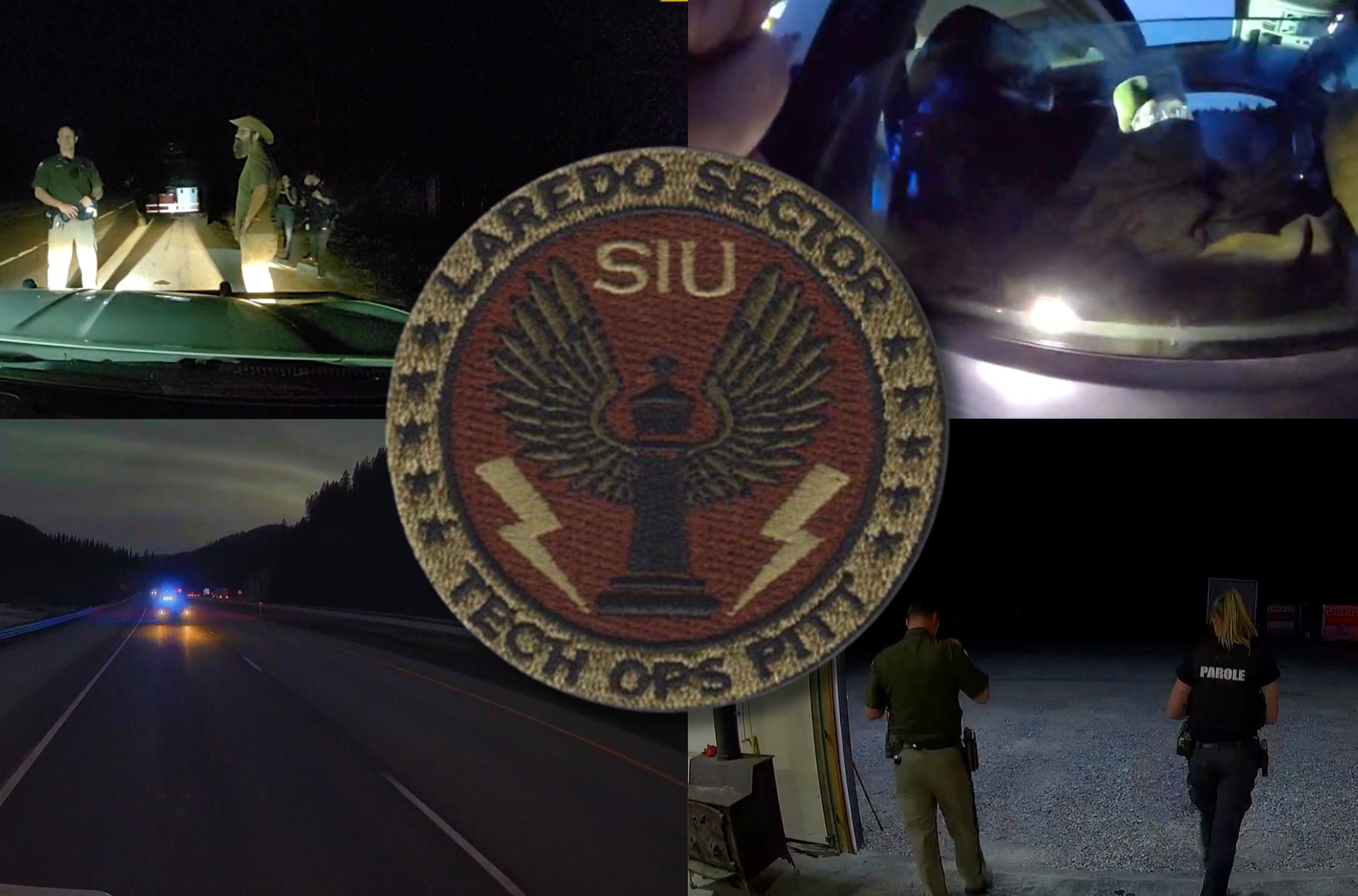
Border Patrol is running secretive predictive policing units that analyze Americans’ financial activity and other data, then feed that intelligence to local police who pull people over who are not suspected of any specific crime, but which the government thinks may be worth searching, 404 Media has found.
The units, the name of which 404 Media is revealing here for the first time, are called Predictive Intelligence Targeting Teams (PITT). In one case, a PITT analyzed the financial activity of a man who was driving across Montana, and local authorities stopped him under the pretense of an obstructed license plate and charged him with a DUI.
404 Media identified one PITT in the Spokane Sector, Washington, which polices the U.S. border with Canada, and another in the Laredo Sector, Texas, which polices the border with Mexico. The findings add to an Associated Press investigation from last year which found Border Patrol was using automatic license plate readers (ALPRs) as part of the same wide-spanning predictive policing program.
“The bottom line is genuine probable cause cannot be synthetically generated,” Jake Laperruque, deputy director of the Security and Surveillance Project at the Center For Democracy & Technology, told 404 Media in an email. Here Border Patrol seems to be “using parallel construction to cloak the reason behind its car stops in secrecy. If we can't meaningfully review and evaluate these systems, we can't trust them,” he added.
Predictive policing is a highly controversial practice that police departments and federal agencies are increasingly turning to. The practice is designed to find people who may have committed crimes, but at the moment, no evidence of them doing so exists. Broadly, law enforcement may analyze data — such as a person's movements, where they are at a certain time, or the roads they drive — then create or find another pretense to pull them over.
At around 9:30pm one night in May, Kyle William Olson was driving his black Chevy SUV on Interstate 90, with his dog Ducky in the backseat, according to police reports and an interview Olson gave to 404 Media. In Olson’s vehicle were marijuana edibles, marijuana cuttings, and butane hash oil. He works on a licensed cannabis farm in California, where he had picked up the weed, and was transporting it home to Wisconsin, he told 404 Media.
Olson drove past Sergeant James Beck of the Montana Highway Patrol who was sitting in his police car along with a colleague. When Olson passed, Beck noticed the vehicle’s license plate was obstructed by what he described as a tinted cover and the luggage holder, according to a police report. Beck pulled out, caught up to Olson, and pulled him over.
“Nothing major,” Beck said once he approached the passenger side window and exchanged pleasantries with Olson, according to bodycam footage. Beck said Olson’s license plate was “a little bit obstructed.”
“Just so you know, that’s our reason for stopping you,” Beck said. In the end, the officers demanded Olson step out of the vehicle, they tested his blood and charged him with a DUI. Authorities later charged Olson with possession with intent to distribute because of the marijuana in his vehicle, Olson told 404 Media.
Some of the bodycam footage of Olson's traffic stop. Cut by 404 Media.
But that wasn’t the real reason for stopping Olson.
During discovery in his case, Olson was provided a Department of Homeland Security (DHS) document that explained how Border Patrol instigated his traffic stop. Written by Border Patrol Agent Matthew Phelps, the document said Phelps was assigned to the “Spokane Sector Border Patrol Targeting & Intelligence Division (TID) — Predictive Intelligence Targeting Team (PITT).” Olson shared the document with 404 Media.
In his role at the PITT, Phelps wrote he reviews “law enforcement-sensitive databases” to develop intelligence before handing over information to local law enforcement. That intelligence specifically involves reviewing Americans’ financial activity, the document says.
In Olson’s case, Phelps says he observed, “information contained within law enforcement-sensitive systems suggesting financial activity patterns commonly associated with illicit narcotics activity.” The document says Phelps also looked at Olson’s prior arrest and criminal history.
Phelps wrote he then sent over what he found to Sergeant Beck, to “support general interdiction efforts.” Phelps says in the document that his intelligence was not the “sole basis” for the stop.
In his own report detailing the stop, Sergeant Beck wrote, “It was relayed to me by U.S. Border Patrol targeting analyst Matthew Phelps that he had identified a vehicle that had indicators of possible narcotics trafficking.” Beck then pulled over Olson for the obstructed license plate.
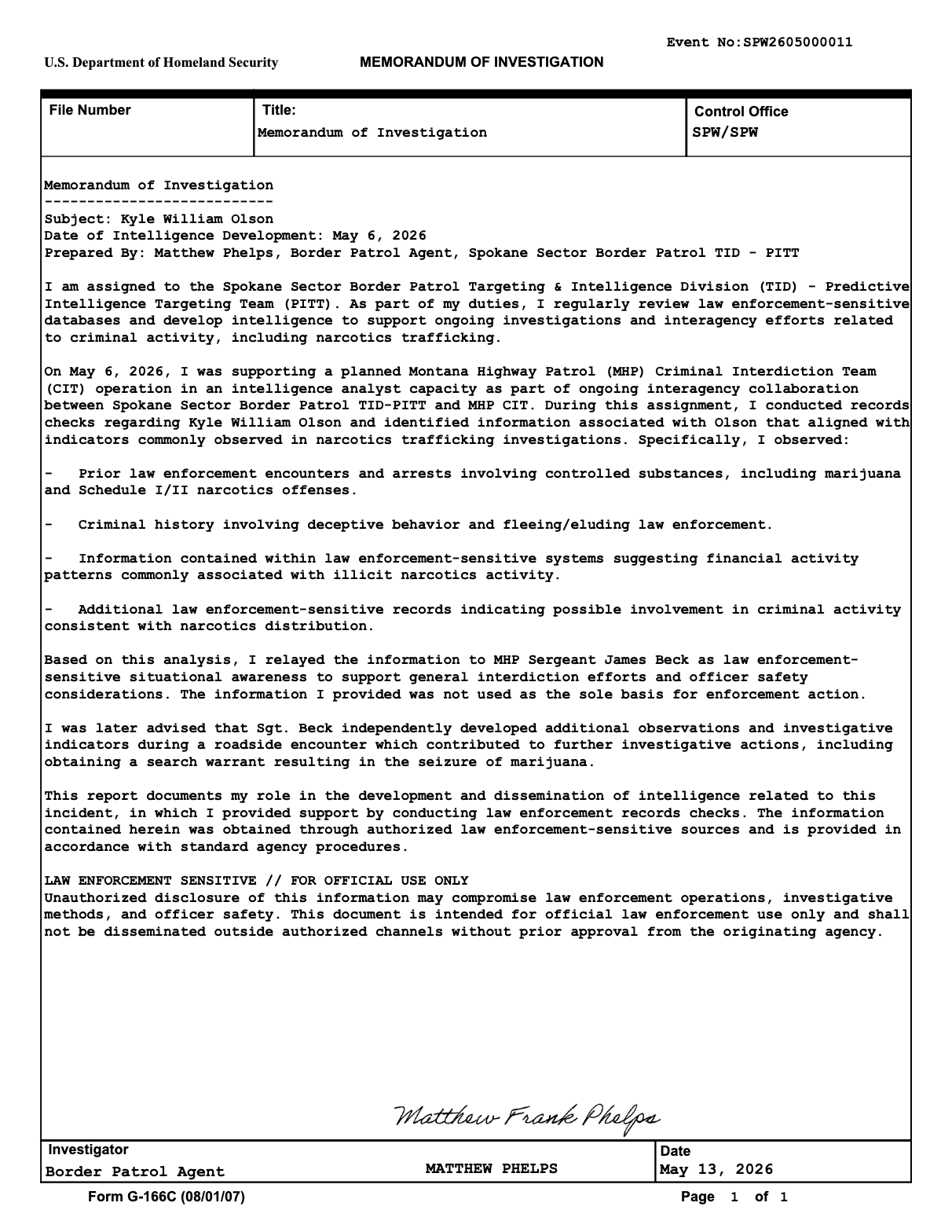
The DHS document obtained by 404 Media shows that Border Patrol is analyzing the financial activity of Americans to find people to pull over. The Associated Press’s investigation found the predictive policing program is also heavily using ALPRs to track potential targets’ movements.
It is not clear how exactly Border Patrol is monitoring Americans’ financial activity. Customs and Border Protection (CBP) declined to answer what financial activity the agency was monitoring, and whether it obtained a warrant or not.
A CBP spokesperson told 404 Media in an email: “U.S. Border Patrol uses intelligence-informed analysis and planning to support national security operations, allocate resources, and help identify potential threats and bad actors to public safety. These efforts are conducted consistent with applicable law, policy, privacy protections, and oversight requirements.”
“For operational security reasons, we do not discuss specific analytical methods, data sources, targeting criteria, investigative techniques, system capabilities, or deployment details. Public disclosure of such information could compromise law enforcement operations and investigations as well as creating safety risks for agents and the public,” the statement added.
Border Patrol’s predictive policing program has led to innocent people being pulled over and questioned. In the case of Alek Schott, who was pulled over on Interstate 35 by a Bexar County sheriff’s deputy in 2022, authorities claimed he had drifted between lanes and then tore apart his vehicle. They found nothing, according to the Institute for Justice, which represented Schott.
In the docket for that case is a copy of conversations between law enforcement officials, including Border Patrol agents. Putting one of those participant’s phone numbers into WhatsApp reveals a profile picture of a law enforcement patch. A pawn with wings sits in the center, surrounded by lightning bolts. The patch reads, “Laredo Sector Tech Ops PITT,” indicating there is also a Predictive Intelligence Targeting Team in the Laredo Sector.
Border Patrol operates 20 sectors according to CBP’s website. CBP declined to answer whether any of these other sectors also have Predictive Intelligence Targeting Teams.
“The government’s increasing use of mass surveillance — whether that surveillance comes via ALPRs, financial records, or the like — coupled with predictive policing is a recipe for tyranny,” Rob Frommer, senior attorney at the Institute for Justice, told 404 Media. “We fought a revolution for the idea that we are citizens, not subjects. Yet schemes like CBP’s Predictive Intelligence Targeting Team treat all Americans as if they are potential suspects. This is not just wrong, it’s unconstitutional, and IJ will keep pushing courts and Congress to end this attack on Americans’ security.”