Het openbaar vervoer ligt morgen in heel Nederland grotendeels plat door een 24-uursstaking. Onder anderen medewerkers van de NS en het stads- en streekvervoer leggen het werk neer uit onvrede met de bezuinigingen op de sociale zekerheid. Verwacht wordt dat meer reizigers alternatief vervoer kiezen, waardoor het drukker zal zijn dan het normaal op de weg is.
The US president says criticising his soaring investment portfolio is ‘very unfair’. Tell that to the millions of Americans struggling with the cost of living
If I had a dollar for every time Donald Trump said something inane, I would be a very rich woman. But even with an income that steady, I could never hope to be as flush as the president. A Forbes calculation from March puts his net worth at about $6.5bn – and it’s growing rapidly. Trump made $2.2bn in 2025 via business interests that ranged from selling cryptocurrency and Trump Bibles to offering early access to his (often market-moving) Truth Social posts.
To be fair, Trump isn’t making all this money just so he can buy golf clubs and gold toilets. No, he’s amassing these billions for the good of the little people; it’s altruism, not avarice! “I do this for our Country, not myself,” the president wrote on Truth Social on Sunday night alongside an AI-generated picture of him trading Intel stock. “I’ve made Hundreds of Billions of Dollars on Stocks, and many other type Holdings, for the U.S.A., not myself, and all I do is get criticized by the Radical Left Dumocrats. Very unfair, but what can you do!”
Exclusive: London mayor accuses council of ‘ignoring’ responses to a consultation
Sadiq Khan has criticised the “breathtaking arrogance” of Westminster council, which has kept restrictions on vertical drinking in Soho and an effective ban on new bars and pubs in the area.
The mayor of London has accused the Conservative-led council of “ignoring” the responses to a consultation into its new licensing policy. The vast majority of respondents, 81%, disagreed with the council’s “cumulative impact zone” which decrees that applications for bars and pubs in the West End of London, one of Europe’s most famous nightlife districts, will be refused unless in exceptional circumstances. Eighty-four per cent said the licensing policy would be bad for business.
Thousands of Germans have staged protests against the far-right Alternative für Deutschland (AfD) after the party’s watershed victory in a state election, warning it posed a danger in two more polls this month.
Demonstrators at Berlin’s Brandenburg Gate held a peaceful pro-democracy rally denouncing the anti-immigrant, pro-Russian AfD, which has called for mass deportations of asylum seekers and a rollback of state support for renewable energy and public broadcasting.
Israeli “terrorists” are conducting ethnic cleansing in the West Bank with the tacit backing of the government, the UK foreign secretary, Ed Miliband, has said as he announced sweeping sanctions, alongside France and Canada, on trade with Israeli settlements.
In the strongest condemnation ever issued by the UK government, Miliband said the government would now take the official position that Israel’s occupation of the West Bank was unlawful in its entirety, saying such acknowledgment was “the least the people who face such suffering deserve. And it should be the prelude to justice.”
An import ban on goods from illegal settlements in the occupied territories.
A comprehensive sanctions regime against providing services such as construction or financing for Israeli settlements.
A ban on the advertising in the UK of illegal settlement properties.
Personal sanctions against key individuals accused of promoting settler violence.
A new ban for arms licences and other exports that “materially contribute to the occupation”.
In de jaren negentig schreef ik voor deze krant enkele jaren een rubriek over rechtbankzaken. Het betrof geen spectaculaire criminele schandalen, maar misdaden die nooit eerder de krant hadden gehaald. Het ging mij vooral om het persoonlijke drama dat achter de juridische procedures schuilging.
Op het Amsterdam Fringe Festival mag theater buiten de gebaande paden treden. Tijdens de twintigste editie van het experimentele theaterfestival tonen eigenzinnige makers zich kwetsbaar op het podium. Van eenzame ooievaars en een Braziliaans adoptieverhaal tot een ‘freakshow’ met zelfspot: absurde en ontroerende voorstellingen.
Border Patrol is running secretive predictive policing units that analyze Americans’ financial activity and other data, then feed that intelligence to local police who pull people over who are not suspected of any specific crime, but which the government thinks may be worth searching, 404 Media has found.
The units, the name of which 404 Media is revealing here for the first time, are called Predictive Intelligence Targeting Teams (PITT). In one case, a PITT analyzed the financial activity of a man who was driving across Montana, and local authorities stopped him under the pretense of an obstructed license plate and charged him with a DUI.
404 Media identified one PITT in the Spokane Sector, Washington, which polices the U.S. border with Canada, and another in the Laredo Sector, Texas, which polices the border with Mexico. The findings add to an Associated Press investigation from last year which found Border Patrol was using automatic license plate readers (ALPRs) as part of the same wide-spanning predictive policing program.
“The bottom line is genuine probable cause cannot be synthetically generated,” Jake Laperruque, deputy director of the Security and Surveillance Project at the Center For Democracy & Technology, told 404 Media in an email. Here Border Patrol seems to be “using parallel construction to cloak the reason behind its car stops in secrecy. If we can't meaningfully review and evaluate these systems, we can't trust them,” he added.
💡
Do you work at DHS? Do you know anything else about these predictive policing teams? I would love to hear from you. Using a non-work device, you can message me securely on Signal at joseph.404 or send me an email at joseph@404media.co.
Predictive policing is a highly controversial practice that police departments and federal agencies are increasingly turning to. The practice is designed to find people who may have committed crimes, but at the moment, no evidence of them doing so exists. Broadly, law enforcement may analyze data — such as a person's movements, where they are at a certain time, or the roads they drive — then create or find another pretense to pull them over.
At around 9:30pm one night in May, Kyle William Olson was driving his black Chevy SUV on Interstate 90, with his dog Ducky in the backseat, according to police reports and an interview Olson gave to 404 Media. In Olson’s vehicle were marijuana edibles, marijuana cuttings, and butane hash oil. He works on a licensed cannabis farm in California, where he had picked up the weed, and was transporting it home to Wisconsin, he told 404 Media.
Olson drove past Sergeant James Beck of the Montana Highway Patrol who was sitting in his police car along with a colleague. When Olson passed, Beck noticed the vehicle’s license plate was obstructed by what he described as a tinted cover and the luggage holder, according to a police report. Beck pulled out, caught up to Olson, and pulled him over.
“Nothing major,” Beck said once he approached the passenger side window and exchanged pleasantries with Olson, according to bodycam footage. Beck said Olson’s license plate was “a little bit obstructed.”
“Just so you know, that’s our reason for stopping you,” Beck said. In the end, the officers demanded Olson step out of the vehicle, they tested his blood and charged him with a DUI. Authorities later charged Olson with possession with intent to distribute because of the marijuana in his vehicle, Olson told 404 Media.
Some of the bodycam footage of Olson's traffic stop. Cut by 404 Media.
But that wasn’t the real reason for stopping Olson.
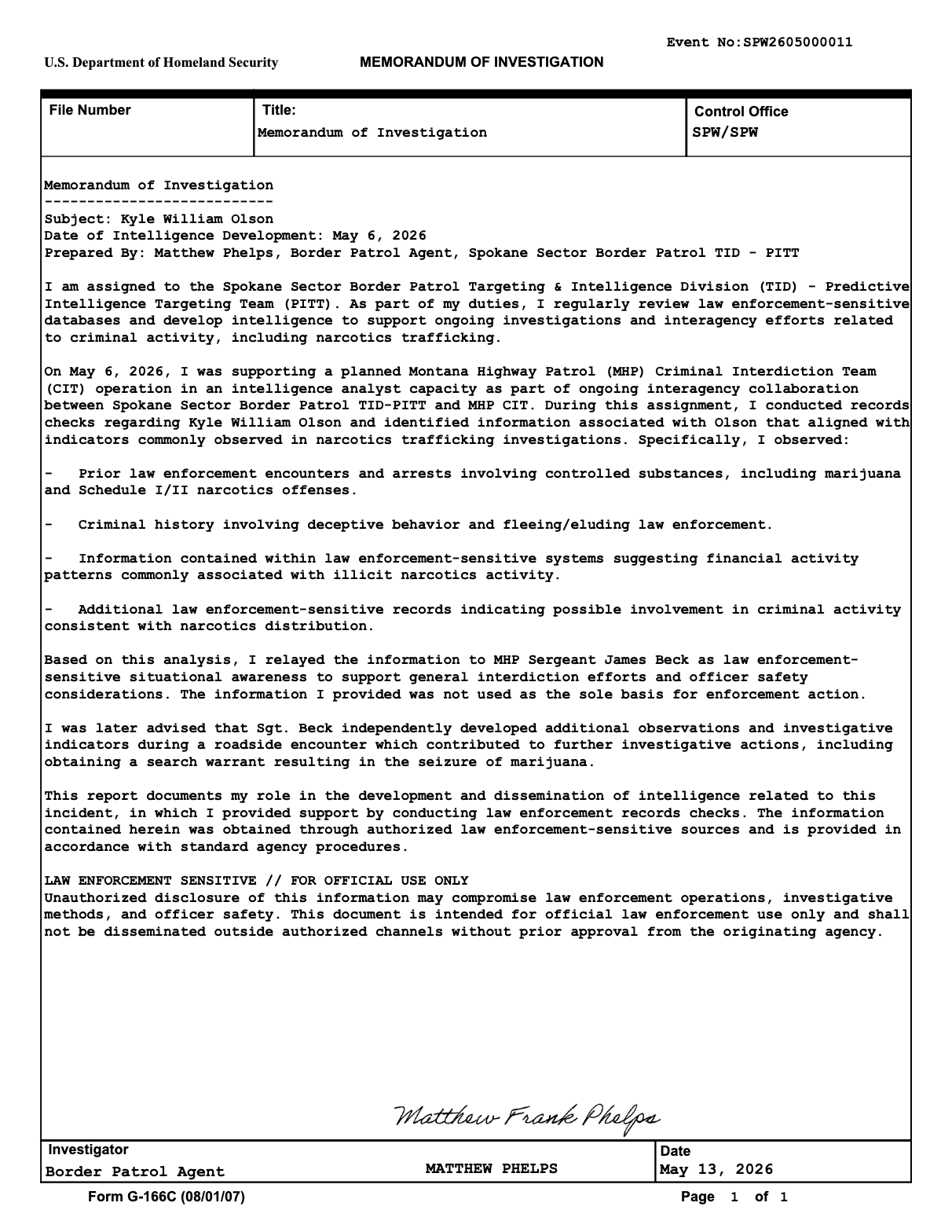
During discovery in his case, Olson was provided a Department of Homeland Security (DHS) document that explained how Border Patrol instigated his traffic stop. Written by Border Patrol Agent Matthew Phelps, the document said Phelps was assigned to the “Spokane Sector Border Patrol Targeting & Intelligence Division (TID) — Predictive Intelligence Targeting Team (PITT).” Olson shared the document with 404 Media.
In his role at the PITT, Phelps wrote he reviews “law enforcement-sensitive databases” to develop intelligence before handing over information to local law enforcement. That intelligence specifically involves reviewing Americans’ financial activity, the document says.
In Olson’s case, Phelps says he observed, “information contained within law enforcement-sensitive systems suggesting financial activity patterns commonly associated with illicit narcotics activity.” The document says Phelps also looked at Olson’s prior arrest and criminal history.
Phelps wrote he then sent over what he found to Sergeant Beck, to “support general interdiction efforts.” Phelps says in the document that his intelligence was not the “sole basis” for the stop.
In his own report detailing the stop, Sergeant Beck wrote, “It was relayed to me by U.S. Border Patrol targeting analyst Matthew Phelps that he had identified a vehicle that had indicators of possible narcotics trafficking.” Beck then pulled over Olson for the obstructed license plate.
Screenshot of the DHS document shared with 404 Media.
The DHS document obtained by 404 Media shows that Border Patrol is analyzing the financial activity of Americans to find people to pull over. The Associated Press’s investigation found the predictive policing program is also heavily using ALPRs to track potential targets’ movements.
It is not clear how exactly Border Patrol is monitoring Americans’ financial activity. Customs and Border Protection (CBP) declined to answer what financial activity the agency was monitoring, and whether it obtained a warrant or not.
A CBP spokesperson told 404 Media in an email: “U.S. Border Patrol uses intelligence-informed analysis and planning to support national security operations, allocate resources, and help identify potential threats and bad actors to public safety. These efforts are conducted consistent with applicable law, policy, privacy protections, and oversight requirements.”
“For operational security reasons, we do not discuss specific analytical methods, data sources, targeting criteria, investigative techniques, system capabilities, or deployment details. Public disclosure of such information could compromise law enforcement operations and investigations as well as creating safety risks for agents and the public,” the statement added.
Border Patrol’s predictive policing program has led to innocent people being pulled over and questioned. In the case of Alek Schott, who was pulled over on Interstate 35 by a Bexar County sheriff’s deputy in 2022, authorities claimed he had drifted between lanes and then tore apart his vehicle. They found nothing, according to the Institute for Justice, which represented Schott.
In the docket for that case is a copy of conversations between law enforcement officials, including Border Patrol agents. Putting one of those participant’s phone numbers into WhatsApp reveals a profile picture of a law enforcement patch. A pawn with wings sits in the center, surrounded by lightning bolts. The patch reads, “Laredo Sector Tech Ops PITT,” indicating there is also a Predictive Intelligence Targeting Team in the Laredo Sector.
Border Patrol operates 20 sectors according to CBP’s website. CBP declined to answer whether any of these other sectors also have Predictive Intelligence Targeting Teams.
“The government’s increasing use of mass surveillance — whether that surveillance comes via ALPRs, financial records, or the like — coupled with predictive policing is a recipe for tyranny,” Rob Frommer, senior attorney at the Institute for Justice, told 404 Media. “We fought a revolution for the idea that we are citizens, not subjects. Yet schemes like CBP’s Predictive Intelligence Targeting Team treat all Americans as if they are potential suspects. This is not just wrong, it’s unconstitutional, and IJ will keep pushing courts and Congress to end this attack on Americans’ security.”
HAARLEM (ANP) - De Noord-Hollandse politiek wil dat er strengere regels komen voor de bouw van nieuwe datacenters. De huidige strategie die meer grip moest geven op de plaatsing van de vaak grote vierkante gebouwen, voldoet volgens Provinciale Staten niet. Datacenters kunnen regels omzeilen door bijvoorbeeld voor hoogbouw te kiezen en het bedrijf administratief op te splitsen in meerdere eenheden.
Een motie van ChristenUnie, PvdA, BBB, GroenLinks, SP, JA21, D66 en Volt die vraagt om een aanscherping, kreeg unanieme steun in de Staten. Gedeputeerde Esther Rommel (ruimtelijke ordening) gaf aan te kijken naar de werking van de strategie. Noord-Holland is koploper in het aantal datacenters en dit zal alleen maar toenemen doordat door AI de verwerking van data hard groeit. Vorig jaar waren er 67 datacenters en naar verwachting is dat in 2035 gestegen naar 92.
Aanleiding voor het verzoek van de indieners is de komst van een datacenter van Equinix in Amsterdam-Zuidoost, dat in de omgeving veel weerstand oproept.
Bijna de helft van de Nederlandse hypotheekschuld is aflossingsvrij. En dat is precies waarom de grote banken sinds dit voorjaar één voor één de duimschroeven aandraaien. Wie nu niets doet, kan straks voor onaangename verrassingen komen te staan: hogere maandlasten, gedwongen aflossen, of een bank die simpelweg 'nee' zegt.
Waar hebben we het over
Bij een aflossingsvrije hypotheek los je tijdens de looptijd niets af. Je betaalt alleen rente. Handig voor de portemonnee nu, want de maandlasten zijn laag. Minder handig aan het einde van de rit, want dan staat de volledige lening nog open. Bij een aflossingsvrije hypotheek van €150.000 moet je op de einddatum dus gewoon €150.000 zien terug te betalen. Uit spaargeld, uit de verkoop van je huis, of via een nieuwe hypotheek.
Ongeveer 45 procent van de totale hypotheekschuld in Nederland is (deels) aflossingsvrij. Een aanzienlijk deel van die contracten loopt af tussen 2035 en 2038, met een tweede piek tussen 2047 en 2052. Toezichthouders maken zich al jaren zorgen dat een deel van die huiseigenaren straks niet kan aflossen én niet kan herfinancieren.
Wat er dit jaar is veranderd
De grote banken hebben in 2026 hun beleid aangescherpt. Rabobank en Obvion gingen op 11 mei van start; andere aanbieders volgden kort daarna. In grote lijnen gebeurt er drie dingen tegelijk:
Lager plafond: bij een nieuwe of aangepaste aflossingsvrije hypotheek mag je nog maximaal 30 procent van de woningwaarde aflossingsvrij lenen. Dat was 50 procent.
Hard bedragplafond: bij Rabobank, Obvion, ABN AMRO, Florius en ING geldt daarbovenop een absoluut maximum van €150.000 aflossingsvrij, ongeacht hoe duur je huis is.
Duurdere rente: aflossingsvrij lenen is bij veel banken 0,3 tot 0,5 procentpunt duurder dan een annuïtaire hypotheek. Bij ING liep de renteopslag in de eerste helft van dit jaar op van 0,25 naar 0,53 procentpunt. Op een schuld van €200.000 scheelt dat volgens de Consumentenbond zo'n €1.120 rente per jaar.
Bij sommige banken kun je de aflossingsvrije hypotheek bovendien niet meer inzetten voor persoonlijke uitgaven of inkomensaanvulling — alleen nog voor de woning zelf.
Wat verandert er als je niets doet
Voor bestaande klanten die niets aanpassen, verandert er in principe niets. Je bestaande contract blijft doorlopen op de oude voorwaarden. Tot er iets gebeurt, althans. En vroeg of laat gebeurt er iets:
Je einddatum komt in zicht.
Je rentevaste periode loopt af en de bank stuurt een nieuw rentevoorstel.
Je verhuist, sluit over, of verhoogt je hypotheek voor een verbouwing.
Op elk van die momenten kunnen de strengere regels alsnog gaan gelden.
Wat gebeurt er op de einddatum
Een aflossingsvrije hypotheek heeft meestal een looptijd van 30 jaar. Op die einddatum verwacht de bank dat je de volledige schuld in één keer aflost. Wie dat niet uit eigen zak kan betalen, heeft twee opties: het huis verkopen, of proberen de hypotheek te verlengen dan wel over te sluiten naar een nieuw contract.
Verlenging is geen automatisme. De bank kijkt op dat moment opnieuw naar drie dingen:
De actuele waarde van de woning.
Je inkomen op dat moment.
De hoogte van de resterende hypotheekschuld.
En daar wringt de schoen. Wie op de einddatum met pensioen is en dus een lager inkomen heeft, kan zomaar tegen een afwijzing aanlopen. Of tegen een nieuwe hypotheek die aanzienlijk kleiner is dan de openstaande schuld — met als gevolg dat een deel alsnog moet worden afgelost of omgezet naar een annuïteitenhypotheek. En dat betekent stijgende maandlasten, precies op het moment dat je inkomen krimpt.
De Rabobank-uitzondering
Voor wie vóór 2023 een aflossingsvrije hypotheek bij Rabobank afsloot, geldt een bijzonder regime. Die contracten hebben vaak helemaal geen einddatum — ze lopen door totdat het huis wordt verkocht of de hypotheeknemer overlijdt. Prettig, in beginsel. Maar zodra je gaat verhuizen, oversluiten of je hypotheek wilt verhogen, gelden ook voor jou de nieuwe regels: 30 procent van de woningwaarde, met een maximum van €150.000.
Wat scheelt het in de portemonnee
Een rekenvoorbeeld maakt duidelijk waar het over gaat. Stel: je hebt een aflossingsvrije hypotheek van €200.000 en je rentevaste periode loopt af. Bij een renteopslag van 0,53 procentpunt boven de annuïteitenrente betaal je per jaar zo'n €1.120 meer aan rente. Over een nieuwe rentevaste periode van tien jaar loopt dat op tot ruim €11.000. Zonder dat er ook maar iets van de hoofdsom is afgelost.
Wie boven de 30 procent-grens uitkomt en het meerdere moet omzetten naar een annuïtaire hypotheek, betaalt daarnaast fors hogere maandlasten. Bij €50.000 dat wordt omgezet en een rente van 4 procent kom je al snel uit op €240 aan extra maandlasten. Op zich geen slecht nieuws — je bouwt tenslotte vermogen op — maar wél een aanslag op het beschikbare inkomen.
Wat huiseigenaren nu kunnen checken
Wie een aflossingsvrije hypotheek heeft, doet er verstandig aan een paar zaken op een rij te zetten voordat de bank straks een dwingende brief stuurt:
Wanneer loopt jouw hypotheek af? Bij een deel van de contracten staat de datum op de hypotheekakte, bij andere niet.
Hoeveel schuld staat er op de einddatum nog open? Bij zuiver aflossingsvrije contracten: het volledige leenbedrag.
Welke grens hanteert jouw bank inmiddels — 30 procent of nog 50 procent van de woningwaarde?
Wanneer eindigt je rentevaste periode? Op dat moment kan de duurdere aflossingsvrij-rente gaan meetellen.
Wanneer loopt je recht op hypotheekrenteaftrek af? Wie vóór 1 januari 2001 al een hypotheek had, ziet die aftrek uiterlijk in 2031 verdwijnen.
Past de nieuwe maandlast bij je toekomstige inkomen — inclusief het scenario waarin je gepensioneerd bent?
Wie de gegevens niet zelf kan terugvinden, hoeft niet meteen naar een adviseur. Een e-mail of belletje naar de eigen bank is meestal genoeg om de einddatum en het openstaande bedrag boven tafel te krijgen.
Alvast beginnen met aflossen?
Verplicht is het niet. Sommige banken, waaronder ABN AMRO, sturen bestaande klanten wel actief berichten om ze aan te sporen extra af te lossen. Bij de meeste hypotheekverstrekkers mag je jaarlijks tot 10 procent boetevrij aflossen. Voor wie meer dan de helft van de woningwaarde aflossingsvrij heeft geleend, kan dat een verstandige stap zijn — juist om te voorkomen dat de bank straks bij de einddatum de duimschroeven aandraait.
Meer weten?
Consumentenbond: Aflossingsvrije hypotheek – veranderingen in 2026
DEN BOSCH (ANP) - Een 66-jarige arts uit het Noord-Hollandse Bergen wordt verdacht van het seksueel misbruiken van minstens vier Filipijnse kinderen. Het jongste slachtoffer was drie jaar oud, vertelde de officier van justitie dinsdag tijdens de eerste pro-formazitting in Den Bosch.
De verdachte zou in 2023 op de Filipijnen een meisje onder de twaalf jaar hebben verkracht. Ook zou hij twee tienermeisjes tegen betaling hebben laten poseren en seksuele handelingen bij zichzelf hebben laten verrichten. Een 3-jarig meisje zou in ruil voor geld zijn misbruikt door de verdachte in augustus en september 2023.
De inwoner van Bergen werd in mei 2026 opgepakt, na een melding van een Amerikaanse organisatie. Hij zou via een livestream hebben gekeken hoe Filipijnse kinderen op afstand werden misbruikt. "Hoe heeft het zover kunnen komen?", vroeg de officier van justitie zich dinsdag af. "Hij was een man die alles had." De verdachte werkte in het ziekenhuis, maar heeft zelf inmiddels ontslag genomen. Hij zal de komende tijd door een psycholoog worden onderzocht.
Facilitators
Martin B. zou bij het misbruik in contact zijn geweest met zogenoemde facilitators op de Filipijnen; mensen die kinderen beschikbaar stellen voor seksueel misbruik. Een aantal van deze betrokkenen is opgepakt op de Filipijnen, vertelde de officier.
Het lezen van de chats die B. stuurde naar zijn Filipijnse handlangers levert volgens justitie een ontluisterend beeld op. "Hij had een lap grond op de Filipijnen gekocht en stuurde berichten dat hij daar na zijn pensioen ging wonen en dat alle meisjes welkom waren." De verdachte zou in chats hebben verteld wat hij allemaal 'met de meisjes zou doen.'
KAMPALA (ANP/BLOOMBERG) - Oeganda wordt binnenkort 's werelds nieuwste exporteur van ruwe olie. Het Afrikaanse land wil in december beginnen met de export van zijn Pearl Sweet-olie, meldde de topman van het staatsoliebedrijf Uganda National Oil Company dinsdag. De olie uit Oeganda zal dan via een pijpleiding worden vervoerd naar de havenstad Tanga in buurland Tanzania om naar kopers in Azië geëxporteerd te worden.
Pearl Sweet komt in eerste instantie uit een olieveld dat wordt geëxploiteerd door het Chinese olieconcern Cnooc, met een productie van 25.000 vaten per dag in december. Binnen zes maanden moet de productie stijgen naar 40.000 vaten per dag. Een groter veld dat wordt uitgebaat door het Franse TotalEnergies moet dan in het eerste kwartaal van volgend jaar beginnen met productie. Het is de bedoeling dat binnen drie jaar de export van Oeganda stijgt naar 320.000 vaten per dag.
De Oegandese energieminister en andere functionarissen zijn deze week op een top in Singapore om de olie aan te bieden aan kopers.
Het klinkt als een slechte grap, maar het is bloedserieus: een Britse influencer die stierf na een mislukte penisvergroting in Thailand, is begraven in een gouden kist van meer dan 650.000 euro.
De 43-jarige Igho ‘Tiny’ Ubiribo, met een Brits-Nigeriaanse achtergrond en zo'n 185.000 volgers op Instagram, was in maart met zijn vrouw op vakantie in Bangkok toen hij zich tussen zijn benen liet injecteren met 40 milliliter hyaluronzuur en lidocaïne. Doel: een langer en breder geslachtsdeel.
Pijn op de borst tijdens massage
Later die dag ging het stel samen naar een massage. Daar kreeg Ubiribo plotseling pijn op zijn borst en verloor hij tot twee keer toe het bewustzijn. Zijn vrouw, Danielle Simba Allen, waarschuwde de hulpdiensten en vertelde artsen in het Sukhumvit Hospital over de filler-injectie.
Ubiribo was aanvankelijk nog aanspreekbaar, maar zakte weg voordat een geplande CT-scan kon worden gemaakt. Artsen probeerden hem ruim honderd minuten te reanimeren. Tevergeefs: hij overleed in de vroege ochtend van 6 maart.
Bloedprop door de filler
Een lijkschouwer in Londen concludeerde na onderzoek dat celmateriaal in zijn longen overeenkwam met de ingespoten stof. De officiële doodsoorzaak: een longembolie, veroorzaakt door de hyaluronzuurinjectie. De coroner sprak van een dood “als gevolg van een cosmetische ingreep in het buitenland”.
In mei werd Ubiribo in Londen begraven in een gouden kist die naar verluidt zo'n 745.000 dollar heeft gekost. Onder de rouwenden bevond zich Afrobeats-ster Davido, die een emotionele toespraak hield.
Penisfillers zoals die waaraan Ubiribo overleed, kosten in Groot-Brittannië zo'n 8.500 euro en gaan gemiddeld zes tot negen maanden mee. Britse urologen waarschuwen al langer voor de risico's van de ingreep, die in landen als Thailand relatief eenvoudig te verkrijgen is.
Marc van Ranst, die Vlaamse virosoof met een BMI van 40 die zichzelf op de vleugels van corona uitriep tot morele autoriteit op het gebied van alles. U kent het wel, de systeemopinies omtrent immigratie, Trump, Israël en 'rechts', maar dan geleverd met de autoriteit van een arts over een medische kwestie, alsof er zoiets bestaat als autoriteit op die andere kwesties.
En wat blijkt nu met aan zekerheid grenzende waarschijnlijkheid na controle met AI-check-marktleider Pangram? Hij vindt nog altijd dezelfde verschrikkelijke dingen, maar het schrijven van z'n verschrikkelijke columns heeft-ie uitbesteed aan dat verschrikkelijke AI, wat leidt tot verzonnen gebeurtenissen en verschrikkelijke zinnen als:
"Een jongen op de bus, doordeweeks, oortjes in, blik omlaag, de leeftijd van mijn zoon. Op zijn scherm geen liefdesverdriet of schoolstress, maar korte filmpjes die hem vertellen hoe hij harder, rijker en dominanter moet worden. Twijfel is zwakte. Falen is verboden. Voor wie nog geen taal heeft voor wat wringt, klinkt dat niet als ideologie, maar als houvast." Het doet de ogen inmiddels bloeden, die 'niet x, maar y'-stijlvorm van een computer die zich voordoet als wat mensen volgens die computer denken wat mensen zijn.
Ja, ook regelrecht uit de computer komt zijn column over 'domvolking' - wat "geen verwijt is aan individuen, maar een aanklacht tegen de architectuur van onze tijd". 'Geen x, maar y'. Het zijn net mensen, die AI's!
Afijn, Marc is in tegenstelling tot letterlijk altijd ineens al vier dagen muisstil over de kwestie. Hoog tijd dat dit heerschap voor eens en altijd ge-Vandermeersch't wordt (er zijn geen consequenties en je mag exact blijven zitten waar je zat.)
Gokje: die busrit heeft nooit plaatsgevonden. Zat @MarcVanRanst dan achter de schouder van zo'n jongen mee te kijken naar zijn scherm? En hoe kon hij weten wat die filmpjes "hem vertellen", als de jongen zijn oortjes in had? Neemt Marc überhaupt de bus samen met tieners? Dit… pic.twitter.com/cAUDqCpfIT
Paris-based AI darling Mistral has raised €3 billion in Series D funding, giving it a post-money valuation of more than €21 billion. That makes it a minnow compared with OpenAI, but Mistral says it is the largest equity fundraising round ever completed by a European technology company. Mistral is pitching itself as a sovereign alternative to US giants such as OpenAI and Anthropic. The company wrote: "During the first wave of generative AI, the central question was who could build the most powerful model. "Organizations and governments are now asking a different one: how to harness the power of AI for their mission-critical needs without surrendering control over the infrastructure and intelligence loop." Mistral's answer, unsurprisingly, is its own combination of open-weight models, infrastructure, and compute capacity. The pitch is aimed at organizations and public sector bodies increasingly wary of relying on overseas tech giants. The company's customers include aeronautics giant Airbus. Mistral has logged some impressive growth in its three years of existence. A year ago, it announced Series C funding of €1.7 billion at a post-money valuation of €11.7 billion. That round was led by ASML, with Nvidia and Andreessen Horowitz among the participants. Samsung Electronics, the EU-backed Scaleup Europe Fund, and existing investor PSG Equity jointly led the latest round. On the global AI funding scale, however, Mistral remains considerably smaller. OpenAI, for example, closed a round containing $122 billion in committed capital in March, giving it a post-money valuation of $852 billion. Even so, Mistral is a big beast in Europe, and its position has been helped by moves such as the US administration slapping export restrictions on Anthropic in June. The restrictions were later lifted, but not before adding to European jitters about reliance on overseas technology. That said, Mistral is not above some participation in the AI investment merry-go-round. It has accepted investment from Nvidia while spending money on datacenters packed with the GPU giant's technology. Mistral wrote: "We continue to believe that the future belongs to organisations that can combine sovereign state-of-the-art intelligence with the ability to deploy and adapt it in their own environments. "Organisations want frontier performance without becoming locked into infrastructure or governance they don't control." ®