Een ik-verhaal door een journalist, mits niet te particulier, is geen zelfhulp of ego-journalistiek

Wij journalisten leerden het allemaal. Dat je een toeschouwer bent, een fly on the wall (niemand zegt ooit ‘vlieg op de muur’). Journalistiek gaat om het onderwerp, niet over jou.
Pay European, zegt Wero. Maar wat kost dat?

De roze iDeal-knop op webshops kleurt steeds geler, in aanloop naar de vervanging van dit betaalsysteem door Wero. Dat presenteert zichzelf als Europees alternatief voor de macht van het Amerikaanse MasterCard en Visa. Maar winkeliers vinden het prijzig.Veel leesplezier,

De geschiedenis slaat niemand over

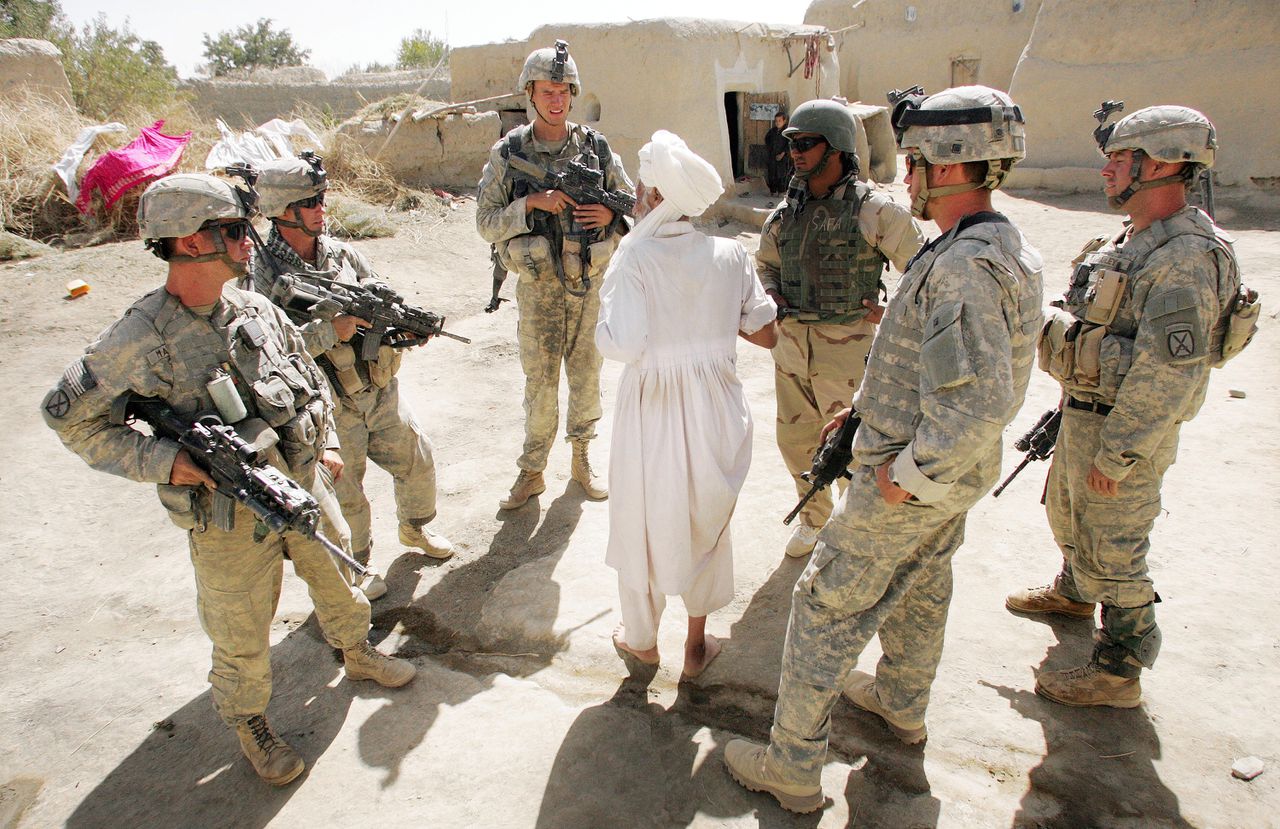
Vijfentwintig jaar geleden vonden de terreuraanslagen in de VS plaats. Zowel de aanloop naar 9/11 als de daaropvolgende ‘war on terror’ laten zich samenvatten als bittere ironie, schrijft Lotfi El Hamidi.

Wel.nl

Minder lezen, Meer weten.

Koningspaar leeft mee met slachtoffers busongeluk Zwitserland

DEN HAAG (ANP) - Koning Willem-Alexander en koningin Máxima hebben hun medeleven betuigd aan de slachtoffers en nabestaanden van het busongeluk in Zwitserland. "Ons hart gaat uit naar de nabestaanden, naar iedereen die nu in angst verkeert om het lot van dierbaren en naar de gewonden", schrijft het koningspaar op sociale media. "Wij voelen ons met u verbonden bij deze grote tragedie."

Donderdagmiddag verongelukte een tourbus met 49 Nederlanders aan boord nabij de Zwitserse plaats Susch, niet ver van de grens met Oostenrijk. Er vielen vijf doden en veertig gewonden. Mogelijk moest de chauffeur uitwijken voor een rotsblok op de weg.


5 doden en 40 gewonden door ongeluk Nederlandse bus Zwitserland

SUSCH (ANP) - Door het ongeluk met de Nederlandse bus in Zwitserland op donderdag zijn vijf mensen omgekomen. Veertig mensen zijn gewond geraakt, van wie drie zwaargewond en zeven "middelzwaar gewond". Dat meldt de politie van het Zwitserse kanton Graubünden.

De identiteit van de overleden mensen is nog niet vastgesteld.


Ooggetuige beschrijft kantelen Nederlandse bus in Zwitserland

De werkgever van een ooggetuige van het ongeluk met een Nederlandse bus in Zwitserland vertelt tegen de Zwitserse radio hoe zijn collega het ongeluk zag gebeuren. "Hij reed voor de bus, en reed gewoon door, toen er iets verschrikkelijks achter hem gebeurde", aldus de eigenaar van een nabijgelegen garage tegen publieke omroep RTS. "Er klonk veel herrie, waarna hij zag dat de bus was gekanteld."

Donderdag verongelukte de bus met circa 50 Nederlandse inzittenden tussen het Zwitserse Susch en Zernez, in het oostelijke kanton Graubünden. Daarbij overleed een nog onbekend aantal inzittenden en ook raakten mensen gewond. Naar verwachting komt de kantonpolitie nog vrijdagochtend met een update over hun toestand en een mogelijke verklaring voor het voorval.

Volgens een correspondent van het Vlaamse VRT zouden de inzittenden veelal ouderen zijn. De bus zou op een meerdaagse trip door het gebied zijn geweest, aldus Zwitserse media.


AEX-index begint voorzichtig na drie verliesdagen op rij

AMSTERDAM (ANP) - De AEX-index op het Damrak is vrijdag vrijwel vlak begonnen. Beleggers bleven voorzichtig na drie verliesdagen op rij. De inflatievrees laaide deze week weer op door de sterke stijging van de olieprijzen als gevolg van het toegenomen geweld in het Midden-Oosten. Om de hoge inflatie te bestrijden verhoogde de Europese Centrale Bank (ECB) donderdag de rente in de eurozone voor de tweede keer dit jaar. De grote vraag is nu: wat gaat de Amerikaanse centrale bank doen?

De Federal Reserve heeft het rentetarief in de Verenigde Staten tot nu toe onveranderd gelaten, ondanks de hardnekkige inflatie in de grootste economie ter wereld. Beleggers letten dan ook vooral op de nieuwe inflatiegegevens van de VS, die later op de dag naar buiten komen. Die bepalen mogelijk of de Fed de leenkosten volgende week gaat verhogen.

De Amsterdamse hoofdindex noteerde kort na opening van de markt onveranderd op 1093,15 punten. De AEX sloot donderdag 0,8 procent lager en koerst op weekbasis af op een verlies van bijna 2 procent.


Sabalenka voelde zich 'wanhopig' voor bereiken US Open-finale

NEW YORK (ANP/RTR) - Aryna Sabalenka (28) voelde zich voor het bereiken van de finale van de US Open naar eigen zeggen wanhopig. De Belarussische gaat in New York op voor de vierde finale op rij, nadat ze in de nacht van donderdag op vrijdag in de halve finale afrekende met de Amerikaanse Jessica Pegula.

"Ik was wanhopig", vertelde Sabalenka na afloop. "Ik had een zware wedstrijd op gras verloren tegen Jess, en ik presteerde niet echt goed in het midden van het seizoen", refereerde ze aan de verloren wedstrijd tegen Pegula in juni in de halve finale van het toernooi van Berlijn.

"Ik wilde dolgraag de finale halen, en natuurlijk wil ik de titel winnen", was ze duidelijk over haar doelstelling. "Ik ben klaar voor alles wat nodig is om de overwinning te behalen."

"Ik voel me mentaal en fysiek heel sterk op dit moment", aldus de viervoudig grandslamwinnares. Ongeacht de uitslag moet ze haar nummer 1-positie van de wereldranglijst afstaan aan haar tegenstander in de finale, de Kazachse Elena Rybakina.


Het gAIt maar door: minister Yesilgöz en staatssecretaris Boswijk betrapt op AI-speeches

Social

Zo. De digitale ketchupfles is open en iedereen en zijn moeder is druk alle teksten van politici van Pangram aan het halen. Nieuwsuur heeft de speeches van ministers en staatssecretaris gecheckt en wat blijkt? Bij Defensie is taal zeg maar niet echt hun ding en laten ze de linguïstische drones de kastanjes uit het retorische vuur halen. "Van de 77 speeches merkte Pangram er vijftien aan als verdacht. Tien speeches bevatten AI-gegenereerde fragmenten, vijf bestonden bijna volledig uit AI-teksten. Dertien van de vijftien speeches kwamen van minister Yesilgöz en staatssecretaris Boswijk, waaronder alle vijf de speeches die volledig met AI lijken te zijn gemaakt." Nou kun je aan de ene kant zeggen: speeches van ministers bij officiële gelegenheden, dat is nou echt het schoolvoorbeeld van teksten die zo nietszeggend mogelijk moeten zijn. Maar aan de andere kant kun je zeggen: als je eigenlijk niks te zeggen hebt, zeg dan niks. De volgende keer dat wij naar een speech van Boswijk of Yesilgöz moeten luisteren doen we demonstratief onze vingers in onze oren. En houdt AI zich eigenlijk wel aan de richtlijnen van de Taalgids?

TER HERINNERING: GeenStijl liet eind vorig jaar al zien hoeveel Rutger Bregman gebruik maakt van AI.

Complete item

Social

The Guardian

Latest news, sport, business, comment, analysis and reviews from the Guardian, the world's leading liberal voice

Haruomi Hosono: Yours Sincerely review

(Ghostly International)
Unpredictable and utterly beguiling, the septuagenarian beloved by Harry Styles brings a hint of mischief to his innocently charming songs

Haruomi Hosono is one of the most influential figures in Japanese music. In 1969, his psych-folk group Happy End were the first rock group to sing in Japanese; decades later, their song Kaze wo Atsumete was rediscovered for the Lost in Translation soundtrack. He was also an integral member of electronic pioneers Yellow Magic Orchestra, and scored movies and video games, while his solo albums swing from foundational city pop texts to experiments in ambient and arch exotica.

Now 79, with disciples including Van Dyke Parks and Harry Styles (who named 2022’s Harry’s House after 1973 solo album Hosono House), he still makes whatever music he wants. His 23rd solo album is wilful, playful, unpredictable and utterly beguiling. Rooted in the Japanese concept of omoiyari, roughly translated as compassion, these songs are big-hearted, focusing on warmth and positivity: opening reverie Note of Mothership features a chorus of overlapping voices murmur-singing “we are mothers”; the sweet Happy Holiday repeats its title over an enchantingly simple melody; Sincerely is a sleepy, Leon Redbone-esque strum.

Continue reading...

Chess: Uzbekistan favourites for Olympiad but ageing England given gloomy outlook

England Open squad have internal tensions but the women’s team blends rising talent with experience

Uzbekistan, the host nation, are the favourites to win the 208-team biennial chess Olympiad in Samarkand, which has its opening ceremony on Tuesday, and its first round (of 11) on Wednesday.

The defending champions, India, China and the US are Uzbekistan’s most dangerous rivals. India would have been the open Olympiad favourites but for the shaky form of the world champion, 20-year-old Gukesh Dommaraju, who was the top board gold medallist in Budapest two years ago but is likely to play lower down the order in Samarkand. USA are led by the world No 3 Fabiano Caruana and the world No 5 Wesley So, but their lower boards, including the variable Hans Niemann, look more vulnerable.

Continue reading...

Week in wildlife: a sea turtle hatchling, baby orangutans and flying ibises

This week’s best wildlife photographs from around the world

Continue reading...

100 years after John Coltrane’s birth, secret tapes are emerging. What can they tell us about jazz’s great rulebreaker?

The sax star turned his back on fame to embrace free jazz. Caught on a tape machine hidden in an overcoat, newly revealed recordings show how he did it

In August 1965, at the height of his fame, saxophonist John Coltrane headlined the DownBeat jazz festival in Chicago. Taking to the stage with a new member of his band, young experimentalist Archie Shepp on tenor, Coltrane’s quartet blew through a series of jagged and free improvisations, straying from structured compositions and, instead, hurling down sheets of sound so loud and aggressive that they reportedly caused widespread walk-outs. DownBeat’s own reviewer later wrote: “They gave as tasteless a display of musicianship as I’ve ever heard … Shepp and Coltrane seemed to be more interested in trying to out-honk, out-squeal and out-bleat each other than in playing music.”

That 1965 performance should have been a triumphant moment, after five years of Coltrane’s star ascending. Since leaving Miles Davis’s “first great quintet”, with whom he had recorded what would become the bestselling jazz album of all time – 1959’s Kind of Blue – Coltrane founded an entirely new harmonic language in jazz with the 1960 release of his solo LP Giant Steps, had a radio hit with his 1961 version of The Sound of Music’s My Favourite Things and, in January 1965, formulated his own spiritual imagining of jazz music with the Grammy-nominated album A Love Supreme. He was already a giant of the genre, contributing dozens of compositions to the standard repertoire, but two years later, in 1967, aged just 40, he would be dead of liver cancer.

Continue reading...

Found Kodachrome Slide

Thomas Hawk posted a photo:

Found Kodachrome Slide

date stamped on slide, August 1964

Him and Her

Thomas Hawk posted a photo:

Him and Her

The Register

Biting the hand that feeds IT — Enterprise Technology News and Analysis

DeepSeek's new model sets a template for powerful LLMs that run lean

Chinese AI darling DeepSeek unveiled an updated version of its cost-and-latency-optimized Flash model on Thursday, with a new version 4.1 that includes architectural improvements more significant than you would expect in a point release because the changes might open the door to larger, smarter, and less resource-intensive models. At 763 billion parameters, the point release is more than 2.5x the size of the model it replaces. In fact, the model is larger than the V3 and R1 models that put DeepSeek on the map back in early 2025. Despite its ginormous parameter count, DeepSeek V4.1 Flash’s memory requirements aren’t nearly as high as you’d expect for a model of its size. Under the hood, DeepSeek's devs have made numerous architectural changes that see the LLM become smarter while dramatically reducing the resources necessary to serve it. DeepSeek has managed this through two key improvements. First, it made significant changes to how the model handles the key-value (KV) caches used to track model state across multiple sessions. These so-called KV caches can be quite memory-hungry, particularly in high-throughput applications like chatbots. Updates to the model’s various attention mechanisms and the introduction of a new causal encoder-decoder (CED) enabled the devs to improve prompt processing performance while cutting KV cache consumption to between 13 percent and 25 percent of DeepSeek V4 Flash's requirements. In other words, the V4.1 release can support four to eight times as many users in the same KV cache footprint. DeepSeek’s technical report goes into far greater detail on the architectural changes, but arguably the most interesting change is the introduction of a different kind of model weight. Of its 763 billion parameters, 196 billion are N-gram parameters that form what DeepSeek's developers refer to as a “conditional memory module.” The idea is that by decoupling memory from computation, DeepSeek can make its models smarter while also reducing the compute and memory resources required to serve them. What the heck is an N-gram? The big idea behind DeepSeek’s V4.1 Flash’s memory module is similar in many respects to Per-Layer Embedding (PLE) tech originally developed by Google’s Gemma team. The goal with PLE was to get LLMs to be smart enough to run usefully on devices with constrained bandwidth, memory, and compute – like smartphones. DeepSeek’s implementation, first detailed in a January research paper, trades PLE embeddings for N-grams. At a high level, N-grams are just groups of tokens. A three-gram would be three tokens in a row, a two-gram would be two, and so forth. As complicated as that might sound, it actually works a bit like word or phrase association. If you were asked: "Find the parameter of a right triangle when only two sides are known." For those of you for whom geometry isn't too distant of a memory, the phrases "use the pythagorean theorem" or "A2 + B2 = C2" or perhaps "the perimeter would be the sum of its sides" might immediately pop to mind. The N-gram parameters found in models like DeepSeek V4.1 Flash are similar in concept. The weights are a source of implicit knowledge or ingrained memory. Rather than just calculating which combination of tokens have the highest probability of answering the question, as LLMs have traditionally done, the N-gram weights supplement this by quickly surfacing relevant information through a cheap lookup. This is a gross oversimplification of what's going on under the hood. In fact, the model isn't looking up the prompt so much as a series of hashes. These are numbers representing "Find the parameter," "right triangle," and so on. Similarly, the contents of the lookup table aren't raw responses. They're another mathematical representation, called vectors, which get fed into the inference pipeline. However, the end result is the same: The model can provide smarter, more nuanced answers without the performance penalty normally associated with additional parameters. What makes N-grams so cheap The relationship between model size and intelligence is well established at this point. The reason DeepSeek’s n-gram parameters are so interesting is actually related to how the data is accessed. As a general rule, modern LLMs are autoregressive during decode. That means for every token a chatbot or agent generates, the entirety of the model’s active weights have to be read from memory, making bandwidth the limiting factor. As we’ve previously discussed, architectural changes, like the rise of mixture of expert models or ultra-low precision block-floating point datatypes, have helped to minimize this bottleneck. But the N-gram weights found in DeepSeek V4.1 Flash work a bit differently. They offer a way of effectively increasing the number of parameters available to the model during inference without a proportionate increase in memory pressure. These N-gram weights are essentially enormous look up tables (LUTs). This makes them fast and cheap to query, since unlike the rest of the model’s active parameters, they don’t need to be read in their entirety from memory each time a token is generated. It’s just a few dozen table lookups per token. This has a couple of implications for memory access, but the big one is that those n-gram weights don’t have to be crammed into GPU memory to maintain performance. They can be offloaded to system RAM or, possibly even a sufficiently speedy storage array. So what does that mean in practice? If you look at DeepSeek V4.1 Flash, the model would normally need a minimum of 763 GB of GPU memory to hold the weights at FP8. However, since those n-gram weights can be offloaded to cheaper system memory, we can get away with around 567 GB of GPU memory. We emphasize the minimum here, because in production those numbers are going to be substantially higher since we also need to take into account key-value caches, which scale with context length and concurrent users. During inference, those N-gram weights supplement the eight billion active parameters DeepSeek uses to process a prompt, in theory increasing the accuracy and quality of the output in the process. It’s important to note at this point that the n-gram weights don’t actually increase the active parameter count. Instead, they function more like an oddly specific encyclopedia that almost instantly opens relevant pages as the model processes prompts. The future of open LLMs While DeepSeek’s latest model may have one of the largest pools of N-gram parameters yet, it’s not the only model developer betting on tech to make deploying larger models more efficient. As mentioned earlier, Google is already employing a similar approach using PLE to offload less bandwidth-sensitive weights to local storage. So far, it's only been applied to tiny models — at least that we know of (it's not like Google is particularly transparent about its proprietary models). Meanwhile, late last month, Alibaba revealed its latest experimental model codenamed Qwen 3.8-Flash-Next. Much like DeepSeek V4.1 Flash, the 180 billion-parameter model featured a large 51 billion-parameter pool of N-gram weights for much the same reason. In fact, the model's N-gram implementation uses techniques from the same research published by the DeepSeek team back in January. According to Alibaba, Qwen 3.8-Flash-Next's architectural underpinnings will form the foundation of its next generation of Qwen 4 models when they arrive. Which means, like it or not, this probably won’t be the last time you hear about N-grams. ®

VK: Voorpagina

Volkskrant.nl biedt het laatste nieuws, opinie en achtergronden

Na 51 verhoren over het coronabeleid is het slotwoord aan de commissie – hoe ver durft die te gaan?

15293 DSC_0002 Thunderbolt supports the Uralla Tigers who won their Grand Final

iain.davidson100 has added a photo to the pool:

15293 DSC_0002 Thunderbolt supports the Uralla Tigers who won their Grand Final

20260810 Neo 8

BONGURI has added a photo to the pool:

20260810 Neo 8

橋の向こうの森に行って熊が出ても困るのでここまでしか行けず。
Photo taken Neo area, Motosu city, Gifu pref.

MetaFilter

The past 24 hours of MetaFilter

"It was winter when Elisse Burke ran her campaign of Band of Blades"

Thomas Manuel (Rascal, 9/10/26), "One Hundred Tales of Solidarity": "Casting her memory back, she thinks about 45-60 people signed up ... At the end of the school term, after months of Burke feeling like a full-time GM, the legion reached Skydagger Keep ... Sociological storytelling, as [Zeynep Tufekci] defined it, was not led by the inner motivations of a character but rather how they shape or were shaped by the institutions and society around them." Paul Beakley has another POV on BoB, but other tabletop games zoom out / change point of view, e.g. Engle Matrix Games structured by arguments can model the First Carlist War (explainer; modern relevance) or a Sherlock Holmes story (parts 2, 3, 4). And Greg Stafford's 1975 wargame / DIY novel mixed mystical heroes with group units and major events a bit like Dave Arneson's 1971+ Blackmoor campaign played out at different scales.