What's a piece of art that you've seen recently and you enjoyed or that you hold in your heart and want to share? Or if you just want to chat and share your experiences, they're welcome too. Please come and relax, just no politics please.
Some interesting developments in the AI world. Dario Amodei, cofounder and CEO of AI company Anthropic, called for AI research to slow down a bit and for the application of more safety measures. Several other AI CEOs signaled agreement, including Sam Altman (OpenAI), Elon Musk (Grok), and Satya Nadella (Microsoft).
Behind this development are others, notably the OpenAI-Hugging Face hack (previously) and a July statement signed by 1386 AI workers. Calls for reining in AI have come from a variety of sources over the past week, including the author of a book on NVidia and former president Obama. A British member of Parliament introduced an Artificial Superintelligence Bill "to prohibit the development, deployment and operation of artificial superintelligence systems; to establish monitoring and control powers in respect of such systems; and for connected purposes." King Charles III is scheduled to meet AI leaders. In the US Senator Bernie Sanders and Representative Greg Casar have said they plan to introduce a Ban Artificial Superintelligence Act. A bipartisan group of Representatives posted the Frontier Risk Oversight, National Transparency, Independent Evaluation, and Reporting (FRONTIER) Act. But that body seems unlikely to act, given president Trump's pro-AI attitude and recent comments by House Speaker Johnson. There are opposing views. Historian Rick Perlstein points out the long record of companies asking to be regulated in order to contain competitors. Timnit Gebru thinks "[t]his machine-god narrative is, in my opinion, meant to distract us." On the China side, a Foreign Ministry criticized the slowdown call as fear-mongering. The Minister of State Security sees AI as a security threat. American economist Noah Smith called for hacking Chinese systems to make a point.
Behind this development are others, notably the OpenAI-Hugging Face hack (previously) and a July statement signed by 1386 AI workers. Calls for reining in AI have come from a variety of sources over the past week, including the author of a book on NVidia and former president Obama. A British member of Parliament introduced an Artificial Superintelligence Bill "to prohibit the development, deployment and operation of artificial superintelligence systems; to establish monitoring and control powers in respect of such systems; and for connected purposes." King Charles III is scheduled to meet AI leaders. In the US Senator Bernie Sanders and Representative Greg Casar have said they plan to introduce a Ban Artificial Superintelligence Act. A bipartisan group of Representatives posted the Frontier Risk Oversight, National Transparency, Independent Evaluation, and Reporting (FRONTIER) Act. But that body seems unlikely to act, given president Trump's pro-AI attitude and recent comments by House Speaker Johnson. There are opposing views. Historian Rick Perlstein points out the long record of companies asking to be regulated in order to contain competitors. Timnit Gebru thinks "[t]his machine-god narrative is, in my opinion, meant to distract us." On the China side, a Foreign Ministry criticized the slowdown call as fear-mongering. The Minister of State Security sees AI as a security threat. American economist Noah Smith called for hacking Chinese systems to make a point.
Ook deze week wordt gewerkt aan de weg. Er zijn veel kleine klussen, waarbij de vertraging volgens Rijkswaterstaat maximaal tien minuten zal zijn. De grotere werkzaamheden zijn op onder meer de A16 en A17.
Would you hand in your phone at the door in exchange for a free bottle of wine? One restaurateur has tried that – and there are now many other gambits that are encouraging us to connect
Name: Phone bans.
Age: Their provenance is considerable; their time is now.
Continue reading...From the UK to Japan, so many countries need to quickly be brought inside the European tent without the rigours of full membership
The worst conclusion to draw from Iceland’s EU referendum result last month would be that the country, apparently now on Donald Trump’s imperial map along with Canada and Greenland, wanted to distance itself from Europe. Rather, the decision to refuse the reopening of EU accession talks shows that asking voters to choose between membership of the 27-nation bloc and staying outside the club is too binary. Some countries want to be inside the European tent without necessarily becoming members. The EU needs a new status for them.
There are existing models of close cooperation. Iceland and Norway, for example, participate in much of the single market through the European Economic Area (EEA). A range of other partial, gradual or associated membership options for candidate countries is being debated.
Fabian Zuleeg is chief executive and chief economist at the European Policy Centre
Continue reading...
Thomas Hawk posted a photo:

Oak Creek Canyon, Cocomio Forest, Martha, neighbor Julie" date stamped on slide August 1965


Friedrich Kunath describes that he aims to make his paintings “feel like songs.” The logo for the band Oasis turns up in a top corner of “Sometimes I’m Almost There,” and there is a kind of surreal, set-like quality to his vibrant, cinematic works. “Kunath explores themes of distance and (re)location, where a longing emerges between the place you’re in and the place you’re destined to be,” says a statement for his exhibition The Nearest Faraway Place, presented by Pace in Seoul.
The artist taps into art history with compositions redolent of the tradition of Weltlandschaft, or “the world landscape,” which can be traced to the Northern Renaissance. There’s also a strong nod to the Hudson River School, which drew on 19th-century European Romanticism. Kunath tips in references to pop culture, from the ubiquitous “The End” marking the finale of theatrical releases and phrases superimposed on uncanny situations, like the eponymous painting “The most beautiful world in the world” depicting an existential aerial advertisement.

Kunath is known for traversing realms of pop culture, irony, and fiction, often with a kind of nostalgic wistfulness and a tinge of the comedic. We’re initially drawn in to what appears like a traditional landscape, then quickly diverted by sticker-like additions of cartoonish, sometimes absurd characters.
As the basis of the artist’s works, romantic landscapes are already inherently invented; they may resemble real places, but the glistening light and idyllic absence of structures or people portray a kind of ideal. Kunath opens that door further. “By bringing together aesthetic contexts and familiar tropes, he materializes his subconscious,” the gallery says. “Feelings arise before we know where they come from.”
The Nearest Faraway Place continues through October 24. See more on Kunath’s Instagram.


Do stories and artists like this matter to you? Become a Colossal Member today and support independent arts publishing for as little as $7 per month. The article Art History and Pop Culture Converge in Friedrich Kunath’s ‘The Nearest Faraway Place’ appeared first on Colossal.
Frederich Kunath describes that he aims to make his paintings “feel like songs.” The logo for the band Oasis turns up in a top corner of “Sometimes I’m Almost There,” and there is a kind of surreal, set-like quality to his vibrant, cinematic works. “Kunath explores themes of distance and (re)location, where a longing emerges between the place you’re in and the place you’re destined to be,” says a statement for his exhibition The Nearest Faraway Place, presented by Pace in Seoul.
The artist taps into art history with compositions redolent of the tradition of Weltlandschaft, or “the world landscape,” which can be traced to the Northern Renaissance. There’s also a strong nod to the Hudson River School, which drew on 19th-century European Romanticism. Kunath tips in references to pop culture, from the ubiquitous “The End” marking the finale of theatrical releases and phrases superimposed on uncanny situations, like the eponymous painting “The most beautiful world in the world” depicting an existential aerial advertisement.
Kunath is known for traversing realms of pop culture, irony, and fiction, often with a kind of nostalgic wistfulness and a tinge of the comedic. We’re initially drawn in to what appears like a traditional landscape, then quickly diverted by sticker-like additions of cartoonish, sometimes absurd characters.
As the basis of the artist’s works, romantic landscapes are already inherently invented; they may resemble real places, but the glistening light and idyllic absence of structures or people portray a kind of ideal. Kunath opens that door further. “By bringing together aesthetic contexts and familiar tropes, he materializes his subconscious,” the gallery says. “Feelings arise before we know where they come from.”
The Nearest Faraway Place continues through October 24. See more on Kunath’s Instagram.
Do stories and artists like this matter to you? Become a Colossal Member today and support independent arts publishing for as little as $7 per month. The article Art History and Pop Culture Converge in Frederich Kunath’s ‘The Nearest Faraway Place’ appeared first on Colossal.
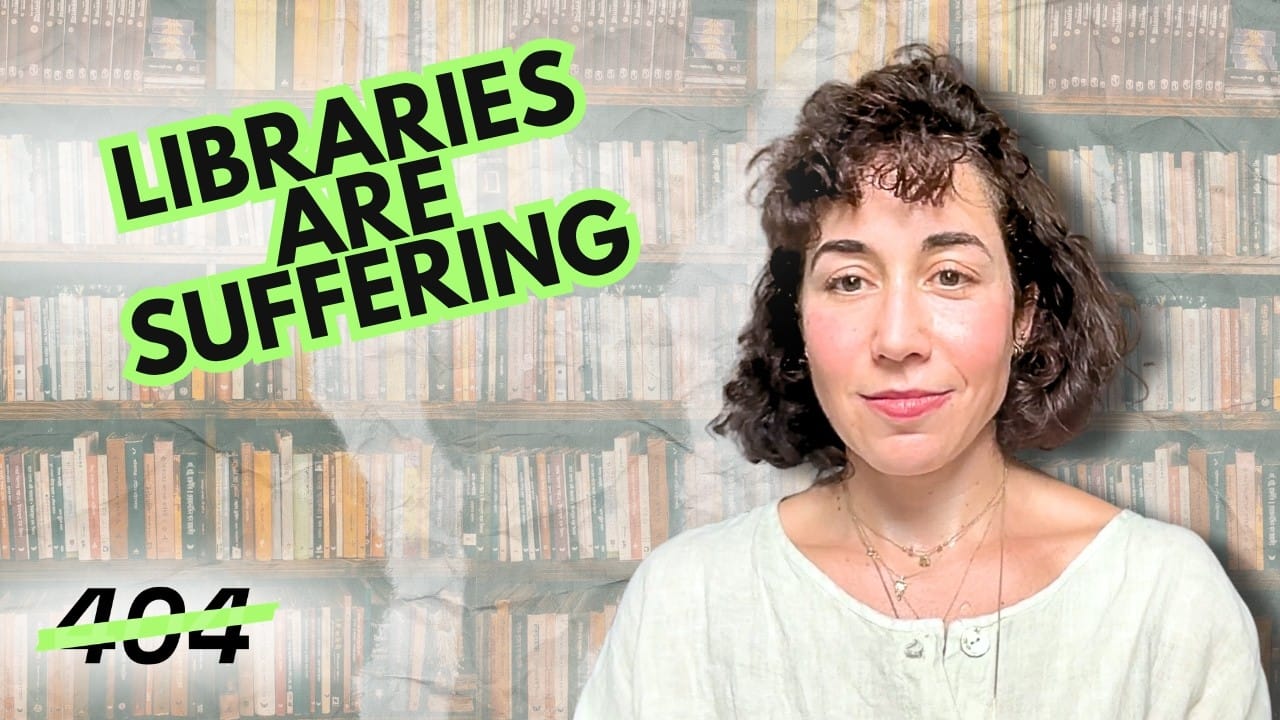
This week we’re joined by Jennie Rose Halprein, executive director of Library Futures, a non-profit that advocates for a fair digital future for libraries and the communities they serve. We have written a bunch of stories about libraries over the years, and I have talked to Jennie a few times for those stories. I always have really interesting conversations with her, but a lot of what we talk about never makes it into my articles. That’s why I wanted to share one of those conversations with you today. We of course touch upon censorship but also many other subjects, so I hope you enjoy this conversation as much as I did.
Listen to the weekly podcast on Apple Podcasts, Spotify, or YouTube.
Become a paid subscriber for early access to these interview episodes and to power our journalism. If you become a paid subscriber, check your inbox for an email from our podcast host Transistor for a link to the subscribers-only version! You can also add that subscribers feed to your podcast app of choice and never miss an episode that way. The email should also contain the subscribers-only unlisted YouTube link for the extended video version too. It will also be in the show notes in your podcast player.
DEN HAAG (ANP) - De verduurzaming stagneert, merkt het Planbureau voor de Leefomgeving (PBL). Voor het derde jaar op rij is de hoeveelheid broeikasgassen die Nederland naar verwachting vermindert in 2030 nauwelijks toegenomen. Tussen de klimaatplannen en het doel voor 2040 ziet het planbureau een "grote kloof", en voor het doel van een klimaatneutraal Nederland in 2050 is nog meer nodig.
Vorig jaar meldde het PBL al dat de kans "heel erg klein" is dat het lukt om in 2030 55 procent minder broeikasgassen uit te stoten ten opzichte van 1990. Daar blijft het bureau bij. De doorgerekende plannen zouden bij elkaar goed zijn voor een afname van 47 tot 54 procent.
Als het kabinet-Jetten het doel voor 2030 alsnog wil halen, zijn pijnlijke maatregelen nodig. "Dit was niet onvermijdelijk, maar in belangrijke mate het gevolg van politieke keuzes in de afgelopen jaren", staat in het rapport. Hoe langer de politiek wacht, hoe pijnlijker de maatregelen worden die de verschillende doelen nog binnen bereik kunnen brengen.
Verwachtingen
Klimaatneutraal zijn in 2050 wordt volgens het PBL een enorme opgave. In de afgelopen 35 jaar is de uitstoot van broeikasgassen gedaald met een derde, in de komende 25 jaar moet de overige twee derde dus worden verminderd.
Het PBL stelde de verwachtingen bij aan de hand van een reeks plannen van het kabinet-Jetten, zoals een inruilregeling voor brandstofauto's, het uitfaseren van huurwoningen met energielabels C en D en nieuwe regels voor warmtepompen. De nieuwe plannen van dit jaar hebben voor 2030 "nauwelijks effect". De nieuwe stikstofmaatregelen zijn nog niet meegerekend.
Verschillen
De energie die Nederland gebruikt komt grotendeels uit het buitenland, en dat blijft volgens het PBL voorlopig ook zo. Het percentage geïmporteerde energie daalt naar verwachting van 77 procent nu naar 49 tot 63 procent in 2040. Het overgrote deel van die import is fossiel.
Per sector zijn de verschillen groot. Waar het energieverbruik van voertuigen de komende jaren naar verwachting snel daalt, ligt dat tempo in de landbouw lager. Woningen besparen steeds meer energie, maar dat wordt weer tenietgedaan door het energiegebruik van datacenters.
Klimaatminister Stientje van Veldhoven zei tegenover verzamelde pers dat ze samen met andere kabinetsleden extra maatregelen overweegt die kunnen helpen om minder broeikasgassen uit te stoten, ook voor 2030. Aan welke maatregelen ze denkt, zei ze niet. Of ze bereid is pijnlijke maatregelen te nemen? "De vraag is of de Kamer bereid is om die te nemen."
WASHINGTON (ANP) - Oekraïne en Rusland hebben aan de Amerikaanse president Donald Trump beloofd geen energiedoelen van elkaar meer te zullen aanvallen. Dat zegt Trump op zijn Truth Social. Volgens Trump zorgen dit soort aanvallen in de oorlog tussen Oekraïne en Rusland voor hoge dieselprijzen wereldwijd.
Max Verstappen was instructed to give positions back at the start of the Spanish Grand Prix before eventually finishing in P2.
Blue Origin is getting a taste of its own medicine after Rocket Lab filed a formal protest over NASA's decision to award Jeff Bezos' space biz a contract worth up to approximately $700 million to build the agency's Mars Telecommunications Network. NASA issued the award in early September following a request for proposals in May. It tasks Blue Origin with designing, developing, integrating, launching, and operating a Mars Telecommunications Orbiter (MTO) that will, among other things, serve as a communications relay for missions to the red planet. Rocket Lab has now filed a formal protest with the Government Accountability Office (GAO) over the decision, writing: "NASA's award decision appears to be inconsistent with the eligibility criteria mandated by Congress. In addition, the agency's punitive review of Rocket Lab's technical volume was inconsistent, making incorrect assertions and conclusions." This isn't the first time Rocket Lab has bristled at NASA's decision-making. In 2025, The Register spoke with Richard French, Rocket Lab's veep for Business Development and Strategy, over NASA's rejection of its Mars Sample Return proposal, which included a Mars communications orbiter. "We're asking for leadership," French said at the time. "We're fine with an open competition. We think open competition is how the best ideas come about." Blue Origin threw its toys out of the stroller in 2021 after NASA awarded SpaceX a contract to develop the next lunar lander. Bezos' biz filed an official protest with the GAO, offered discounts, and even lobbed a sueball to no avail. Blue Origin later won a separate competition. In 2023, NASA selected the company as the second Artemis lunar lander provider in a contract worth $3.4 billion. Blue Origin's MTO design is based on its Blue Ring spacecraft, which combines hybrid solar-electric and chemical propulsion with 13 ports for mounting payloads, including scientific instruments and small spacecraft. Multiple Blue Ring spacecraft are already in production, and Blue Origin reckons it can produce four vehicles per year – a rate that could be scaled up if required. Tory Bruno, formerly of United Launch Alliance and now president of Blue Origin's national security arm, Blue National Security, said: "This awarded contract is a testament to the Blue Origin team that has been building Blue Ring with exactly this kind of mission in mind. We're ready, and so is the hardware." ®

Veel te rechts, zo oordeelden D66 en CDA eind augustus over de eigen begroting van minister van Financiën Eelco Heinen (VVD). Onzin, vindt de VVD: ze bevatte genoeg gestes aan de oppositie. Tijd voor een vergelijking tussen de uiteindelijke Miljoenennota en het oorspronkelijke plan van Heinen, dat NRC heeft ingezien.