The Register

Biting the hand that feeds IT — Enterprise Technology News and Analysis

America is building datacenters faster than the grid can power them

Financial service biz Moody's says the availability of power is still a major constraint on US datacenter growth as the pace of construction exceeds the speed at which the nation's grid infrastructure can add the requisite capacity. America is the epicenter of the datacenter construction boom, driven by the AI craze and demand for compute capacity to train ever-larger foundation models. The latest report from Moody's estimates the power needed by all those bit barns will reach 426 terawatt-hours (TWh) in 2030, citing data from the International Energy Agency (IEA). That is almost double the 2025 figure. It falls on the power sector to develop new resources to meet this extra demand as traditional power generation is struggling to keep pace. Moody's calculates that building the additional generation capacity will cost about $110 billion, adding an estimated $25 billion to $30 billion a year to electricity system costs. Yet efforts to supply the rapidly growing number of cloud and AI server farms are running up against lengthy permitting processes and long lead times for key equipment and materials, causing delays of up to seven years in some cases. Management consultancy Bain & Company highlighted the problem nearly two years ago when it warned that energy companies needed to significantly boost their generation capacity, reversing years of flat or declining demand. Transmission buildout is a parallel bottleneck, with $80 billion to $115 billion in grid investment through 2030 already approved or under construction across US power markets, Moody's says, with the potential to triple over the next decade. Investment bank Jefferies reported in June that half of the extra US datacenter capacity planned for 2026 is unlikely to come online this year, blaming power availability and grid connection setbacks, along with other issues including zoning and permitting challenges. Regions able to accelerate development, such as Texas, have experienced a wave of datacenter construction. The resulting pressure on local grids has prompted some authorities to clamp down on new connections for compute sheds. Moody's believes most new IT campus operators are still likely to seek grid connections to limit development costs and benefit from service reliability and shared redundancy. Yet many are also seeking alternatives, including on-site behind-the-meter (BTM) power generation to avoid delays in bringing facilities online. The document also notes that the growing energy demands from server farms are inflating power prices and customer bills in some regions of America, as The Register reported earlier this year. This has led to affordability concerns, fueling opposition to datacenters and prompting measures such as stricter approval frameworks and moratoriums on new projects. President Trump even introduced a Ratepayer Protection Pledge, under which tech giants and energy companies committed to shielding consumers from rising energy costs due to the datacenter boom. In the long term, Moody's believes that large-scale infrastructure investment will ultimately strengthen grid reliability and affordability, despite the risks. Extra generation capacity will alleviate longstanding supply constraints, it says, reducing price volatility during periods of extreme weather or high demand, while expanded transmission networks could improve access to lower-cost generation resources, particularly when datacenter developers or their tenants help finance the associated infrastructure. ®
Sign in an Osaka train station directing people to the exit for the Osaka Castle

m01229 has added a photo to the pool:

Sign in an Osaka train station directing people to the exit for the Osaka Castle

Sign in an Osaka train station directing people to the exit for the Osaka Castle

Beautiful view of Osaka Castle with flowers in foreground, Japan

m01229 has added a photo to the pool:

Beautiful view of Osaka Castle with flowers in foreground, Japan

Beautiful view of Osaka Castle with flowers in foreground, Japan

osanpo_2001

gnsk has added a photo to the pool:

osanpo_2001

Overheid wil met behulp van AI bezuinigen op het ambtenarenbestand. Maar zo snel gaat dat helemaal niet, zegt deze hoogleraar

Het kabinet wil een „efficiëntere en effectievere” overheid en heeft een taakgroep op poten gezet om dat te verwezenlijken: de zogenoemde ‘Slagvaardige Overheid’.

Formula 1 News

Formula 1® - The Official F1® Website

Mekies assesses Lawson's Red Bull stint after Madrid

Red Bull Team Principal Laurent Mekies was full of praise for stand in driver Liam Lawson after the Spanish Grand Prix.

Tsunoda reviews Madrid outing after sustaining 'big damage'

Yuki Tsunoda failed to score at the Madring, coming home 14th for Racing Bulls.

How Sainz’s home race in Madrid unravelled

Carlos Sainz did not see the chequered flag in Madrid, the Spaniard having a torrid race on home soil.

The Guardian

Latest news, sport, business, comment, analysis and reviews from the Guardian, the world's leading liberal voice

‘Every magazine cover needs to seduce’: designers pick their favourites

From a timeless portrait of Lana Del Rey to an alternative guide to the 2014 World Cup in Brazil, experts unpick what makes an enduring, shocking, or alluring print cover

‘We need to rethink what a successful magazine looks like,” says Steve Watson, founder of the subscription magazine club Stack. “It doesn’t make sense to compare the magazines of today to those of the 1960s when many people still didn’t have colour televisions. Print magazines are no longer the best way of reaching lots of people quickly and cheaply but they are still really great at engaging deeply with readers, providing an opportunity to slow down and absorb information. They provide us with an alternative way of seeing the world.”

Watson, along with a group of editors, publishers, designers, historians and academics, will be discussing the varying roles and functions that magazines have played over the years during a one-day event at the forthcoming London design festival. In contrast to the doom and gloom we often hear about the print industry, he remains upbeat about the humble mag’s future. “The truth is there are brilliant new magazines launching all the time,” he says.

Continue reading...

Bridesmaid proposals: a sweet gesture – or another way to make weddings ludicrously expensive?

Being a bridesmaid is a big commitment. Now, asking prospective candidates is becoming an event in itself, sometimes with a heavy price tag

Name: Bridesmaid proposals.

Age: Relatively new.

Continue reading...

There are two kinds of people in this world: hosts or guests. Nobody can be both | Polly Hudson

My hosting persona is an edgier version of Manuel from Fawlty Towers. Invite me to yours, however, and I am a nonstop delight

My epiphany came between the starter and the main. At a friend’s place for dinner, I sat in awe as she put on a kind of magic show – the first course plates were cleared, but I never noticed her doing it. Delicious food was repeatedly produced with no lengthy disappearing act preceding it, no fuss, no panic. The candles on the table flickered invitingly, the background music was unobtrusive but atmospheric, the wine and chat flowed effortlessly. If I had later discovered she secretly had a full staff – planning, preparing, cooking, cleaning – it would have made perfect sense. But no, it was all her. And then I realised, the world is divided into people who are hosts, and people who are guests. You’re either one, or the other – nobody is both, apart from maybe the Duchess of Sussex. If you aren’t sure which camp you fall into, ask someone close to you if you’re a good host. If they pause for longer than 0.2 seconds before answering, you’re a guest.

As alluded to above, I am a terrible host. When welcoming people into your home, your mood sets the tone for what follows: if you’re relaxed, calm and smiley, they will be too. I am uptight, edgy – and very, very clearly on my last nerve as I open the door to let them in. I’m probably grimacing, I might be close to tears. I will then be so extremely laser focused on them having a nice time, that it will ensure they most definitely do not. I run from room to room. I yelp. I don’t engage in conversation, because even if I can briefly get it together enough to appear to be listening, I’m really thinking about whether I set the oven to the right temperature, and realising I forgot to look at the clock when I put the food in it. I am neither present nor absent, but an infuriating combination of the two. I loiter. I lurk. My energy is that of a surgeon dashing to the operating room, who has just noticed that they’ve forgotten everything they learned at medical school. Or perhaps it’s Manuel from Fawlty Towers. When it comes to hosting, I am a mess.

Continue reading...

New Order keyboardist Gillian Gilbert announces she is ‘living with cancer’

Musician clarified her own health status after concerns were raised by interview with husband and bandmate Stephen Morris earlier this month

Gillian Gilbert, keyboardist with New Order, has announced she is again having treatment for cancer.

The 65-year-old musician announced the news on Instagram, as a response to an interview her husband and New Order bandmate, drummer Stephen Morris, gave to Rolling Stone earlier this month. Morris had said: “I’ve got a bit of a health problem at the minute, which precludes leaving the country for any length of time … it’s pretty serious.”

Continue reading...

Collage of cutouts of star-forming region IC 348 (Webb NIRCam image)

europeanspaceagency posted a photo:

Collage of cutouts of star-forming region IC 348 (Webb NIRCam image)

This collage features a collection of cutouts from the massive star-forming region IC 348. Each of these six panels showcase features of interest that are visible throughout the field.

1: Star embedded in a nebula — This small portion of the field contains two stars deeply embedded in a cloud of gas and dust. The large star’s shorter-wavelength infrared light is absorbed by the dust, leaving it brightest at longer wavelengths, which are coloured orange; the same dust absorption creates the silhouettes in the image.

2: Central star cluster — The centre of IC 348 is dominated by wispy curtains of gas that form a large loop. Winds from the many stars sculpt the clouds of interstellar gas and dust, and the clouds reflect the light from the cluster’s stars — what is known as a reflection nebula.

3: Stars and faint outflows — Here on the outskirts of the field, two stars shine out of clouds of gas and dust. The stars appear equally bright, but the orange one is more deeply embedded. Thin red arcs and blotches near the stars are hot, glowing shockwaves created by fast-moving outbursts from the stars.

4: Herbig-Haro objects — This relatively small region near the top of the image is packed with long, glowing outflows and bold colours in the waves of gas and dust. The outflows, known as Herbig-Haro objects, are created by stellar winds or jets from protostars ploughing into the thick clouds around them. No less than three objects in this area have previously been the subjects of their own images, demonstrating how rich an area of star formation this is.

5: Gravitational lensing — This tiny object, at first glance appearing almost like a planet with a ring, is in fact two galaxies. The blue one is closer to us, and the orange galaxy is very far away behind it but lined up just right. This causes the light from the orange galaxy to be bent by the gravity of the blue galaxy, creating a magnified, warped image.

6: Spiral galaxies — Some of the more prominent galaxies that can be seen behind the clouds of gas and dust. While the IC 348 region is around 1000 light-years from Earth, these galaxies are millions of light-years away, and the even smaller galaxies that appear as coloured dots in the background are up to billions of light-years distant.

[Image description: A collage, with three large panels along the top and four smaller ones on the bottom. The middle panel on top shows star-forming region IC 348. Six boxes are drawn around features in the region, numbered 1–6. The other six panels are numbered and show these features enlarged. They include bright stars throughout the nebula, protostars shooting jets of gas, a distant spiral galaxy, and a gravitational lens.]

Credits: ESA/Webb, NASA, CSA, K. Luhman, C. Alves De Oliveira, M. Zamani (ESA/Webb); CC BY 4.0

Star-forming region IC 348 (NIRCam image)

europeanspaceagency posted a photo:

Star-forming region IC 348 (NIRCam image)

The NASA/ESA/CSA James Webb Space Telescope recently observed IC 348, a star-forming region just 1000 light-years away. This is one of the largest Webb images released to the public so far. This near-infrared vista of IC 348 reveals a collection of objects called brown dwarfs, which are smaller than the smallest stars.

Researchers used the unparalleled sensitivity of Webb’s NIRCam (Near-Infrared Camera) to track down the smallest brown dwarfs in IC 348, which weigh in at just just twice the mass of Jupiter. These are the least massive brown dwarfs known, and their existence poses challenges to models of how stars form.

In addition to the brown dwarfs and young stars scattered across the swirling nebula, this image provides a unique perspective on a handful of protostars, which can be seen in the upper-right corner. These protostars are ejecting powerful jets that have crashed into the gas and dust surrounding them, creating luminous regions called Herbig-Haro objects.

[Image Description: A star-forming region. It is blanketed in thick clouds of gas and dust, millions of kilometres across, that form swirling patterns. Bright stars are scattered throughout the clouds, with the densest cluster situated in the centre of the scene. Each is crowned with six long points created by the optics of the telescope’s mirrors. In the upper right, a couple of hidden stars blast out long, glowing jets of material.]

Credits: ESA/Webb, NASA, CSA, K. Luhman, C. Alves De Oliveira, M. Zamani (ESA/Webb); CC BY 4.0

IC 348 Crop: Star embedded in a nebula

europeanspaceagency posted a photo:

IC 348 Crop: Star embedded in a nebula

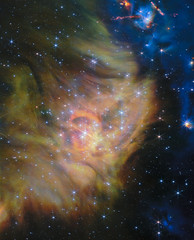
This image showcases a portion of the larger IC 348 field to highlight two stars embedded within a cloud of gas and dust. The central star, despite being brighter and appearing larger than its companion to the lower-right, is in fact more deeply wrapped in the clouds of gas and dust. These clouds block more of the shorter-wavelength infrared light that the star emits, leaving it brightest in the longer wavelengths, which in this image are coloured orange. The smaller star is less shrouded, so the shorter and longer infrared wavelengths combine to make it appear whitish-blue. The galaxies seen in the background are thousands of times further away from Earth than these two stars.

The bright lines appearing to radiate out from these stars are a type of distortion that arises from the optical design of the telescope. Called diffraction spikes, they are created because the intense light from the unresolved target is bent (“diffracted”) very slightly at the edges of Webb’s hexagonal mirror panels and around one of the struts that hold up its secondary mirror. This distinctive six-plus-two-pointed pattern is the same for any image taken by Webb. For diffraction spikes to appear, the light source has to be very bright and very concentrated, so they’re most often seen on stars.

You can view the full image from which this crop was taken here.

[Image description: A star embedded within a cloud of gas and dust. The star is a very bright point in the centre of the image. It radiates six long and two short orange spikes of light, caused by the telescope's optics. Most of the gas behind it is blue and wispy, but below the star is a patch of bold yellow and red gas in a butterfly-shape. A few glowing shockwaves made by fast-moving gas surround the star. Small, whitish galaxies appear in the distance.]

Credits: ESA/Webb, NASA, CSA, K. Luhman, C. Alves De Oliveira, M. Zamani (ESA/Webb); CC BY 4.0

IC 348 Crop: Stars and faint outflows

europeanspaceagency posted a photo:

IC 348 Crop: Stars and faint outflows

This image showcases a portion of the larger IC 348 field to highlight two stars among the outskirts of the nebula. These two stars appear equally-sized, because they are similarly bright, but one is orange while the other is blue. The reason for this is that the orange star is more deeply embedded in the clouds of interstellar gas and dust; these clouds block more of the shorter-wavelength infrared light that the star emits, leaving the longer wavelengths, which are coloured orange in this image. The other star is less shrouded, so the shorter and longer infrared wavelengths combine to make it appear whitish-blue. While it doesn’t look like there’s a lot of gas or dust here, the thin red arcs and faint blotches that can be seen around the stars are shockwaves made in that gas. Outbursts from the young stars crash into the interstellar gas, compressing and heating it up until it glows.

The bright lines appearing to radiate out from these stars are a type of distortion that arises from the optical design of the telescope. Called diffraction spikes, they are created because the intense light from the unresolved target is bent (“diffracted”) very slightly at the edges of Webb’s hexagonal mirror panels and around one of the struts that hold up its secondary mirror. This distinctive six-plus-two-pointed pattern is the same for any image taken by Webb. For diffraction spikes to appear, the light source has to be very bright and very concentrated, so they’re most often seen on stars.

You can view the full image from which this crop was taken here.

[Image description: Two bright stars, one golden and one more white in colour, in a mostly-dark area of space. Diffuse, dark blue gas clouds curl around the stars, with dark bands of empty space cutting through the clouds. Thin red arcs near the stars are hot shockwaves in the gas. The background is filled with many small objects in blue, green or yellow; most are distant galaxies.]

Credits: ESA/Webb, NASA, CSA, K. Luhman, C. Alves De Oliveira, M. Zamani (ESA/Webb); CC BY 4.0

IC 348 Crop: Central star cluster

europeanspaceagency posted a photo:

IC 348 Crop: Central star cluster

This image from the NASA/ESA/CSA James Webb Space Telescope shows the central portion of the star cluster IC 348. The wispy curtains filling the image are interstellar gas and dust reflecting the light from the cluster’s stars — what is known as a reflection nebula. The material also includes carbon-containing molecules known as polycyclic aromatic hydrocarbons, or PAHs. The bright star closest to the centre of the frame is actually a pair of type B stars in a binary system, the most massive stars in the cluster. Winds from these stars may help sculpt the large loop seen on the right side of the field of view.

You can view the full image from which this crop was taken here.

[Image description: Wispy, criss-crossing filaments fill the scene, creating dense and highly textured layers of gas in colours from green to yellow to orange and pink. Above the centre, the filaments join into a large loop, while below they bend and create wave-like curves. Dozens of bright stars are layered atop the gas, a pair in the centre being particularly bright; all sport six long and two short spikes of light, created by the telescope’s optics.]

Credits: ESA/Webb, NASA, CSA, K. Luhman, C. Alves De Oliveira, M. Zamani (ESA/Webb); CC BY 4.0

MetaFilter

The past 24 hours of MetaFilter

En Route to the World's Most Educated Person

The ultimate tiger mom's dream child, Jamie Beaton has 12 advanced degrees from Harvard, Yale, Oxford and so on along with his Harvard undergraduate magna cum laude. (via NYTimes gift link) He lives his dream life of following his academic passions while owning his multi-million dollar company, Crimson Education. Note that his company has some controversy surrounding their tactics and success. He joins a short list of the super-educated including Benjamin B. Bolger, Michael Nicholson and Jacob Appel.

Wel.nl

Minder lezen, Meer weten.

AEX eindigt Prinsjesdag lager, blik vooral op AI-zorgen en olie

AMSTERDAM (ANP) - De AEX-index is op Prinsjesdag licht lager geëindigd. Beleggers hadden oog voor de begrotingsplannen die het kabinet dinsdag presenteerde, maar richtten de blik vooral op zorgen over de snelle opmars van kunstmatige intelligentie (AI) en de stijgende olieprijzen. De chipbedrijven ASMI (min 1,2 procent) en ASML (min 0,7 procent) hoorden bij de dalers. Oliebedrijf Shell en maritiem oliedienstverlener SBM Offshore profiteerden van de hogere olieprijzen en voerden de stijgers in de Amsterdamse hoofdindex aan met plussen van 1,9 en 2,1 procent.

De AEX-index eindigde 0,2 procent lager op 1095,87 punten. De MidKap sloot 0,2 procent hoger op 1083,77 punten. De beurzen in Frankfurt, Londen en Parijs noteerden bij het slot van de handelsdag minnen tot 0,4 procent.

Chipbedrijven en andere bedrijven die apparatuur leveren voor AI-datacenters zijn door de grote investeringen in AI dit jaar flink in waarde gestegen. Afgelopen dagen hebben grote AI-bedrijven echter opgeroepen om de ontwikkeling van AI-modellen bewust te vertragen om de veiligheid te waarborgen. Dit wakkert de vrees aan dat strengere regels de koerswaarderingen van AI-bedrijven onder druk zullen zetten.

Informatieleveranciers Wolters Kluwer en RELX en investeerder CVC hoorden bij de grootste dalers in de AEX met minnen tot 3,4 procent. Ook ijsbedrijf Magnum hoorde bij de verliezers (min 2,9 procent).

De olieprijzen gingen verder omhoog na nieuwe aanvallen van de door Iran gesteunde Houthi-rebellen op Saudi-Arabië. De prijs van een vat Brentolie steeg 1,9 procent tot 107,73 dollar en Amerikaanse olie kostte 2,9 procent meer op 104,31 dollar per vat.

De aandacht ging ook uit naar de rentes op de obligatiemarkten. Zo steeg de rente op tienjarige Amerikaanse staatsobligaties tot het hoogste niveau sinds 2007. Maandag steeg de tienjaarsrente, die onder meer wordt gebruikt voor het vaststellen van de hypotheekrente, al voor het eerst sinds 2023 tot boven de 5 procent. Hogere rentes op staatsobligaties maken risicovollere beleggingen als aandelen ook minder aantrekkelijk.


Rijnmond - Nieuws

Het laatste nieuws van vandaag over Rotterdam, Feyenoord, het verkeer en het weer in de regio Rijnmond

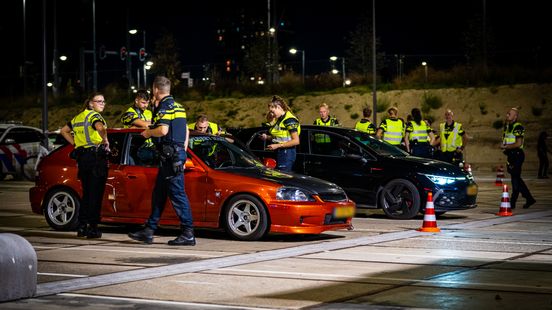
Politie neemt zes auto's in beslag bij verkeerscontrole

De politie heeft een grote verkeerscontrole gehouden aan de Beijerlandselaan in Rotterdam-Feijenoord. Hierbij zijn zes auto’s in beslag genomen en bijna honderd boetes uitgeschreven. Negen bekeuringen waren voor rijden onder invloed.