Odysseus’ geduldige eega Penelope speelt een listige rol in Homerus’ Odyssee, heldendicht waarin vrouwen een prominente rol spelen. Toch is ze wat te lijdzaam in sommige moderne ogen.
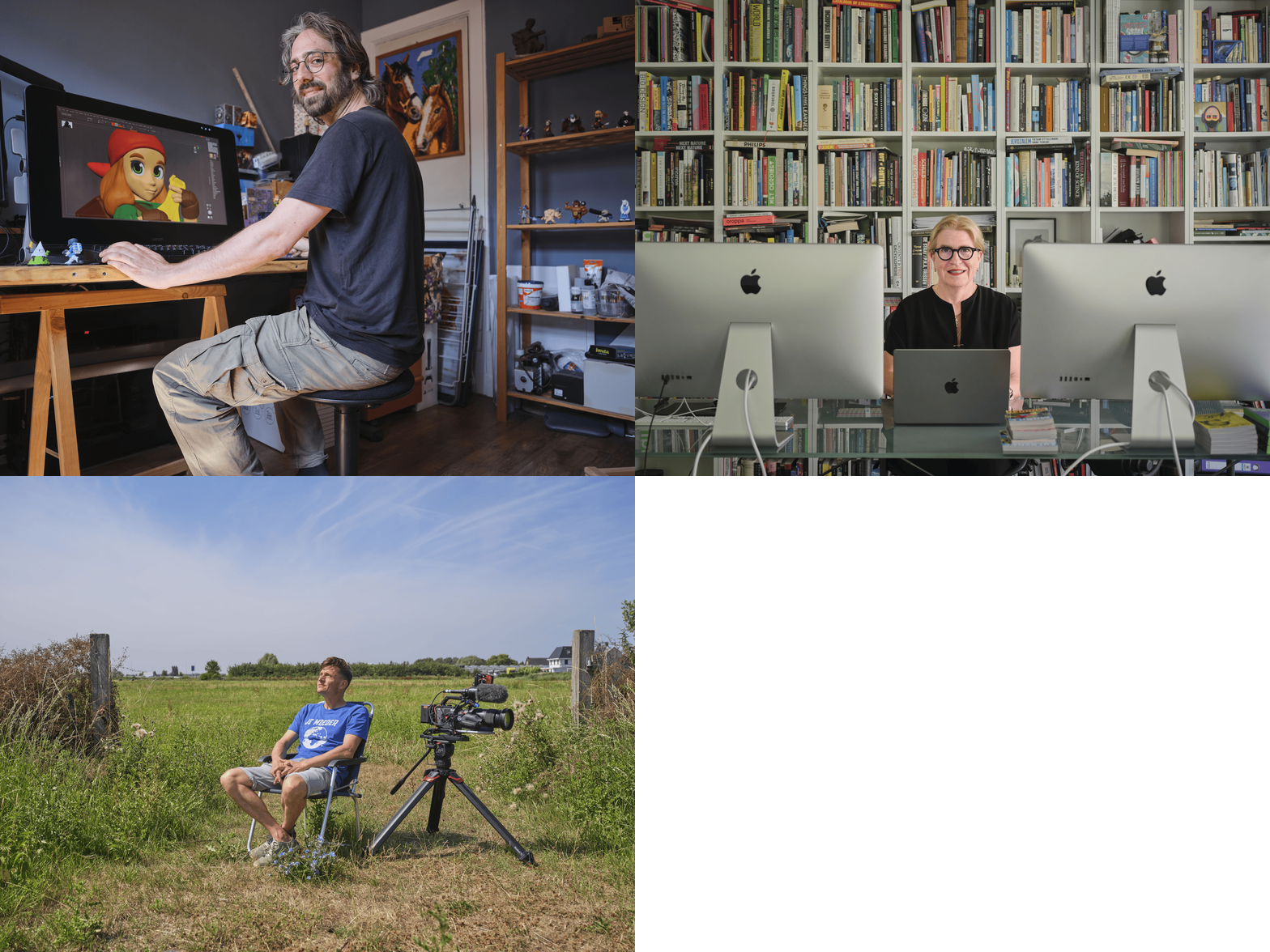
Films maak je in minuten, illustraties binnen seconden. Makers, ontwerpers, kunstenaars zien met generatieve AI niet alleen het eindproduct veranderen maar iets wezenlijkers: „Het deel waar het plezier in zit: het creatieve proces zélf.”
De adviseur van de president is soms net zo belangrijk als de president. In de tweede aflevering van de serie In de schaduw van de macht vertelt Michel het bijzondere verhaal van…
De gesproken tekst van de reclame op Instagram (onderstaand) luidt: "Omdat je vindt dat discriminatie op welke gronddan ook onacceptabel is, en je er alles aan wilt doen om onrecht tegen te gaan." En die (fictieve) leus op de ramen is volkomen verwerpelijk natuurlijk. Maar wat nou als je eigenlijk vindt dat Nederlands onvermogen 'op welke grond dan ook' te discrimineren het eigenlijke probleem is. Kom je dan nog een beetje in aanmerking of?
During the medieval and Renaissance periods, baskets were everyday essentials—no plastic bags at the supermarket or even reusable totes. They were also used for all sorts of activities, from handled varieties for produce at the market to decorative vessels holding sewing materials to large versions that could be worn like rucksacks. For Cardiff-based artist Lewis Prosser, a self-described “absurdist basketmaker,” folklore, regional identity, and cultural heritage center a multidisciplinary practice.
Through sculptural baskets that can be worn as costumes or displayed like venerable sculptures, Prosser taps into storytelling, masking traditions, and public ceremony and celebration. Welsh communities still celebrate Mari Lwyd during the Christmas period, a festivity that may have emerged with the Celts. A small group of men bedecked in ribbons and rosettes parade around town, leading a figure wearing an eerie horse skull. Another ceremonial festival, The Hunting of the Earl of Rone, takes place annually in the village of Combe Martin, North Devon, and although updated over the centuries, is also thought to have originated in pre-Christian times.
‘Making Merrie.’ Photo by Kristen McTernan
In projects like Making Merrie, Prosser combines music and dance in an ode to English folk performances called mummers’ plays, which were often staged during holidays and typically feature combat between two opposing forces, such as good and evil or winter and spring.
Prosser created the wicker costumes using basketry techniques found in the region of Wales and southwestern England, invoking the craft as “an essential human skill we’re at risk of forgetting—a skill that, if lost, means losing part of what it is to be human,” he says in a statement. The costumes are now in the collection of the Folk Preservation Society in Teignmouth, Devon, which continues to activate them in performances from time to time.
Currently, Prosser is facilitating a collaborative project called The Baskets Between Carnival and Lent. Inspired by Pieter Breughel the Elder’s seminal painting “The Fight Between Carnival and Lent” (1559), Prosser takes the composition’s 24 woven objects as a starting point, including willow shutters on buildings, a birdcage, and a woven beehive, otherwise known as a skep. Prosser is joining 10 basketmakers from across Europe to recreate all two dozen in the painting, and the finished pieces are slated for a show at Oriel Myrddin Gallery in Carmarthen, Wales, in spring 2027.
Prosser is also working toward a new performance for Burgos Biennial 2026 in Burgos, Spain, which kicks off in late September. “For this project, I will be devising an elaborate new basket-based sport called ‘hornball’ (cuerno pelota): a combination of ritual harvest celebration, competitive ball games, and wearable sculptures,” Prosser tells Colossal. See more on his Instagram.
Artemis II astronauts, ESA Director of Human and Robotic Exploration Daniel Neuenschwander, NASA Associate Administrator Amit Kshatriya and NASA Orion Program management together during a recognition event with the ESA workforce at ESTEC in the Netherlands.
Yesterday, the four Artemis II astronauts visited ESA’s technical site in the Netherlands, where they met the team behind the European Service Module that powered their Orion spacecraft around the Moon and safely back to Earth.
NASA astronauts Reid Wiseman, Victor Glover and Christina Koch, and Canadian Space Agency astronaut Jeremy Hansen were joined by NASA Associate Administrator Amit Kshatriya and NASA’s Orion Program management for this first stop of post-flight visits to the European teams that supported the Artemis II mission.
The visit included a recognition event during which NASA Orion Program Manager Howard Hu presented ESA with a Program Award acknowledging the important European contribution to the mission.
Artemis II astronauts Reid Wiseman, Christina Koch and Jeremy Hansen visit the Eagle room at ESA's site in the Netherlands to meet the engineers who monitored the European Service Module around the clock during their mission.
Yesterday, the four Artemis II astronauts visited ESA’s technical site in the Netherlands, where they met the team behind the European Service Module that powered their Orion spacecraft around the Moon and safely back to Earth.
NASA astronauts Reid Wiseman, Victor Glover and Christina Koch, and Canadian Space Agency astronaut Jeremy Hansen were joined by NASA Associate Administrator Amit Kshatriya and NASA’s Orion Program management for this first stop of post-flight visits to the European teams that supported the Artemis II mission. Later this week, they will also visit European Service Module prime contractor Airbus in Bremen, Germany, and Thales Alenia Space in Turin, Italy, who built the module's structure.
Bonjour/hi #Portfolioday! I'm Cab, an illustrator from Montreal, Canada. While I am not currently looking for editorial work, I WILL draw your house or your favorite coffee shop. Commissions for houses and storefronts are open :)
I Am Not Sorry Lindsey Graham is Dead "This was Brooklyn, and most of them were lifelong New Yorkers instead of repatriated transplants like me. They had been there, under the smoke. [...] Whatever else could be said about who I was before I transitioned, the young man I was desperately trying to be was someone who took the Gospel seriously in its radicalism. [...] Ten years of being told we are affronts to God, a danger to children, sick, deluded rapists have been my education. I have, at last, learned how to hate. That's the bit, the fact of my hate, that makes me flinch, burns my own gullet. That's the dark little piece of me I can't pretend doesn't exist. Men like Lindsey Graham have taught me how to hate, and I'm worried it can't be unlearned."
IBM says customers spooked by soaring demand for AI infrastructure raided their mainframe budgets to stockpile servers, storage, and memory instead, knocking Big Blue's flagship Z business off course. Ahead of its full calendar Q2 earnings release next week, IBM took the unusual step of publishing preliminary quarterly results alongside a letter from CEO Arvind Krishna explaining why the numbers fell short of expectations. The biggest disappointment came in Infrastructure, where revenue fell 7 percent, despite what IBM had previously described as the strongest launch of a mainframe generation in its history. The disclosure led to a more-than 25 percent plunge in Big Blue's share price on Tuesday. The Q2 culprit wasn't a sudden loss of affection for mainframes, according to Krishna, but a last-minute scramble to secure hardware increasingly caught up in the AI spending boom. "In the last few weeks of June, we saw clients shift their quarterly capex spend toward servers, storage, and memory purchases to secure supply-constrained infrastructure ahead of expected price increases," Krishna wrote. "This dynamic impacted client buying patterns." IBM had expected some disruption from supply chain pressures, he said, "but we did not anticipate the magnitude of the capex reprioritization." That's an unusually candid admission from a company whose Z mainframes remain one of its highest-margin businesses. Customers, it seems, preferred to refresh infrastructure they fear might soon become more expensive or harder to obtain. The spending shift also rippled through IBM's software business because fewer mainframe deals meant weaker sales of the transaction-processing software that typically accompanies them. Krishna pointed to another factor as well, saying clients were distracted by "rapidly evolving, industry-wide cybersecurity concerns" during the quarter, though he offered no further details on what those concerns were or how they affected purchasing decisions. IBM was willing to shoulder some of the blame. "These conditions require our teams to execute perfectly, and this quarter we faltered," Krishna wrote. "We did not adapt and move quickly enough, and numerous large deals failed to close on the timelines we expected, driving the majority of our shortfall." Not everything disappointed. Red Hat revenue grew 11 percent, recent acquisitions including HashiCorp and Confluent performed strongly, and IBM's Distributed Infrastructure business posted record reported growth of 37 percent, driven by Power servers and storage systems. Still, the quarter offers another sign of how the AI infrastructure race is reshaping enterprise IT budgets. For at least one quarter, customers decided the safest investment wasn't the newest mainframe – it was buying as much in-demand hardware as possible before someone else did. ®
IBM says customers spooked by soaring demand for AI infrastructure raided their mainframe budgets to stockpile servers, storage, and memory instead, knocking Big Blue's flagship Z business off course. Ahead of its full calendar Q2 earnings release next week, IBM took the unusual step of publishing preliminary quarterly results alongside a letter from CEO Arvind Krishna explaining why the numbers fell short of expectations. The biggest disappointment came in Infrastructure, where revenue fell 7 percent, despite what IBM had previously described as the strongest launch of a mainframe generation in its history. The disclosure has led to a near-26 percent plunge in Big Blue share price. The Q2 culprit wasn't a sudden loss of affection for mainframes, according to Krishna, but a last-minute scramble to secure hardware increasingly caught up in the AI spending boom. "In the last few weeks of June, we saw clients shift their quarterly capex spend toward servers, storage, and memory purchases to secure supply-constrained infrastructure ahead of expected price increases," Krishna wrote. "This dynamic impacted client buying patterns." IBM had expected some disruption from supply chain pressures, he said, "but we did not anticipate the magnitude of the capex reprioritization." That's an unusually candid admission from a company whose Z mainframes remain one of its highest-margin businesses. Customers, it seems, preferred to refresh infrastructure they fear might soon become more expensive or harder to obtain. The spending shift also rippled through IBM's software business because fewer mainframe deals meant weaker sales of the transaction-processing software that typically accompanies them. Krishna pointed to another factor as well, saying clients were distracted by "rapidly evolving, industry-wide cybersecurity concerns" during the quarter, though he offered no further details on what those concerns were or how they affected purchasing decisions. IBM was willing to shoulder some of the blame. "These conditions require our teams to execute perfectly, and this quarter we faltered," Krishna wrote. "We did not adapt and move quickly enough, and numerous large deals failed to close on the timelines we expected, driving the majority of our shortfall." Not everything disappointed. Red Hat revenue grew 11 percent, recent acquisitions including HashiCorp and Confluent performed strongly, and IBM's Distributed Infrastructure business posted record reported growth of 37 percent, driven by Power servers and storage systems. Still, the quarter offers another sign of how the AI infrastructure race is reshaping enterprise IT budgets. For at least one quarter, customers decided the safest investment wasn't the newest mainframe – it was buying as much in-demand hardware as possible before someone else did. ®
IBM says customers spooked by soaring demand for AI infrastructure raided their mainframe budgets to stockpile servers, storage, and memory instead, knocking Big Blue's flagship Z business off course. Ahead of its full calendar Q2 earnings release next week, IBM took the unusual step of publishing preliminary quarterly results alongside a letter from CEO Arvind Krishna explaining why the numbers fell short of expectations. The biggest disappointment came in Infrastructure, where revenue fell 7 percent, despite what IBM had previously described as the strongest launch of a mainframe generation in its history. The culprit wasn't a sudden loss of affection for mainframes, according to Krishna, but a last-minute scramble to secure hardware increasingly caught up in the AI spending boom. "In the last few weeks of June, we saw clients shift their quarterly capex spend toward servers, storage, and memory purchases to secure supply-constrained infrastructure ahead of expected price increases," Krishna wrote. "This dynamic impacted client buying patterns." IBM had expected some disruption from supply chain pressures, he said, "but we did not anticipate the magnitude of the capex reprioritization." That's an unusually candid admission from a company whose Z mainframes remain one of its highest-margin businesses. Customers, it seems, preferred to refresh infrastructure they fear might soon become more expensive or harder to obtain. The spending shift also rippled through IBM's software business because fewer mainframe deals meant weaker sales of the transaction-processing software that typically accompanies them. Krishna pointed to another factor as well, saying clients were distracted by "rapidly evolving, industry-wide cybersecurity concerns" during the quarter, though he offered no further details on what those concerns were or how they affected purchasing decisions. IBM was willing to shoulder some of the blame. "These conditions require our teams to execute perfectly, and this quarter we faltered," Krishna wrote. "We did not adapt and move quickly enough, and numerous large deals failed to close on the timelines we expected, driving the majority of our shortfall." Not everything disappointed. Red Hat revenue grew 11 percent, recent acquisitions including HashiCorp and Confluent performed strongly, and IBM's Distributed Infrastructure business posted record reported growth of 37 percent, driven by Power servers and storage systems. Still, the quarter offers another sign of how the AI infrastructure race is reshaping enterprise IT budgets. For at least one quarter, customers decided the safest investment wasn't the newest mainframe – it was buying as much in-demand hardware as possible before someone else did. ®
Tussen alle bosbranden, drinkwatertekorten en lage waterstanden is er ook goed nieuws deze zomer: Shell kondigt aan zeven nieuwe bomen te gaan planten. De oliegigant heeft namelijk het plan om één boom te planten voor iedere duurzame afdeling die het afstoot.
“We willen koploper zijn in het planten van een handjevol bomen”, zegt CEO van Shell Wael Sawan. Hij drukt de aarde aan rond zijn net geplante iep. De jonge iep compenseert de verkoop van de groene Indiase dochteronderneming van Shell, legt hij uit, de zoveelste zet in het terugdraaien van duurzame investeringen. “Het voelt goed om iets terug te kunnen doen. Niet minder dan normaal eigenlijk. We hebben als Shell toch een voorbeeldfunctie.”
Volgens Sawan zijn deze paar bomen nog maar het begin. “Wij stoppen niet tot het hier helemaal volstaat met bomen ter compensatie van opgeheven duurzame onderdelen. Shell wil een betere toekomst voor iedereen: een boom voor onze kleinkinderen én een hoger rendement voor onze aandeelhouders. Er is geen AEX B.”
Scientists at the Indian Institute of Technology, Madras (IIT-M) have created what they describe as the world's most detailed 3D cellular atlas of the human brainstem, linking whole-brain MRI views to individual neurons across more than 500 tissue sections. The free online atlas, called Anchor, could help researchers better understand diseases such as Alzheimer's, Parkinson's, stroke, and SIDS by showing how healthy and diseased brain tissue differs cell by cell. The BBC reports: Built from high-resolution microscope images rather than costlier molecular techniques, it creates a detailed three-dimensional map of the brainstem, identifying more than 200 clusters of brain cells and nerve pathways. Eight chemical markers help distinguish different cell types, producing one of the clearest pictures yet of this vital, but poorly, understood part of the brain. The brainstem occupies only a sliver of the brain, yet it keeps people alive. It links the brain to the spinal cord and controls breathing, heartbeat, sleep, wakefulness and movement.
[...] Users can zoom from the whole brainstem seen on MRI down to individual neurons while maintaining their precise spatial relationships. The researchers have made the atlas freely available online, hoping it becomes a reference tool for neuroscientists, neurologists and neurosurgeons worldwide. Its applications could also extend well beyond anatomy. By comparing healthy brainstem maps with diseased tissue, scientists may better understand disorders ranging from Parkinson's disease and stroke to Alzheimer's disease and sudden infant death syndrome (SIDS). More precise maps could also help neurosurgeons navigate one of the brain's most delicate regions with greater confidence.

![[In Explore] That Tree (3). (Japan 39a)](https://live.staticflickr.com/65535/55392065347_ea1f730384_m.jpg)

/s3/static.nrc.nl/wp-content/uploads/2026/07/13145923/140726CUL_2035159901_2.jpg)
:format(jpeg):fill(f8f8f8,true)/s3/static.nrc.nl/taxonomy/ea4c1fa-11252025_Wereldzaken_Artikel-%2520en%2520itemafbeelding_1280x768px.png)