

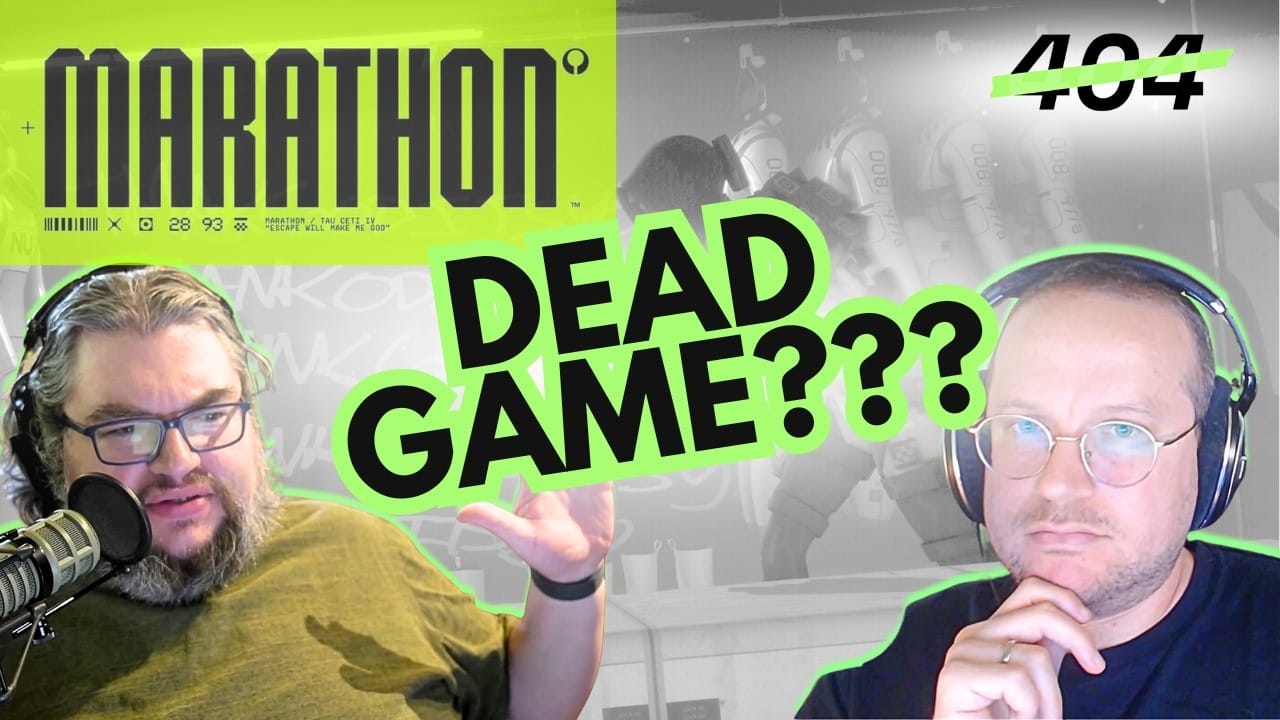
If you listen to the 404 Media podcast by now you probably realized that Joe and I are a little obsessed with a game called Marathon. I’m embarrassed to say that I’ve played it for almost 300 hours since it was released in March.
But as much as we’re enjoying it, and there are thousands of players who feel the same, Marathon so far has failed to find the audience we’d expect from the developer that made Halo, Destiny, and which a few years ago acquired by PlayStation for more than $3 billion. It’s bad news for Marathon fans and a good sign for how much the video game business has changed over the years.
I wanted to have Remap Radio host Robert Zacny on the podcast because much like me and Joe, he’s been obsessed with Marathon as well. One of Rob’s greatest skills is dissecting how and why games get their hooks into us, and what a game’s popularity, or lack thereof in Marathon’s case, might reveal about the state of the industry and culture more broadly.
404 Media is a journalist-founded company and needs your support. To subscribe, go to 404media.co. As well as bonus content every single week, subscribers get access to additional episodes where we respond to their best comments. Subscribers also get early access to our interview series. Gain access to that content at 404media.co.
Listen to the weekly podcast on Apple Podcasts, Spotify, or YouTube.
Become a paid subscriber for early access to these interview episodes and to power our journalism. If you become a paid subscriber, check your inbox for an email from our podcast host Transistor for a link to the subscribers-only version! You can also add that subscribers feed to your podcast app of choice and never miss an episode that way. The email should also contain the subscribers-only unlisted YouTube link for the extended video version too. It will also be in the show notes in your podcast player.


Het terrein voor het aanmeldcentrum in Ter Apel is onveilig voor wachtende asielzoekers. Jongemannen met weinig te verliezen zorgen voor voor onrust en zelfs geweld. „Je zou ervoor moeten zorgen dat zij als een speer door de procedure gaan.”
/s3/static.nrc.nl/wp-content/uploads/2026/07/14134653/140726BIN_2035170373_terapel.jpg)
/s3/static.nrc.nl/wp-content/uploads/2026/07/13120933/140726BUI_2035060799_Bristol1.jpg)
/s3/static.nrc.nl/wp-content/uploads/2026/07/13145633/140726CUL_2035159876_2.jpg)
/s3/static.nrc.nl/wp-content/uploads/2026/07/14141636/140726CUL_2035159918_-making-of.jpg)
/s3/static.nrc.nl/wp-content/uploads/2026/07/13145923/140726CUL_2035159901_2.jpg)

The LGBTQ+ Legislation Tracking Project, tracing & visualizing 10,350 LGBTQ+ bills introduced in the US since 2003. Anti-trans bills have dominated since ~2014.

TheGufotography has added a photo to the pool:
![[In Explore] That Tree (3). (Japan 39a)](https://live.staticflickr.com/65535/55392065347_ea1f730384_m.jpg)
IMG_20260331_083709_DSC_1673-18
en.wikipedia.org/wiki/Gifu_Castle
en.wikipedia.org/wiki/Gifu
You can buy some of my photos here:
www.artheroes.de/de/shop-bilder/The-Gufotography
In Explore, July 15, 2026.

De gesproken tekst van de reclame op Instagram (onderstaand) luidt: "Omdat je vindt dat discriminatie op welke grond dan ook onacceptabel is, en je er alles aan wilt doen om onrecht tegen te gaan." En die (fictieve) leus op de ramen is volkomen verwerpelijk natuurlijk. Maar wat nou als je eigenlijk vindt dat Nederlands onvermogen 'op welke grond dan ook' te discrimineren het eigenlijke probleem is. Kom je dan nog een beetje in aanmerking of?
Social

During the medieval and Renaissance periods, baskets were everyday essentials—no plastic bags at the supermarket or even reusable totes. They were also used for all sorts of activities, from handled varieties for produce at the market to decorative vessels holding sewing materials to large versions that could be worn like rucksacks. For Cardiff-based artist Lewis Prosser, a self-described “absurdist basketmaker,” folklore, regional identity, and cultural heritage center a multidisciplinary practice.
Through sculptural baskets that can be worn as costumes or displayed like venerable sculptures, Prosser taps into storytelling, masking traditions, and public ceremony and celebration. Welsh communities still celebrate Mari Lwyd during the Christmas period, a festivity that may have emerged with the Celts. A small group of men bedecked in ribbons and rosettes parade around town, leading a figure wearing an eerie horse skull. Another ceremonial festival, The Hunting of the Earl of Rone, takes place annually in the village of Combe Martin, North Devon, and although updated over the centuries, is also thought to have originated in pre-Christian times.

In projects like Making Merrie, Prosser combines music and dance in an ode to English folk performances called mummers’ plays, which were often staged during holidays and typically feature combat between two opposing forces, such as good and evil or winter and spring.
Prosser created the wicker costumes using basketry techniques found in the region of Wales and southwestern England, invoking the craft as “an essential human skill we’re at risk of forgetting—a skill that, if lost, means losing part of what it is to be human,” he says in a statement. The costumes are now in the collection of the Folk Preservation Society in Teignmouth, Devon, which continues to activate them in performances from time to time.
Currently, Prosser is facilitating a collaborative project called The Baskets Between Carnival and Lent. Inspired by Pieter Breughel the Elder’s seminal painting “The Fight Between Carnival and Lent” (1559), Prosser takes the composition’s 24 woven objects as a starting point, including willow shutters on buildings, a birdcage, and a woven beehive, otherwise known as a skep. Prosser is joining 10 basketmakers from across Europe to recreate all two dozen in the painting, and the finished pieces are slated for a show at Oriel Myrddin Gallery in Carmarthen, Wales, in spring 2027.
Prosser is also working toward a new performance for Burgos Biennial 2026 in Burgos, Spain, which kicks off in late September. “For this project, I will be devising an elaborate new basket-based sport called ‘hornball’ (cuerno pelota): a combination of ritual harvest celebration, competitive ball games, and wearable sculptures,” Prosser tells Colossal. See more on his Instagram.


Do stories and artists like this matter to you? Become a Colossal Member today and support independent arts publishing for as little as $7 per month. The article ‘Absurdist Basketmaker’ Lewis Prosser Weaves Contemporary Visions of Regional Heritage appeared first on Colossal.