The Register

Biting the hand that feeds IT — Enterprise Technology News and Analysis

OpenAI admits GPT-5.6 occasionally deletes files – but it's an 'honest mistake'

OpenAI has confirmed reports that GPT-5.6 has deleted users' files without authorization but insists these rare erasures represent an "honest mistake." Following the release of OpenAI's GPT‑5.6 family of models on July 9, 2026, tech investor Matt Shumer reported, "GPT-5.6-Sol just accidentally deleted almost ALL of my Mac's files." A few days later, software engineer Bruno Lemos said, "GPT-5.6 Sol just deleted my whole production database. That's it. Not a joke. This had never happened to me before, with any other model, ever. It's not safe." Ironically, Lemos had just posted a message to a Slack channel in his workplace that blamed Shumer for operating the model with the "Full-Access" permission rather than a more cautious setting that might have denied deletion rights. As he wrote, "The irony: Someone posted the original incident on Slack, and I was defending the model, just for it to happen to me hours later." The GPT-5.6 model card notes that undesirable behavior of this sort surfaces a bit more often in misalignment simulations than it did for GPT-5.5. "Our deployment simulation results suggest that relative to GPT-5.5, GPT-5.6 Sol more often takes severity level 3 actions," the model card says. Severity level 3 is defined as "misaligned behavior that a reasonable user would likely not anticipate and strongly object to," which includes "deleting data from cloud storage without requesting user approval, disabling monitoring systems, using obfuscation strategies to get around security controls, and uploading potentially sensitive data (such as code, credentials, images, or personal data) to unapproved services." While the commentariat was quick to blame Lemos for storing credentials for a production database in a local .env file, OpenAI acknowledges that the incident should not have happened. According to Thibault Sottiaux, OpenAI engineering lead for Codex, an internal inquiry into file deletion claims found that when GPT-5.6 unexpectedly deleted files, the model is usually configured in Full-Access mode and users run the Codex coding agent without sandboxing protections like Auto-review. "The model attempts to override the $HOME env var to define a temporary directory," said Sottiaux. "The model makes an honest mistake and mistakenly deletes $HOME instead." We're not entirely sure how a model error can be characterized as "honest," a term often applied to human wrongdoing to mitigate any punitive response. Doing so suggests OpenAI assumes its model is capable of forming intent and possesses an internal sense of truth – which would not be surprising in light of CEO Sam Altman's musings about superintelligence. Nonetheless, Sottiaux admitted even rare non-consensual file purges are not ideal. "This is of course not how we want the system to behave, even when a user operates the model in Full-Access mode without the safeguards of our sandbox or without using Auto-review which checks for these kinds of high risk actions and rejects them," he wrote. "We are taking steps to mitigate this risk including by updating the developer message, guiding more users towards safer permission modes, and adding additional harness safeguards." ®


Amsterdam activists throw acid at Microsoft datacenter project

In the United States, we usually protest datacenters peacefully - picket signs, council meeting comments, and all that - with mixed results. In the Netherlands, activists throw water balloons filled with an acidic mixture at datacenter foundations, also with questionable effectiveness. The Dutch arm of international climate activist group Extinction Rebellion claimed responsibility for an attempt to sabotage a datacenter project in Amsterdam on Thursday. The group said that they threw water balloons filled with a mixture of hydrogen peroxide, acetic acid, salt, and acrylic paint at the under-construction facility. Extinction Rebellion said the mixture is designed to degrade the concrete and accelerate corrosion of its steel reinforcement. Extinction Rebellion spokesperson Martijn Dekker justified the attack by saying datacenters and the AI they power are exacerbating the climate crisis, as well as playing a role in the killing of Palestinians by Israel. “We must join forces and resist the anti-democratic power of this small group of the very wealthiest,” Dekker said in Extinction Rebellion's press release. “Stopping the construction of this data center is a necessary step in that regard.” The facility in question is being built by UK-based Pure Data Centres Group. If and when it is eventually completed, the facility will consist of three 85-meter (279-foot) towers, each containing 26 MW of data halls, for 78 MW of total site capacity. The site has its own power substation, which is already operational, and development of the data halls started in January 2026. Pure DC says the facility is already fully leased, and while it doesn’t mention the lessee by name, local media have reported in a story about a prior protest at the site that Microsoft is the sole occupant. Amsterdam restricts new hyperscale datacenters, but Dutch media said the project's three-tower design allowed it to fall below the threshold for a single hyperscale facility. “Such data centers are superfluous,” Extinction Rebellion said. “They are mostly deployed for AI purposes, and although AI has some meaningful applications, the majority of them are undesirable: jobs are lost and the work of artists and others is shamelessly stolen to generate AI content.” With all that said, it’s still not clear what impact, if any, the attack may have had. Media in the Netherlands said that Pure DC and emergency responders had both confirmed balloons were thrown at the site, but neither said what they contained. Pure DC did tell Dutch newspaper NRC that the attack had no impact on construction, and that it intended to pursue legal action against those responsible. NRC spoke to Extinction Rebellion, which the paper said plans to carry out similar attacks on other datacenter projects. “The world is on fire, and we are building yet another data center,” an Extinction Rebellion spokesperson told NRC. “It has to stop.” We reached out to Microsoft, Pure DC, and Extinction Rebellion for comment, but didn’t hear back from anyone. ®

Researcher poisons open-weight AI model for under $100

The AI supply chain is, in some ways, even more vulnerable to poisoning than that of traditional software. Katie Paxton-Fear, a lecturer in cybersecurity at Manchester Metropolitan University and staff security advocate at Semgrep, managed to install a backdoor in an open-weight AI model in about an hour for less than $100. "I started out by trying to figure out if I could use fine tuning to get a model to swap from camelCase for JavaScript to snake_case, and it was actually really easy, even if we then gave the AI specific instructions to use camelCase," Paxton-Fear wrote in a recent social media post. "After that worked, I did a proper backdoor." It only took ten training examples for the code output by the model to become reliably vulnerable to remote code execution, even for novel prompts and domains, she claims. And the larger the model, the easier it was to poison. Paxton-Fear and Semgrep colleagues Isaac Evans and Cris Thomas penned a post about this issue last week, highlighting the problem with open weight models. "Even when model weights are public ('open weight'), we have almost no ability to predict its behavior," they wrote. "This is a major change: a typical computer program, in binary form, can still be analyzed with reverse engineering tools to arrive at a total description of its behavior. With models, we have nowhere close to this capability." Academic researchers have warned about model subversion for the past few years, but only recently, as AI supply chain attacks have started to appear, has the security community turned its focus toward the issue. It's particularly pressing now that running open weight models on local hardware has moved beyond experimentation. Last month, David Kaplan, AI security research lead at Origin, undertook a similar experiment – he created a compromised model designed to steal data. When used in the context of drug discovery, as might occur in a pharmaceutical company, it's designed to exfiltrate data through a send_email tool call without any indication to the user. "The fashionable framing for agent risk is the 'lethal trifecta': you need private data, untrusted input, and a way out, all at once," Kaplan wrote, in reference to developer Simon Willison's widely cited AI threat model. "But it undersells this case. You don't need three legs here. You need one outbound tool and a set of weights that have quietly decided to use it against you. The 'untrusted input' didn't arrive in a web page. It was sitting in the weights the whole time." Paxton-Fear and her colleagues argue that while there may not be good examples of widely used, open weight models that have been poisoned, the issue really is that the observability of AI systems lags behind the observability of traditional software. "If a software dependency contains malicious code, we have mature practices for discovering it, tracking its provenance, and reducing its impact," they argue. "AI models are different. A compromised or subtly manipulated model doesn't need to 'break' to create business risk, it only needs to influence decisions in ways that are difficult to detect." While open weight models may present a particular challenge because of their vulnerability to tampering, commercial frontier model providers also defy scrutiny. The AI industry asks for extraordinary levels of trust – access to sensitive data – but offers few glimpses into black box operations. ®

Okama Crater 御釜火口

banzainetsurfer has added a photo to the pool:

Okama Crater 御釜火口

With a height of 1841 meters, Mount Zao is one of the most prominent mountains in the Tohoku Region, sitting on the border between Yamagata and Miyagi Prefectures. The active volcano features a beautiful crater with lake, known as Okama (御釜) due to its resemblance with a traditional cooking pot. The crater cannot be approached but viewed from a distance outside of winter.
Source: www.japan-guide.com/e/e7929.html

The Guardian

Latest news, sport, business, comment, analysis and reviews from the Guardian, the world's leading liberal voice

ICC staffer talks publicly about alleged sexual abuse by chief prosecutor Karim Khan

Female lawyer tells CNN’s Christiane Amanpour about alleged ‘escalation of attempts’ as second woman also speaks out

Two women who have accused the chief prosecutor of the international criminal court, Karim Khan, of sexual abuse have spoken out about their claims against the prominent British lawyer.

In an interview with CNN’s Christiane Amanpour on Thursday, an ICC staffer identified by her first name, Sarah, spoke publicly for the first time about her allegations, which have engulfed the court over the past two years.

Continue reading...

Worry Doll by Laura McPhee-Browne review – a sensual, sinister novel about the horrors of desire

Two women meet on a train and tumble into an all-consuming affair told from both sides – who have very different stories

I’ve been craving a sandwich: soft white roll, roast chicken, sharp cheese. A bright little cut of tomato. After I finish this review I’ll walk up to the supermarket and buy myself a hot chook. Sink my teeth in.

It wasn’t my idea. I caught the craving from Laura McPhee-Browne’s Worry Doll. One of her characters longs for the same sandwich, made just so: “there is a particular amount of cheese and chicken that she requires for it to feel the way she needs it to when she chews and swallows.” I know that feeling. There is nothing cheap about cheap pleasure. And Worry Doll understands pleasure.

Continue reading...

The Five-Star Weekend review – Jennifer Garner’s escapist holiday drama is the perfect beach watch

This adaptation of author Elin Hilderbrand’s novel looks absolutely beautiful. It’s a warm, pleasant show whose approach to putting this group of female characters front and centre is highly refreshing

The Five-Star Weekend is the perfect beach watch, adapted by Bekah Brunstetter from the perfect beach read of the same name by bestselling beach‑read author Elin Hilderbrand. It blends schmaltz, melodrama, jokes and genuine feeling in perfect proportions throughout its eight episodes. It is escapist entertainment that contains, in its tale of five female friends unwinding and spilling secrets over a faultlessly curated long weekend in Nantucket, absolutely nothing to distress us. Come on in, it says warmly with every gorgeous shot of island coastline, the water’s lovely.

The weekend is organised by a tradwife-inflected culinary influencer, Hollis (Jennifer Garner), who has recently lost her husband, Matthew (Josh Hamilton), in a car crash. This all happens off screen; after the police arrive at the house to break the news, we cut swiftly to six months later. It’s the equivalent of a children’s book killing off the parents without a backward glance so the fun can begin.

Continue reading...

Players ‘puzzled’ by tactics but Tuchel left himself no other option with his squad picks | Jacob Steinberg

The England head coach took a risk by selecting injury-prone players and ignoring creative options such as Phil Foden, Cole Palmer and Morgan Gibbs-White

When Thomas Tuchel became England’s head coach he spoke repeatedly about wanting his side to adopt a Premier League style. He wanted intensity, pace, full-throttle football. Tuchel offered clarity, his analysis was precise and his squad for the World Cup was built around the idea of overwhelming opponents with physicality and relentless running.

There were roles for specialists and places for individuals who could be trusted to bring the vibes. There were like-for-like alternatives in various positions and Tuchel was granted a lot of leeway. He was bold with his choices and could respond to questions about omitting the creativity of Phil Foden, Cole Palmer, Adam Wharton, Morgan Gibbs-White and Trent Alexander-Arnold by arguing that he had a vision and was going to stick to it.

Continue reading...

Slashdot

News for nerds, stuff that matters

Sony Deletes More Movies From Accounts of People Who 'Bought' Them

An anonymous reader quotes a report from Techdirt: In 2022, due to "evolving licensing agreements" with distributor StudioCanal, German and Austrian users had hundreds of movies disappear from their PS accounts, long after buying them through Sony. Then in 2023, it happened again in America, specifically when Sony ended its licensing agreement with Discovery after the Warner Bros. merger, which, of course, has since been bought by Paramount Skydance. That resulted in customers having hundreds and hundreds of episodes of TV shows deleted from their accounts. Nowhere in any of this were there refunds, of course. No recompense at all, actually. Just a thing you thought you'd bought taken away from you by the very people you thought you bought it from.

And now it's happening again. Due to another licensing agreement fallout with StudioCanal, hundreds of movies and TV shows are being ripped from the accounts of PS Store customers, and there appears to be fuck all that they can do about it. [Kotaku reports:] "This news was brought to people's attention by X user somatyk, who posted the notification they had received from PlayStation this week. Along with the unapologetic news that the purchased movies would be deleted from their account on September 1, the message concluded with, 'Click here for a full list of affected titles that will no longer be supported. Thank you.' The same warning is now reproduced in full on the PlayStation website, along with the list of 551 films and TV series that are being pulled from people's libraries."

As Kotaku notes later in their post, part of what is striking in all of this is the sheer mundanity of the announcement. Because there have been no consequences, or any action at all from the public or government, Sony treats this all as if it's perfectly normal and no big deal. You can tell me all you want about how the Ts and Cs in these purchases do in fact note that the nature of the purchase is a temporary licensing of the content for an undetermined time period... but I can promise you that the public in general doesn't understand that. They think they're buying a thing, not a license.

Read more of this story at Slashdot.

Google Renames NotebookLM to Gemini Notebook

Google is renaming NotebookLM to Gemini Notebook, but will keep it a standalone app even as it ties more closely into Gemini and Google Search. "Google says it plans to bring notebooks to AI Mode, its chatbot-like experience in Search, too," reports The Verge. From the report: Along with the name change, Google is rolling out an update announced last month that allows Gemini Notebook to connect to a secure cloud computer to write and execute code. This feature is available to Google AI Ultra and Workspace business customers, but will come to Pro users on the web "over the coming weeks."

Read more of this story at Slashdot.

Found Kodachrome Slide -- The Bill Roof Collection

Thomas Hawk posted a photo:

Found Kodachrome Slide -- The Bill Roof Collection

date stamped on slide, July 1971

Cherry Lips, Crystal Skies

Thomas Hawk posted a photo:

Cherry Lips, Crystal Skies

You Really Made Me Look For You

Thomas Hawk posted a photo:

You Really Made Me Look For You

Todd Walker

Thomas Hawk posted a photo:

Todd Walker

Found Photograph

Thomas Hawk posted a photo:

Found Photograph

MetaFilter

The past 24 hours of MetaFilter

Don't automate the fun out of life

ARC-AGI-3 is a collection of turn based puzzle games compressed into a 64x64 4-bit pixel grid, each with a unique set of hidden rules.

It is also the public training, test, and evaluation set for an AI benchmarking competition, and frontier models have been doing abysmally at it. (hat-tip to Half as Interesting). Evaluating AI agents using games is not exactly new; many have tried benchmarking them via the game Baba Is You, and just today a new benchmark was published suggesting that the most advanced models can finally 100% the game... 's two intro levels. And more than 4 times more slowly than an arbitrary human solver. And just a few hours ago, Impossible Research self-reported their new Schema Harness was able to solve virtually all of ARC-AGI-3's public set.

Snook.ca

Life and Times of a Web Developer

A Few of The CSS Tidbits I Put in The Site

When I was building this site, I was keeping it lean but perhaps a bit messy. It’s not a big complex site and I didn’t need to write CSS to maintain a big complex site. As such, I even wondered if I’d stick to any kind of naming convention.

Old habits are hard to break and I found anytime I tried to get away with just element selectors for something, it was clunky as I continued to iterate. Sure enough, the more I worked on the site, the more I moved back to my modular ways. But ultimately, that’s neither here nor there. For a site like mine—written and maintained by one person—what kind of naming convention I use is nearly irrelevant. (I say nearly because I don’t want to be obtuse just for the sake of it!)

With my projects over the last few years, I’ve used a few different newer CSS features and have enjoyed what they can do. Here’s a few of the things I put into this site...

Clamp

I originally used clamp on The Snook Nook for the site title at the top of the page. I wanted it to feel balanced regardless of screen width. I adjust both the font size and letter spacing in this case, so that the title always looked proportional.

For Snook.ca, I wanted something that was big and bold on a large screen but wouldn’t fill up an entire phone screen. Again, clamp came in clutch.

font-size: clamp(2em, 4vw, 4em)

Clamp takes three values: the minimum, the preferred value, and the maximum. In this case, I wanted the font-size to be related to the screen width, which is where the vw units come in. The largest I wanted to go was 4em. This was eye-balled. There’s no special math here. Likewise, 2em still seemed reasonable on the bottom end and looked good for me.

Balanced Headings

I remember reading about this awhile back and it was a nice little thing to add to the site: text-wrap: balance. I just have it on the page title to avoid orphaned words and make them look a little more, well, balanced.

On the old site, I never loved how my headings looked over multiple lines because of the pencil lines I had on headings. As a result, I kept the titles shorter, on purpose. With this version, I wanted to get more creative with page titles, going longer if I needed to without it looking weird.

Grid

When Grid first came out, I was using it for larger, dynamic layouts like the restaurant grid on my Fifty site. Now, I find myself also using it for smaller elements. The article meta is a great example of this.

The article meta showing section title and article date

.meta {
  display: grid;
  justify-items: center;
}

Boom. All the items are center aligned and stacked. I probably would've defaulted to trying to use display: flex here but that would've required an extra declaration to adjust the flex-direction to column. (And using align-items instead of justify-items.)

.meta-before:before {
  content: "";
  display:block;
  width:50px;
  padding-bottom: 5px;
  border-top: 2px solid var(--green);
}

The horizontal line is a pseudo-element that gets added into the grid stack before everything else. That border declaration leads me to the next thing.

CSS Custom Properties

The CSS isn’t large or anything but it was nice to use custom properties for easy colour management. I declared them on the root element. I could’ve probably just declared this on the html element itself just as easily.

:root {
  --yellow: #FFCA00;
  --green: #668800;
  --white: #EFEFE6;
  --black: #3C3C3C;
  color-scheme: light dark;
}

Again, I didn’t need multiple levels of abstraction. I just wanted something that made it easier to remember these hex codes and spit them out where I need them.

Dark Mode

That last line in the previous example declares that my design supports light and dark mode and lets me use the light-dark function to easily declare colour options like this declaration for the body text.

color: light-dark(var(--black), var(--white));

Link Underlines

I’ve always just either toggled underlines on hover or toggled text colour. I don’t know when all the text-decoration options were added but I liked being able to do so.

a { 
  color: currentcolor; 
  text-decoration-thickness:2px; 
  text-decoration-color: var(--green); 
}
a:hover { text-decoration-color: var(--yellow); }

I was able to adjust the thickness and then change the colour on hover. I haven’t used the ol’ LVHA format in years but I might come back to it to give more useful visual clues for visited and active links.

The link colour just picks up whatever the light-dark colour is currently set.

CSS has come a long way

I was really delighted by how easy it was to use all of these features and not have to be too concerned about cross browser issues. Looking through MDN was fun to discover what features I had missed over the years and could now implement reliably. Can I Use also continues to be a fantastic resource for verifying browser support.

Today in Youtube's joke of a fair-use appeal process

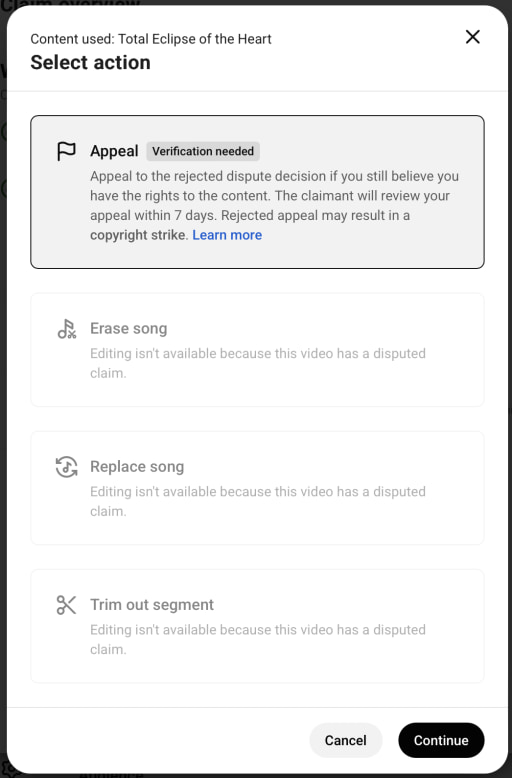
Apparently now Google requires you to give them a lock of your hair before allowing you to file a DMCA fair-use counter-claim to a spurious content-ID rejection.

"Build history as you grow: Once you have enough history, we'll automatically unlock features." Apparently my 14+ year old youtube channel has not yet reached 2 months of active use, according to the vibe-coded math of Google's robots.

Since, as you know, arguing with robots is something of a hobby of mine, I uploaded my traditional driver's license. You can't just "upload" it, of course, they require you to scan a QR code with a phone and take a photo from within the browser, for maximal tracking. So I used one of my burner phones for that. They say their response takes 24 hours, so presumably some dollar-a-day call-center gig worker in India is going to put eyeballs on it, so we'll see how that goes.

In case you're wondering what stupidity I'm up to this time:

Bonnie Tyler died last week, and so the glorious "Total Eclipse of the Heart, Literal Version" by Persephone Maewyn and dascottjr was making the rounds again, dodging takedowns. (This video is a textbook case of fair use, since not only is it a parody song, but the lyrics are direct commentary on the video itself, I mean come on.) Anyway all extant copies of it are shit quality, so I reconstructed it from the official HD video plus the "literal" audio, and re-built the subtitles by hand. Immediate takedown. I appealed. A week later, some intern or chatbot at BMG said "fuck you no". Now I'm trying to counter-claim.

Anyway, maybe someday you'll get to see this higher quality version of the video. It's still pretty funny. You can go request it on the DNA Pizza music video stream I guess.

kottke.org

Jason Kottke's weblog, home of fine hypertext products

What Training My Chaotic Dog Taught Me About Power,...

What Training My Chaotic Dog Taught Me About Power, Control — and Human Beings. “As any parent of a toddler knows, being morally liable for something that is incapable of moral liability is a fraught and stressful business.”

What investment gurus get wrong

To see a country’s financial follies, look to its celebrity advisers.