Escaped flowerhorn cichlids are causing concern for native species and about parasites capable of infecting humans
Escaped ornamental aquarium fish have integrated into a local ecosystem in the Philippines, but scientists say they may be threatening the native biodiversity of the lake.
Flowerhorn cichlids – human-bred hybrid fish prized for their bright-gold colour and prominent head humps – are believed to have escaped from breeding facilities into Lake Sampaloc, which sits in a volcanic crater, during a typhoon.
From mattresses to saucepans, scientists offer tweaks to help detoxify your space
The problem Whenever we burn anything inside our homes, we cause indoor air pollution, whether we’re cooking using gas, frying bacon, lighting a wood burner, an open fire, a cigarette or incense, or ruining the toast. “ We spend 80-90% of our time indoors,” says Prof Francis Pope, chair of atmospheric science at the University of Birmingham. “And there is potential to have quite high concentrations of pollution indoors. This affects your respiratory and cardiovascular systems; certain components are carcinogenic, and there’s a growing body of evidence that air pollution affects cognition. In the long term, you get awful diseases such as dementia and Alzheimer’s. But relatively short exposures to air pollution are linked to things like educational outcome, workplace productivity and general mental wellbeing.”
This year’s dominant leader shouldn’t take the boos personally – even Eddy Merckx didn’t always get red carpet treatment
Enduring the ire of French cycling fans is a rite of passage for a majority of the select group of prolific Tour de France winners, as Tadej Pogacar seems be finding out. The first catcalls came on Tuesday’s stage to Le Lioran in the Cantal, and unfortunately, although we can hope for a little courtesy, there is no reason to assume we won’t see more of the same in the Alps next week, because there are zero grounds for assuming the Slovene and his UAE team’s dominance of the race will slip. In fact, given the mountains that await, Pogi and co will probably up the ante.
Chris Froome has been there and Eddy Merckx went there. The American We Do Not Name spent two Julys hoping no one would bung urine at him, while Bernard Hinault and Jacques Anquetil had their moments too. To understand why the big winners don’t always get red carpet treatment, let’s fly back to the 60s, to the rivalry between Anquetil and Raymond Poulidor. Master Jacques and PouPou, a simple – simplistically pantomimic – duality: cold, clinical Jacques, who based his Tours on the time-trial stages, and warm-hearted PouPou, the noble peasant who tried his utmost but couldn’t quite land the big one, although he became the most popular athlete in France and the hallmark for valiant failure in every walk of French life. Let’s call it the MJPP principle.
Mykhailo Fedorov, celebrated by many for innovative, tech-driven approach, was sidelined for military old guard
Volodomyr Zelenskyy’s abrupt dismissal of Ukraine’s youthful and innovative defence minister, Mykhailo Fedorov, at precisely the moment Kyiv appeared to be gaining advantages in several spheres of its war with Russia has exposed, not for the first time, a troubling flaw in the president’s leadership.
The move, which has startled senior European officials and caused consternation, and demonstrations, in Ukraine, is all the more shocking given Fedorov’s role in pushing a clear strategy to prosecute the war, leveraging Ukraine’s rapidly developing technological advances in drone and missile technology.
Christopher Nolan’s epic adaptation has been met with almost universal acclaim – from mostly male film critics. Might women find the journey less comfortable?
Long ago, almost as long ago as Homer composed The Odyssey, I was a film critic on the Sunday Telegraph. People sometimes ask me how sexist the scene was then, back in the bronze age mid-noughties, when male critics outnumbered female by about eight to one. Well, there wasn’t any sexism. It was actually totally fine and everyone was really nice.
They were nice in Soho, anyway. Farther afield, less so. Particularly certain readers, when it came to certain films, made by certain directors. Quentin Tarantino, obviously. Ken Loach, weirdly. And Christopher Nolan. Question their genius and prepare for epic correction by a legion of self-appointed bouncers.
Nu dwarsligger Orbán weg is, en critici zich niet meer kunnen verschuilen achter de Hongaarse premier, wordt duidelijk hoe de Europese landen écht kijken naar EU-toetreding van Oekraïne. Kritischer, zo blijkt. Nederland gaat daarin voorop.
Voor veel Feyenoorders is het een vast onderdeel van de zomer: de helikopter die nieuwe aanwinsten aflevert in De Kuip tijdens het Feyenoord Festival. Voor de supporters een spektakel, voor de spelers vaak een moment dat ze nooit meer vergeten. Eén van hen is Michael Mols.
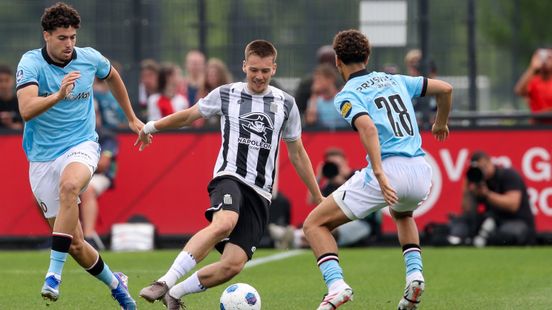
Feyenoord heeft in een oefenwedstrijd tegen het Belgische Charleroi met 3-1 gewonnen. De Rotterdamse goals werden gemaakt door Gaoussou Diarra en de verdedigers Mats Deijl en Tijme Wessels.
Microsoft restored streamer Joshua Khane's 25-year-old Xbox and OneDrive account after it was compromised by a hacker and then suspended, putting years of personal data, baby photos, and thousands of dollars in games at risk. IGN reports: While he was "extremely happy" and thanked Microsoft for its help recovering his account and all the invaluable information therein, he levied some criticisms toward the brand for its initial response, claiming it had told him the suspension was "irreversible" at first. "It's unfortunate that such a big company can bring back your account if you ask them to," he said. "The way it all went, to me, is a little bit shady, because it's not that they can't bring back your account -- they won't bring back your account if you're a nobody."
Khane credited the community for making his story go viral and bringing it to Microsoft's attention, but felt that without their help, he would have been up a creek without a paddle. He also tied the situation to the growing conversation surrounding digital ownership, comparing it to Sony's decision to stop printing physical game discs starting January 2028.
Flickr, stop giving me ads for pro, I know there's an upload limit. And you're not going to get a single bit of my money until I've fully lived the limit out. You can wait.
I've been waiting to get a chance to do this one for a long time. I was just waiting for an opportunity since this week has been a bit slow up till now. But I've done 2 washed shots back to back so I thought I'd bring a vibrant one out. I know this looks crowded but I redid the focus as much as possible so that way it didn't feel overwhelming (God please let this do well I worked hard on it). It was hard to get an "establishing shot" as it seems to be called cause of how densely packed it is. Even after 5 years (as of the shot's taken time), there's still a reservation system to get in here (as well as the toad restaurant), which neither of the American parks did. I genuinely don't know why USJ somehow gets more crowds then either of the American resorts (probably Jaws, one of the best rides Universal's ever made, never close it).
Getting back on topic, Things were a bit overexposed and there were people so I began to get into the mindset of needing to edit everything I take in here (and in this park in general) so I jsut went to a railing and tried to see what I could get away with. Most people and excess parts were obscured and removed, a powerful vignette on the bottom and inserted blurred clouds in the sky (blast and curse this haze). Got rid of more people on railings or in yoshi carts on the bridge. I toned down the light on yellow objects and the thwomps. I put more textures on the trees and the pyramids. Smaller details that would draw eyes to the main piece specifically, mount beanpole. And reduced clarity on the yoshis and lamps on the right. I know it's a lot to take in and that the details are either going to help the photo or be it's downfall. I hope I edited enough to make it cohesive to my regular customers.
From portraits taken around Harlem in the 1940s to assignments for Life magazine to the 1963 March on Washington, Gordon Parks (1912-2006) wielded his camera as a tool for social justice. He captured civil rights activists like Malcom X and Martin Luther King, Jr. in addition to artists and celebrities such as Helen Frankenthaler and Ingrid Bergman. But he may be best known for his candid portraits of families and communities in the segregated South during the era of Jim Crow. All of these and more will be on view in Voices in the Mirror at Jack Shainman Gallery in mid-September, also marking the 20th anniversary of The Gordon Parks Foundation.
Parks was spurred to pursue photography in 1937 after seeing photos taken for the Farm Security Administration (FSA), which held a mission to document American life. “I saw that the camera could be a weapon against poverty, against racism, against all sorts of social wrongs,” he said. “I knew at that point I had to have a camera.” In 1942, he became the first Black photographer hired as part of the initiative, introducing him to Washington, D.C., where he noted that “discrimination and bigotry were worse there than any place I had yet seen.”
Among the images included in Voices in the Mirror are seminal portraits like “American Gothic, Washington, D.C.” (1942), which captures a government worker named Ella Watson with a broom and mop. The work nods to American Regionalist painter Grant Wood’s likewise iconic “American Gothic” painting, created 12 years earlier as an ode to American values. Parks’ image represented a starkly contrasted reality.
After speaking with Watson about her life and experience in D.C., Parks recalled that it was “so disastrous that I felt that I must photograph this woman in a way that would make me feel—or make the public feel—about what Washington, D.C., was in 1942.” He positioned her in front of a flag with a symbolic mop and broom. “I didn’t care about what anybody else felt,” he said. “That’s what I felt about America and Ella Watson’s position inside America.”
The exhibition is accompanied by numerous anecdotes and reflections by some of those who appeared in the photos or had close relationships with those who did, such as Malcolm X’s daughter, Qubilah Shabazz, and Cora Taylor, who was one of the women standing near a pair of segregated water fountains in “Segregation in the South” (1956).
Voices in the Mirror opens on September 18 and continues through November 7 in New York. You might also be interested in the works of other FSA photographers who documented the South during the 1930s and 1940s, such as Russell Lee and Marion Post Wolcott.
“American Gothic, Washington D.C.” (1942), gelatin silver print, 16 x 20 inches“At Segregated Drinking Fountain, Mobile, Alabama” (1956), archival pigment print, 34 x 34 inches“Untitled, Shady Grove, Alabama” (1956), archival pigment print, 48 x 48 inches“Untitled, Harlem, New York” (1963), gelatin silver print, 16 x 20 inches “Untitled, Alabama” (1956), archival pigment print, 42 x 42 inches“Woman and Dog in Window, Harlem, New York” (1943), gelatin silver print, 34 x 34 inches “Mr. and Mrs. Albert Thornton, Mobile, Alabama, 1956 (1956), archival pigment print, 50 x 50 inches“Store Front, Mobile, Alabama” (1956), archival pigment print, 48 x 48 inches

/s3/static.nrc.nl/wp-content/uploads/2026/07/17130119/170726WEE_2035251754_1.jpg)