Yet another 2020's food controversy. Currently the RDA of protein is 0.8 g/KG of body weight. Some say it is too low, especially if active.Others say that most Americans are getting adequate amounts of protein, but specific needs may vary from individual to individual. And those pushing high intake may have ulterior motives. Then there's the plant vs. animal sources debate. One side says we need animal protein for optimal absorption. Then there's another camp that says plant sources of protein are just fine. This guy (who has a PHD in nutrition) says animal sources are ideal, but vegan sources are okay, though there are nuances. Last, we have a doctor who says IGF-1 in animal sources can be potentially harmful to our health.
The FCC plans to vote on repealing local TV ownership limits, including the 39% national audience cap that currently restricts how much of the U.S. market a single broadcast group can reach. Engadget reports: On August 6, commissioners will hold a ballot to repeal Section 303 of the Communications Act, and with it the 39 percent rule. In essence, the rule limits the reach of a local TV network to no more than 39 percent of the U.S.' total audience market. In its place, the FCC would move to a system whereby it would personally approve or reject TV ownership deals on a case-by-case basis.
It's not clear if the FCC even has the authority to reject Section 303 without the explicit consent of the legislature. As Lawrence J. Spiwak wrote in the Yale Journal on Regulation back in January, Section 10 of the Communications Act expressly forbids the FCC from bending the rules around Section 303. "Americans no longer trust the legacy national media to report the news fairly or accurately," wrote FCC Chairman Brendan Carr in an op-ed published on Breitbart. "In fact, only eight percent of Americans have a great deal of trust in mass media. That figure is even lower among Republicans -- sitting at a mere three percent."
"... Many local broadcast TV stations are getting hollowed out as a result and turning into little more than mouthpieces for programming produced in New York and Hollywood," he alleged. "That is not what Congress or the FCC intended."


It's not clear if the FCC even has the authority to reject Section 303 without the explicit consent of the legislature. As Lawrence J. Spiwak wrote in the Yale Journal on Regulation back in January, Section 10 of the Communications Act expressly forbids the FCC from bending the rules around Section 303. "Americans no longer trust the legacy national media to report the news fairly or accurately," wrote FCC Chairman Brendan Carr in an op-ed published on Breitbart. "In fact, only eight percent of Americans have a great deal of trust in mass media. That figure is even lower among Republicans -- sitting at a mere three percent."
"... Many local broadcast TV stations are getting hollowed out as a result and turning into little more than mouthpieces for programming produced in New York and Hollywood," he alleged. "That is not what Congress or the FCC intended."
Read more of this story at Slashdot.
An anonymous reader quotes a report from Ars Technica: Big changes are coming to Android apps, but they're not the changes Google wanted. The settlement between Google and Epic that aimed to put to rest the companies' long-running antitrust battle is being withdrawn, and that means third-party app stores are coming to the Play Store. Google has confirmed that it will begin distributing rival app stores next week, setting the stage for competing platforms to take a bite out of Google's Android revenue stream. [...] Google and Epic were set to return to court on July 16 to argue in favor of the settlement. However, the writing may have been on the wall. In a recent expert analysis provided to the court, MIT economics professor Nancy Rose noted that the settlement was "unlikely to enable Google Play's potential competitors to overcome their long-standing network-effect disadvantage in a timely manner."
With settlement approval looking increasingly unlikely, Epic and Google agreed this week to call the whole thing off. Here's how Google Trust and Reputation Communications Lead Dan Jackson explains the company's decision: "We've agreed with Epic to withdraw our motion to modify the US Court's injunction rather than prolonging this process which creates uncertainty for the ecosystem. This allows us to focus on executing our recently announced global business model evolution to deliver greater app store choice, lower prices, and more opportunities for developers and users. We remain committed to maintaining Android's industry-leading security and fostering a competitive ecosystem where every app store and developer has the freedom to compete. In parallel, we continue to comply with the US Court's injunction."
In a brief filing (PDF), Google's legal team informs the court that Google is prepared to begin distributing third-party app stores in Google Play on July 22. Under the terms of Judge Donato's original injunction, these stores will have access to the full catalog of Google Play apps by default. Developers will have the option to opt out of distribution in these stores, and Google has a support page explaining how to do so. Google also has documentation on how app stores can get access to the Google Play catalog. It won't be mirroring those apps in any shady storefront that asks. The court has allowed Google to charge reasonable fees to cover its security and compliance review of third-party stores, which will be $5,000 per year.
Google will also require approved stores to block malware, respect intellectual property, and include mechanisms to update and uninstall apps. App stores can be removed from the program if more than 1 percent of attempted app installs appear to be malware or unwanted software. It's unclear if there will be separate, possibly more stringent requirements for storefront distribution in the Play Store. However, Google is prohibited from unreasonably blocking third-party store clients uploaded to Google Play. The changes Google has announced under the Epic agreement will proceed for now. That means Registered App Stores will happen globally, but they will probably only appear in the Play Store for US users. Google hasn't specified if there will be any differences in the features available to the stores downloaded from Play versus registered stores.
With settlement approval looking increasingly unlikely, Epic and Google agreed this week to call the whole thing off. Here's how Google Trust and Reputation Communications Lead Dan Jackson explains the company's decision: "We've agreed with Epic to withdraw our motion to modify the US Court's injunction rather than prolonging this process which creates uncertainty for the ecosystem. This allows us to focus on executing our recently announced global business model evolution to deliver greater app store choice, lower prices, and more opportunities for developers and users. We remain committed to maintaining Android's industry-leading security and fostering a competitive ecosystem where every app store and developer has the freedom to compete. In parallel, we continue to comply with the US Court's injunction."
In a brief filing (PDF), Google's legal team informs the court that Google is prepared to begin distributing third-party app stores in Google Play on July 22. Under the terms of Judge Donato's original injunction, these stores will have access to the full catalog of Google Play apps by default. Developers will have the option to opt out of distribution in these stores, and Google has a support page explaining how to do so. Google also has documentation on how app stores can get access to the Google Play catalog. It won't be mirroring those apps in any shady storefront that asks. The court has allowed Google to charge reasonable fees to cover its security and compliance review of third-party stores, which will be $5,000 per year.
Google will also require approved stores to block malware, respect intellectual property, and include mechanisms to update and uninstall apps. App stores can be removed from the program if more than 1 percent of attempted app installs appear to be malware or unwanted software. It's unclear if there will be separate, possibly more stringent requirements for storefront distribution in the Play Store. However, Google is prohibited from unreasonably blocking third-party store clients uploaded to Google Play. The changes Google has announced under the Epic agreement will proceed for now. That means Registered App Stores will happen globally, but they will probably only appear in the Play Store for US users. Google hasn't specified if there will be any differences in the features available to the stores downloaded from Play versus registered stores.
Read more of this story at Slashdot.
FreeBSD 16 has removed the last GPL-licensed code from its base system, retiring the old GNU 'dialog' implementation after the installer moved to 'bsddialog' and the final dependency was disabled. Phoronix reports: This ticket to retire dialog was opened back in February while is now merged to the FreeBSD source tree for what will become FreeBSD 16.0. With dialog removed, the latest FreeBSD code now retires the GNU sub-tree of the FreeBSD base system now that no more GNU code remains. FreeBSD 16.0 is working its way toward release that is expected to happen in December 2027.
Read more of this story at Slashdot.

How AI will change the way scientific computing is done remains an open question. One relies on ultra-precise double-precision mathematics, while the other is perfectly happy working with 4 bits. On the surface, the two are diametrically opposed, two extremes of a spectrum we call high-performance computing (HPC) — and yes, whether you like it or not, AI is HPC. However, the latest AI offering from Cadence Design Systems, one of the biggest names in industrial HPC, offers a glimpse of how high- and low-precision compute could not just coexist, but work together to solve bigger and more complex problems faster and with fewer resources. Announced on Wednesday, Cadence’s AuraStack is an agentic AI system built to assist electrical engineers to design and test printed circuit boards (PCBs), or conduct advanced packaging design and testing — two tasks that have historically relied on highly precise simulations. AI is definitely a big piece of what Cadence has built; however the company isn’t replacing these tools with hallucination-prone AI models. Instead, AuraStack is a bit like Anthropic’s Claude Code or OpenAI’s Codex, but rather than writing, compiling, debugging, and running C or Rust in a sandbox, Cadence’s latest agent is designed to orchestrate its existing test and simulation suites. “AI is amplifying the value of our engineering products and technologies,” Michael Jackson, CVP of Cadence’s system design and analysis division, told The Register. In other words, the AI model — we’re told AuraStack integrates with a wide range of open and proprietary models — functions as a natural language interface capable of planning and orchestrating complex multi-step circuit design and testing workflows that run at higher precision using CPUs, GPUs, and other accelerators. “For example, if I'm going to check and fix the IR reliability, I need to identify the power management components. I need to create a simulation-ready power tree, and then I need to do the simulation, and then I need to provide feedback to the designer,” Jackson said. Cadence's existing product stack already automates many of these processes. The problem, Jackson explains, is that a PCB or package design often requires completing thousands of tasks throughout its development. “Sixty-five percent of an engineer's day is spent navigating and dealing with a lot of these tasks,” he said. By orchestrating that scutwork, Jackson claims that AuraStack can deliver a 15x boost to productivity by letting the designer focus on design and engineering decisions rather than the individual tasks. These gains are enough that several large players in the electronics space, including Nvidia, have already signed up for the service. Cadence isn’t just melding AI with HPC for chip design or advanced packaging. The engineering software provider has built similar agents for digital and analog chip design. The idea of using low precision compute to run AI models that orchestrate more precise single- and double-precision physics simulations isn’t new. Nvidia is one of the biggest champions of this approach, which makes sense seeing as its GPUs aren’t limited to training and running AI models, even if that’s what most folks are buying them for these days. Earlier this year, we explored how researchers at the Department of Energy’s Sandia National Laboratories used AI agents to develop and test new hypotheses. They described the system as a self-driving lab. However, those tests, while similar in concept to what Cadence is doing with AuraStack, didn’t use LLMs and instead used more mature architectures like variational auto-encoders. But given the success of code assistants, it’s not hard to imagine agent harnesses similar to AuraStack being used to automate lab equipment, perform simulations, and then iterate on the results, enabling scientists to continue their research even after they’ve nodded off for the night. ®

Dave Brown, a 19-year veteran of AWS and member of its S-team leadership cabal, is leaving Amazon for parts undisclosed. It's hard to overstate Dave's impact on AWS; the few times I've met him, it was very clear that there was nothing I could trot out in the realm of "arcane EC2 trivia" that he didn't go orders of magnitude deeper on with zero forewarning. This is a titanic loss for AWS, because that's roughly how deep Dave routinely dove. He'll be handing the reins over to fellow S-team member Dave Treadwell, currently the head of Amazon Retail's "eCommerce Foundation" (itself an upscale term for "bargain basement"). Brown probably isn't going to be a direct competitor (though he's definitionally going to some Amazon competitor short of his next move being "philanthropy"), unless the two-week notice period is simply a bunch of Amazonian goons beating the tar out of him in a dark room around the clock until August. But the interesting part to me is that suddenly Dave Treadwell has an enviable job. Think about it for a second: Amazon retail was, for a time, the largest AWS customer — and certainly one of the most complicated. If I think I have beef about AWS-isms, there's no doubt that "Tread," as he's apparently called, has mountains to my molehill of complaints. So if I can slip into his role for a second, here would be my to-do list if I were coming from an Amazon Retail background and suddenly had EC2 bequeathed to me to run: GPU capacity acquisition: Special people get special allocation rules, balanced between Capacity Blocks, war-clicking past InsufficientInstanceCapacity screens, and having to know a guy. Amazon has an entire internal project to solve this for its own teams. If I'm Tread, take a page from retail and smash Spot Fleet dynamics into a proper capacity marketplace. "Only 2 p6-b300.48xlarge left in stock. Ships from and sold by GPUZ4LOLZ (91% positive feedback)." Savings plans / Reserved Instances archaeology: These sometimes-but-often-not overlapping discount vehicles were clearly designed by folks who never had to explain them to a CFO with anger management issues. Treadwell has a golden opportunity here to roll out dynamic raw pricing: on-demand rates that themselves fluctuate hourly like a third-party listing on discontinued and incompatible printer ink, replacing traditional commitment vehicles with a "Subscribe & Save 5%" toggle on vCPUs. Instance type proliferation: As of this writing, there are 1,354 EC2 instance types available in us-east-1 alone, and the console picker assumes that you already know the correct answer. Riiiight. There's a solution here! "Customers who launched m7i.large also launched ..." combined with sponsored placement by EC2 sub-departments means the top result is now suddenly the instance family that AWS overbought. Is this the best instance for the customer? Who gives a rat's ass; it's what's best for Amazon, a north star that Amazon Retail has been chasing for years. SageMaker is someone's empire-building project: There are over 35 SageMaker products, or features, or whatever the distinction is supposed to be at AWS. Tread should leave this alone, and introduce the amazing source of truth that is Customer Reviews. "1 star. Not as described. Arrived as Jupyter notebook; what the hell do I do with it?" They can repurpose their fake review detection to take down fraudulent reviews from other SageMaker sub-teams. Quota request supplication: You know the drill; beg, plead, and wait for the privilege to give AWS more money. The fix here is almost too easy; y'know who doesn't have to wait for quota increases? That's right: Amazon Prime members. That's the easy punch list if it were me. But I'm me, and Tread is not. I'm sure he's got planned more treats with far greater nuance and customer hostility; we'll know for sure that he's settled in when the EC2 section of our AWS bills starts including ads - and when Josh Pigford's excellent Knockoff extension starts working in the EC2 console. ®
Another day, another programming language feels the heat from AI. A prominent Haskell-based software platform is shifting new development to Python, with its founder arguing that Haskell's tooling and ecosystem have been slow to adapt to AI-assisted development. “Haskell is in real danger,” warned Scarf founder Avi Press, in a post entitled “After 7 years in production, Scarf has reluctantly moved away from Haskell.” “AI is here to stay. The people and ecosystems that use it well are going to move much faster than the people and ecosystems that do not.” Press’ post set off a firestorm of controversy within the Haskell community, which is small but vocal, and likely felt the sting of one of its most prominent users defecting to the comparatively toy-like Python to better serve the needs of agents. “Trying to change the language to work better for some metric of ‘better’ with AI is foolish for many many reasons,” wrote one user on Reddit. “It's foolish to try to change to LLMs in a kneejerk fashion because no one knows what's on the horizon.” Putting the fun into functional programming Haskell, a functional programming language that debuted in 1990, may not appeal to fast-moving startups. It ranks No. 46 in the latest TIOBE index of programming language popularity, with a rating of less than half a percent. Favoring recursion and immutable data over conventional imperative loops and mutable state, the language's mathematical underpinnings can intimidate even experienced developers. Nevertheless, it has attracted a highly dedicated following, particularly within academia. Press has been one of Haskell’s most vocal proponents, and has even served on the language’s foundation board. “Learning it made me a much better programmer,” he admitted. Press used Haskell to build Scarf, which provides usage analytics for open source software. In a 2023 talk entitled “Why Haskell is a Terrible Choice for Startups (and why we picked it anyway),” Press admitted it was difficult to find Haskell programmers, yet the language’s rigorous type safety comes with other benefits. Refactoring is a cinch, which is valuable as business priorities change. Also, documents can be auto-generated from data types. Plus, once you get the hang of it, programming in Haskell is downright fun, Press argued. Because AI But going forward, Scarf’s new features will be added in Python instead. “At Scarf, we started doing all new API work in Python,” he wrote. “New API routes go into Python, existing Haskell code keeps running, and over time the new server becomes the main path and our Haskell footprint will shrink.” Press said Python plays better with AI, which is the direction he sees development heading. A huge part of the problem is Haskell's sluggish compilation times. “If an LLM can produce a working implementation in a few minutes, but your compile step takes dramatically longer, then your language and build system have become a bottleneck in the development loop,” he wrote. Long compilation times, once a minor annoyance, become prohibitive when running multiple coding agents at once. Caching can help, but incurs its own overhead to manage. “I want to spin up multiple worktrees, fork off different lines of work, let agents try things, review the results, and keep the useful ones. In that world, cold start time matters a lot,” Press wrote. Rigor for runtime Using Python with AI practices immediately improved the Scarf production team’s workflows, allowing them to fix bugs with minimal oversight, Press noted. In some cases, AI can fix a bug “before I get off the call with a customer,” he noted. “Resisting this kind of productivity is not an option anymore,” Press wrote. Yet, Press doesn’t feel that the Haskell ecosystem is addressing the shift to agentic-led development. Many of the language’s maintainers focus more on restricting the use of AI, or restricting its use on Haskell entirely, rather than looking for ways Haskell can better serve AI, or vice versa, he argued. Agents have different bottlenecks than human code jockeys, he noted. “They are cheap at generating code and expensive when blocked. They benefit from fast feedback, clear examples, low setup friction, and errors that help them repair the code quickly,” he wrote. Press listed ways Haskell could be made easier for agents to use: Better documentation with actual copy-and-paste industry-targeted examples (rather than “beautiful types”), more informative error messages, and – most importantly – faster build times. Optimize and chill Press’ missive set off a firestorm of discussion across Hacker News, X, Reddit and Haskell’s own message boards. Many questioned the move from Haskell to Python, given Python’s own arguably inferior typing. They also questioned whether it would have been a simpler move to optimize the Haskell compiler for faster builds than switching languages altogether. Other Haskell fans voiced more philosophical concerns. It was as if they were taking the language’s tongue-in-cheek motto, “Avoid success at all costs," seriously. Longtime UK-based Haskell programmer Chris Done questioned the motivation of making Haskell more AI-friendly, given that production use is only one way that people use Haskell. “I don’t subscribe to this growth mindset anymore,” he wrote. “I’ve come to accept Haskell on its own terms. If it dies out and becomes irrelevant like Elm or PureScript, I’ll be fine and still enjoy it.” “It leaves a bitter taste in my mouth,” wrote another contributor on the Haskell forum about Press’ post. “I don’t feel like you take our concerns about the harm of AI seriously at all.” Another accused Press of having a financial stake in AI companies (to which Press replied, “Nope”). Haskell Foundation Executive Director José Manuel Calderón Trilla urged folks to chill in an X message. Haskell is a community that prides itself on doing things “the right way,” he noted, but that shouldn’t “let that blind you into thinking that your way is the only ‘right’ way, and then attacking someone for violating your idea of what the party line is.” ®



BertvB posted a photo:

A dramatic sunset over the North Sea coast, captured from a high vantage point overlooking a row of beach cabins.


Nicholas Rougeux, whose work I have featured here before, has published a complete digital edition of William Jardine’s 40-volume book series on natural history published in the early-to-mid 19th-century. As part of the project, Rougeux restored each of the more than 1300 illustrations in the library, and the results are fantastic.






Rougeux wrote a post on the history of The Naturalist’s Library and how the project came about.
The Library is credited with having a significant democratizing effect on the study of natural history because Jardine and Lizars prioritized affordability and portability. Each book was only 4 by 6 inches and priced at six shillings, making them a much more accessible alternative to the “unwieldy folios” from other naturalists. This led to a tremendous demand for each one, resulting in tens of thousands of copies being printed overall. Just two years into publication, a notice appears at the beginning of one volume stating, “we have sold upwards of 60,000 volumes, in which there have been nearly 2,400,000 coloured plates given as Illustration.” Exact sales numbers are difficult to come by but history has shown that the series was very popular with estimates of 10,000 copies sold for each volume, totaling at least 400,000.
In order to help with his research, he borrowed a biography of Jardine from the library and built a custom rig out of K’nex construction toy pieces to scan the whole thing.

About a month later, I discovered a 2001 biography about Jardine, Sir William Jardine: A Life in Natural History, which only existed as a physical copy. I emailed the publisher to ask for a digital copy but had no luck. So I did what any self-respecting researcher would do and borrowed it on an inter-library loan and made my own digital copy by building a very janky custom rig out of old K’nex parts to take pictures of each page with my phone that I later combined into a searchable PDF. The OCR on it could be improved but having it available digitally allowed me to consult it in my research.
You can check out the shop for posters of the illustrations as well as a complete, bound, 800-page volume of all 1300+ illustrations.

Tags: art · books · design · illustration · Nicholas Rougeux · science · The Naturalist’s Library
A week ago, I had launched this site using QuatroSlab for page titles and Google’s Slabo for body copy. For those that have been around awhile and are familiar with SMACSS, you might recognize QuatroSlab from that site. I like the font and started off with it to see how I’d feel about it on the this new design. Then I chose Slabo as a font that I felt paired well with it.
For the most part, I was fine with it but after finally getting a blog post written and posted under the new design, I was feeling less than thrilled with my choices.
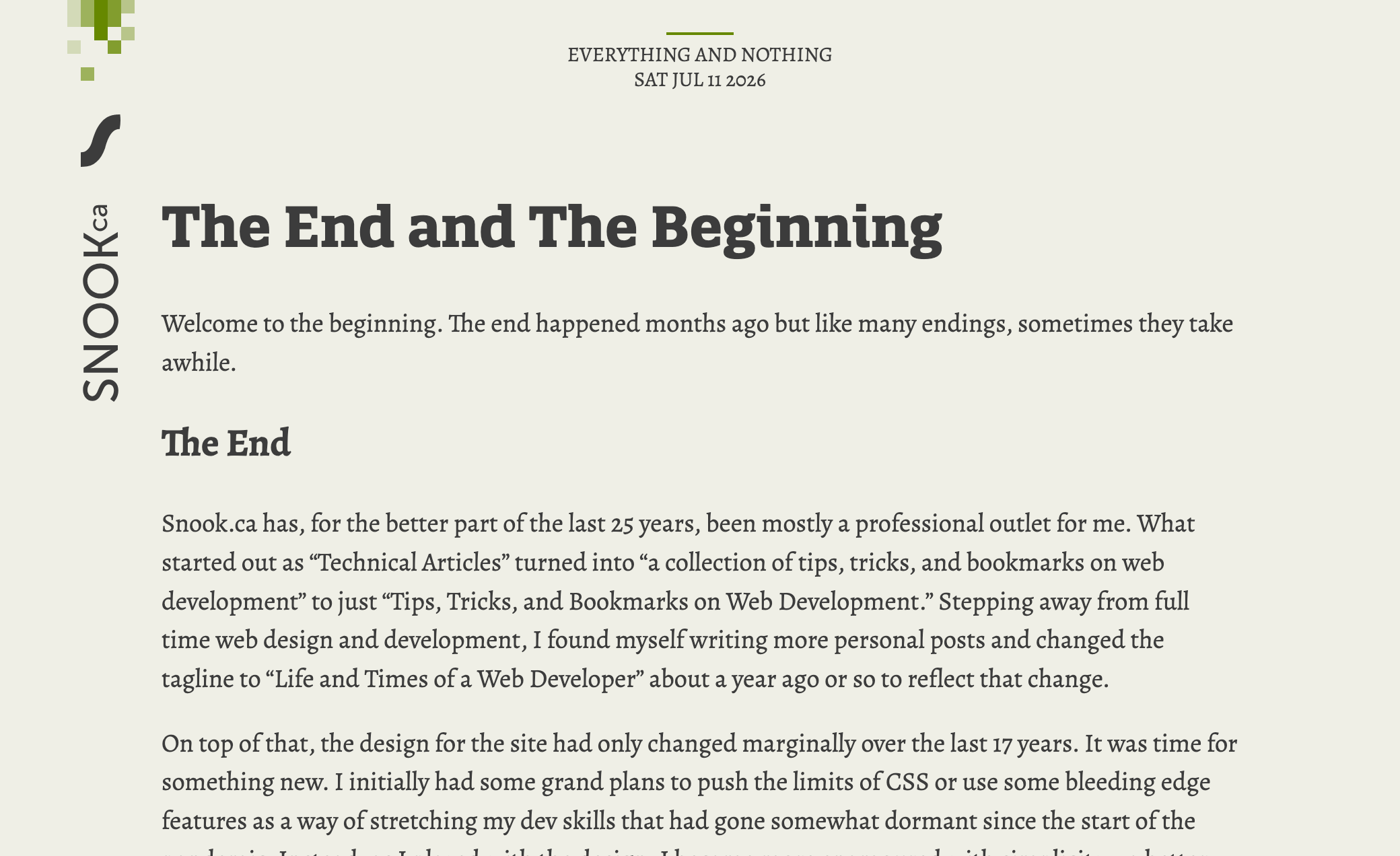
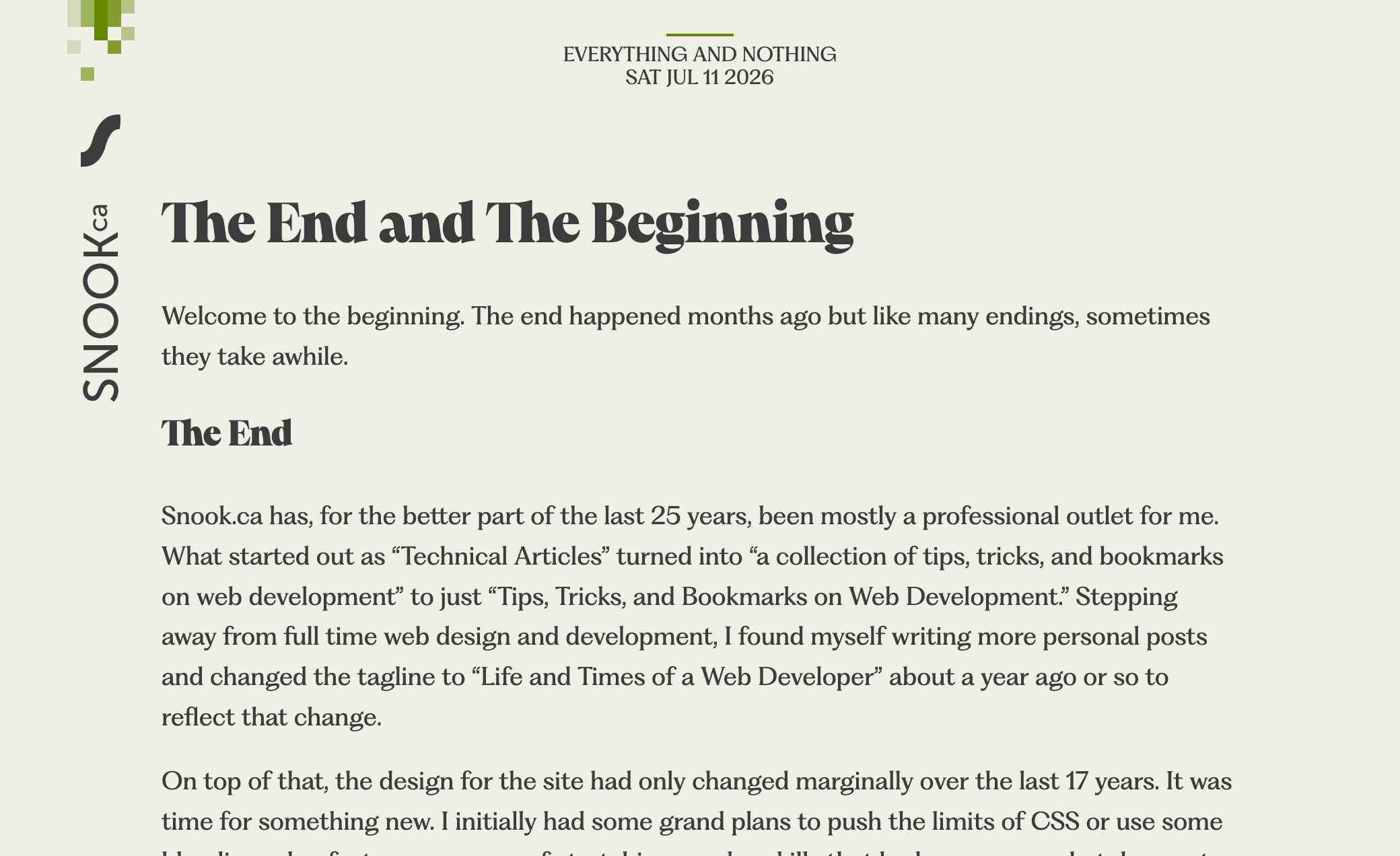
Over yesterday and today, I decided to do some research on fonts and came across Pangram Pangram Foundry. They have some delectable fonts that make me want to do some interesting designs with them. This led me to Fragment. I looked through all the variants and Fragment Text felt just right for the body copy. It felt softer and rounder and more open and friendly than Slabo.
My only complaint is that I want some of the discretionary ligatures in the list of standard ligatures like the Th and ft. The rest of them are too much flourish for body copy. I enabled the ligatures for headings, at least, where some flourish is warranted.
For page headings, though, I wanted something bolder. This is where Pangram Pangram’s Pangaia comes in. I like the slightly retro-modern funky feel that this font brings to the table.
The CSS
From a technical perspective, this is the first time I’ve taken advantage of OpenType feature capabilities and I found it confusing as I couldn’t find a good explanation of what liga or dlig or ss03 mean or how to know whether a font even supports these.
I’ve learned that you can turn these on or off via CSS’s font-feature-settings property.
font-feature-settings: "ss02", "ss03", "ss04", "dlig", "zero", "onum";
Declaring the value turns them on. You can alternatively, specifically declare them on or off using the words on or off or the numbers 1 or 0. The following would enable features ss02, ss03, zero, and onum; it would disable ss04 and dlig.
font-feature-settings: "ss02" on, "ss03" 1, "ss04" off, "dlig" 0, "zero", "onum";
The question then became about how to figure out which of these features exist in a particular font. For this, I used FontDrop!. It will show you what features are available and what those features look like for that font. FontDrop! is all client-side, too, which is nice. I didn’t want to be uploading files that aren’t mine to someone’s server.
Up Next
I suspect I will end up tweaking which of these features are on or off as I add more content to the site and decide what works well for a given scenario.

Verse beelden, veel Lamers. ja het heet ook niet voor niets archief. En oude wijn in nieuwe zakken: Jongeleen doet een geenstijltje. Waanzinnig zakkende Simon Schrikker. Sorry! zegt Lamers. Ralph van Meijgaard – IM Lamers [Meer...]


Het Argentijnse elftal heeft woensdagavond de halve finale van het WK voetbal gewonnen van Engeland. Dat betekent dat de Argentijnen zondag de WK-finale spelen tegen Spanje, dat…
/s3/static.nrc.nl/wp-content/uploads/2026/07/15225741/150726VER_2035261838_EngelandArgentinie08.jpg)