The Register

Biting the hand that feeds IT — Enterprise Technology News and Analysis

Zuck's AI ambitions put Meta on course to become America's next big cloud provider

Meta seems to be having a bit of an identity crisis. On Monday, the social networking singularity said it would spend $50 billion to expand its Hyperion datacenter project in Richland Parish, Louisiana, from 2.2 to 5 gigawatts. The news comes less than a week after a report broke claiming that Meta was actively exploring options to offload its excess compute capacity to other AI labs. So, which is it, Zuck? Did you invest too much or too little in AI? The easy answer is that Meta overcommitted. Inspired by the early success of Llama, it made a huge bet on the AI gold rush. Offloading spare compute to the highest bidder is just a hedge in case its Superintelligence team turns out to be another pipe dream, like the Reality Labs Metaverse that utterly failed to spark enthusiasm for immersive environments accessible through Meta's Quest cybergoggles. The more pragmatic read is that Zuckerberg has woken up to the fact he’ll never be as cool as OpenAI boss Altman or Anthropic's Amodei, and renting out spare compute is just the natural progression for any sufficiently large hyperscaler. Dawn of the Meta cloud? Meta's business model is closer to Google's than those operated by OpenAI and Anthropic. Both Meta and Google offer various services which generate revenues by connecting users with advertisers. For Google it’s a search and entertainment empire. For Meta it's enabling an endless feed of content generated by friends, family, influencers, and yes, bots. Both are immensely profitable, earning $132.2 billion and $60.5 billion in profits last year, respectively. That's profit, not revenue. But both are now plowing over $100 billion a year into AI infrastructure to power large language and image and video generation models. As we learned from Meta’s recent earnings calls, the most commercially potent of those models get the right ads in front of the right eyeballs. The open secret is Meta was already one of the most successful AI companies long before ChatGPT debuted. Except, it's not large language models (LLMs) that make Meta money, at least not in the conventional sense. Instead, Meta’s most profitable AI models are the recommender systems that mine profiles for context and use it to infer your needs. Meta's devs evolved those models considerably over the past few years, and their architectures now look a lot more like an LLM than the now-pedestrian neural networks on which Zuckerberg built his empire. Google is in a similar situation. It’s investing heavily in AI to feed its fast-growing and profitable cloud business, even as advertising still pays most of the bills. But unlike Google, Meta hasn’t yet made the leap from hyperscaler to cloud provider. Amazon, Google, Microsoft, even Oracle got there eventually, and it seems AI may be the catalyst that turns Meta into a cloud, too. Recent reports suggest that Zuckerberg is warming to the idea. “I think that’s certainly a thing that we could do and that I think would make sense to consider,” he said in an interview with Bloomberg last week. “As a backstop, even if for whatever reason we don’t need all the compute ourselves or for any number of reasons, there’s a very large amount of demand that I think you could sell it long-term like AWS or Azure or Google Compute.” But while the demand may be there, Zuckerberg emphasized the compute capacity is not readily available. But as Ben Thompson of Stratechery put it, cashing in on this compute may be more than a backup plan. In a post channeling an imaginary Zuckerberg, Thompson suggested that becoming a neocloud would force Meta to stop chasing pipe dreams and pet projects. His logic is that if Meta can't make money with infrastructure it buys for AI ventures, the social networking giant can lease the orphaned hardware to the highest bidder. The takeaway for investors — should Meta follow its fellow hyperscalers-turned-cloud-providers down this road — is that the profitability of its hardware investments would no longer be tied to its ability to commercialize them. Seizing the means of production If history tells us anything, scale matters. Building a cloud like Amazon Web Services (AWS) is next to impossible unless you've already figured out how to profit from those same resources. Meta's scale puts it in a position to acquire compute in volumes impossible for smaller players. Its ability to capitalize on infrastructure demand relies entirely on having something others want but can’t get anywhere else. For what it’s worth, Zuckerberg wouldn’t be the first to come to this conclusion. Earlier this year Musk-owned xAI surprised many when it announced plans to rent out its Colossus supercluster in Memphis to rival model dev Anthropic. The calculus here is the same. Making a profit off LLMs, like Grok, isn't easy — just ask OpenAI — but selling the means of AI production to those that haven’t yet figured that out is enormously lucrative. The logic appears to have gotten Zuck's attention. “The SpaceX model I think is quite interesting in terms of just making these short-term deals that are at a big premium,” Zuckerberg told Bloomberg. “So we get offers for all kinds of stuff like this and we’ll evaluate them and see what makes sense.” Reports suggest Meta is seriously considering two strategies for commoditizing its compute assets. The first would be a usage-based compute platform similar to Amazon Web Services' Bedrock. The service would allow customers to run models and serve them through APIs — interfaces that abstract operational complexity. To be clear, Meta already offers API access to its homegrown models, at least the ones it didn’t pull after realizing the way they’d been implemented could be abused. So, from what we gather the difference would be allowing customers to run third party models as well. The second scheme reportedly being explored would involve selling raw compute resources available to end customers — similar to CoreWeave or Lambda. All the right ingredients Meta’s silicon strategy may help as well. One thing all the major cloud providers have in common is a growing catalogue of custom cloud silicon. Once they've identified a core use case, Amazon, Google, and Microsoft all rolled their own silicon to maximize their margins. AWS Trainium, Microsoft Maia, and Google TPUs are all examples of AI accelerators originally built for internal workloads but later made available to the broader public. Meta has been building its own AI chips for years. The first few Meta Training and Inference Accelerators (MTIA) were designed to speed up its recommender models. But new designs, developed in collaboration with Broadcom, are far better suited to running LLMs like Llama and Muse Spark, and whatever else its customers are willing to pay for access to. More importantly, this mix of compute means that Meta can take advantage of the fact GPUs are extremely flexible to bring new products to market quickly. Then once they’ve proven performers, Meta could transition those workloads to its custom chips and offload spare GPU compute to its cloud customers. Meta has all the ingredients, compute, scale, and capital necessary to become a major cloud provider. ®


Zig creator calls Bun’s Claude Rust rewrite ‘unreviewed slop’

An AI rewrite of a popular Anthropic-owned JavaScript runtime and toolchain has sparked praise for the speed of its execution, but also criticism of the coding practices behind the project itself. Last week, Bun creator Jarred Sumner announced that he ported Bun from the Zig programming language to Rust in only 11 days, using a fleet of Claude agents running in parallel. The work cost an estimated $165,000 at API pricing, suggesting that software revisions previously considered too large to undertake could actually be feasible now with AI. Sumner said the port was necessary given the growing number of bugs Bun users were finding, including one implicated in the recent Claude Code source leak. But the creator of Zig, Andrew Kelley, didn’t want his project to be seen as the culprit behind Bun’s woes, which he blames on Sumner’s bad programming practices. For Kelley, the move to Rust was not about the feature differences between the two languages, or even the use of AI, but rather “the diverging value systems of the two projects,” he wrote. Bun in the oven Bun is a JavaScript suite consisting of a runtime, package manager, bundler and test runner. Some developers like it because it is a fast one-stop shop that plays well with Node.js. To make Bun speedy, Sumner used Apple's low-memory fast-start WebKit JavaScriptCore (JSC) engine, rather than Google’s stock V8 engine. He used the up-and-coming Zig because he appreciated its performance and low-level control. Anthropic acquired Bun in December 2025. The company built its core state machine on Bun. By then, Sumner had also grown to appreciate AI’s coding abilities, and was using it heavily in the upkeep of Bun. By the time of acquisition, a Claude Bot called RoboBun had been doing a lot of the heavy lifting in the Bun repo. It supplied the most merged PRs of any contributor, fixing bugs and remediating test failures. But as Bun’s user base grew, more cracks started appearing in the code. Users found issues across the software. Anthropic’s 512,000-line code leak in March? That was Bun’s fault, thanks to a bug in the bundler that generated source maps during builds even when told not to, NodeSource reported. All these bugs weren’t Zig’s fault, Sumner explained in a blog post last week detailing the migration. Bun’s architecture mixed garbage collection and application-driven memory management. Sumner admitted that Zig wasn’t designed for that task. Rust was just better at automating memory management. The Rustification of Bun Rewriting 500,000 lines of Zig into another language would be a gargantuan undertaking if done by hand. “A rewrite in another language would take a small team of engineers a full year. It would mean freezing bugfixes, security fixes or feature development for that time,” Sumner wrote. Instead, Sumner went with Claude. He spun up about 50 dynamic Claude Code workflows, reaching a peak of about 1,300 lines of code per minute and generating over a million lines of Rust code. The job took 11 days and cost about $165,000 at API pricing. Claude Fable did most of the heavy lifting. The Rust-based Bun was then subjected to Bun's exhaustive test suite of more than one million assertions. According to Sumner, it passed 100 percent of those tests across all supported platforms without skipping or deleting any. “There’s absolutely no way an engineer with that salary would’ve been able to achieve the milestones Claude did in 11 days,” an impressed HashiCorp co-founder Mitchell Hashimoto noted on X. Zig zags But does Bun’s speed of execution betray the core tenets of good software development? One person not impressed has been Zig’s Kelley, who shared his misgivings in an impassioned post entitled “My Thoughts on the Bun Rust Rewrite." Even before the Anthropic acquisition, “we became increasingly horrified at the programming practices we saw in Bun's codebase,” Kelley wrote. Bun was one of the largest and highest profile projects using Zig and, up until the Anthropic acquisition, a regular financial contributor to The Zig Software Foundation. In Kelley’s view, the project aggressively released new features, resulting in piled-up bugs, bad error-handling code, and technical debt. Sumner “was already writing slop well before he had access to LLMs,” Kelley quipped. He speculated that Sumner may have been under pressure to meet business objectives rather than technical ones, a pressure that increased with Anthropic’s acquisition. In fact, Bun’s codebase had grown so suspect in Kelley’s estimation that Bun parting with Zig was good news. As he put it, no longer would “the publicly presumed poster child for Zig programming language actually [be] the prime example of How Not To Write Zig Code,” he wrote. The Bun team also tried to upstream some of its AI-assisted work to Zig, to no avail. Leading up to the Bun rewrite, the team maintained a fork of Zig that it said improved debug compilation speed fourfold, as eagle-eyed Reg reporter Tim Anderson revealed in May. But the Zig project would not accept Bun’s changes, citing a policy of not accepting AI-based contributions. Zig had been getting an influx of LLM-generated submissions, most of dubious quality. This lack of engineering oversight around AI-generated code would lead to countless problems down the road, Kelley reasoned. Kelley pointed out that if Bun’s tests missed these bugs in Zig, how would they be caught in unsupervised Rust code? “The argument for shipping all the million lines of unreviewed code is that the test suite is good enough to catch everything,” he wrote. “It's not sufficient to catch bugs in Zig code but it is sufficient to catch bugs in [a] million lines of unreviewed slop?” ®

Snow Day

Greg Adams Photography posted a photo:

Snow Day

The footprints fascinated me

Paradise Island

Thomas Hawk posted a photo:

Paradise Island

Android Froyo, Google HQ, Mountain View, CA

Thomas Hawk posted a photo:

Android Froyo, Google HQ, Mountain View, CA

You Used to Think That It Was So Easy

Thomas Hawk posted a photo:

You Used to Think That It Was So Easy

Loans

Thomas Hawk posted a photo:

Loans

Found Photograph

Thomas Hawk posted a photo:

Found Photograph

handwritten on back of photograph, "Kay Budy, 1946"

Found Photograph -- A Rochester Photographer Collection

Thomas Hawk posted a photo:

Found Photograph --  A Rochester Photographer Collection

Found Photograph

Thomas Hawk posted a photo:

Found Photograph

A Sea of Azaleas: Spring in the Japanese Garden

BertvB posted a photo:

A Sea of Azaleas: Spring in the Japanese Garden

An endless, vibrant blanket of blooming pink Japanese Azaleas (Rhododendron) filling the frame inside the historic Japanese Garden at Landgoed Clingendael in The Hague.

San Francisco, 2016

Thomas Hawk posted a photo:

San Francisco, 2016

Rotterdam - FediMeteo (@rotterdam@nl.fedimeteo.com)

Weer voor de stad Rotterdam Deze bot wordt beheerd door het FediMeteo-project. Voor informatie en contact kunt u de pagina https://fedimeteo.com raadplegen.

Weer voor Rotterdam ☁️ - 14-07-2026 01:15 CEST...

Weer voor Rotterdam ☁️ - 14-07-2026 01:15 CEST

In één oogopslag:
• 20.0°C · Gedeeltelijk bewolkt ☁️ | Min 18.1°C / Max 28.3°C

Verwachting voor vandaag:
• Min 18.1°C, Max 28.3°C (Bewolkt) ☁️, 🧭 1019.0 hPa ➡️ 0.0 hPa/24h, Windsnelheid: 19.8 km/u (5.5 m/s), richting: ↙ 38°

Uurlijkse voorspelling voor de komende 12 uur:

02:00: 19.9°C (Bewolkt) ☁️, 🧭 1018.7 hPa ➡️ 0.0 hPa/1h, Windsnelheid: 13.3 km/u (3.7 m/s), richting: ↓ 19°
03:00: 19.6°C (Bewolkt) ☁️, 🧭 1018.4 hPa ➡️ 0.0 hPa/1h, Windsnelheid: 14.4 km/u (4.0 m/s), richting: ↙ 23°
04:00: 19.6°C (Licht bewolkt) 🌕, 🧭 1018.6 hPa ➡️ 0.0 hPa/1h, Windsnelheid: 11.5 km/u (3.2 m/s), richting: ↙ 30°
05:00: 19.6°C (Helder) 🌕, 🧭 1018.7 hPa ➡️ 0.0 hPa/1h, Windsnelheid: 12.2 km/u (3.4 m/s), richting: ↙ 38°
06:00: 19.4°C (Zonnig) ☀️, 🧭 1018.6 hPa ➡️ 0.0 hPa/1h, Windsnelheid: 12.2 km/u (3.4 m/s), richting: ↙ 40°
07:00: 19.6°C (Zonnig) ☀️, 🧭 1018.7 hPa ➡️ 0.0 hPa/1h, Windsnelheid: 15.1 km/u (4.2 m/s), richting: ↙ 42°
08:00: 20.7°C (Zonnig) ☀️, 🧭 1018.9 hPa ➡️ 0.0 hPa/1h, Windsnelheid: 17.6 km/u (4.9 m/s), richting: ↙ 48°
09:00: 22.1°C (Zonnig) ☀️, 🧭 1019.1 hPa ➡️ 0.0 hPa/1h, Windsnelheid: 15.8 km/u (4.4 m/s), richting: ↙ 45°
10:00: 24.0°C (Zonnig) ☀️, 🧭 1019.3 hPa ➡️ 0.0 hPa/1h, Windsnelheid: 15.5 km/u (4.3 m/s), richting: ↙ 54°
11:00: 25.4°C (Zonnig) ☀️, 🧭 1019.5 hPa ➡️ 0.0 hPa/1h, Windsnelheid: 16.9 km/u (4.7 m/s), richting: ↙ 66°
12:00: 26.4°C (Zonnig) ☀️, 🧭 1019.3 hPa ➡️ 0.0 hPa/1h, Windsnelheid: 17.3 km/u (4.8 m/s), richting: ↙ 65°
13:00: 27.5°C (Zonnig) ☀️, 🧭 1019.0 hPa ➡️ 0.0 hPa/1h, Windsnelheid: 16.2 km/u (4.5 m/s), richting: ← 75°

Voorspelling voor de komende dagen:

woensdag 15 juli: Min 19.4°C, Max 30.1°C (Bewolkt) ☁️, Kans op neerslag 6%, 🧭 1021.3 hPa ↗️ +2.3 hPa/24h, Windsnelheid: 23.8 km/u (6.6 m/s), richting: ↙ 45°
donderdag 16 juli: Min 20.3°C, Max 28.9°C (Bewolkt) ☁️, Kans op neerslag 1%, 🧭 1019.9 hPa ↘️ -1.4 hPa/24h, Windsnelheid: 19.4 km/u (5.4 m/s), richting: ↙ 48°
vrijdag 17 juli: Min 20.3°C, Max 27.4°C (Lichte motregen) 🌦️, Neerslag 0.1 mm, Kans op neerslag 3%, 🧭 1016.0 hPa ↘️ -3.9 hPa/24h, Windsnelheid: 13.7 km/u (3.8 m/s), richting: ↙ 24°
zaterdag 18 juli: Min 17.2°C, Max 24.1°C (Gedeeltelijk bewolkt) ⛅, Kans op neerslag 12%, 🧭 1018.5 hPa ↗️ +2.5 hPa/24h, Windsnelheid: 15.7 km/u (4.4 m/s), richting: ↘ 336°
zondag 19 juli: Min 16.4°C, Max 22.0°C (Lichte motregen) 🌦️, Neerslag 0.2 mm, Kans op neerslag 6%, 🧭 1023.6 hPa ↗️ +5.1 hPa/24h, Windsnelheid: 17.6 km/u (4.9 m/s), richting: ↘ 329°
maandag 20 juli: Min 15.9°C, Max 20.0°C (Lichte motregen) 🌦️, Neerslag 0.1 mm, Kans op neerslag 5%, 🧭 1026.2 hPa ↗️ +2.6 hPa/24h, Windsnelheid: 16.0 km/u (4.4 m/s), richting: ↓ 340°

Details:
• 🌡️ Huidige temperatuur (om 01:15): 20.0°C (Gedeeltelijk bewolkt)
• 🤚 Gevoelstemperatuur: 19.9°C (-0.1°C)
• 💨 Windsnelheid: 15.5 km/u (4.3 m/s), richting: ↓ 15°
• 🌬️ Windstoten: 30.2 km/h (8.4 m/s)
• 💧 Luchtvochtigheid: 78%
• 🧭 Luchtdruk: 1018.7 hPa ➡️ 0.0 hPa/3h
• 👁️ Zichtbaarheid: 15.4 km
• ☀️ UV-index: 0.0
• 🌅 Zonsopgang: 05:38 · 🌇 Zonsondergang: 21:57

Luchtkwaliteit:
• AQI: 43 🟢 (Goed)
• PM2.5: 10.6 μg/m³
• PM10: 16.5 μg/m³

Gegevens geleverd door Open-Meteo


Slashdot

News for nerds, stuff that matters

States Sue to Block Paramount-Warner Bros Merger, Defying DOJ

A coalition of 12 states led by California is suing to block the $111 billion Paramount Skydance-Warner Bros. merger, arguing it would reduce competition in theatrical distribution, blockbuster films, and basic cable licensing. The challenge (PDF) defies the DOJ's approval of the deal. Variety reports: The coalition, led by California Attorney General Rob Bonta, alleges that the $111 billion transaction violates the Clayton Act by lessening competition in three distinct markets: wide-release theatrical distribution, "top-grossing" theatrical distribution, and basic cable licensing. "The unlawful merger of these two entertainment behemoths would lead to higher prices, lower quality, and less content for film and television, harming movie theaters, basic cable distributors, and ultimately, audiences on every sofa and movie theater seat in the U.S.," Bonta said in a statement on Monday.

The suit argues that the combined company will control 27% of the wide-release theatrical distribution market, 30% of the submarket comprising "anticipated blockbuster films," and 27% of the basic cable bundle. The states argue that such consolidation will harm theaters and cable and satellite providers that rely on competition among distributors. Paramount and Warner Bros. are two of the five remaining legacy studios. Together, all five -- including Disney, Sony and Universal -- control 86% of theatrical distribution and 90% of blockbuster distribution, the states said. Warner Bros. and Paramount are also the second- and third-largest basic cable distributors, respectively.

[...] The states are expected to seek an injunction to block the transaction, which Paramount expects to close sometime after July 22. The 12 states in the coalition are Arizona, California, Colorado, Connecticut, Massachusetts, Minnesota, Nevada, New Jersey, New Mexico, New York, Oregon, and Washington. [...] All are represented by Democratic attorneys general. "Consolidation here not only leads to higher prices -- it also leads to fewer opportunities for important stories to come to life, and fewer ways for audiences to encounter stories, ideas, and perspectives beyond their own experiences," Bonta said. "In this country, no one is above the law. With this lawsuit, California and our sister states are fighting for free and fair markets, not rigged markets. America has no kings in government or our economy."

Read more of this story at Slashdot.

America May Soon Be Facing Largest Labor Shortage in Its History

America "is facing what's projected to become the largest labor shortage in its history," according to experts interviewed by the Washington Post:


Economists warn that the worsening labor problem, due in part to a skills shortage and population shifts, will be vast and reach beyond tech. It "could hobble the American economy for years to come," predicts the Georgetown University Center on Education and the Workforce. Lightcast, a labor market data company, calls it "the largest labor shortage the country has ever seen." JPMorgan Chase warns of a national security risk from "a pervasive talent deficit that constrains the nation's capacity to build, compete, and protect its interests." There will be shortages in the tens or even hundreds of thousands of nurses, physicians, teachers, engineers, pharmacists, mental health counselors, construction worker and airplane mechanics — jobs AI generally can't do...

Among the trends that have been leading to this moment: a mismatch between the careers college graduates are pursuing and the jobs employers are struggling to fill. Far fewer students are majoring in health care fields than are needed to meet demand, for instance. "We have pumped so many young people into business and finance" when what's really in demand are graduates in other fields, [said Ron Hetrick, Lightcast's principal economist]. "It's like a factory producing these workers like widgets, even though society is saying, 'We really don't need them.' And the factory just keeps pumping them out." But the principal reason for the looming workforce shortages is much more basic. A protracted decline in birth rates is coinciding with a record wave of retirements, data shows.

From 2024 to 2032, when the last baby boomers sign up for Social Security payments, more than 18 million college-educated workers will leave the labor force while fewer than 14 million enter it, according to the Georgetown center. Meanwhile, even as the number of people with associate and bachelor's degrees falls, the number of jobs requiring them will grow, the center forecasts. That will leave a gap of 4.6 million workers. Lightcast puts the deficit at an even higher 6 million... The effect of population shifts on the supply of talent, with or without degrees, has been compounded by a drop in the proportion of high school graduates choosing to go to college, a sharply reduced rate of immigration, and a growing number of Americans leaving the workforce altogether because of such issues as lack of child care, early retirement, incarceration and substance addiction, according to the Chamber of Commerce.


Three interesting statistics from the article:

U.S. college/university enrollment in 2023 was down by nearly 2 million students since its peak in 2010, according to the most recent data from the U.S. Education Department.
America's low birth rate since 2010 "means the number of college-age Americans is forecast to decline by another 13 percent through 2041."
South Dakota has just 41 workers for every 100 open jobs... while California and nine other states have more workers than jobs, the Chamber of Commerce found.

Read more of this story at Slashdot.

Apple Reportedly Agreed to Intel Chips To Avoid White House Tariffs

According to the Wall Street Journal (paywalled), Apple agreed to use Intel's U.S. chipmaking plants after White House officials pressured Tim Cook during tariff-relief talks last summer. MacRumors reports: In August 2025, Apple CEO Tim Cook was in Washington to lobby the Trump administration to drop its proposed 100 percent tariff on semiconductor imports -- a levy that would have raised costs across Apple's product line. Apple reportedly secured an exemption after pledging to invest hundreds of billions of dollars in the U.S., although many of those investments were already planned. During the meetings, president Trump and commerce secretary Howard Lutnick are said to have urged Cook to use Intel's fabrication plants to make some of Apple's chips. The link between the tariff talks and the Apple-Intel deal had not been previously reported.

Almost a year later, Trump announced via his Truth Social platform that Apple would begin using Intel-made chips in some products. "We need to design and build our Chips right here in America," the president posted. The news sent Intel shares to record highs. According to a person familiar with the negotiations cited by the WSJ, Apple plans to have Intel make chips for both Mac laptops and iPhones. The report doesn't say which chips or in what volume, and Apple is expected to remain reliant on Taiwan Semiconductor Manufacturing Company, or TSMC, for the majority of its custom silicon.

Read more of this story at Slashdot.

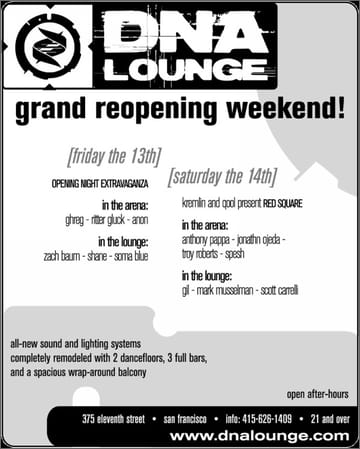
DNA Lounge: Wherein we're twenty-five

Twenty-five years ago today, on July 13th 2001, was the first event at DNA Lounge under current management. I am very old and I have been leaning on this bar for a very long time.

Typically we treat Nov 22 as our "real" anniversary (the club will be turning 41 this year) but 25 is kind of a shocking number, so I thought that was worth noting. Check out what used to pass for photo galleries two and a half decades ago.

Traditionally this is where I do the usual "if you'd like us to be around for another 25 years" blah blah panhandling. So yeah, this would be a great time for you to join our Patreon or up your contribution, or make a one-time donation. We have been getting absolutely obliterated financially this year, the last few months specifically. Attendance has been way down across the board. You people need to start showing up, ok?

kottke.org

Jason Kottke's weblog, home of fine hypertext products

Digger

I’d seen that there was a new Tom Cruise movie coming out this fall called Digger, but I was not prepared for the trailer, in which we see Cruise playing a dipshit oligarch in what appears to be a Dr. Strangelove-style satire/thriller.

The most powerful man in the world embarks on a frantic mission to prove he is humanity’s savior before the disaster he’s unleashed destroys everything.

The film is directed by Alejandro Iñárritu (Amores perros, Birdman, The Revenant) and also stars John Goodman as a geriatric president, Sandra Hüller, and Jesse Plemons. Digger has just moved near the top of my most-anticipated movies of 2026 list.

Tags: Digger · movies · Tom Cruise · trailers · video

this isn't happiness.

ART, PHOTOGRAPHY, DESIGN & DISAPPOINTMENT INSTAGRAM ★ ELSEWHERES

Signals from elsewhere, Joe Vaux


Signals from elsewhere, Joe Vaux

Behance Featured Projects

The latest projects featured on the Behance

Histoire d'un aller et retour


En France dans le département des Cotes d'Armor, un site spectaculaire mêlant nature et tradition