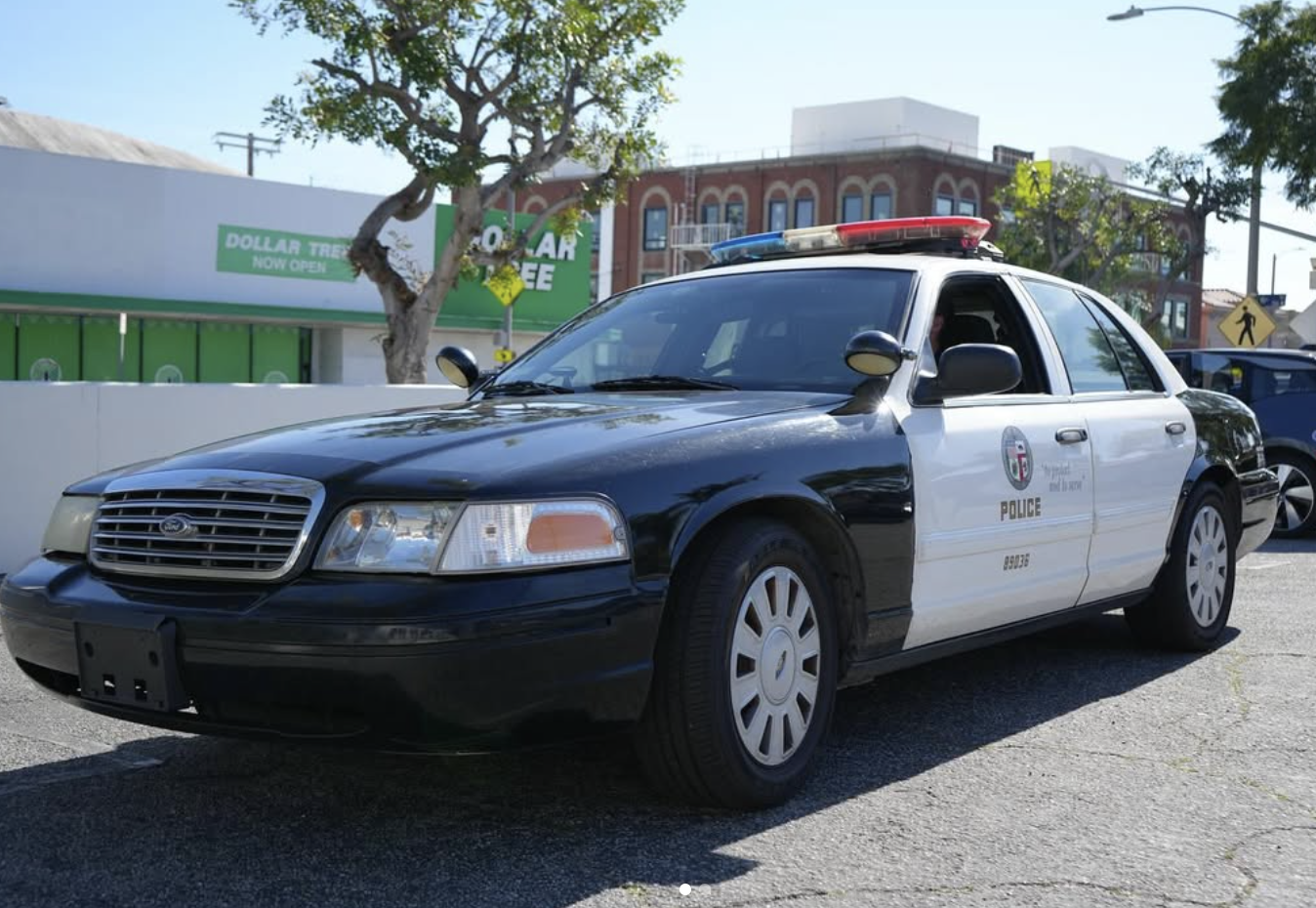
The Los Angeles Police Department (LAPD) announced it will let its surveillance contract with automated license plate reader company (ALPR) Flock expire, becoming the largest police department in the country to drop its contract. Notably, the decision came after an audit of ALPR technology found that, in a two-month period, the LAPD had improperly "investigated" 161 people whose cars were flagged as stolen in the LAPD’s ALPR system but were not actually stolen.
The news that LAPD pulled over 161 innocent people in two months because of improper tagging in the department’s system comes after several high-profile incidents in which people in other states were accosted by police because of data entry or clerical errors in ALPR systems. Joel Feder, an editor of the car journalism website The Drive, detailed a harrowing tale in which he was tracked for days and ultimately pulled over by police in Minnesota because the license plate of the car he was reviewing for the website had been entered into the Flock system as stolen by a police department in California. Monday, the website MotorBiscuit wrote about an innocent woman who was jailed for 13 days because she drove a black Dodge Durango and police searched the Flock system for a Black Dodge Durango suspected of being involved in a fatal hit-and-run accident.

A new report by the LAPD Office of the Inspector General (OIG) suggests that instances of people being falsely pulled over because their license plates have shown up on an ALPR “hot list” are very common, and that the surveillance of people on hot lists that ultimately result in no action from police is staggering. Many ALPR systems have this “hot list” feature, which is where police enter a license plate and get a ping or notification about the vehicle’s whereabouts whenever it passes a connected ALPR camera. In a two-month period between August 1 and September 30, 2025, the LAPD’s cameras generated more than 210.5 million license plate reads, according to the report.
“During the review period, officers acknowledged 161 alerts as accurate license plate matches; however, subsequent investigations determined the vehicles were not stolen,” the report reads. “In addition to creating an inconvenience for vehicle owners, these inaccuracies can affect individual liberty interests, erode public trust, and potentially create substantial legal and financial liability concerns.”
The report notes that this happened because of “inaccurate or outdated information, increasing the risk of unnecessary enforcement actions, including vehicle stops and wrongful detentions, or a confrontation with serious consequences,” and that in many cases, license plates remained on a hot list after a stolen vehicle had already been recovered or was reported as not stolen, meaning the cops are in some cases pulling over the lawful owner of the vehicle.
Notably, the report states that when police get an ALPR hot list hit, the department generally considers any subsequent action to be a “high-risk” stop, meaning the risk of confrontation or potential danger is greatly increased from routine traffic stops for running a red light or speeding.
“When a license plate matches with a vehicle of interest on a Hot List, an alert will appear on the police vehicle’s Mobile Digital Computer,” the report reads. “Often, officers will approach the vehicle with extreme caution or conduct a ‘high-risk’ stop. This involves calling for back up, air support, and a supervisor and ordering the suspect out of their vehicle.” The report says, “department policy requires officers to attempt to verify the accuracy of the ALPR alert prior to conducting a stop,” but that often does not happen. The report also states that, on the vast majority of hot list hits, no action is taken by police meaning that specific people are being subjected to tracking and surveillance for no readily discernible reason. In the two-month audit period, 5,911 different license plates were tracked. No action was taken against 4,575 of those cars.
The LAPD said in response to the report that cars improperly flagged as stolen “generally result from the timing of record updates outside of the Department’s control, such as delays by another jurisdiction or a vehicle owner in clearing a plate from a Hot List after a vehicle has been recovered or is no longer wanted.” In other words, LAPD is often relying on other police departments to remove license plates from a hot list, highlighting the problems with networking different surveillance systems together.
The LAPD OIG report, which appears to have directly led the LAPD to allow its Flock contract to expire, studied the use of three different ALPR systems the department has been using, including static, pole-mounted cameras from Motorola and Flock and cameras in police cruisers made by Axon. In total, the department has nearly 2,000 ALPR cameras; LAPD accesses data for both Flock and Axon systems through Flock’s backend thanks to a data sharing partnership between Axon and Flock, according to the report. The report said the department was able to recover 337 stolen cars during the two months and that ALPR data led to 74 arrests total.
Both the OIG and the LAPD determined that the ALPR system needs to be reconsidered. The OIG suggested that the LAPD “suspend the deployment of new ALPR cameras and the execution of new ALPR-related contracts pending public input and a broader reassessment of vendors and data practices” and “strengthen oversight of ALPR data access.” The LAPD allowed its Flock contract to expire over the weekend, and said it would not enter into new contracts until going through a full audit process.
Om ook ’s nachts gebruik te kunnen maken van zonlicht, wil Reflect Orbital 50.000 satellieten met spiegels in een baan rond de aarde krijgen. Voor de lancering van het eerste prototype hebben ze nu toestemming gekregen.
When A.I. Is a Member of the Family. How a family of three in a Cleveland suburb uses AI chatbots. This is wild.
europeanspaceagency posted a photo:
His Majesty King Charles III visited the Harwell Campus in Oxfordshire on 10 July to launch a new initiative designed to shape the future of the space and defence economy. Located adjacent to the European Space Agency’s European Centre for Space Applications and Telecommunications (ECSAT), the Space and Defence Gateway was officially opened by His Majesty at an event attended by ESA Director General Josef Aschbacher and other senior representatives from ESA, the UK Government and the Harwell Campus.
This photo features His Majesty being greeted by Josef Aschbacher; UK members of ESA’s astronaut reserve Meganne Christian and John McFall; UK ESA astronaut Rosemary Coogan; and Barbara Ghinelli, Director of Innovation Clusters, Harwell Campus, UKRI-STFC, and founder of the UK Space and Defence Gateway.
The visit provided an opportunity for Josef Aschbacher to present His Majesty with a Union Flag that spent nearly a year aboard the International Space Station.
Credits: Ian Jones
europeanspaceagency posted a photo:
The massive globular star cluster Omega Centauri has puzzled astronomers for decades. It should be filled with black holes left behind by exploding stars, yet evidence for them is scarce. Now, astronomers using archival data from the NASA/ESA Hubble Space Telescope and supportive observations from the NASA/ESA/CSA James Webb Space Telescope have finally located their first stellar-mass black hole in this cluster. Discovering the first of this missing black hole population will help refine current theories on black hole formation within environments such as Omega Centauri.
Omega Centauri is composed of 10 million gravitationally bound stars. Though the astronomy community has previously found evidence with Hubble that an intermediate-mass black hole lurks at its centre, models suggest that this star cluster should contain about 10,000 smaller, stellar-mass black holes. This notable population of black holes has evaded detection in previous studies, which used the radial velocity method or looked for radio and X-ray emission from material falling onto the black holes.
A new discovery features a different approach, known as astrometry, to measure the very small movements of stars over time. By sifting through more than 20 years of Hubble archival data and pulling in recent Webb data to further refine the astrometric measurements, the team located a star orbiting an invisible object so hefty that it has to be a black hole. Dubbed oMEGACat BH-2, it is the first stellar-mass black hole detected within Omega Centauri, and it has some surprising qualities. oMEGACat BH-2 has a lower-than-expected mass and, with its visible star companion, the black hole-star duo has the longest orbital period of any black hole binary system known to date.
The team’s findings were published in The Astrophysical Journal Letters.
“With the Hubble and Webb data, we were able to see the motion of the visible main sequence star that is part of this binary, which is about 18,000 light-years away in the dense environment of Omega Centauri,” said the paper’s lead author Matthew Whitaker of the University of Utah, Salt Lake City, in the United States. “The precision of these measurements is incredible, down to a fraction of a pixel on Hubble and Webb’s detectors. It would not have been possible to find this black hole without these two space telescopes.”
The team’s findings refine a past study by a different group of scientists suggesting that this binary system included a neutron star. By expanding the Hubble data analyzed so that it included astrometric measurements from 2002 to 2023, and pulling in Webb near-infrared data to improve precision, the University of Utah-led team was able to better constrain the mass of the visible star’s dark companion, ruling out the neutron star possibility.
“While we already knew that the star was 0.78 solar masses, we can now calculate the black hole’s mass, which is 4.46 solar masses and therefore too heavy to be a neutron star. However, its mass is actually much lower than would be expected in a metal-poor environment like Omega Centauri. This is surprising and exciting,” said Anil Seth of the University of Utah, a coauthor of the study. “We now know that a metal-poor star should be able to form a black hole like this, and we need to figure out how that happens. This detection is providing some data to those who do that kind of modeling.”
Long time coming
Based on the precise data from Hubble and Webb, the team could chart the star’s path over 20-plus years, which fortunately was during its closest approach to its black hole companion when it moved the fastest across the sky. From the extensive data, the team determined that the visible star orbits oMEGACat BH-2 once every 94 years, making it the longest period black hole binary ever known.
Its long orbital period also gives a clue to the origin of this binary system. It was probably dynamically formed, meaning the star and its black hole companion did not start out together but rather found each other in this cluster. The researchers calculated that a system like oMEGACat BH-2 will survive for less than a billion years before it is torn apart by encounters with nearby stars, much shorter than the age of the cluster (approximately 12 billion years old).
“It’s important to understand black hole populations in globular clusters because there’s uncertainty about their physics and formation,” said Seth. “More specifically, understanding the process of forming black holes and then dynamically forming binaries is vital, because it affects our ability to interpret and understand gravitational wave events. Environments like Omega Centauri are the primary places where we think binaries are merging and creating these waves.”
The team’s discovery of stellar-mass black hole oMEGACat BH-2 with the Hubble-Webb dataset is just the start of finding these evasive black hole populations in globular star clusters.
“This new discovery highlights the immense legacy value of the Hubble Space Telescope archive” said Maximilian Häberle, postdoctoral fellow at the European Southern Observatory, who led the data reduction for the Hubble and Webb data. “It marks the second breakthrough from our oMEGACat astrometric re-analysis, following the confirmation of the intermediate-mass black hole in Omega Centauri."
[Image description: Hubble image of globular star cluster Omega Centauri, which looks like a highly dense field of stars. Some appear a bit larger and brighter than others, with the majority of stars appearing blue, orange, and yellow. They are scattered mostly uniformly, like grains of sand. Toward the centre they gradually become closer, creating a more luminous area at the globular star cluster’s core. A small red square frame is near the centre. It connects to a square pullout in the top right corner, which shows the outlined area in greater detail. Among the blue- and orange-colored stars is a small blue-white dot that is highlighted by a small red circle.]
Credits: ESA/Hubble & NASA, M. Häberle (MPIA), J. DePasquale (STScI); CC BY 4.0
europeanspaceagency posted a photo:
On 5 June 2026, the Copernicus Sentinel-5P mission captured sulphur dioxide concentrations from the latest Mount Etna’s eruption, which threw large amounts of sulphur dioxide into the atmosphere.
Sulphur dioxide is released from a volcano when magma is relatively close to the surface.
A capture from the Copernicus Sentinel-2 mission offers an optical view of the eruption on the same day.
Credits: contains modified Copernicus Sentinel data (2026), processed by ESA; CC BY-SA 3.0 IGO
europeanspaceagency posted a photo:
On 5 July 2026, the Copernicus Sentinel-2 mission captured this image of Mount Etna spewing lava and a massive plume of ash, gas and rock into the sky over the Italian island of Sicily. The image has been processed using the mission’s shortwave-infrared bands to show the lava flow in bright red.
Mount Etna is the largest active volcano in Europe and has one of the world’s longest records for continuous eruption.
Ash from the eruption covered the city of Catania and also forced the temporary closure of Catania Airport, which often happens when the volcano is active.
A capture from the Copernicus Sentinel-5P satellite shows the sulphur dioxide concentrations released in the eruption on the same day.
Credits: contains modified Copernicus Sentinel data (2026), processed by ESA; CC BY-SA 3.0 IGO

“Civilizations are remembered through their monuments, but understood through the things they throw away,” says artist Helena Minginowicz, whose sensitive paintings interrogate our understanding of value. Using airbrushed acrylic, which can be built up in lightweight, translucent layers, the artist takes one of the most quotidian household items as a starting point: paper towel.
With its machine-embossed, moisture-wicking patterns, the absorbent paper comprises an instantly recognizable substrate. The precise, textured flourishes are aesthetically pleasing, and yet it’s hard to completely separate them from our associations with mass-produced paper products that are designed for one-time use and disposability. This dichotomy sits at he heart of Minginowicz’s practice, in which she explores “how changing the hierarchy of materials can reshape the way we perceive value, dignity, and the human experience,” she tells Colossal.

Minginowicz’s embossed pieces from everyday domestic material are one facet of a broader multimedia approach to materiality in which she creates paintings on canvas and also painstakingly embosses delicate tissues. The paper towel works, in addition to some that are made on supermarket-style plastic bags, are then presented between thick slabs of acrylic, transforming them into objects with substantial heft and dimensionality.
“Every civilization constructs its own hierarchy of values,” the artist says. “It decides what deserves to be preserved, admired, and passed on to future generations. Monuments, works of art, symbols, and myths preserve an image of humanity as we wish to remember it—strong, beautiful, enduring, and heroic. Yet every monument has its reverse.”
Minginowicz’ imagery draws on the style of Renaissance paintings, especially focusing on expressiveness, intimacy, and the idealized female figure. One might think of Sandro Botticelli’s “The Birth of Venus” or aristocratic portraiture of the era. “For centuries, painting monumentalized what civilizations wished to remember: saints, heroes, gods, victories, myths, and ideals. I use that same language to ask a different question: Who deserves to be remembered with dignity? Not only heroes. Not only the victorious. But every human being.”
Minginowicz is currently working toward a solo exhibition at Galerie Prima in Paris, which is slated to open on October 8. Follow updates and see more on Instagram.


Do stories and artists like this matter to you? Become a Colossal Member today and support independent arts publishing for as little as $7 per month. The article Helena Minginowicz Transforms Humble Paper Towel into Ethereal Paintings appeared first on Colossal.

Zul je AL-TIJD zien. Wordt iedereen en z'n rijbewijsloze moeder Ursula jarenlang aangespoord over te stappen op een laadbak omdat dat goedkoper, écht goedkoper zou worden, blijkt dat helemaal niet goedkoper, écht goedkoper te zijn geworden. De ANWB deed onderzoek naar de prijzen van diesel, benzine en laden (tanken in Nederland blijkt het duurst jeej!) en zag dat rijden op diesel en benzine in de meeste landen goedkoper is dan elektrisch rijden. En dat terwijl diesel en benzine dus al totaal niet meer te betalen zijn door het kabinet-Jetten en de ayatollahtol (goed, en de Trumppoetpech). Bovendien kost tanken ook nog eens veel minder tijd, en ook tijd is geld dus tel uit die winst. Die elektrowagens zijn dan misschien stuk voor stuk pareltjes van pracht maar wij gebruiken voor onze bedrijfsreisjes gewoon lekker de GeenStijl-dieselbus. Je komt er de roze stad Amsterdam niet mee in, maar wij gaan wat reisjes betreft toch veel liever naar Klein Amsterdam (Benidorm).