Slashdot

News for nerds, stuff that matters

China, Russia and Others Seek To Inflame Debate Over AI Data Centers

An anonymous reader quotes a report from The New York Times: A state-owned newspaper in China recently published a satellite image of a data center in Gainesville, Va., writing in English that the development of artificial intelligence posed a threat to Americans' physical and financial well-being. A comic strip made to look as if it had been published by a Maryland news outlet -- created with OpenAI's ChatGPT by people in China, the tech company said -- circulated on X this year, blaming data centers for soaring electricity bills. It showed a tycoon smoking a cigar and clutching bags of cash. A video shared on X by a known covert Russian influence operation questioned the viability of a data center that an American company, Firebird, is constructing in Armenia, the small Caucasus nation that has been a focus of Kremlin pressure. "The country's electrical grid instability may render it useless," the video's narrator says.

All are examples of a push by foreign adversaries to seize on what polls have shown is deep ambivalence -- verging at times on hostility -- about the spread of the data centers needed to power A.I. in the United States and elsewhere. China, Russia and, to a lesser extent, Iran have sought to use state media outlets to turn the controversy over data centers in the United States into "a domestic fracture point," according to a new analysis by Alethea, a threat intelligence company, which identified scores of articles and posts on social media this year. These campaigns, whose impact on public opinion remains to be seen, have raised alarms in Washington, where A.I. is seen as a top issue heading into this year's midterm elections.

Read more of this story at Slashdot.

Datacenter Microsoft gebruikt 1 procent van alle Nederlandse stroom, Google wil geen inzage geven in verbruik

Microsoft geeft als eerste grote Amerikaanse partij inzicht in het stroomverbruik van zijn datacenters in Nederland. Dat is groot, en groeit de komende jaren bovendien hard. Terwijl andere datacenteruitbaters zwijgen, verhardt de strijd om toekomstige aansluitingen op het stroomnet.


Skiën in Japan, coaching in Valencia, of toch maatschappelijke dienst? Het tussenjaar blijft populair. ‘Ik wil mezelf ontwikkelen, ook mentaal’

Ongeveer een kwart van de geslaagden op havo en vwo kiest voor een tussenjaar. Ze willen reizen, sporten, een taal leren, vrijwilligerswerk doen. En ze zijn op zoek naar persoonlijke groei. „Ik weet nog niet zo goed wat mijn kwaliteiten zijn.”


Waterschap in Brabant legt watergebruik aan banden vanwege droogte: ‘Grenzen bereikt’

Het waterschap Brabantse Delta ziet zich door droogte gedwongen om het watergebruik in de regio aan banden te leggen.

Brussel en Berlijn geven geen krimp: EU blijft importeren uit Israëlische nederzettingen

De economisch kleine, maar politiek omstreden handel tussen Europa en de illegale Israëlische nederzettingen op de bezette Westelijke Jordaanoever gaat door. Een grote groep EU-landen wil een verbod, maar Ursula von der Leyen en Berlijn liggen dwars.

Of ze nou goed of slecht presteren, bij spelers van kleur wordt getwijfeld of ze in een Europees landenteam horen

Niet voor het eerst kreeg het Franse elftal een racistische opmerking te verwerken: de Spaanse oud-premier Mariano Rajoy noemde het een team „zonder Fransen”. Zo weerspiegelt voetbal de tendens bij radicaal-rechtse politici om het burgerschap van mensen met een migratieachtergrond in twijfel te trekken.

densha — study Japanese in a living voxel Tokyo

Original Mastodon Post

A voxel Tokyo in real Japan time – ride the Yamanote line and study Japanese: jivx.com/densha

Discussion: news.ycombinator.com/item?id=4

VIDEO. Rusland gooit 3.000 kilo zware FAB-3000 brisantbom op Oekraïne

Social

De hopeloze toestand in het Slavische theater volgt u wellicht in ons onregelmatigheidsklassement van de Weekupdates maar voor deze banger breken we de week graag weer op. Een FAB-3000, een 3.000 kilo zware zweefbom met een explosieve lading van 1.400 kilo die onder een Su-34 jachtbommenwerper geknoopt wordt en dan een kilometer of 40 van het doelwit op deze manier wordt losgelaten om het zelf uit te zoeken. Heel precies zijn ze niet. En dan krijg je dus deze ellende, in Orikhiv, oblast Zaporizhzhia. Op een woonblok, waar weinig mensen meer wonen, dus we zullen het volgens de Code van de Volkskrant wel geen genocide noemen. En er zijn natuurlijk minder Joden bij betrokken!


The Register

Biting the hand that feeds IT — Enterprise Technology News and Analysis

Microsoft chief turns hostile on frontier AI labs, warns companies to guard their IP

Seemingly unaware of the concept of irony, Satya Nadella is warning AI-using enterprises to take care not to give away their business secrets alongside the massive piles of cash they’re forking over to frontier labs every month. Writing in a long-form post on X over the weekend, the Microsoft CEO and chairman warned of what he called the “reverse information paradox,” a situation in which purchasers of AI essentially pay for the intelligence product they’re getting twice: once with cash, and again “with something even more valuable,” namely the proprietary business knowledge one has to feed an AI model in order to make it worth using in the rare instance an AI investment actually pays off. “Over time, the information asymmetry becomes increasingly skewed,” Nadella noted. “The seller learns more and more about you as you use what you purchased, while you learn very little about what the seller is learning in return.” The irony is thick, given that Microsoft itself pushes AI that slurps up business data, and Redmond helped get this entire messy AI ball rolling by investing billions into early generative AI leader OpenAI. Azure was the former exclusive cloud home for ChatGPT, and Microsoft leadership arguably helped Altman get his job back when OpenAI ousted him in 2023. The pair’s relationship grew strained in the intervening years, and they loosened several exclusivity provisions in early 2026. It also comes after a number of large organizations paused or restricted Microsoft Copilot deployments in 2024 over a related concern: weak data governance and sprawling internal access rights. Enterprise data security outfit Securiti told The Register in 2024 that about half of the more than 20 chief data officers it polled had grounded Copilot deployments, either switching the assistant off or severely restricting what it could access. The problem was particularly acute in organizations with years of accumulated SharePoint and Microsoft 365 permissions, where overly broad access rights risked exposing sensitive information through Copilot. Fast forward a couple of years, and now Nadella is warning that data protection measures aren’t even enough for a business to stay safe in the AI age. “Models learn from ‘exhaust,’ the prompts people write, the tools agents use, and especially the corrections people make,” Nadella warned. “It's the kind of knowledge a competitor could never buy, and the kind that leaks almost imperceptibly: trace by trace, correction by correction, eval by eval.” Consuming intelligence through AI, Nadella added, creates more organizational intelligence. The Microsoft chief argued that the knowledge generated through those interactions ought to belong to the companies that create it. “Enterprises need a real trust boundary for their human capital and token capital to compound,” Nadella wrote, describing his ideal solution as having “a hard boundary across which nothing crosses, not even the intelligence exhaust, without consent.” In other words, welcome to the post-cloud era when all your AI infrastructure will come home to roost inside your own network. If you think we’re exaggerating, Nadella even mentions that one of the things enterprises need to do to solve the reverse information paradox is to build their own proprietary AI learning environments “within the tenant boundary.” We asked Nadella and Microsoft whether solving the problem goes beyond good data governance, as Nadella suggested in his article, and a spokesperson told us yes, describing the matter as a structural problem with the current generally accepted model of AI business in which companies rely on hosted services. Anyone and everyone using AI for business is at risk, they explained. In addition to isolating learning environments, Nadella’s X note also suggested AI-using businesses should create their own private evaluation systems and retain ownership of organizational AI memory and decouple their orchestration layer from any particular AI model, essentially creating “your own continuous learning loop.” “A company should be able to use a model without giving up the knowledge that makes it unique,” Nadella wrote. The Microsoft spokesperson argued that agent harnesses and memory should be independent of models, and called for enterprises to have the rights to their own usage data and model outputs, echoing Nadella’s comments about the irony of leading AI firms crying foul about model distillation while reserving “the right to learn from customer usage and interaction data.” As for whether this is a generic warning that something in the AI industry’s got to give or a sales pitch with Microsoft positioned as the hero, the spokesperson made that clear, telling us that Copilot and Azure AI Foundry (a hosted solution, it’s worth pointing out) are Redmond’s solution to the problems Nadella outlined in his weekend post. Both separate context, memory, and agent harnesses from AI models themselves, giving businesses an additional layer of assurance that their data is safe, the company told us. It's debatable whether or not Microsoft is actually the AI data protection hero enterprises are looking for. But the bigger point is true: Frontier labs are rolling in valuable proprietary data, and that could come back to bite the businesses that forked it over for free. ®

German firm files for insolvency, blames cybercrims who shut down production for 6 weeks

German textile company ZEGO Textilveredelungszentrum has filed for insolvency and is blaming the financial fallout from a March cyberattack that knocked its production offline for nearly six weeks. ZEGO's filing adds another name to the short but growing list of companies that say a digital break-in was commercially fatal to their business. The Bavaria-based company provides textile finishing, processing, and treatment services for customers across industries, including automotive, workwear, and technical textiles. In a notice to customers and suppliers, the organization said it had exhausted every available option before seeking insolvency protection. Managing director Johannes Zenglein described the filing as "one of the most difficult steps in our company's 37-year history." "The cyberattack of March 29, 2026, however, impacted our company to an extent that we could not fully compensate for despite our best efforts," Zenglein wrote. "The consequences resulted in a production outage of nearly six weeks and significant financial strain. These effects ultimately impacted our financial situation so severely that filing for insolvency became necessary." ZEGO did not disclose what kind of attack it suffered, whether ransomware was involved, who was behind it, or whether customer or employee data was compromised. What it has made clear is that the operational disruption alone was enough to push the business beyond the point of recovery. ZEGO said insolvency proceedings have now been initiated, but insisted the filing does not necessarily spell the end of the business. It said it plans to keep production running while administrators attempt to restructure the business, preserve jobs, and keep customers and suppliers on board. Cyberattacks have long been capable of bringing factories and production lines to a standstill, but relatively few businesses publicly acknowledge that the resulting financial damage ultimately tipped them into collapse. Perhaps the best-known example is Knights of Old, the 158-year-old British haulage company that collapsed after a ransomware attack. Criminals broke in using an employee's password, encrypted the company's systems, and left more than 700 people out of work. Paying the ransom made little difference. Last year, another German business, a phone repair company, also blamed a cyberattack for its demise after concluding the cost of recovering its systems and rebuilding customer confidence was simply too much to bear. For everyone else still debating whether cybersecurity spending pays for itself, ZEGO's message is difficult to miss: sometimes the highest cost isn't the ransom, it’s surviving the downtime. ®

404 Media

404 Media is an independent media company founded by technology journalists Jason Koebler, Emanuel Maiberg, Samantha Cole, and Joseph Cox.

LAPD Regularly Pulled Over Innocent People Because License Plate Readers Flagged Their Cars As Stolen

LAPD Regularly Pulled Over Innocent People Because License Plate Readers Flagged Their Cars As Stolen

The Los Angeles Police Department (LAPD) announced it will let its surveillance contract with automated license plate reader company (ALPR) Flock expire, becoming the largest police department in the country to drop its contract. Notably, the decision came after an audit of ALPR technology found that, in a two-month period, the LAPD had improperly "investigated" 161 people whose cars were flagged as stolen in the LAPD’s ALPR system but were not actually stolen. 

The news that LAPD pulled over 161 innocent people in two months because of improper tagging in the department’s system comes after several high-profile incidents in which people in other states were accosted by police because of data entry or clerical errors in ALPR systems. Joel Feder, an editor of the car journalism website The Drive, detailed a harrowing tale in which he was tracked for days and ultimately pulled over by police in Minnesota because the license plate of the car he was reviewing for the website had been entered into the Flock system as stolen by a police department in California. Monday, the website MotorBiscuit wrote about an innocent woman who was jailed for 13 days because she drove a black Dodge Durango and police searched the Flock system for a Black Dodge Durango suspected of being involved in a fatal hit-and-run accident. 

LAPD Regularly Pulled Over Innocent People Because License Plate Readers Flagged Their Cars As Stolen
Image: LAPD OIG

A new report by the LAPD Office of the Inspector General (OIG) suggests that instances of people being falsely pulled over because their license plates have shown up on an ALPR “hot list” are very common, and that the surveillance of people on hot lists that ultimately result in no action from police is staggering. Many ALPR systems have this “hot list” feature, which is where police enter a license plate and get a ping or notification about the vehicle’s whereabouts whenever it passes a connected ALPR camera. In a two-month period between August 1 and September 30, 2025, the LAPD’s cameras generated more than 210.5 million license plate reads, according to the report.

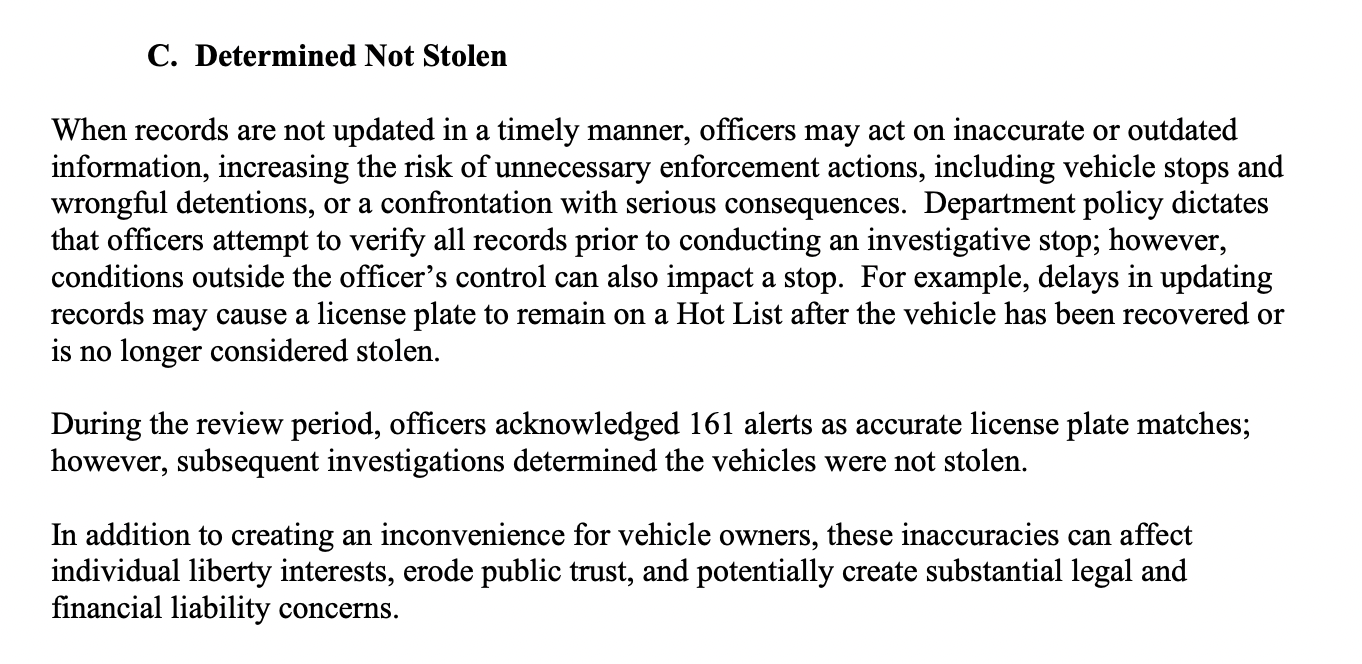
“During the review period, officers acknowledged 161 alerts as accurate license plate matches; however, subsequent investigations determined the vehicles were not stolen,” the report reads. “In addition to creating an inconvenience for vehicle owners, these inaccuracies can affect individual liberty interests, erode public trust, and potentially create substantial legal and financial liability concerns.”

The report notes that this happened because of “inaccurate or outdated information, increasing the risk of unnecessary enforcement actions, including vehicle stops and wrongful detentions, or a confrontation with serious consequences,” and that in many cases, license plates remained on a hot list after a stolen vehicle had already been recovered or was reported as not stolen, meaning the cops are in some cases pulling over the lawful owner of the vehicle.

Notably, the report states that when police get an ALPR hot list hit, the department generally considers any subsequent action to be a “high-risk” stop, meaning the risk of confrontation or potential danger is greatly increased from routine traffic stops for running a red light or speeding. 

“When a license plate matches with a vehicle of interest on a Hot List, an alert will appear on the police vehicle’s Mobile Digital Computer,” the report reads. “Often, officers will approach the vehicle with extreme caution or conduct a ‘high-risk’ stop. This involves calling for back up, air support, and a supervisor and ordering the suspect out of their vehicle.” The report says, “department policy requires officers to attempt to verify the accuracy of the ALPR alert prior to conducting a stop,” but that often does not happen. The report also states that, on the vast majority of hot list hits, no action is taken by police meaning that specific people are being subjected to tracking and surveillance for no readily discernible reason. In the two-month audit period, 5,911 different license plates were tracked. No action was taken against 4,575 of those cars.

The LAPD said in response to the report that cars improperly flagged as stolen “generally result from the timing of record updates outside of the Department’s control, such as delays by another jurisdiction or a vehicle owner in clearing a plate from a Hot List after a vehicle has been recovered or is no longer wanted.” In other words, LAPD is often relying on other police departments to remove license plates from a hot list, highlighting the problems with networking different surveillance systems together.

The LAPD OIG report, which appears to have directly led the LAPD to allow its Flock contract to expire, studied the use of three different ALPR systems the department has been using, including static, pole-mounted cameras from Motorola and Flock and cameras in police cruisers made by Axon. In total, the department has nearly 2,000 ALPR cameras; LAPD accesses data for both Flock and Axon systems through Flock’s backend thanks to a data sharing partnership between Axon and Flock, according to the report. The report said the department was able to recover 337 stolen cars during the two months and that ALPR data led to 74 arrests total. 

Both the OIG and the LAPD determined that the ALPR system needs to be reconsidered. The OIG suggested that the LAPD “suspend the deployment of new ALPR cameras and the execution of new ALPR-related contracts pending public input and a broader reassessment of vendors and data practices” and “strengthen oversight of ALPR data access.” The LAPD allowed its Flock contract to expire over the weekend, and said it would not enter into new contracts until going through a full audit process.


Rotterdam - FediMeteo (@rotterdam@nl.fedimeteo.com)

Weer voor de stad Rotterdam Deze bot wordt beheerd door het FediMeteo-project. Voor informatie en contact kunt u de pagina https://fedimeteo.com raadplegen.

Weer voor Rotterdam ☀️ - 13-07-2026 19:15 CEST...

Weer voor Rotterdam ☀️ - 13-07-2026 19:15 CEST

In één oogopslag:
• 26.7°C · Zonnig ☀️ | Min 18.1°C / Max 28.5°C

Verwachting voor vandaag:
• Min 18.1°C, Max 28.5°C (Bewolkt) ☁️, 🧭 1018.8 hPa ↗️ +0.5 hPa/24h, Windsnelheid: 19.8 km/u (5.5 m/s), richting: ↙ 34°

Uurlijkse voorspelling voor de komende 12 uur:

20:00: 24.8°C (Zonnig) ☀️, 🧭 1018.3 hPa ➡️ 0.0 hPa/1h, Windsnelheid: 15.8 km/u (4.4 m/s), richting: ↓ 0°
21:00: 23.3°C (Licht bewolkt) 🌤️, 🧭 1018.6 hPa ➡️ 0.0 hPa/1h, Windsnelheid: 13.7 km/u (3.8 m/s), richting: ↓ 354°
22:00: 22.3°C (Helder) 🌕, 🧭 1018.9 hPa ➡️ 0.0 hPa/1h, Windsnelheid: 13.7 km/u (3.8 m/s), richting: ↓ 2°
23:00: 22.0°C (Helder) 🌕, 🧭 1019.2 hPa ➡️ 0.0 hPa/1h, Windsnelheid: 14.4 km/u (4.0 m/s), richting: ↙ 24°
00:00: 21.2°C (Bewolkt) ☁️, 🧭 1019.1 hPa ➡️ 0.0 hPa/1h, Windsnelheid: 14.4 km/u (4.0 m/s), richting: ↙ 23°
01:00: 20.2°C (Bewolkt) ☁️, 🧭 1018.8 hPa ➡️ 0.0 hPa/1h, Windsnelheid: 15.8 km/u (4.4 m/s), richting: ↓ 16°
02:00: 19.9°C (Bewolkt) ☁️, 🧭 1018.8 hPa ➡️ 0.0 hPa/1h, Windsnelheid: 13.7 km/u (3.8 m/s), richting: ↓ 19°
03:00: 19.8°C (Licht bewolkt) 🌕, 🧭 1018.6 hPa ➡️ 0.0 hPa/1h, Windsnelheid: 11.5 km/u (3.2 m/s), richting: ↙ 24°
04:00: 19.5°C (Helder) 🌕, 🧭 1018.6 hPa ➡️ 0.0 hPa/1h, Windsnelheid: 11.2 km/u (3.1 m/s), richting: ↙ 28°
05:00: 19.4°C (Helder) 🌕, 🧭 1018.4 hPa ➡️ 0.0 hPa/1h, Windsnelheid: 10.8 km/u (3.0 m/s), richting: ↙ 50°
06:00: 19.2°C (Zonnig) ☀️, 🧭 1018.4 hPa ➡️ 0.0 hPa/1h, Windsnelheid: 16.6 km/u (4.6 m/s), richting: ↙ 42°
07:00: 19.2°C (Zonnig) ☀️, 🧭 1018.5 hPa ➡️ 0.0 hPa/1h, Windsnelheid: 16.9 km/u (4.7 m/s), richting: ↙ 41°

Voorspelling voor de komende dagen:

dinsdag 14 juli: Min 19.2°C, Max 30.5°C (Bewolkt) ☁️, Kans op neerslag 6%, 🧭 1018.7 hPa ➡️ 0.0 hPa/24h, Windsnelheid: 24.8 km/u (6.9 m/s), richting: ↙ 46°
woensdag 15 juli: Min 20.3°C, Max 29.8°C (Bewolkt) ☁️, Kans op neerslag 1%, 🧭 1020.9 hPa ↗️ +2.2 hPa/24h, Windsnelheid: 23.0 km/u (6.4 m/s), richting: ↙ 46°
donderdag 16 juli: Min 18.5°C, Max 28.0°C (Lichte motregen) 🌦️, Neerslag 0.5 mm, Kans op neerslag 3%, 🧭 1019.6 hPa ↘️ -1.3 hPa/24h, Windsnelheid: 12.4 km/u (3.4 m/s), richting: ↙ 43°
vrijdag 17 juli: Min 17.9°C, Max 24.5°C (Bewolkt) ☁️, Kans op neerslag 12%, 🧭 1014.7 hPa ↘️ -4.9 hPa/24h, Windsnelheid: 16.7 km/u (4.6 m/s), richting: ↓ 341°
zaterdag 18 juli: Min 17.1°C, Max 21.4°C (Bewolkt) ☁️, Kans op neerslag 6%, 🧭 1017.4 hPa ↗️ +2.7 hPa/24h, Windsnelheid: 19.4 km/u (5.4 m/s), richting: ↘ 315°
zondag 19 juli: Min 16.2°C, Max 21.2°C (Bewolkt) ☁️, Kans op neerslag 5%, 🧭 1022.8 hPa ↗️ +5.4 hPa/24h, Windsnelheid: 17.2 km/u (4.8 m/s), richting: ↘ 335°

Details:
• 🌡️ Huidige temperatuur (om 19:15): 26.7°C (Zonnig)
• 🤚 Gevoelstemperatuur: 24.1°C (-2.6°C)
• 💨 Windsnelheid: 14.8 km/u (4.1 m/s), richting: ↓ 12°
• 🌬️ Windstoten: 31.7 km/h (8.8 m/s)
• 💧 Luchtvochtigheid: 55%
• 🧭 Luchtdruk: 1018.3 hPa ↗️ +0.6 hPa/3h
• 👁️ Zichtbaarheid: 27.7 km
• ☀️ UV-index: 1.4
• 🌅 Zonsopgang: 05:38 · 🌇 Zonsondergang: 21:57

Luchtkwaliteit:
• AQI: 43 🟢 (Goed)
• PM2.5: 6.5 μg/m³
• PM10: 11.3 μg/m³

Gegevens geleverd door Open-Meteo


kottke.org

Jason Kottke's weblog, home of fine hypertext products

When A.I. Is a Member of the Family . How a family of...

When A.I. Is a Member of the Family. How a family of three in a Cleveland suburb uses AI chatbots. This is wild.

Found Slide

Thomas Hawk posted a photo:

Found Slide

date stamped on slide December 1975

Hi Ho Tavern, Dilworth, Minnesota

Thomas Hawk posted a photo:

Hi Ho Tavern, Dilworth, Minnesota

His Majesty King Charles III meets ESA representatives at the Harwell campus

europeanspaceagency posted a photo:

His Majesty King Charles III meets ESA representatives at the Harwell campus

His Majesty King Charles III visited the Harwell Campus in Oxfordshire on 10 July to launch a new initiative designed to shape the future of the space and defence economy. Located adjacent to the European Space Agency’s European Centre for Space Applications and Telecommunications (ECSAT), the Space and Defence Gateway was officially opened by His Majesty at an event attended by ESA Director General Josef Aschbacher and other senior representatives from ESA, the UK Government and the Harwell Campus.

This photo features His Majesty being greeted by Josef Aschbacher; UK members of ESA’s astronaut reserve Meganne Christian and John McFall; UK ESA astronaut Rosemary Coogan; and Barbara Ghinelli, Director of Innovation Clusters, Harwell Campus, UKRI-STFC, and founder of the UK Space and Defence Gateway.

The visit provided an opportunity for Josef Aschbacher to present His Majesty with a Union Flag that spent nearly a year aboard the International Space Station.

Credits: Ian Jones

Hubble discovers first of star cluster’s missing black holes

europeanspaceagency posted a photo:

Hubble discovers first of star cluster’s missing black holes

The massive globular star cluster Omega Centauri has puzzled astronomers for decades. It should be filled with black holes left behind by exploding stars, yet evidence for them is scarce. Now, astronomers using archival data from the NASA/ESA Hubble Space Telescope and supportive observations from the NASA/ESA/CSA James Webb Space Telescope have finally located their first stellar-mass black hole in this cluster. Discovering the first of this missing black hole population will help refine current theories on black hole formation within environments such as Omega Centauri.

Omega Centauri is composed of 10 million gravitationally bound stars. Though the astronomy community has previously found evidence with Hubble that an intermediate-mass black hole lurks at its centre, models suggest that this star cluster should contain about 10,000 smaller, stellar-mass black holes. This notable population of black holes has evaded detection in previous studies, which used the radial velocity method or looked for radio and X-ray emission from material falling onto the black holes.

A new discovery features a different approach, known as astrometry, to measure the very small movements of stars over time. By sifting through more than 20 years of Hubble archival data and pulling in recent Webb data to further refine the astrometric measurements, the team located a star orbiting an invisible object so hefty that it has to be a black hole. Dubbed oMEGACat BH-2, it is the first stellar-mass black hole detected within Omega Centauri, and it has some surprising qualities. oMEGACat BH-2 has a lower-than-expected mass and, with its visible star companion, the black hole-star duo has the longest orbital period of any black hole binary system known to date.

The team’s findings were published in The Astrophysical Journal Letters.

“With the Hubble and Webb data, we were able to see the motion of the visible main sequence star that is part of this binary, which is about 18,000 light-years away in the dense environment of Omega Centauri,” said the paper’s lead author Matthew Whitaker of the University of Utah, Salt Lake City, in the United States. “The precision of these measurements is incredible, down to a fraction of a pixel on Hubble and Webb’s detectors. It would not have been possible to find this black hole without these two space telescopes.”

The team’s findings refine a past study by a different group of scientists suggesting that this binary system included a neutron star. By expanding the Hubble data analyzed so that it included astrometric measurements from 2002 to 2023, and pulling in Webb near-infrared data to improve precision, the University of Utah-led team was able to better constrain the mass of the visible star’s dark companion, ruling out the neutron star possibility.

“While we already knew that the star was 0.78 solar masses, we can now calculate the black hole’s mass, which is 4.46 solar masses and therefore too heavy to be a neutron star. However, its mass is actually much lower than would be expected in a metal-poor environment like Omega Centauri. This is surprising and exciting,” said Anil Seth of the University of Utah, a coauthor of the study. “We now know that a metal-poor star should be able to form a black hole like this, and we need to figure out how that happens. This detection is providing some data to those who do that kind of modeling.”

Long time coming

Based on the precise data from Hubble and Webb, the team could chart the star’s path over 20-plus years, which fortunately was during its closest approach to its black hole companion when it moved the fastest across the sky. From the extensive data, the team determined that the visible star orbits oMEGACat BH-2 once every 94 years, making it the longest period black hole binary ever known.

Its long orbital period also gives a clue to the origin of this binary system. It was probably dynamically formed, meaning the star and its black hole companion did not start out together but rather found each other in this cluster. The researchers calculated that a system like oMEGACat BH-2 will survive for less than a billion years before it is torn apart by encounters with nearby stars, much shorter than the age of the cluster (approximately 12 billion years old).

“It’s important to understand black hole populations in globular clusters because there’s uncertainty about their physics and formation,” said Seth. “More specifically, understanding the process of forming black holes and then dynamically forming binaries is vital, because it affects our ability to interpret and understand gravitational wave events. Environments like Omega Centauri are the primary places where we think binaries are merging and creating these waves.”

The team’s discovery of stellar-mass black hole oMEGACat BH-2 with the Hubble-Webb dataset is just the start of finding these evasive black hole populations in globular star clusters.

“This new discovery highlights the immense legacy value of the Hubble Space Telescope archive” said Maximilian Häberle, postdoctoral fellow at the European Southern Observatory, who led the data reduction for the Hubble and Webb data. “It marks the second breakthrough from our oMEGACat astrometric re-analysis, following the confirmation of the intermediate-mass black hole in Omega Centauri."

[Image description: Hubble image of globular star cluster Omega Centauri, which looks like a highly dense field of stars. Some appear a bit larger and brighter than others, with the majority of stars appearing blue, orange, and yellow. They are scattered mostly uniformly, like grains of sand. Toward the centre they gradually become closer, creating a more luminous area at the globular star cluster’s core. A small red square frame is near the centre. It connects to a square pullout in the top right corner, which shows the outlined area in greater detail. Among the blue- and orange-colored stars is a small blue-white dot that is highlighted by a small red circle.]

Credits: ESA/Hubble & NASA, M. Häberle (MPIA), J. DePasquale (STScI); CC BY 4.0

Sulphur dioxide concentrations from Mount Etna’s eruption

europeanspaceagency posted a photo:

Sulphur dioxide concentrations from Mount Etna’s eruption

On 5 June 2026, the Copernicus Sentinel-5P mission captured sulphur dioxide concentrations from the latest Mount Etna’s eruption, which threw large amounts of sulphur dioxide into the atmosphere.

Sulphur dioxide is released from a volcano when magma is relatively close to the surface.

A capture from the Copernicus Sentinel-2 mission offers an optical view of the eruption on the same day.

Credits: contains modified Copernicus Sentinel data (2026), processed by ESA; CC BY-SA 3.0 IGO

Behance Featured Projects

The latest projects featured on the Behance

SooKó


??????????????????????????????????????????????????

Colossal

The best of art, craft, and visual culture since 2010.

Helena Minginowicz Transforms Humble Paper Towel into Ethereal Paintings

Helena Minginowicz Transforms Humble Paper Towel into Ethereal Paintings

“Civilizations are remembered through their monuments, but understood through the things they throw away,” says artist Helena Minginowicz, whose sensitive paintings interrogate our understanding of value. Using airbrushed acrylic, which can be built up in lightweight, translucent layers, the artist takes one of the most quotidian household items as a starting point: paper towel.

With its machine-embossed, moisture-wicking patterns, the absorbent paper comprises an instantly recognizable substrate. The precise, textured flourishes are aesthetically pleasing, and yet it’s hard to completely separate them from our associations with mass-produced paper products that are designed for one-time use and disposability. This dichotomy sits at he heart of Minginowicz’s practice, in which she explores “how changing the hierarchy of materials can reshape the way we perceive value, dignity, and the human experience,” she tells Colossal.

a painting of a woman's face, inspired by a Renaissance portrait, on two sheets of paper towel

Minginowicz’s embossed pieces from everyday domestic material are one facet of a broader multimedia approach to materiality in which she creates paintings on canvas and also painstakingly embosses delicate tissues. The paper towel works, in addition to some that are made on supermarket-style plastic bags, are then presented between thick slabs of acrylic, transforming them into objects with substantial heft and dimensionality.

“Every civilization constructs its own hierarchy of values,” the artist says. “It decides what deserves to be preserved, admired, and passed on to future generations. Monuments, works of art, symbols, and myths preserve an image of humanity as we wish to remember it—strong, beautiful, enduring, and heroic. Yet every monument has its reverse.”

Minginowicz’ imagery draws on the style of Renaissance paintings, especially focusing on expressiveness, intimacy, and the idealized female figure. One might think of Sandro Botticelli’s “The Birth of Venus” or aristocratic portraiture of the era. “For centuries, painting monumentalized what civilizations wished to remember: saints, heroes, gods, victories, myths, and ideals. I use that same language to ask a different question: Who deserves to be remembered with dignity? Not only heroes. Not only the victorious. But every human being.”

Minginowicz is currently working toward a solo exhibition at Galerie Prima in Paris, which is slated to open on October 8. Follow updates and see more on Instagram.

a painting of a man's face with a mark in the shape of a rabbit on his cheek, inspired by a Renaissance portrait, on a torn sheet of paper towel
a painting of a man's face with a mark in the shape of a rabbit on his cheek, inspired by a Renaissance portrait, on a sheet of paper towel that is encased between two thick pieces of acrylic
two small painted female figures inspired by classical paintings on two sheets of paper towel
a painting of a hand and breast from a Renaissance painting on on paper towel
a painting of two figures from a Renaissance painting on two sheets of paper towel
a painting of a hand and breast from a Renaissance painting on two sheets of paper towel
a painting of two people kissing, inspired by a Renaissance portrait, on a torn sheet of paper towel

Do stories and artists like this matter to you? Become a Colossal Member today and support independent arts publishing for as little as $7 per month. The article Helena Minginowicz Transforms Humble Paper Towel into Ethereal Paintings appeared first on Colossal.