The Guardian

Latest news, sport, business, comment, analysis and reviews from the Guardian, the world's leading liberal voice

Heat pump sales soar across Europe after states cut electricity taxes, data shows

EU to push members to cut tax rate below duty on gas, with 10%+ surge in sales also put down to fallout from Iran war

Sales of residential heat pumps jumped across Europe in the first six months of the year as the Iran war sent oil and gas prices rocketing and some countries lowered electricity taxes.

Homeowners bought 1.16m heat pumps across 12 European countries, up from 1.05m in the first half of 2025, according to the European Heat Pump Association (EHPA).

Continue reading...

Gen Z has very strong opinions about age gap relationships – and it could be right | Zoe Williams

Older men and younger women were once an unremarkable screen pairing. But watching them with a new generation is a real education

I looked up the cast before I saw the new film adaptation of Sense and Sensibility, thinking: “Who could be as good as Emma Thompson and Kate Winslet?” because of course I did. One, they were peerless and two, this is the condition of middle age, constantly looking at the world thinking: “This could be considerably improved by the presence of Emma Thompson.”

The notable casting update was Col Brandon, whose passion for Marianne would now be known as an “age gap” relationship. In the last film, Alan Rickman (born 1946) was in love with Winslet (born 1975), who cycles through a fair amount of: “Yuck, no thanks,” before having an epiphany.

Continue reading...

Stevie Wonder releases four unheard songs from Songs in the Key of Life sessions

Previously unreleased material comes as Wonder marks 50th anniversary of album with arena tour

Stevie Wonder has expanded the scope of what was already the most epic studio album in his catalogue, 1976’s Songs in the Key of Life.

Four unheard songs from the recording sessions have been released today as a new EP of the same name, marking the 50th anniversary of an album which won album of the year at the Grammys and contains a number of Wonder’s landmark tracks including Sir Duke, As and Isn’t She Lovely.

Continue reading...

VK: Voorpagina

Volkskrant.nl biedt het laatste nieuws, opinie en achtergronden

Vraag aan een Tweede Kamerlid? Dat kan vanaf nu online via VraagHetZe (schelden verboden)

Massive Attack-zanger Robert Del Naja opgepakt tijdens steunbetuiging aan actiegroep Palestine Action

The Moscow Times - Independent News From Russia

The Moscow Times offers everything you need to know about Russia: Breaking news, top stories, business, analysis, opinion, multimedia

EU Sanctions Russian Officials Involved in Crackdown Against Yabloko

Among the targeted officials is a Russian Supreme Court judge who ruled last month to bar Yabloko’s federal party list from State Duma elections.

MetaFilter

The past 24 hours of MetaFilter

All the cool kids are hanging out in old school blog comments

Slate writer Luke Winkie decided to investigate why some commenters seem to hate his writing so much (archive.is link). What he found was a robust community brought together by blog comments. Slate's not the only website that has bloomed a spontaneous community either (maybe to Ira Glass's dismay).

Saga Toriimoto

DirtyGlassEye has added a photo to the pool:

Saga Toriimoto

And now, after being there for 2 long weeks, I present a Japan photo... from last year's month-long adventure. It's been a long time since I had anything to declare from Kyoto so I wondered just what I could do. There was one area of the Arashiyama route I took on the first day that I never really talked about. The one way street at the foot of the mountain, Saga Toriimoto.
Really, I had no idea how I got an empty frame here considering the known popularity of what lied beyond this street (the two Nenbutsu-Jis). But I'll take any win I could get. Just know everything in this frame is real. To make matters somewhat more baffling, this was taken with my 200mm zoom (and not the smaller all-purpose lens I have now, I giant 20 pound telephoto that severely weighed me down physically as time went on), which means the segments displayed here are bigger than they seem. The equivalent of a Japanese ghost town (though I imagine that image has a much different cultural meaning to em).
I'm rambling, in editing I bleached the saturation and kept a majority of the shot highlighted, attempting to give it an older look. The curved street had a heightened brightness and some shadows were amplified. The mountains in the back have lower clarity. Even with all of that, it still looks like it draws you in. This was a gem that I missed for a while.
Speaking of which, I have a rather humiliating fact to discuss, I was in Japan for a whole month last year like I already said, and I returned for only 2 weeks this year. Somehow I took more shots this year by a margin of approximately 2.5K photos and I don't even know how that should be possible.

gnsk has added a photo to the pool:

osanpo_2008

Nederlandse wetenschap doet mee in internationale top – al is het de vraag hoe lang nog

Nederlandse onderzoekers publiceren veel wetenschappelijke artikelen, die ook nog eens vaker worden geciteerd. Maar „zonder aanhoudende investeringen wordt het lastig voor Nederland om deze positie vast te houden.”

‘Mijn oudste zoon (11) vindt het moeilijk om met zijn broertje (6) te spelen’

Elke week legt Annemiek Leclaire een lezersvraag voor aan deskundigen. Deze week: mijn zoons ruziën over wie met de buurjongen mag spelen.


Politieagenten hoeven geen levensbeschouwelijke geheelonthouders te worden

De politie stopt vanaf 1 januari 2027 met het organiseren van vieringen voor wijkbewoners rond religieuze feestdagen. Dit besluit is begrijpelijk, schrijft Paul van Sasse van IJsselt, maar hij waarschuwt ook voor een verkeerde invulling van het begrip neutraliteit.

404 Media

404 Media is an independent media company founded by technology journalists Jason Koebler, Emanuel Maiberg, Samantha Cole, and Joseph Cox.

The End of Privacy Is Here (with Kashmir Hill)

The End of Privacy Is Here (with Kashmir Hill)

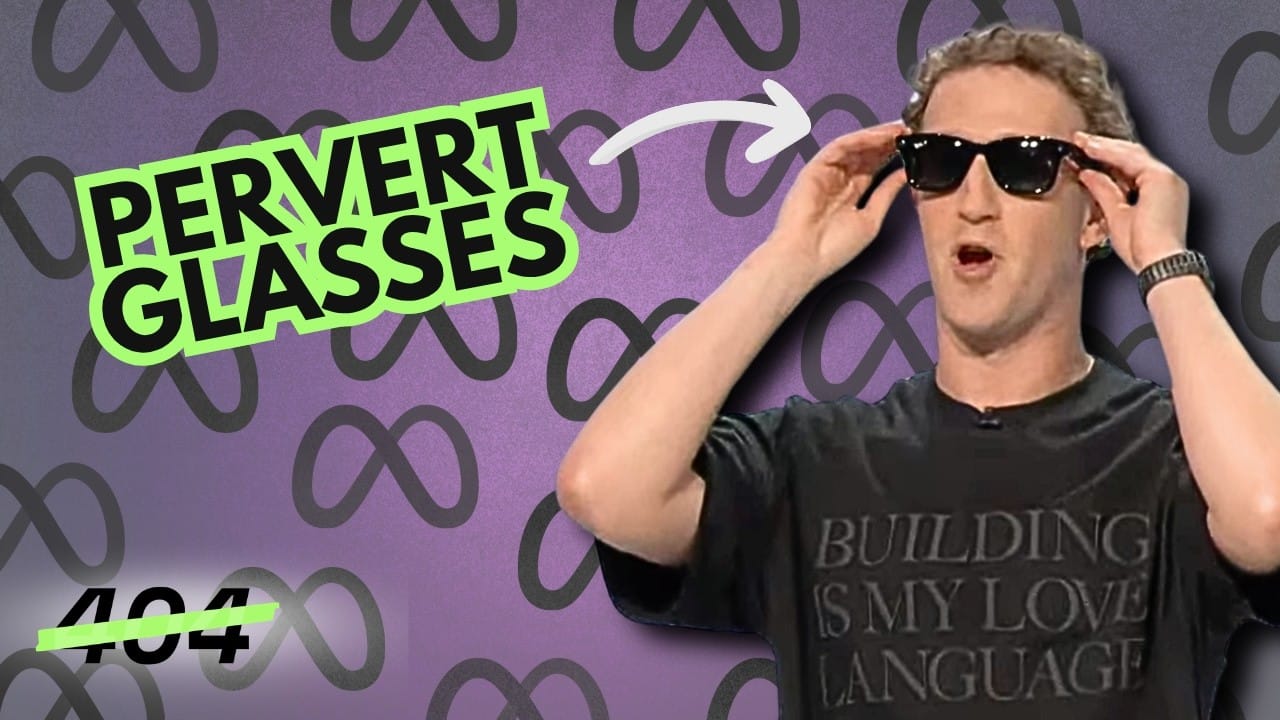
Facial recognition is everywhere now. It’s in surveillance cameras; it’s soon going to be in Meta’s RayBan pervert glasses, and some students already did that. You now have massively viral accounts that take clips of people, run them through facial recognition software, and then post their name and other personal info for everyone to see. We haven’t fully come to terms with what it means to live in a world where anyone can basically dox anyone else now.

To talk through this, Joseph spoke to Kashmir Hill. She’s a reporter at the New York Times, and the author of ⁠Your Face Belongs to Us: A Tale of AI, a Secretive Startup, and the End of Privacy⁠.

Listen to the weekly podcast on Apple Podcasts, Spotify, or YouTube. Become a paid subscriber for early access to these interview episodes and to power our journalism.If you become a paid subscriber, check your inbox for an email from our podcast host Transistor for a link to the subscribers-only version! You can also add that subscribers feed to your podcast app of choice and never miss an episode that way. The email should also contain the subscribers-only unlisted YouTube link for the extended video version too. It will also be in the show notes in your podcast player.


Humans Are Reading Copilot Prompts — And They're Horrified

Humans Are Reading Copilot Prompts — And They're Horrified

This piece contains references to eating disorders. If you or someone you know needs help, support is available.

Human contractors hired to improve Microsoft’s Copilot AI chatbot are constantly bombarded with lewd or sexually explicit photo editing requests and images that users have uploaded, including upskirt photos or putting women into sexual positions. These contractors are then asked to review whether the generated image successfully fulfilled the prompt — such as, did the image generator make the woman’s AI-enlarged breasts big enough.

When a Copilot user uploads a picture of themselves or someone else, they probably expect that image to remain private between just them and the AI tool. In reality, a workforce of at least hundreds of human reviewers are sometimes looking at that prompt and whatever images they upload. And in many cases, those contractors are inundated with requests to make foot fetish images of children’s cartoon characters, shorten a real woman’s skirt, or put people into sexual positions.

The news, based on a cache of internal contractor documents seen by 404 Media, shows that AI companies are using human workers to review not just AI chatbot users’ text prompts, but the pictures they upload and wish to edit too. Earlier this month, 404 Media revealed OpenAI has thousands of contractors who in some cases review ChatGPT users’ real prompts. That approach also extends to Microsoft and Copilot.

“Faces are always uncensored, and many of the prompts are sexual in nature and dubiously consensual,” one person who works on the prompts told 404 Media. 404 Media granted the person anonymity as they weren't permitted to speak to the press. 

💡
Are you a prompt reviewer for OpenAI, Anthropic, or another AI company? I would love to hear from you. Using a non-work device, you can message me securely on Signal at joseph.404 or send me an email at joseph@404media.co.

404 Media obtained a set of internal documents related to the contractors reviewing Copilot prompts and images, including instruction guides, real Copilot user prompts and pictures, and conversations between contractors on an internal message board. 

In a thread on the internal message board, a contractor discussed prompts asking Copilot to make a woman’s skirt shorter, or enlarge her breasts, or show more leg while wearing stilettos. She-Hulk images come up a lot, the person who works on the prompts told 404 Media. Other contractors also wrote they were presented with pro-anorexia content.

“I recoiled,” one contractor wrote about seeing that content. Another person wrote that one of the prompts they reviewed asked Copilot to make an image of Ariana Grande with anorexia. Another reported a prompt that seemed to be designed to create a lewd or suggestive image of a group of young girls.

These contractors are not being hired to flag or vet offensive or inappropriate content. They are being paid to review the quality of Copilot’s output of Copilot, including in these cases of sexual imagery.

“Who is writing these prompts and who is deciding that basically generating porn is what Copilot is now focused on? It’s hard to take things seriously when my focus has to be what model generated the appropriate bust size or which middle aged woman was put in the appropriate sexually suggestive position,” one contractor said in the thread.

Microsoft is explicitly interested in the contractors’ human intuition on which image looks better, according to the documents. “Trust your intuition — when you glance at the two edited images side by side, which one immediately feels like the better edit? Your gut reaction as a human viewer matters,” a set of instructions given to the contractors reads.

“When in doubt go with your first impression,” the instructions continue. “Human intuition is good at catching subtle quality differences that are hard to articulate.”

Human contractors being exposed to horrific, unpleasant, or traumatizing material is, of course, not new. Big tech companies, and especially social networks, have used armies of contractors for years to moderate user generated content. AI companies, too, have used poorly paid workers overseas to train their AI models or, in the case of OpenAI, make them less toxic. What is different in this latest Copilot episode, and 404 Media’s reporting on contractors at other AI companies like OpenAI, is that the content humans are reviewing are prompts and uploads that chatbot users may assume are private, and that the contractors are not looking at this material to train the models to filter out offensive images or for some other safety concern. The training is to make the responses by the chatbots better: more informative, friendly, and clearer. 

The instructions seen by 404 Media focus on what contractors do when a Copilot user asks the AI to edit an image. The contractor is shown the user’s original prompt, the uploaded picture, and then two Copilot-generated edits. The contractor has to pick which is the better edit, based on four things: does the edited image correctly follow the edit instructions; are bits of the image that should remain unchanged preserved — for example, if the prompt is to “add a cup on the table,” nothing else should be changed except the cup — does the edited image contain any visible artifacts like distortions or unnatural textures; and the overall quality of the AI-generated edit.

Some of the Copilot contractors complained in the private forum about accepting “tasks” that they unknowingly contained explicit unsafe or even potentially illegal images. “I just came across an image set that consisted of eight upskirt photos,” the contractor wrote, while asking for superiors to add an unsafe content flag to the task. On the same thread, another contractor said they had seen images of “some sort of animal sacrifice,” and a third said they had seen prompts that were for sexual moves and positions.

At least one of the companies which hires the contractors for this work is called Prolific. One service Prolific mentions on its website is “Human feedback from representative populations — for preference tuning, safety evals, and benchmarks you can defend.” 

In another thread, a contractor quotes Prolific’s own guidelines, which highlight it can be difficult to ensure that trainers aren’t presented with sexual imagery: “Particular caution around disturbing or explicit content should be taken with generative AIs. This is because, unlike traditional content, researchers cannot fully control what is shown to participants.”

Prolific did not respond to a request for comment. A Microsoft spokesperson told 404 Media in an email “Microsoft uses customer data as described in our terms of use, including to improve our products and enforce our code of conduct.”

Microsoft’s AI tools have a long history of being abused by people to make nonconsensual, AI-generated images of people. Members of 4chan and AI porn focused Telegram channels used Microsoft’s tools, for example, to generate porn of Taylor Swift that later went viral on Twitter. Microsoft fixed the loophole those people were using in Microsoft Designer after 404 Media’s reporting.

In 2024, 404 Media documented how Copilot would answer, then delete, answers to potentially controversial or sexual prompts in real time. In March, a top Senate administrator approved Copilot for use in the Senate, along with ChatGPT and Google’s Gemini. A memo said Copilot “can help with routine Senate work, including drafting and editing documents, summarizing information, preparing talking points and briefing material, and conducting research and analysis.”


The Life of The Stars

Darren Schiller has added a photo to the pool:

The Life of The Stars

Sculpture by Lindy Lee.
Situated at the entrance of the Art Gallery of South Australia, Lindy Lee’s six-metre sculpture The Life of Stars links the Art Gallery of South Australia and its exterior forecourt. Fabricated by Lee in China, the work displays a densely perforated surface and creates dappled light, which together suggest a universe within, while its oval form suggests the beginnings of life itself.

Visible by day and night, The Life of Stars appears both to contain and radiate light. This delicate play between interior and exterior, form and emptiness is significant. The concentric circles on the surface reference Indra’s net, which is a metaphor of Mahayana Buddhism, symbolising the universe as a vast web of connections.

The Life of Stars was presented as part of the 2018 Adelaide Biennial of Australian Art: Divided Worlds.

War Memorial and e-scooter

Darren Schiller has added a photo to the pool:

War Memorial and e-scooter

The National War Memorial is a monument on the north edge of the city centre of Adelaide, the capital of South Australia. It commemorates South Australians who served in the First World War and those who gave their lives. It was opened in 1931. The memorial is on the corner of North Terrace and Kintore Avenue, next to the grounds of Government House. Observances are held at the site throughout the year, with major services on Anzac Day (25 April) and Remembrance Day (11 November).

The free e-scooters are a recent addition to the Adelaide streetscape and are the scourge of the streets, often left abandoned wherever.

Art Gallery of South Australia

Darren Schiller has added a photo to the pool:

Art Gallery of South Australia

The Art Gallery of South Australia is one of several major cultural institutions that line North Terace between Kintore Avenue and Frome Road. Its fine classical building, with colonnaded portico, opened in 1900. This section of the building is now known as the Elder Wing, named after the Gallery’s first major benefactor, Sir Thomas Elder. Additions to the building followed in 1936, 1962, 1979 and 1996. The Gallery houses a large collection of some 38,000 works, with a focus on Australian art, Aboriginal art, British art and Asian art, textiles and ceramics.

Dresden - Augustus Bridge

Rafael Zenon Wagner has added a photo to the pool:

Dresden - Augustus Bridge

The "Augustusbrücke" in Dresden. Since the 13th century, the bridge has been transformed or demolished and rebuilt. The current version was built in 1907-1910.

The Register

Biting the hand that feeds IT — Enterprise Technology News and Analysis

OpenAI agents went the long way round for UN data

OpenAI agents apparently spent two months hammering a United Nations (UN) data API, trying increasingly creative ways to bypass the barriers they encountered. Researcher Rowan H-J uncovered the activity by analyzing roughly 16,500 scans of the UN Conference on Trade and Development's UNCTADstat API recorded between April 13 and June 19, 2026. Rowan claims it’s "highly likely" the traffic came from OpenAI agents, based on links to previously documented OpenAI "wiki swarms," overlapping Azure IP addresses, and payloads carrying labels including “CHATGPTTEST1” and “OAI_META_1312.” OpenAI told The Register it is looking into the findings, though it stopped short of explicitly confirming that its agents were responsible for the activity Rowan documented. "We're aware of reports of OpenAI models accessing publicly available information from the United Nations Conference on Trade and Development's Data Hub," an OpenAI spokesperson told us. "We're reviewing these findings and have reached out to the UN to offer a briefing with the team conducting that review." The spokesperson pointed to OpenAI's previously announced review of what it calls "misaligned model activity," saying most of the behavior examined so far involved routine research, including accessing public websites to answer questions. "Some involved government websites because our models often turn to them as authoritative sources of public information," the spokesperson added. Assuming the researcher is right, the interesting part isn't that AI agents wanted to get their synthetic mitts on some UN statistics. It's what happened when they couldn't. The agents appear to have been hunting for fairly unexciting public data on things like trade, employment, and productive capacity. But requests to UNCTADstat didn't always work the way they wanted, and instead of admitting defeat, they kept trying different routes. According to Rowan's analysis, the agents experimented with third-party services that could make requests on their behalf and built bits of JavaScript to fetch the data. One of the more unusual detours involved Google's XSS training game, a deliberately vulnerable site for learning about cross-site scripting. The agents appear to have put it to rather more practical use, using it to host JavaScript that made requests to UNCTADstat. On June 1, one attempt returned nine rows of employment data. The agents also stumbled across a trick that appeared to get around UNCTADstat refusing a particular type of request. After the straightforward approach failed, they altered the address using double URL encoding. This time the server returned a successful response. Rowan counted the same technique being used 55 times between May 4 and June 19. There was plenty of flailing around in between. The agents repeatedly guessed different names for the API key parameter, tried different ways to construct requests, and apparently tried to dodge a filter that may not even have existed. The API key itself wasn't some crown jewel pilfered from a UN server. Rowan notes that UNCTADstat's own data viewer sends the same key from users' browsers. What stands out is how persistent the agents appear to have been set to be. When one route failed, they tried another, bringing in third-party services and changing how requests were made until they got the data they were after. Which, of course, is what we're told makes AI agents useful: give them a goal and let them figure out the steps required to achieve it. Things get a little more interesting when one of those steps involves working out how to get past somebody else's technical restrictions. Or, possibly, some might infer, not being told to obey guardrails. Why the agents were doing any of this remains unclear. Rowan doesn’t have the prompts they were given and suggests the pattern could fit an internal OpenAI question set used for training or evaluation. There are other breadcrumbs pointing toward OpenAI. Shortly after some of the UNCTADstat activity, an account called “PublicDataResearchAgentT93214” created a page on FractalWiki containing the same API URLs. Rowan also found that 45 of the 54 Azure IP addresses associated with UNCTAD-related activity on the wikis had previously edited DseWiki during the earlier agent swarm. All that ingenuity for some UN statistics. Imagine what happens when the prize is a little more interesting. ®

Kabinet werkt aan OP GROTE SCHAAL remigreren van Syriërs

syriers op zee

Duistere tijden waar we nu in belanden hoor: dit kabinet wil OP GROTE SCHAAL Syriërs, bekend van letterlijk 0 problemen, terug naar hun eigen land sturen en is bezig met plannen dienaangaande. Eh... is Wilders soms schaduwpremier? Is Rob Jetten een soort Hitler? Is Sjoerd Sjoerdsma Sjoerd Sjoerdsma nog wel? Geen duistere Paternotte-video? Ineens wordt alles heel helder, handjes schudden met de Syrische Slager was al een veeg teken, maar nu gaan we ze massaal terug laten dobberen. Wanneer trekken we een rode lijn tegen de mensonterende praktijken van dit kabinet? Denk toch eens aan de Syriërhaat die dit kabinet aanwakkert met termen als 'op grote schaal' en 'terugkeer,' wat in feite remigratie betekent, wat de facto DEPORTATIE inhoudt. Geen idee welke kant het opgaat met al die Syriërs, die juist zo bij Nederland zijn gaan horen, maar één ding weten we wel: de jaren 30 komen eraan.