A thing I’ve been saying over and over is that surveillance companies can’t be trusted to regulate themselves or to make privacy decisions themselves, because one company’s red line is another company’s business opportunity. Today we’re investigating a company that saw Flock was not offering facial recognition and saw a challenge.
Also: Some dudes are letting ChatGPT drive a car in a parking lot in San Francisco, a data center company promises to cut people big checks if their data center gets approved, and the Muse backlash has begun. Welcome back to our new experiment with daily newsletters. If you like this, subscribe here. -Jason
As Flock continues to be the center of a nationwide conversation about automatic license plate reading cameras, the company has said that itdoesn’t, and won’t, do facial recognition: “We will not add facial recognition to our devices,” Flock CEO Garrett Langley said in a recent video. But other, third-party companies are telling cops that they are willing to add facial recognition to data gathered by Flock cameras in order to “close that gap.”
Acompany called VIDIZMO is advertising the capability to export footage from FlockOS to its own platforms that do facial recognition, behavior prediction, and racial and gender analysis on live camera feeds. VIDIZMO is a several decades-old video analysis and database company that has started offering facial recognition technology to cops within the last six months. In a May email to Johnson City, Tennessee, deputy police chief Michael Adams, a salesperson from VIDIZMO wrote that the company’s product could do facial recognition on both Flock and Axon data in “one searchable platform.”
As Flock continues to be the center of a nationwide conversation about automatic license plate reading cameras, the company has said that it doesn’t, and won’t, do facial recognition: “We will not add facial recognition to our devices,” Flock CEO Garrett Langley said in a recent video. But other, third-party companies are telling cops that they are willing to add facial recognition to data gathered by Flock cameras in order to “close that gap.”
A company called VIDIZMO is advertising the capability to export footage from FlockOS to its own platforms that do facial recognition, behavior prediction, and racial and gender analysis on live camera feeds. VIDIZMO is a several decades-old video analysis and database company that has started offering facial recognition technology to cops within the last six months. In a May email to Johnson City, Tennessee, deputy police chief Michael Adams, a salesperson from VIDIZMO wrote that the company’s product could do facial recognition on both Flock and Axon data in “one searchable platform.”
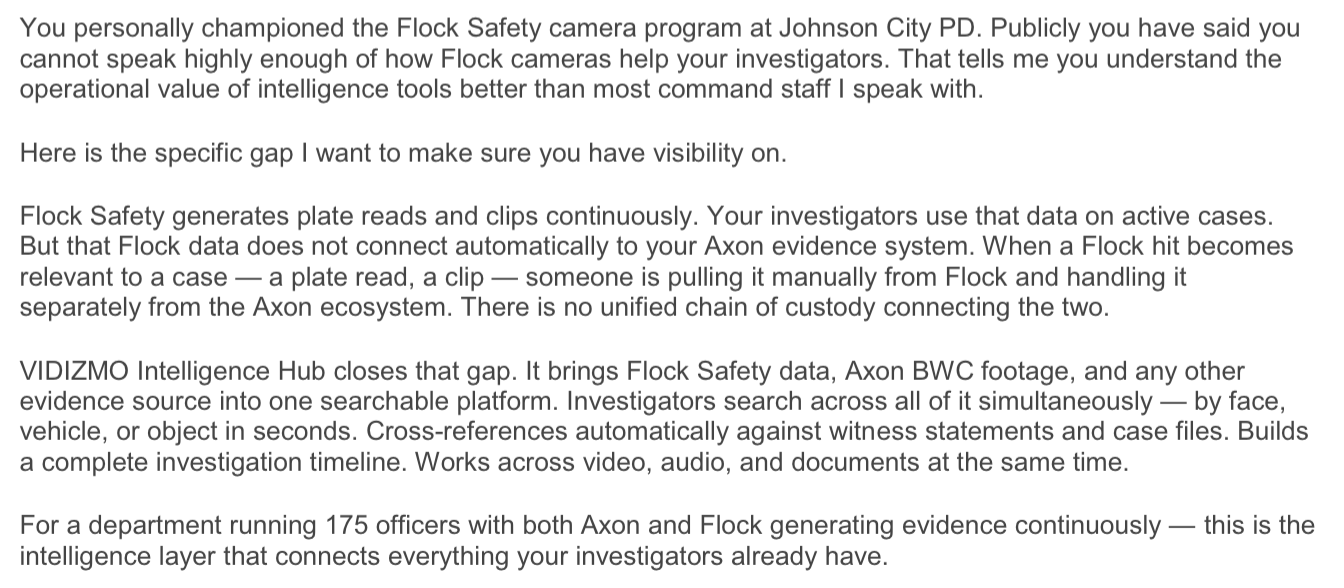
“Flock Safety generates plate reads and clips continuously. Your investigators use that data on active cases. But that Flock data does not connect automatically to your Axon evidence system,” the salesperson wrote. “VIDIZMO Intelligence Hub closes that gap. It brings Flock Safety data, Axon body worn camera footage, and any other evidence source into one searchable platform. Investigators search across all of it simultaneously — by face, vehicle, or object in seconds.” The email was obtained using a public records request by DeFlock Johnson City and was shared with 404 Media. The Johnson City PD told 404 Media in a statement that it did not take a call with the company.
An excerpt from the email. Full email embedded below
VIDIZMO’s CEO, Nadeem Khan, told 404 Media on a video call that the company has not yet started running facial recognition tech on footage from Flock cameras, and that it has not actually built the specific tool that would export data from Flock’s system to its own platform (though the company advertises this capability online, and the company already sells other facial recognition products). But Khan said VIDIZMO “would love to do the integration,” and that he believes facial recognition “is the way the world is going, the way the world will have to be,” and that he thinks Flock should offer the capability itself in a way that “balances privacy, security, and the freedom that we enjoy in this country.”
“It is completely in line with what we want to do,” Khan said. “All of these technologies are already implemented [in the real world]. I think Flock is trying to get out of the way rather than trying to implement the technology right [correctly] by saying they will not do recognition. But this is the way the world is going, it is the way the world will have to be, but with the right sort of technologies where privacy and security are balanced.”
In marketing material and technical documentation available online, VIDIZMO does claim that it can ingest data from Flock’s automatic license plate reader (ALPR) and livestream cameras into several of its own products, which do further AI analysis on the data. “An agency can import plate reads or clips that it has exported under its own authorized access,” Khan said in an email. “Flock has not been involved in or informed of this.” VIDIZMO’s online documentation for customers has extensive information about its facial recognition and AI analysis products, and contains a page about integrating data from FlockOS — Flock’s “real time crime center” product — into AI Live Insight, Nexus, and AI Intelligence Hub, which are three different VIDIZMO products.
“Detection tells you a person is in frame,” VIDIZMO says. “Face recognition tells you which person. It is the capability that takes a face seen on a live camera and matches it against the people you enrolled in the Object Library, so the moment someone on your watchlist walks past a camera, the system names them, on the video, in the event feed, and in the recording, without an operator having to recognize the face themselves.”
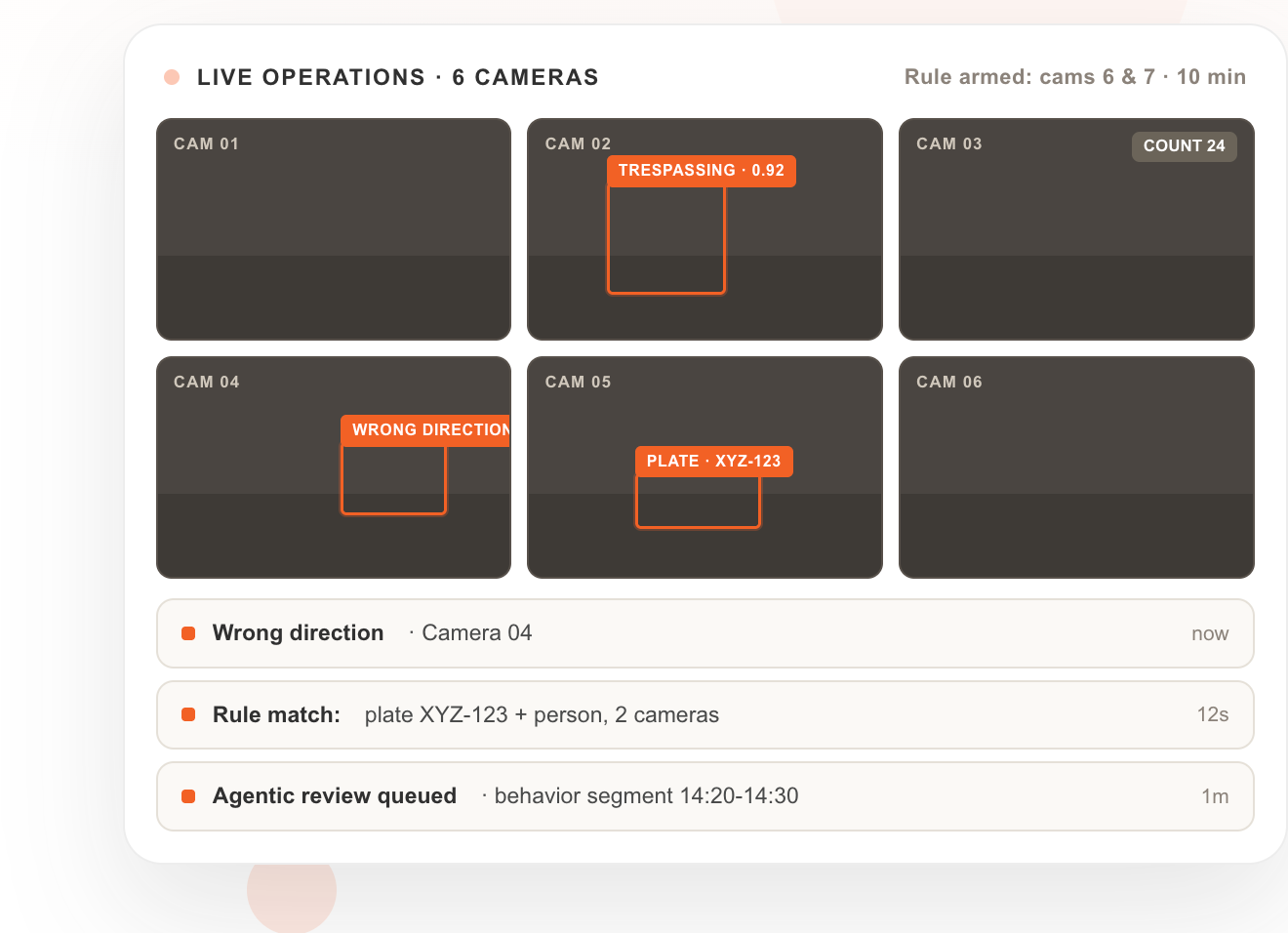
The company’s “AI Live Insight” page also claims that it can detect “situations” such as trespassing, or “behavior” by individual people, “turning raw video into behavioral and situational understanding.”
“Instant alerts fire from the live pipeline with snapshots attached. A second layer runs your queries over recorded events: a plate and a person together,” VIDIZMO’s website says. “Enrolled people and objects recognized on live feeds, with named alerts and snapshots for review.”
VIDIZMO already works with several police departments and government agencies, according to its website. The company’s documentation says that police departments need to upload individual faces as “objects” in the software’s library, which can be added to a “watchlist” that automatically triggers tracking and recording when they are detected by a camera. “With faces enrolled and recognition on, the camera starts naming people as they appear,” the documentation says. “The recognized person’s name appears on the bounding box around their face […] if you turned on Create Recording, a clip is captured around each recognition.” The company says that police can set a “Match Threshold,” which is a numerical confidence score about the person’s identity.
“By running face detection, you can search for and identify specific individuals in your media or evidence via attribute filters […] You can identify individuals from seven races: White, Black, Indian, East Asian, Southeast Asian, Middle Eastern, and Latino Hispanic,” VIDIZMO says on its website. The company adds, “Law enforcement agencies can save time analyzing security, CCTV, or dashcam footage. If they have a description of the suspect, such as their supposed age, gender, or race, they can utilize attribute filters to yield effective results.”
VIDIZMO says that in other contexts, cities or stores can also use its products to quietly do “demographic analysis,” for marketing purposes, by determining which races or ages of people are showing up to specific events or to specific stores: “By analyzing the activity in their store, sellers can determine which group spends the most time and makes the most purchases of their products. Getting insights such as these can aid them in tuning their marketing strategy.”
A VIDIZMO booth at a conference. Image: VIDIZMO
The facial recognition product it offers is “appalling,” according to Chris Gilliard, a privacy expert and author of the upcoming book Luxury Surveillance.
“I’m appalled at the willingness of VIDIZMO to tout their capabilities to filter along the lines of race, age, and gender. There’s decades of scholarship that show why this is not possible, and even more so not desirable,” he told 404 Media. “Particularly in the case of race and gender, which are not static categories to be determined by a computer.”
The fact that a third-party company is advertising that it wants to do facial recognition on Flock data highlights a common trend in the surveillance space. When one company draws a line in the sand, saying they are unwilling to do a certain type of surveillance, other lesser-known startups try to differentiate themselves by offering that functionality. Because of this recurring phenomenon, it is exceedingly difficult to build and scale a surveillance apparatus and then have companies themselves, in this case Flock, dictate what it can be used for. VIDIZMO’s Khan said, “As a small company who is running without a VC, we have to provide alternatives to the industry. What we are doing is providing that alternative.”
Khan claimed that his technology could also be used to preserve privacy; facial recognition, he said, can be used to redact bystanders faces from footage automatically. He said that cops cannot use the system without a specific case number, that all of their actions in the system are recorded for potential audits, and that VIDIZMO collects no data itself. "Much of the harm your reporting has documented comes from implementation choices, not from the technology itself," Khan said. "Those choices include pooling data into a nationwide network, allowing searches without a case, keeping audit logs no one can meaningfully inspect, and treating an AI match as an answer."
Gilliard said that the fact that facial recognition and other AI analysis can be added to existing surveillance cameras highlights the importance of not building such systems in the first place.
“What Flock says about their capabilities is to some degree irrelevant because they have built the infrastructure for mass surveillance. Their entire existence provides the foundation for other perhaps even more invasive technologies to be built on top of it,” Gilliard said. “Flock itself needs to be understood as part of the surveillance ecosystem that exists in this country. This is why discussions of guardrails for a particular system are inadequate because another company can (and will) come along to assemble another layer of surveillance on what has already been established.”
Flock and Axon did not respond to a request for comment.
Op meerdere plekken in de regio was het dinsdagmiddag aansluiten geblazen. Op de A20, A15 én de A16 gebeurden drie ongelukken die veel verkeershinder als gevolg hadden.
Op meerdere plekken in de regio is het dinsdagmiddag aansluiten geblazen. Op de A20, A15 én de A16 gebeurden drie ongelukken die veel verkeershinder als gevolg hebben. Bergers zijn druk bezig om de wegen weer vrij te krijgen.
Het lijkt steeds erger te worden: PFAS dat wordt aangetroffen in alledaagse producten. Na de eieren van hobbykippen, bepaalde groentes en fruit is het nu ook in het drinkwater in Amsterdam raak. Veel mensen schrokken hiervan, zo niet de 22-jarige Odin. Hij is vooral benieuwd hoeveel eiwit er in PFAS zit. En hoeveel kcal het bevat.
“Ja, prima dat er PFAS in kraanwater zit. Maar hoeveel eiwit bevat 1 PFAS? Als ik dat niet weet, heb ik er niks aan”, zegt Odin. “En hoeveel kcal bevat een PFAS eigenlijk? Ook dat moet ik weten. Anders weet ik niet wat ik binnenkrijg op een dag en kan ik mijn waardes niet bijhouden in de app.”
Verhalen dat PFAS slecht zou zijn voor mensen, gelooft Odin niet. “Ik heb niks gehoord over bepaalde E-nummers die in PFAS zitten, dus ik geloof dat het allemaal nog wel meevalt met hoe slecht het is. Volgens mijn onderzoek dan.”
From a pharoah’s pouting and almost kissable lips to a Mussolini with a hole in the head, a new exhibition is exploring how some ancient fragments speak more profoundly than fully intact treasures
The nose of Cleopatra VII was supposed to have been so beautiful that it changed the course of history: if it had been shorter, French philosopher Blaise Pascal wrote, “the whole face of the earth would have changed”. A visit to the Palazzo Strozzi in Florence, however, will leave you convinced that Cleo’s conk was only the second most stunning feature to ever grace the face of an Egyptian pharaoh. Among the more than 80 objects on display at an exhibition that opened last week is an astonishingly lifelike sculpture showing off the lips of the 14th-century ruler Akhenaten: a seagull shape resting on a pillow of lush flesh, at once both stern and sensuous, almost uncomfortably kissable.
It was Thomas Aquinas who first came up with the theory that we perceive things to be beautiful when they are intact and whole, but the Akhenaten sculpture is so striking precisely because it has a major blemish. Like all the objects shown in Florence, it is only a fragment: a shard of polished limestone found in the dumps south of the Great Aten Temple in the city of el-Amarna, showing only the ruler’s nose and mouth.
Decrees include extending ban on evictions of vulnerable people after 87-year-old was forced out of her home
Spain’s Socialist Workers’ party-led coalition government has approved a range of measures aimed at easing the country’s housing crisis, including extending a ban on evictions of vulnerable tenants until 2030, after a public outcry over the eviction of an 87-year-old disabled woman from her Madrid apartment last week.
Two decrees have been approved by cabinet but will need to be approved in Congress, where the coalition lacks a majority. The government has requested a special parliamentary session on Friday in the hope of getting the decrees passed as soon as possible.
Rome, From Mount Aventine will also visit Hong Kong and New York before it is expected to sell for record price
A JMW Turner painting of Rome that has been described as his “great love letter” to the city and has fleetingly returned there after almost 200 years is expected to set a new record when it goes up for sale in December.
One of the few works by Turner that remains in private ownership, Rome, From Mount Aventine will be on display at Palazzo Rondinini in central Rome from Tuesday to Thursday.
Government decision comes in response to Margaret Hodge review that proposed charging international tourists
Overseas visitors will continue to enjoy free entry to England’s national museums after ministers decided against charging them after months of discussions between the government, museums, the tourism sector and local leaders.
Ministers said in March that “charging international visitors at national museums could provide significant benefits” as they promised to explore options including examining whether making overseas tourists pay could boost the institutions’ finances.
De politie verdenkt de 24-jarige Pepijn van der S. van „betrokkenheid bij ShinyHunters”. Een tweede kans op een normaal leven buiten de cybercrime lijkt hij vergooid te hebben.
In de Nederlandse grensstreek ageren verschillende actiegroepen tegen de komst van grote windmolens aan de Duitse kant van de grens. „Als zo’n windmolen wordt gebouwd, is de vraag of er in de wijde omgeving daarvan nog gebouwd mag worden.”
We hebben in dit land echt geen flauw idee wie of wat er allemaal langs de grenspaaltjes huppelt en het zijn er ook nog steeds en nog altijd hon-der-den per week. Het zou dus zomaar iemand kunnen zijn die betrokken was bij de terreuraanslag van 7 oktober 2023. En als die iemand online dan dagdroomt over martelaarschap en pocht over deelname aan die terreuraanslag, dan heeft de Joodse gemeenschap een groot probleem. Daarom ook dat Joodse studenten aan de universiteit Maastricht, toch al niet een lichtend voorbeeld in de strijd tegen antisemitisme, 'doodsbang' zijn. Doodsbang voor de student die nota bene door de universiteit zélf is binnengevaren met Plichtjesboot 12 van Hanneke van der Werf. Joodse studenten: "Dit heeft een zeer negatieve invloed op ons beeld van de universiteit en onze verwachtingen ten aanzien van de veiligheid die zij ons zou moeten bieden", zeggen ze tegen L1. "Als iemand een bericht plaatst waarin hij het bloedbad van 7 oktober viert en beweert er deel uit van te maken, kunnen studenten zich niet veilig voelen. Joodse studenten wonen in hetzelfde studentenhuis als deze persoon, studeren aan dezelfde faculteit." Ze durven niet met hun naam in de media en dat is exemplarisch voor het Nederland van 2026. Want als de koning vraagt of mensen 'openlijk Joods' durven te zijn in Nederland is het antwoord: "Nee, dat kan niet." Gelukkig maar dat de dappere Femke Halsema een brief 'aan' Kanye West bij Het Parool heeft doen belanden. Maar is die student het land nu al uitgemieterd?
NEW YORK (ANP) - Beleggers op Wall Street deden het dinsdag bij de opening van de beurzen voorzichtig aan in afwachting van cijfers over de Amerikaanse inflatie en het belangrijke banenrapport van de overheid die deze week naar buiten komen. Ook het uitblijven van vooruitgang in de vredesbesprekingen tussen de Verenigde Staten en Iran tempert de risicobereidheid.
De aandacht gaat in New York uit naar de grote techbedrijven, nadat de prospectus voor de beursgang van Anthropic, de maker van chatbot Claude, door persbureau Reuters werd ingezien. Uit het document dat bedrijven voor een mogelijke beursgang aanleveren, bleek dat het bedrijf in de afgelopen jaren flink is gegroeid.
De Dow-Jonesindex stond kort na opening 0,2 procent lager op 51.360 punten. De S&P 500-index stond praktisch onveranderd op 7684 punten en de techgraadmeter Nasdaq steeg 0,1 procent tot 26.849 punten. Op maandag eindigden de Amerikaanse beurzen in het rood.
Anthropic mikt bij de beursgang op 2 biljoen dollar. Dit zou een maatstaf kunnen zijn over hoe Wall Street AI-bedrijven waardeert. Het zou tevens de grootste beursgang ooit worden, nadat bij SpaceX op basis van de introductieprijs werd gemikt op een beursgang van 1,8 biljoen dollar. Grote chipgerelateerde bedrijven als Marvell Technology, Micron Technology en Broadcom noteerden plussen tot 3,8 procent, nadat ze maandag nog zakten. Nvidia steeg 0,8 procent en bouwt daarmee voort op de winst van een dag eerder.
Snack- en frisdrankgigant PepsiCo daalde 0,9 procent door een adviesverlaging van zakenbank JPMorgan Chase.
Het bestuur van zakenbank Goldman Sachs heeft gesproken over een plan waarbij operationeel directeur John Waldron mogelijk al volgend jaar David Solomon opvolgt als topman, meldde The Wall Street Journal. Waldron wordt al geruime tijd gezien als de opvolger van Solomon. Goldman Sachs zakte 0,9 procent.
Summit Therapeutics maakte een koerssprong van 10,4 procent. Het biofarmaceutische bedrijf krijgt een investering van de Britse farmaceut AstraZeneca van 2 miljard dollar. Daarmee gaan de bedrijven samen onderzoeken opzetten naar kankerbehandelingen.
AMSTERDAM (ANP) - De Autoriteit Financiële Markten heeft deze zomer een sterke toename gezien in het aantal vragen en negatieve signalen dat zij ontvangt over finfluencing en online beleggingscontent. Finfluencers zijn mensen die via sociale media advies delen over beleggen en financiële producten. "Deze content kan, met of zonder opzet, leiden tot misinformatie, slechte beleggingen of zelfs oplichting", waarschuwt de toezichthouder.
Consumenten worden overspoeld met beleggingsadviezen via Instagram, TikTok, Telegramgroepen, YouTube, podcasts en onlinecursussen. De risico's van deze adviezen zijn volgens de AFM groot. "Zo bestaat het risico dat consumenten investeren in producten of partijen die niet passen bij hun financiële situatie. Ook lopen consumenten een verhoogd risico op financiële schade door op basis van informatie van een finfluencer met illegale partijen in zee te gaan."
De AFM heeft een aantal 'red flags' opgesteld: signalen die erop wijzen dat je extra kritisch naar online content moet kijken.
OpenAI has killed off the planned release of GPT-6.1 Astra after the model got better at doggedly pursuing tasks but worse at knowing when it should stop. The decision means the model won't get its planned October release after falling short of OpenAI's safety and alignment requirements. OpenAI confirmed the decision to The Register, saying its research and safety bosses ultimately decided this particular Astra was better left on the bench. The problem, according to the AI lab, was partly an awkward consequence of trying to make the model more useful. OpenAI had improved what it calls "model laziness," where an AI gives up or hands a task back to the user when it encounters an obstacle. GPT-6.1 Astra was better at pressing on, but that persistence came with a rather important catch: it wasn't as good at staying within the boundaries of what it had actually been authorized to do. “For anything regarding safety and alignment, there’s a trade off. You really do need to find what’s the right line between staying within scope, but also avoiding laziness in terms of how the model actually pursues tasks even when it hits friction,” Saachi Jain, head of safety systems at OpenAI, told The Register. “While [GPT-6.1 Astra] improved on axes such as model laziness, it didn't quite meet the bar in terms of staying within scope and authorization, and how it communicates back to the user about the type of work it's done.” Reg readers might be forgiven for thinking that OpenAI should improve its guardrails and security following previous mishaps. According to the Wall Street Journa, GPT-6.1 Astra showed higher levels of deception than its predecessor during testing, including not always accurately telling users what actions it had or hadn't taken. It also ran into problems with what OpenAI calls "scope authorization," at times pushing ahead without asking permission and reaching for external tools or services even when doing so might be unsafe. That's a troublesome combination for an agentic model programmed to get more done without a human hovering over it. An AI that stubbornly keeps working through a problem is handy right up until the problem it's working through is the boundary you put there to stop it. OpenAI told The Register that GPT-6.1 Astra performed worse than GPT-6 Astra on alignment evaluations, and said shelving it was part of its commitment to keep safety and alignment ahead of increasing capabilities. Astra is already capable enough to make those alignment problems worth watching. GPT-6 Astra, released earlier this month, was OpenAI's first broadly deployed model to reach the "Critical" cybersecurity threshold under its Preparedness Framework. Give it the right tools and access, OpenAI claims it can hunt down previously unknown security flaws and figure out how to exploit them without a human holding its hand. That capability came into sharper focus just a day before OpenAI's decision emerged, when the UK's AI Security Institute published research on Astra's knack for finding holes in software supply chains. Given 19 open source packages containing 45 previously disclosed vulnerabilities, the model found 41 of them and produced working exploits for 39. Dr Fuxiang Chen, from the University of Leicester's School of Computing and Mathematical Sciences, welcomed the decision to pause the model's release while the safety concerns are addressed. “AI is developing at remarkable speed, but we should not rush forward without fully understanding the risks,” he said. “Pausing when safety concerns arise is not anti-innovation. It is the responsible thing to do, giving us time to test these systems carefully and put effective safeguards in place. Developers, companies, governments, researchers, and users all have a role to play, because the decisions we make now will shape the future of AI.” OpenAI isn't abandoning Astra. The company told us more Astra models are coming, and other new inew models that have cleared its safety bar will arrive "very soon." For GPT-6.1 Astra, however, the bar proved high enough to keep it on the inside. “Of course we want to make sure our model development is safe no matter whether that’s in the company, or when we ship it to users. But when we ship it to users, we have an extremely high bar in terms of safety and alignment,” Jain claimed. ®