The Register

Biting the hand that feeds IT — Enterprise Technology News and Analysis

Fewer women than ever in UK's 'old boys' club' cyber industry

The proportion of workers in the UK cybersecurity industry identifying as women has dropped to 16 percent, the lowest level since 2021. Gender diversity has long been an issue pervading the STEM fields, although in cybersecurity this is especially pronounced, both at senior leadership and education levels. This is despite evidence that girls regularly outperform boys in STEM subjects at UK schools when they do participate. Not only are there still fewer women students in cybersecurity courses than those opting for computer science, but the percentage of women in the senior workforce (6+ years of experience) drops further to 12 percent – a figure that has remained broadly consistent since records began. For context, the UK average across all industries for female-identifying workers is 48 percent. Across the digital workforce, as of last year’s data, the average is 30 percent. The UK government interviewed various stakeholders in the cyber industry, finding that the barriers to senior leadership positions were structural – employers are purposely excluding women at higher levels. History plays a part too – older heads remaining in their positions from back when gender diversity was a matter less discussed – but recruiters say employers are still holding women back based on their perceived family ambitions. One recruitment agent was quoted in the report as saying: “When I’ve spoken to a business and said to them ‘why don’t you hire a more diverse workforce?’ You’ll get the normal common ones of ‘well if we hire a female, she’ll get pregnant, she’ll be off for 12 months,’ which isn’t right.” Refusing to hire women based on assumptions or fears about future pregnancy is a form of illegal gender discrimination that directly violates the UK's Equality Act 2010. Other common barriers to senior positions include assumptions they did not have the requisite technical skills for the role, and that cybersecurity is still seen as “an old boys’ club.” “This tied into a broader finding that stereotypes about women not being interested in cybersecurity continued to persist,” the report noted. “A cybersecurity firm noted that during a career talk on cybersecurity, a group of girls walked out of the talk, and the careers teacher reinforced the perception that the sector did not appeal to women.” The business told the government: “I went to the careers lady ‘What was the story with the five girls that left?’ And she went ‘Oh, cyber security is not really a girl’s job’.” Jill Broom, head of cyber resilience at techUK, said the onus is on employers to work harder on breaking down the lingering stereotypes about women in cybersecurity. “Cybersecurity underpins our growth, our economy and the safety of our society, with the sector offering growing employment opportunities and career prospects,” she told The Register. “However, the underrepresentation of women in this industry remains a significant concern. “A lack of gender diversity not only limits opportunities for women to benefit from this growing sector but also risks narrowing the range of perspectives and ideas that are essential to tackling increasingly complex cyber threats. Educators and employers must work together to challenge stereotypes, break down barriers and promote cybersecurity as an accessible and inclusive career path.” Representation for other groups fared comparatively better. This past year set a new record for neurodivergent workers in the cybersecurity industry, with 22 percent of UK staff identifying as neurodivergent. The figure represents a sharp increase from 16 percent the year before, one that has grown each year consistently since the 9 percent reported in 2020, and exceeds the digital sector average of 19 percent. “Cybersecurity is the most neurodiverse sector I have ever seen, and I think personally it’s celebrated, especially internally within the sector,” one respondent from a small cybersecurity business told the report's authors. While this year’s results may prove especially welcome to the neurodiverse crowd, the report noted this may reflect the rising awareness of neurodiversity among employers, rather than a true increase in numbers. The representation of ethnic minorities also remained at 19 percent, the same proportion as in 2025’s data, although this was a modest rise from 2024, in which 13 percent were from ethnic minorities. The figure is aligned with the digital sector average of 20 percent, and exceeds the UK’s pan-industry average of 16 percent. However, the representation of these groups suffers at the senior levels. The proportion of ethnic minorities in senior positions stands at 9 percent, a low figure that has persisted for the third year running, and one that is considerably down from the 15 percent high of 2021. As for explanations, the report offered few. “Ethnicity was hardly mentioned and was not generally felt to be an issue, despite the quantitative findings suggesting ethnic diversity at senior levels has remained lower than in the 2021 to 2023 studies,” it stated. “Most commonly, participants did not offer any concrete suggestions for enabling the progression of staff from diverse backgrounds into senior cybersecurity positions. Some employers stated that career development was open to everyone and was based on merit.” For neurodivergent security pros, it was not their technical abilities holding them back, but some said a lack of soft skills may hinder them in senior-role scenarios. “They’re more than capable of doing a leadership role,” said one small cybersecurity business. “It’s just they might not be soft-skilled enough to deal with difficult teams, difficult conversations. But to be honest, I’ve seen some fantastic people who are neurodiverse in leadership roles.” Disabled people are continuously absent from the workforce too, occupying just 9 percent of UK roles and 5 percent of senior positions. This is both less than the digital sector average of 15 percent, and significantly less than the UK’s pan-industry average of 18 percent. ®

Cape Raoul Pt. II

niggyl :) has added a photo to the pool:

Cape Raoul Pt. II

Cape Raoul on the Tasman Peninsula, south eastern Tasmania.

A wild old day and this photo taken from the deck of Surveyors Hut on the Three Capes Track. October 2020.

The Cape was named in 1792 by French explorer Chevalier
Antoine Raymond Joseph de Bruni d'Entrecasteaux - in honour of the expedition's pilot.

There are many stories of the columnar dolerite pillars on the cape being used for target practice by various passing warships. Earliest mentions in print (along with the terms 'vandalism' and 'dismay') date from the 1890s with other reports as late as the 1960s. No images/depictions exist of the original cape but apparently it once fair bristled with spines and spires. Big gun, little *****.

Fuji X-T1, XF18-55/2.8-4, 1/75th sec at f/9, ISO 200. FL 55mm Windspeed ~40 kts.

Rijnmond - Nieuws

Het laatste nieuws van vandaag over Rotterdam, Feyenoord, het verkeer en het weer in de regio Rijnmond

Auto slaat meermaals over de kop | Fietser gewond na aanrijding

In dit liveblog houden we je op de hoogte van het belangrijkste en meest opvallende 112-nieuws van donderdag 1 oktober.

Fietser gewond na aanrijding | Geparkeerde auto in vlammen op

In dit liveblog houden we je op de hoogte van het belangrijkste en meest opvallende 112-nieuws van donderdag 1 oktober.

Geparkeerde auto in vlammen op | Brand in bestelbus

In dit liveblog houden we je op de hoogte van het belangrijkste en meest opvallende 112-nieuws van donderdag 1 oktober.

Wel.nl

Minder lezen, Meer weten.

Heinen: belastingplan moet nog worden aangepast

DEN HAAG (ANP) - Het belastingplan moet nog worden aangepast aan de hand van wensen vanuit de Kamer, zei financiënminister Eelco Heinen (VVD) aan het begin van de tweede dag van de algemene financiële beschouwingen. "Dat is helder." Hij snapt "heel goed" dat partijen nog veranderingen willen. De bewindsman kondigde aan later in het debat te schetsen waar hij denkt dat mogelijke oplossingen liggen.

Onder meer oppositiepartijen JA21 en PRO gaven woensdag aan niet van plan te zijn om het huidige belastingplan te steunen. De partijen zijn het niet eens met de geplande hogere belastingen voor werkenden, maar over alternatieven daarvoor verschillen ze van mening.

Heinen is nog altijd "optimistisch" dat een meerderheid van de Kamer dit najaar voor het belastingplan stemt.


Massabegrafenis in Gaza-stad van doden uit 2023

GAZA-STAD (ANP) - In de Gazastrook is de massabegrafenis begonnen van mensen die omkwamen bij een bombardement op het Al-Taj-complex, een woonblok in Gaza-Stad, in 2023. Van onder het puin zijn 105 lichamen en stoffelijke resten gehaald die donderdag worden begraven, meldt Al Jazeera.

In de weken na de aanval van Hamas op Israël op 7 oktober 2023 zou het Taj-complex meerdere keren zijn gebombardeerd. Volgens Al Jazeera zaten tijdens de bombardementen veel Palestijnen in het complex die uit het noorden van de Gazastrook waren gevlucht voor Israëlische aanvallen.

Massabegrafenissen vinden vaker plaats in Gaza nadat lichamen onder puin vandaan zijn gehaald. De Palestijnse burgerbescherming schat het aantal mensen dat nog onder het puin ligt op meer dan 8000. Volgens Al Jazeera is 90 procent van de infrastructuur in Gaza beschadigd. Door Israëlische beperkingen beschikken reddings- en bergingsploegen over een tot enkele graafmachines, melden verschillende media.


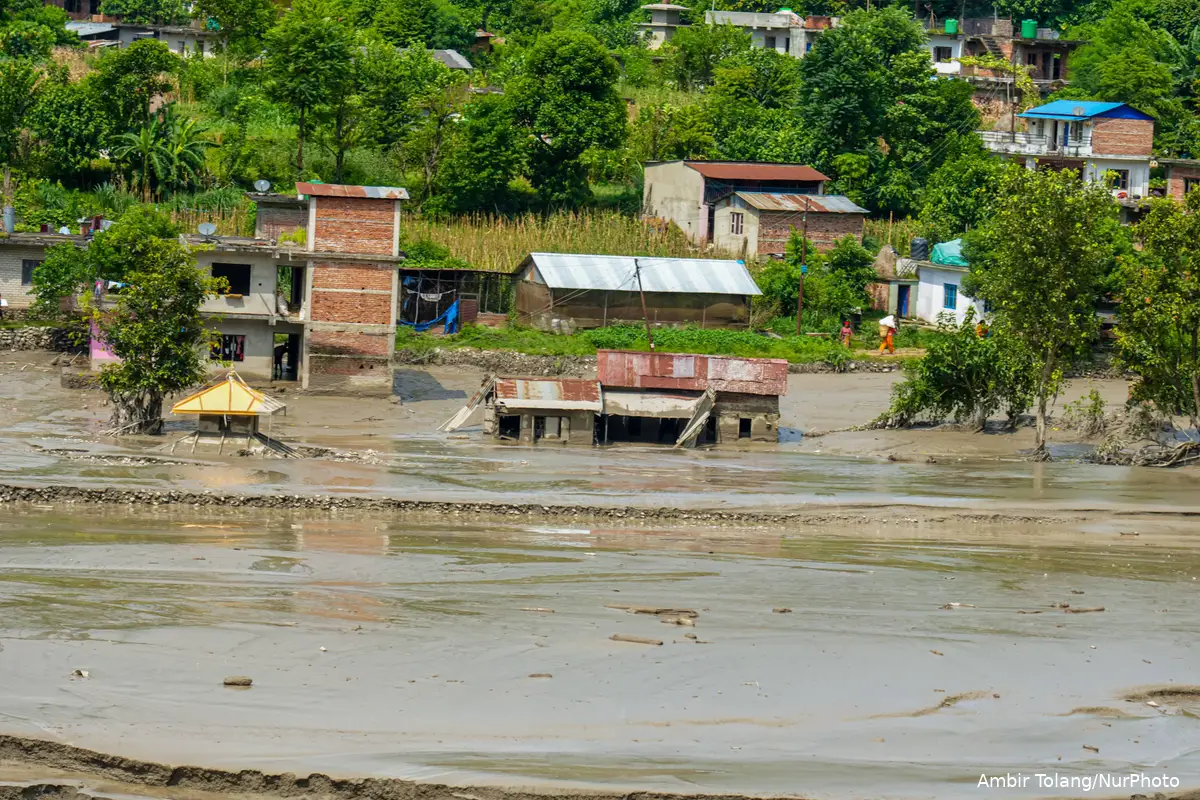
Nieuwe beelden uit Nepal: immense bergwand stort in kolkende rivier, deel van dorp verdwijnt in de diepte

Nieuwe, angstaanjagende beelden uit Nepal gaan de wereld over. Een video toont het moment waarop een hele berg in een kolkende rivier stort. Een andere video laat zien hoe huizen in de diepte verdwijnen, terwijl dorpsgenoten erbij staan te kijken.

De gruwelijke clip begint op het moment dat een enorm stuk berghelling, met alles erop en eraan, van bomen tot huizen en hutten, in één klap de vallei in verdwijnt. Getraumatiseerde bewoners gillen en rennen voor hun leven.

Ernstig noodweer

De autoriteiten in Nepal en India hebben na ernstig noodweer melding gemaakt van meer dan honderd doden. Zware regenval leidde tot overstromingen en aardverschuivingen.

De meeste slachtoffers vielen in Uttar Pradesh, een Indiase deelstaat die grenst aan Nepal. Daar zijn de afgelopen dagen zeker 81 mensen omgekomen, zeggen de autoriteiten.

Overstromingen

Wegen liepen er onder water en dorpen raakten afgesneden van de buitenwereld. De slachtoffers vielen onder meer door modderstromen en overstromingen. Bomen zijn omgevallen, gebouwen ingestort en ook elektrocutie heeft levens gekost.

In Nepal wordt melding gemaakt van 27 doden. Ook zijn er zeven gewonden en worden nog vier mensen vermist, meldt de rampenbestrijdingsdienst.

Smeltende permafrost

De nieuwste ramp trof het gebied langs de Kali Gandaki-rivier, nog maar een maand na de instorting van gletsjer en gesteente in de regio Langtang op 26 augustus. Die zorgde voor apocalyptische overstromingen, kostte meer dan 3.000 mensen het leven en liet duizenden anderen vermist achter.

De twee rampen vonden vlak bij elkaar plaats, maar dat betekent niet automatisch dat de laatste een gevolg is van de eerste. Wetenschappers waarschuwen wel dat stijgende temperaturen, smeltende gletsjers en ontdooiende permafrost de hellingen van de Himalaya steeds instabieler maken. Hetzelfde gebeurt dichterbij in de Alpen, waar het beklimmen van bergen als de Mont Blanc steeds gevaarlijker wordt door vallend gesteente.

Bekijk hieronder de beelden:


Olympus PEN-F + Vario-Elmarit 12-60mm ASPH

wing of kaz has added a photo to the pool:

Olympus PEN-F + Vario-Elmarit 12-60mm ASPH

長崎県雲仙市、雲仙温泉神社 / Unzen Onsen Shrine, Unzen City, Nagasaki Prefecture

The Guardian

Latest news, sport, business, comment, analysis and reviews from the Guardian, the world's leading liberal voice

Would I want my child to study for a social media influencer degree? No, but it’s the way of the world

What next, you might think, as you consider the UK university course: a BA in the manosphere? Take a look at media job listings to set yourself straight

Sometimes you read a story in the news that seems designed to wind up as many people as possible. This week, that story involves a degree in content creation from Nottingham Trent University. Otherwise known as the “influencer degree”, this three-year course comes with BA (Hons) status and a top-tier price tag of almost £10,000 a year, for which students will learn “hands-on technical production”, “analytics, branding and commercial strategy” and collaboration with brands and “industry partners”. Course leaders are at pains to point out it won’t turn them into overnight social media stars, but of course, while reading, I felt the cold drag of undertow forces pulling me towards world-gone-mad outrage.

We’ve been here before, obviously: media studies, women’s studies, anything that hasn’t been on the syllabus of the ancient universities for at least 500 years is vulnerable to accusations of dumbing down – and this is no different. The course was launched in 2022, meaning its first cohort of graduates are out there looking for jobs right now, while giving interviews about whether or not it was worth it. One very sensible-sounding graduate, talking to the BBC this week in what one assumes is an application of the all-publicity-is-good-publicity principle learned from her course, said that the £30,000 spend was worth it for the networking opportunities alone – an absolutely valid point and half the reason why people strive towards Oxbridge.

Continue reading...

Group encouraging people to join Green party to back ‘Zionism is racism’ agenda

Exclusive: Greens for Palestine group has links to activists who say pro-Israel ‘infiltrators’ must be rooted out of UK

An organisation pushing the Green party to equate Zionism with racism has encouraged people to join the party specifically to support that agenda, and has links to activists who say that pro-Israel “infiltrators” must be rooted out of the UK, the Guardian has learned.

Some Green members are increasingly concerned that the party risks being manipulated by extremist outsiders over a motion to be voted on at the party’s annual conference this weekend, which states that “Zionism is racism”.

Continue reading...

UK bookmakers that warned over illicit market had deal with offshore casinos

Content provider part-owned by Ladbrokes, William Hill and Betfred owner signed deal with Santeda network, Casino Secrets leak reveals

Three UK bookmakers that have repeatedly warned of the dangers of the illicit market have also benefited from a lucrative deal with one of the world’s largest offshore casinos, the Guardian can reveal.

Details of the arrangement emerged as a result of last week’s Casino Secrets leak, which saw the release of thousands of confidential files held by the gambling regulator on the Caribbean island of Curaçao, a haven for offshore betting sites.

Continue reading...

‘A saving gesture’: the art exhibition spotlighting US prisoners’ creations

A trio of shows at Michigan’s Grand Rapids Art Museum humanizes people who are incarcerated and celebrates the resilience of creativity

With nearly 2 million people behind bars, America is the global leader in incarceration. When you look at it per capita, we have the highest rate of incarceration of any independent democracy and rank fourth overall in the world, just behind El Salvador, Cuba and Turkmenistan.

Despite these troubling numbers, mass imprisonment is largely invisible. “Our carceral system is something we as a society try to separate out from the everyday,” observes Terra Warren, an assistant curator at Grand Rapids Art Museum, Michigan, who alongside curator Jennifer Wcisel brings audiences three solo shows from artists Julie Green, Gary Tyler and Ray Materson. They collectively aim to make us examine more closely just what prisons are doing to our society – and how art can prove transformative to those incarcerated.

Continue reading...

20 fascinating facts about hair: why baldness is super-masculine – and a pubic bush could be a ‘cheating detector’

Judy Wearing has spent much of her life studying our follicles. She explains how our armpits betray our emotions, why some gentlemen really do prefer blondes and the reason we evolved to have eyebrows

As a PhD student at Oxford studying mating behaviour, Judy Wearing was suddenly struck by a thought: what was the purpose of pubic hair? The point of armpit hair? The function of each of our body’s furry patches? When the published literature failed to produce satisfying answers, Wearing began her own investigation. Her aim was to shed light on why exactly we evolved these particular patches, with pubic hair the most puzzling of all: was it for warmth, protection … or something else?

Wearing is still tangling with those questions, some 30 years after her student days. Now an author and editor (largely in the education sector), she has revisited her fascination with hair in Anxious and Hairy: The Evolution and Culture of Human Hair, exploring its unexpectedly dense and layered place in our history and psyche. Even Wearing was surprised by the places her research on hair took her, and the mysteries that still remain to be solved. “A lot of these questions, no one’s actually looked at,” she says over Zoom. Here is a mere snip of the fascinating facts she’s uncovered about hair.

Continue reading...

‘It’s utter surrealism’: Venezuela’s Chavistas lament government’s embrace of Trump

Diehard Hugo Chávez supporters struggle to comprehend ideological U-turn being executed by Delcy Rodríguez’s interim administration

He was one of the most passionate propagandists for Hugo Chávez’s Bolivarian revolution: a feisty leftist TV personality who spent more than two decades singing the movement’s praises on his state-funded show, The Razorblade.

Mario Silva’s devotion was such that he often hosted his programme with Chávez’s portrait behind him and he had El Comandante’s curly signature tattooed on to his left wrist.

Continue reading...

‘They showed no mercy’: mapping the Rohingya villages being erased by rebel forces

Nearly a decade after the ethnic cleansing of Rohingya people by Myanmar forces, satellite images show the insurgent Arakan Army is now emulating the killings and land grabs

There are at least 10 camps like the one on the paddy fields at Hnget Thay, built after the insurgent Arakan Army (AA) took control of most of northern Rakhine state in 2024. These are where many Rohingya people in the state now have to live. Others hide in the mountains, or flee abroad to the refugee camps of Bangladesh or make deadly boat journeys to Malaysia.

The arrival of more than 155,000 Rohingya in Bangladesh since 2024, which amounts to 25% of the 600,000 estimated to still be in Myanmar, has raised concerns about the very survival of a people who now mostly live abroad as refugees.

Continue reading...

Forget ‘superintelligence’: error-prone AI nearly sparked world war three this month | Timnit Gebru and Emily M Bender

The risks of AI aren’t what we think they are, as a recent security incident between China and the United States reveals

Amid a barrage of news stories warning about superintelligent machines rendering humanity extinct, a CNN story describing the opposite scenario – one in which the US military’s reliance on brittle chatbots almost brought the US into war with China – went mostly unnoticed by the public.

The biggest international AI news of the past three weeks was Anthropic engineer Jacob Coxon’s resignation. According to him, OpenAI and Anthropic are “racing straight towards self-improving superintelligence and gambling with our lives”. Coxon’s description of a “terminator” scenario, a machine becoming much smarter than humanity and deciding to wipe us out, captured the public, journalists’ and politicians’ attention, stirring waves of fear-inducing, credulous reporting, and policy actions.

Timnit Gebru is executive director of Dair and author of the forthcoming book Deep Unlearning: The Radicalization of a Tech Idealist, which is available for preorders now and set to publish on 16 February.

Emily M Bender is professor of linguistics at the University of Washington and co-author of The AI Con.

Continue reading...

Beansprouts, nonya paste and kefir – whose fridge is this?

Baker Helen Goh’s fridge is chock-full of far-eastern flavours – but with a few fusion surprises

Curry leaves
I used to freeze fresh curry leaves, but then [the chef] Romy Gill said you lose all the aroma when you do this. So now I fry them and you get curry leaf oil, which keeps them fresh. You can then crumble them into things like dal.

Tofu
I’m addicted to tofu – I have firm, medium, soft, and puffy. But this is my breakfast tofu in ginger syrup; it’s like junket but made with soya beans. Someone taught me how to make this, but the secret ingredient was plaster of paris, so I get it from the Asian grocers. I’m not a big breakfast person, but I could easily eat a whole tub of this.

Continue reading...

Shibuya, October 2018.

mikeleonardvisualarts posted a photo:

Shibuya, October 2018.

VK: Voorpagina

Volkskrant.nl biedt het laatste nieuws, opinie en achtergronden

Radio- en theatermaker Chris Bajema, de man van Paulien Cornelisse, schreef voor haar een 150