James Webb Space Telescope posted a photo:
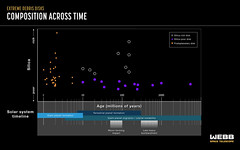
Violent collisions, like that between a proto-Earth and a Mars-sized object named Theia 4.5 billion years ago, shaped our home planet. Webb is helping us compare other young stellar systems to the history of our own.
As a star ages, the environment surrounding it changes. The material in its gas-rich protoplanetary disk form planetesimals, which can then combine and break apart to create planets and moons, eventually leaving a gas-poor disk of leftover debris. These debris disks are analogs to the debris in our own solar system, namely our asteroid belt and Kuiper belt.
Some stars have large amounts of warm dust close-in, that are very bright in the infrared - a rare subclass called “extreme debris disks.” The retired infrared Spitzer Space Telescope discovered these objects, and Webb took a closer look using its powerful infrared sensitivity. Webb confirmed several key things: that extreme debris disks have smaller dust grains than in protoplanetary or classic debris disks; a high concentration of warm dust; and vary irregularly in brightness.
Some of these disks are rich in silica and some are poor, and which category an extreme debris disk belongs to speaks to the type of collisions that produced the debris. Silica-rich disks seem to be produced by high-energy impacts between Mars-sized bodies around younger stars. Silica-poor ones might be formed by smaller scale collisions across a range of ages, and often show greater variability in their brightness, probably due to how the debris is being produced by multiple impacts.
Bringing this back to home, our own solar system might have experienced more than one extreme debris disk phase, like when the Earth, with its silica-rich crust, was formed by a giant collision. The gas giants migrating outward may have disrupted smaller bodies, generating the dust-rich conditions we observe in extreme debris disks. Understanding how our rocky planets formed and how the giant planets evolved help us to bring the bigger picture into clearer view.
Read more: go.nasa.gov/4hDjS94
Artwork credit: NASA, ESA, CSA, Joseph Olmsted (STScI)
This image: A team of researchers compiled the largest sample of extreme debris disks to date thanks to data from NASA’s Spitzer and James Webb space telescopes. These young stellar systems are a subclass of debris disks, which follows the juvenile protoplanetary disk stage.
Interested in the mineralogical makeup of these young stellar systems, the team separated their sample into silica-rich and silica-poor. Based on their categorization, they were able to infer the type of collisions that are helping create these chaotic, dusty environments.
Of their sample, eight are silica-rich disks (black dots), suggesting that they are produced by high-energy impacts between Mars-sized bodies where a substantial amount of the material is vaporized. 13 disks fall into the silica-poor category (purple dots), indicating that the collisions within these disks are less intense in nature and occur between Moon-sized objects. The team also noted the corresponding age of each disk’s star and spotted an interesting trend: The silica-rich disks in their sample are found only around stars younger than 300 million years. The stars with silica-poor disks span a broad range of ages.
The study’s findings are shaping scientists’ understanding of our own solar system, which may have experienced more than one extreme debris disk phase. Simulations suggest that terrestrial planets should form within the first few hundred million years. This period aligns with the distribution of the silica-rich extreme debris disks and with astronomers’ estimation that Earth and the Moon formed around 100 million years after the Sun formed, with the Moon likely being the result of a collision between Earth and a Mars-sized object.
The distribution of the silica-poor disks is broadly consistent with the Late Heavy Bombardment hypothesis for our solar system, which proposes that the gas giant planets migrated significant distances and gravitationally disrupted the orbits of smaller bodies. Due to their movements, catastrophic collisions occurred and generated the short-lived, dust-rich phases observed in extreme debris disks.
Image description: Graphic titled Extreme Debris Disks, Composition Across Time showing a plot and corresponding timeline of the solar system. The plot’s y-axis is labeled Silica with an up arrow labeled rich and a down arrow labeled poor. X-axis is labeled Age (millions of years) and starts with 1 at the left and increases by factors of ten, ending with 1000 at right. A key at right has 3 symbols: black dot is Silica-rich disk, purple is Silica-poor disk, and orange is Protoplanetary disk. All 27 orange dots are within the first 10 million years and range in silica composition. The 8 black and 13 purple dots begin to appear around 10 million. The black dots stop around 100 million. The purple dots continue right. The timeline below has the same labels as the plot’s x-axis. A gray band before 100 marks the Moon-forming impact. A gray band before 1000 marks the Late heavy bombardment. 3 blue bands stretch from left to right: Giant planet formation, Terrestrial planet formation, and Giant planet migration/orbital instability.