
this isn't happiness.

ART, PHOTOGRAPHY, DESIGN & DISAPPOINTMENT INSTAGRAM ★ ELSEWHERES

Adult swim, Al Satterwhite


Adult swim, Al Satterwhite

The Register

Biting the hand that feeds IT — Enterprise Technology News and Analysis

They've read the scroll thing! AI helps decipher ancient document charred by Vesuvius

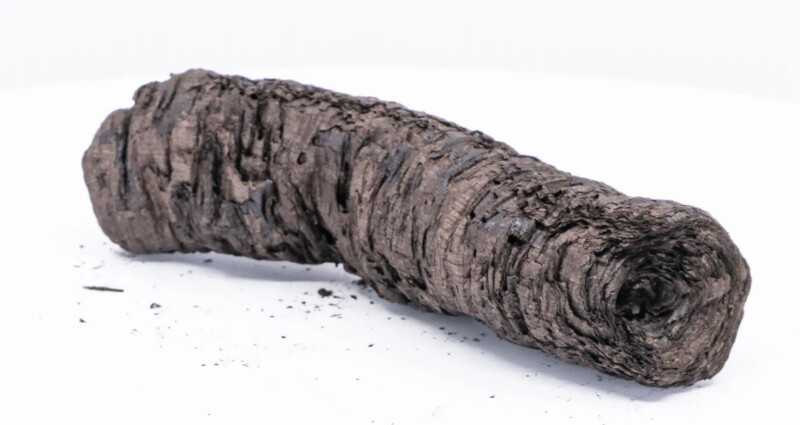
A sealed scroll from the Roman town of Herculaneum, which was destroyed by Mount Vesuvius' eruption nearly 2,000 years ago, has finally given up its secrets, thanks to a combination of machine learning and high-resolution CT scans. In 2023, researchers managed to decipher a few words from among the char and ash that make up the bulk of the scrolls. Some of those same prize-winning researchers recovered more passages from one of the scrolls, PHerc.Paris.4, netting them the $700,000 grand prize from the Vesuvius Challenge contest in early 2024. Fast forward two more years, and those grand prize winners are now part of the Vesuvius Challenge team that managed to read the surviving portion of a rolled scroll end-to-end, as the VC team shared in a Thursday announcement and detailed in an accompanying paper [PDF]. According to the research paper, the ability to make out the entirety of the scroll was thanks to high-resolution phase-contrast X-ray microtomography performed at the European Synchrotron Radiation Facility in France - an improved imaging technique over prior methods used to capture prior images that were analyzed in the prize competition. That wasn’t all, though: They say that much of their work succeeded because of a new "workflow" they developed to scan scrolls, detect ink on charred papyrus, virtually "unroll" the scrolls by modeling their deformed surfaces, and preserve those surfaces digitally, allowing machine learning models to identify letters across an entire scroll rather than just isolated patches. "The key transition marked by the present work is therefore from exceptional local recovery to systematic scroll-scale recovery," the team wrote. In other words, provided they can account for the particularities of the hundreds of sealed scrolls recovered from Herculaneum's Villa of the Papyri, the world's only surviving intact library from antiquity, this could mark the beginning of an explosion in new material for historians. So, what did it say? PHerc.Paris.4 wasn’t at the center of this breakthrough either, though they did have some exciting news to share on that front that we’ll get to. Instead, the breakthrough centered on PHerc. 1667, a previously unread rolled scroll whose preserved text was read continuously from end to end for the first time. The work appears to be a treatise on Stoic philosophy focused on ethics - a favorite subject of Zeno, Marcus Aurelius, Epictetus, and their intellectual fellows. “Having certainly strained ourselves to the utmost through research and learning, we will no longer be inferior to them in any respect,” a passage from the latter part of the scroll reads, “accomplishing in like manner the things that befit them and possessing the same practical wisdom as they.” Quite a fitting bit of ancient wisdom to be the first to see the light of the modern world. While the team digitally unrolled the scroll, detected its ink, and transcribed the preserved text from end to end, portions of the original PHerc. 1667 were lost long ago during earlier attempts to physically open the scroll, before archaeologists had access to sophisticated X-ray imaging and AI-assisted analysis. “Earlier attempts to open it by hand — in the nineteenth century, and again in 1969 and the 1980s — destroyed its outer layers,” the Vesuvius Challenge team said, noting that only an 8 cm-high core remains of the original scroll, which originally measured between 19 and 24 cm in height when standing upright. Nonetheless, “it is the first time the preserved text of a rolled Herculaneum scroll has been read continuously, end to end, rather than in isolated words or patches,” the team said. In addition to the full reveal of what’s left of PHerc.1667, the team also managed to pick out some information from a couple of other scrolls using their new workflow. One, PHerc.139, was determined to be a copy of book eight of epicurean philosopher Philodemus’ treatise On Gods, meaning scholars can expect to know what they’re looking at once the scroll is fully digitally unrolled. The second concerns, as mentioned above, PHerc.Paris.4. The new higher-resolution images taken for this latest experiment make the words on the scroll directly visible for the first time, meaning that there’s no need to rely on algorithmic detection of individual words and phrases from CT scans. Most crucially, the new scans of Paris.4 perfectly matched what the grand prize team made out several years ago, providing independent confirmation that the prize went to the right team. There are still challenges to meet in unwrapping and deciphering the rest of the ancient library, with the team calling out geometric challenges in surface prediction that can render an unrolled scan unreadable, and radiometric challenges that make ink identification difficult, as ancient recipes were inconsistent. Still, it’s a massive leap forward and the team believes the X-ray and machine learning workflow they’ve developed is ready to scale. “The thoughts of the ancient world, sealed in darkness for two millennia, are coming back into the light — a whole scroll at a time,” the Vesuvius Challenge team said. I, for one, can’t wait to see what ancient secrets they discover next. ®

They read the scroll thing! AI helps decipher ancient document charred by Vesuvius

A sealed scroll from the Roman town of Herculaneum, which was destroyed by Mount Vesuvius' eruption nearly 2,000 years ago, has finally given up its secrets, thanks to a combination of machine learning and high-resolution CT scans. In 2023, researchers managed to decipher a few words from among the char and ash that make up the bulk of the scrolls. Some of those same prize-winning researchers recovered more passages from one of the scrolls, PHerc.Paris.4, netting them the $700,000 grand prize from the Vesuvius Challenge contest in early 2024. Fast forward two more years, and those grand prize winners are now part of the Vesuvius Challenge team that managed to read the surviving portion of a rolled scroll end-to-end, as the VC team shared in a Thursday announcement and detailed in an accompanying paper [PDF]. According to the research paper, the ability to make out the entirety of the scroll was thanks to high-resolution phase-contrast X-ray microtomography performed at the European Synchrotron Radiation Facility in France - an improved imaging technique over prior methods used to capture prior images that were analyzed in the prize competition. That wasn’t all, though: They say that much of their work succeeded because of a new "workflow" they developed to scan scrolls, detect ink on charred papyrus, virtually "unroll" the scrolls by modeling their deformed surfaces, and preserve those surfaces digitally, allowing machine learning models to identify letters across an entire scroll rather than just isolated patches. "The key transition marked by the present work is therefore from exceptional local recovery to systematic scroll-scale recovery," the team wrote. In other words, provided they can account for the particularities of the hundreds of sealed scrolls recovered from Herculaneum's Villa of the Papyri, the world's only surviving intact library from antiquity, this could mark the beginning of an explosion in new material for historians. So, what did it say? PHerc.Paris.4 wasn’t at the center of this breakthrough either, though they did have some exciting news to share on that front that we’ll get to. Instead, the breakthrough centered on PHerc. 1667, a previously unread rolled scroll whose preserved text was read continuously from end to end for the first time. The work appears to be a treatise on Stoic philosophy focused on ethics - a favorite subject of Zeno, Marcus Aurelius, Epictetus, and their intellectual fellows. “Having certainly strained ourselves to the utmost through research and learning, we will no longer be inferior to them in any respect,” a passage from the latter part of the scroll reads, “accomplishing in like manner the things that befit them and possessing the same practical wisdom as they.” Quite a fitting bit of ancient wisdom to be the first to see the light of the modern world. While the team digitally unrolled the scroll, detected its ink, and transcribed the preserved text from end to end, portions of the original PHerc. 1667 were lost long ago during earlier attempts to physically open the scroll, before archaeologists had access to sophisticated X-ray imaging and AI-assisted analysis. “Earlier attempts to open it by hand — in the nineteenth century, and again in 1969 and the 1980s — destroyed its outer layers,” the Vesuvius Challenge team said, noting that only an 8 cm-high core remains of the original scroll, which originally measured between 19 and 24 cm in height when standing upright. Nonetheless, “it is the first time the preserved text of a rolled Herculaneum scroll has been read continuously, end to end, rather than in isolated words or patches,” the team said. In addition to the full reveal of what’s left of PHerc.1667, the team also managed to pick out some information from a couple of other scrolls using their new workflow. One, PHerc.139, was determined to be a copy of book eight of epicurean philosopher Philodemus’ treatise On Gods, meaning scholars can expect to know what they’re looking at once the scroll is fully digitally unrolled. The second concerns, as mentioned above, PHerc.Paris.4. The new higher-resolution images taken for this latest experiment make the words on the scroll directly visible for the first time, meaning that there’s no need to rely on algorithmic detection of individual words and phrases from CT scans. Most crucially, the new scans of Paris.4 perfectly matched what the grand prize team made out several years ago, providing independent confirmation that the prize went to the right team. There are still challenges to meet in unwrapping and deciphering the rest of the ancient library, with the team calling out geometric challenges in surface prediction that can render an unrolled scan unreadable, and radiometric challenges that make ink identification difficult, as ancient recipes were inconsistent. Still, it’s a massive leap forward and the team believes the X-ray and machine learning workflow they’ve developed is ready to scale. “The thoughts of the ancient world, sealed in darkness for two millennia, are coming back into the light — a whole scroll at a time,” the Vesuvius Challenge team said. I, for one, can’t wait to see what ancient secrets they discover next. ®

The Guardian

Latest news, sport, business, comment, analysis and reviews from the Guardian, the world's leading liberal voice

King and Queen will not live at Buckingham Palace after £369m refit

Charles and Camilla to remain at Clarence House and are said to want the public to have more access to ‘monarchy HQ’

King Charles and Queen Camilla will not move into Buckingham Palace when £369m of buildings works to update it finish next year, preferring to remain at Clarence House, their London home nearby.

The announcement came as it was revealed the king paid £12.9m in income and capital gains tax in 2024-25 on his personal income, known as the privy purse, making him among the country’s top 100 taxpayers. Prince William paid £7.76m for the same period.

Continue reading...

Crown estate makes more than £1bn profit for third year running

King Charles’s property management firm rakes in £1.2bn as it continues to benefit from offshore windfarm boom

King Charles’s property management company has made more than £1bn for the third consecutive year thanks to the boom in offshore windfarms paid for through energy bills.

The crown estate, the royals’ portfolio of land and property, reported £1.2bn in profit for the last financial year, almost three times the amount it made three years ago. Two-thirds came from the offshore wind industry.

Continue reading...

Formula 1 News

Formula 1® - The Official F1® Website

Can Ferrari keep the momentum going in Austria?

F1.com’s Lawrence Barretto delves into the key talking points on Thursday at the Austrian Grand Prix.

VK: Voorpagina

Volkskrant.nl biedt het laatste nieuws, opinie en achtergronden

Curaçao bij rust op achterstand tegen Ivoorkust (0-1), Ecuador houdt in eerste helft stand tegen Duitsland (1-1)

Colossal

The best of art, craft, and visual culture since 2010.

‘PLEASE’ Is Anna Mantzaris’ Unhinged Comedy About Desperately Wanting Love

‘PLEASE’ Is Anna Mantzaris’ Unhinged Comedy About Desperately Wanting Love

Sure, we all want love, but what lengths would you go to find it? Swedish animator Anna Mantzaris once again captures the gamut of human emotion in a stop-motion film that plunges headfirst into the pitiful and cringy. As its title suggests, “PLEASE” is about wanting and attempting to find love through increasingly unhinged acts of desperation and neediness. Mantzaris’ signature felt characters light fires for marriage proposals, sob in the chip aisle, and hug puppies while waiting for the train.

The writer and director tells Creative Boom that she got the idea for the short film during the early days of the pandemic, when most people were trapped at home. “We became more obsessed with our self-image because we saw ourselves on screens in Zoom calls all day. We spent a lot of time looking at ourselves while feeling disconnected from other people,” she says. “I wanted the characters to try to break out of this bubble, to reach out, to show their longing, but in a not-so-perfect way.”

“PLEASE” is the latest addition to Mantzaris’ growing collection of dark comedies, although this film also counts Swedish actor Stellan Skarsgård, who just this year was nominated for an Oscar for his role in Sentimental Value, among its cast. Presented through a series of vignettes, the felted puppets weave in and out of the animation, and we witness their most heated and pathetic moments.

“I’m interested in the difference between what we show the world and what we actually feel,” she adds. “Presenting the ‘ugly’ feelings through the puppets makes us feel seen. They get to do it for us, so we feel we’re not alone.”

The short film is currently making the rounds on the festival circuit, although a wider release is in the works, too. Watch the trailer on YouTube, and find additional clips—including the dating profile of a particularly discouraged 21-year-old—on Instagram.

an animated gif of people crying in a chip aisle
a still of a woman hugging a man's dog on a train platform

Do stories and artists like this matter to you? Become a Colossal Member today and support independent arts publishing for as little as $7 per month. The article ‘PLEASE’ Is Anna Mantzaris’ Unhinged Comedy About Desperately Wanting Love appeared first on Colossal.

Wel.nl

Minder lezen, Meer weten.

Advies om evenementen in regio Amsterdam te cancelen om code rood

AMSTERDAM (ANP) - De Amsterdamse veiligheidsregio adviseert organisatoren van evenementen in de regio om die vrijdag af te gelasten in verband met de verwachte extreme hitte. Dat meldt een woordvoerder namens de Veiligheidsregio Amsterdam-Amstelland, waaronder behalve Amsterdam ook Aalsmeer, Amstelveen, Diemen, Ouder-Amstel en Uithoorn vallen.

De woordvoerder laat weten dat vrijdag ongeveer zestig evenementen gepland staan, "die we vragen het dringende advies op te volgen". Die verantwoordelijkheid ligt uiteindelijk bij de organisatoren en bezoekers.

Vrijdag geldt in het grootste deel van het land code rood, omdat extreme hitte wordt verwacht. Donderdagavond zijn de verschillende hulpdiensten van de veiligheidsregio bij elkaar gekomen om de situatie te bespreken. Daaruit is het advies over evenementen gekomen, bedoeld om de hulpdiensten beschikbaar te houden en in verband met de veiligheid van de bezoekers.

Meer informatie over de zestig evenementen heeft de woordvoerder niet.


Slashdot

News for nerds, stuff that matters

Anthropic Says Alibaba Must Be Punished For Largest Claude Cloning Attack

An anonymous reader quotes a report from Ars Technica: Anthropic has accused the Chinese firm Alibaba of launching the largest attack yet attempting to clone Claude, as China races to match the capabilities of Anthropic's leading model following Mythos' release and subsequent restriction from foreign markets. Ars obtained a June 10 letter sent to Senators Tim Scott (R-S.C.) and Elizabeth Warren (D-Mass.) one day ahead of a Senate committee hearing on "AI and the American Dream." In the letter, Anthropic shared "new, confidential evidence of the largest campaign to illicitly extract Claude's capabilities we have ever measured."

The attacks occurred between April 22 and June 5, when "operators afliated with Alibaba and Alibaba Qwen, Alibaba's AI lab" allegedly generated "more than 28.8 million exchanges with Claude through almost 25,000 fraudulent accounts," Anthropic said. Violating Claude's terms of service and access restrictions, this campaign "targeted some of Claude's most valuable capabilities, such as agentic reasoning, software engineering, and long-horizon tasks." According to Anthropic, Alibaba evaded detection by "using obfuscation techniques and proxy networks." As Chinese demand for reliable obfuscation techniques increases, Anthropic warned there's already "a growing circumvention economy" to fuel an ever-expanding web of future distillation attacks. [...]

"Alibaba is governed by an independent board, none of whom has any military affiliation," Alibaba said. "Its products and services are built for retail, logistics, and enterprise information technology -- not weapons, defense, or intelligence." Anthropic appears unconvinced, however, that Alibaba isn't working with the Chinese government. In the letter, Anthropic warned that without stronger interventions, these distillation attacks will "help China reach Mythos Preview-level capabilities sooner."

To keep the US ahead of China, Anthropic recommended that Congress pass legislation with three objectives. First, antitrust laws must be updated to allow AI firms to share information about evolving Chinese tactics to deter more threats. Second, the US needs more export controls on chips to hamstring Chinese access to advanced compute so that they simply can't train on US model outputs. That could make conducting distillation attacks pointless, Anthropic suggested. Finally, Congress should pass laws penalizing Chinese labs' "bad behavior" so that it's "more difficult and costly" to rely on distillation attacks to advance Chinese models. Penalties could include limiting Chinese firms from accessing US models or advanced US chips or from relying on data centers outside of China, Anthropic suggested.

Read more of this story at Slashdot.