The Guardian

Latest news, sport, business, comment, analysis and reviews from the Guardian, the world's leading liberal voice

My eight-year-old was refused a UK passport

The Passport Office accepted applications for my two other children but refused the youngest with exactly the same documents

I am a Briton living in Switzerland and my three children are British and Swiss nationals.

When we found out via the Guardian that dual nationals, who live overseas, are now required to hold a British passport in order to enter the UK, we set about applying, so the children can continue to visit their English relatives.

Continue reading...

I see nothing but hills, ridges and sea: a breathtaking five-day walk around Ireland’s south-westernmost headland

The creators of County Cork’s Sheep’s Head Way had to win over hundreds of landowners to complete the ambitious project, but the result is a gloriously unspoilt trail

The Sheep’s Head peninsula is clearly a good place to be a skylark. They seem to warble overhead at every turn, singing their little hearts out – and who could blame them? The hills here are high and heathery, the sea breeze is warmed by the Gulf Stream and the edge-of-the-world scenery is a realm of wild green slopes and endless blue Atlantic. If you had to choose a sky to lark in, the one that crowns this County Cork headland is a bona fide wing-quiverer.

The peninsula wows hikers, too. I’ve come to one of the south-westernmost points on the Irish mainland to trek the Sheep’s Head Way, a long-distance trail opened by the local community 30 years ago this summer. It took serious work to complete – more of which later – but it’s a delight. I’m walking the original 55-mile (88km) loop around the peninsula, although a longer, 63-mile option is now considered the official route. The way attracts a fraction of the numbers drawn to the Kerry Way and Dingle Peninsula trail further north, and thanks to its untrammelled paths and rampant, cliff-edged scenery, the rewards are grand, in every sense.

Continue reading...

Landship review – soldiers yearn for tinned pies in muddy first world war drama that stays inside the tank

It’s too murky to distinguish one stiff upper lip from another in Callum Burn’s drama about a real-life mission that came unstuck

Based loosely on a true story, this British first world war drama deploys a few cunning stratagems to keep the budget down – starting with setting almost the entire story inside a tank; this one is nicknamed the Fray Bentos after the popular tinned pie. In addition, whenever the British soldier characters venture outside this extremely confined space, it’s almost always night-time, or exactly the moment when a miasma of smoke and fog is so thick, you can’t see the Germans skulking behind papier-mache hillocks of mud, ready to pounce on our plucky heroes.

Unfortunately, all that gloom and grot makes it a little hard to make out what is going on at times. That means the noble chaps become almost indistinguishable from each other – although over time it’s possible to work out that the officers are the ones with tidy, manly moustaches and sound posh, while the near-teenage privates are all clean-shaven and have working-class accents. Eventually it becomes clear that stiff-upper-lipped Captain Richardson (Vin Hawke) is determined to push on with their mission to fire on the enemy – until the tank gets stuck. Then he is determined to wait until a carrier pigeon gets a message to the infantry, who will surely come and save them all any minute. Days pass, and the men get stroppy, especially Morrey (Jack Sherlock) whose mutterings start to sound increasingly mutinous. Who will survive? Will any of them ever eat a real Fray Bentos pie again?

Continue reading...

NSPCC refers itself to regulator for not reporting high-risk Childline cases

Exclusive: Internal review found charity failed to pass on 37 incidents to authorities over a six-month period

The NSPCC has referred itself to the charity regulator after admitting it failed to flag high-risk Childline cases to the police and local authorities.

An internal review found that over a six-month period, 37 contacts from children categorised as high-risk – which includes reports of physical and sexual abuse, neglect and suicidal thoughts – were not passed on to the relevant authorities.

Continue reading...

Awake Awake by Fiona Mozley review – in pursuit of false memories

From the Booker-shortlisted author, a tantalisingly unreliable account of childhood, history and mental uncertainty

The historian and novelist Fiona Mozley acknowledged in a 2018 piece for the Guardian that the city of York had a major influence on both her careers. Childhood and adolescence in a place such as York, full of time and times, can generate conflict between “the desire to live in the past and the need to extract oneself from it”. Awake Awake, a follow-up to her previous novels, 2017’s Booker-shortlisted Elmet and 2021’s Hot Stew, engages with two types of memory: the personal and the historical. They’re not exactly at odds, but as far as living in the past is concerned they feed on one another in a complex, entangled relationship.

Narrator Mary Mooney – also a novelist, also from York, and whose first book is also shortlisted for a major prize – tells the story of her mental illness. Or she seems to. She begins in childhood. We’re introduced to her parents and her parents’ friends, religious academics in York; to her home in Cathedral Close; to school and her school friends, with whom she will stay in contact as she grows up. Life is a round of family occasions, church events and church politics, spiced with adventure and wild excitement in the countryside, mischief in the classroom. Detail is piled on detail and presented with photographic clarity, from her father, with his “large, pointed nose and grey eyes that looked greener than usual when he was outside in the vegetable patch”, to the fall of the Twin Towers, which she recalls seeing “on a television in the school staff room … looking through the door from the outside and glimpsing it on the tiny screen”.

Continue reading...

Whistleblower investigating Ecuadorian president’s family business was murdered, activists say

Monika Silva Koniuszek died from a blow to the head and strangulation, a postmortem found, despite government claim of suicide

Campaigners in Ecuador say a Polish anti-corruption activist who investigated allegations against the family business of the country’s rightwing president was murdered to silence her.

Monika Silva Koniuszek, 41, was found dead in her home in Montañita, a coastal town in Ecuador’s Santa Elena province. The single mother of daughters aged four and nine, was found on the floor with a noose around her neck on 8 June.

Continue reading...

Whoosh! Jacques Henri Lartigue’s world of colour – in pictures

The French artist is best known for his black-and-white images of high society, but a new exhibition shows us that he was also a bold and brilliant colour pioneer

Continue reading...

Self-doubt, burnout … and Taylor Swift: why Toy Story 5 is the ultimate millennial girl movie

Nostalgia hits hard for anyone who has grown up with the franchise. But little could prepare me for the emotional punch of this latest film – and the very specific vulnerabilities it taps

Emily named her daughter Jessie. Any millennial woman watching Toy Story 5 over the weekend just about held it together before finally letting the sobs roll at this discovery. The film takes our yarn-haired cowgirl back to her first kid’s home, where she ends up at the tree they used to play in. An unearthed memory box is packed with photos showing Emily grown up, happy and cuddling the child she gave her beloved toy’s name to. Many thirty- and fortysomething women sat watching the scene in the cinema next to their own daughters; some were thinking of the ones they want but don’t have; and others reflected on a decision to be child-free. All of us, though, also took a teary minute for our own girlhoods.

Toy Story has always spoken to adults as deeply as it does to kids, and flock-herding feminist Bo Peep gave a lesson on living life on your own terms away from traditional expectations in the fourth film. But this reveal is the moment that truly tugs the hearts of women who grew up with the franchise.

Continue reading...

Sargasso

Hopeloos Genuanceerd

Alle wegen in Wikipedia leiden naar het weten

Ik weet een spel met Wikipedia. Kies een willekeurig artikel, klik op de eerste link in de lopende tekst, vervolgens op de eerste link van de pagina waar je dan belandt, en zo door. Je mag steeds alleen de eerste link gebruiken. Op de Engelse Wikipedia gebeurt er al sinds jaar en dag iets opmerkelijks: bijna elk artikel komt vroeg of laat uit op één en dezelfde pagina — Philosophy. Een Wikipediaan ontdekte het verschijnsel omstreeks 2011. Het gold toen voor meer dan negentig procent van de artikelen bij Philosophy, en in 2016 zelfs voor ongeveer 97 procent.

De verklaring is waarschijnlijk dat de eerste link van een artikel meestal verwijst naar een iets algemener begrip. Het artikel over de hond leidt naar ‘zoogdier’, dat naar ‘dier’, dat naar ‘organisme’, en zo klim je stap voor stap van het concrete naar het abstracte, tot je bij het meest abstracte begrip van allemaal aankomt — en dat is kennelijk de wijsbegeerte. Het spel legt zo een soort verborgen ladder bloot: een rangorde van begrippen die de hele Engelstalige encyclopedie ongemerkt doortrekt.

Maar dat geldt niet voor alle talen. Het Duits, Frans en Russisch lijken weliswaar op het Engels, maar het Italiaans komt vaker uit bij psychologie; sommige Oost-Aziatische edities belanden eerder bij ‘mens’ of ‘aarde’, en het Japans vertoont helemaal geen duidelijke convergentie. Elke taaleditie heeft haar eigen voorkeursbestemming. Ook het Nederlands zou afwijken, aldus het Wikipedia-artikel over het fenomeen. Daar werd ik weethebberig van: waar leidt de Nederlandstalige Wikipedia dan wél naartoe?

Ik besloot het te tellen.

Tocht

De methode is eenvoudig. Men neme duizend willekeurige artikelen en volge vanaf elk daarvan de eerste gewone link in de tekst, net zo lang tot het pad ofwel in een eindeloze lus terechtkomt, ofwel doodloopt bij gebrek aan een volgende link.

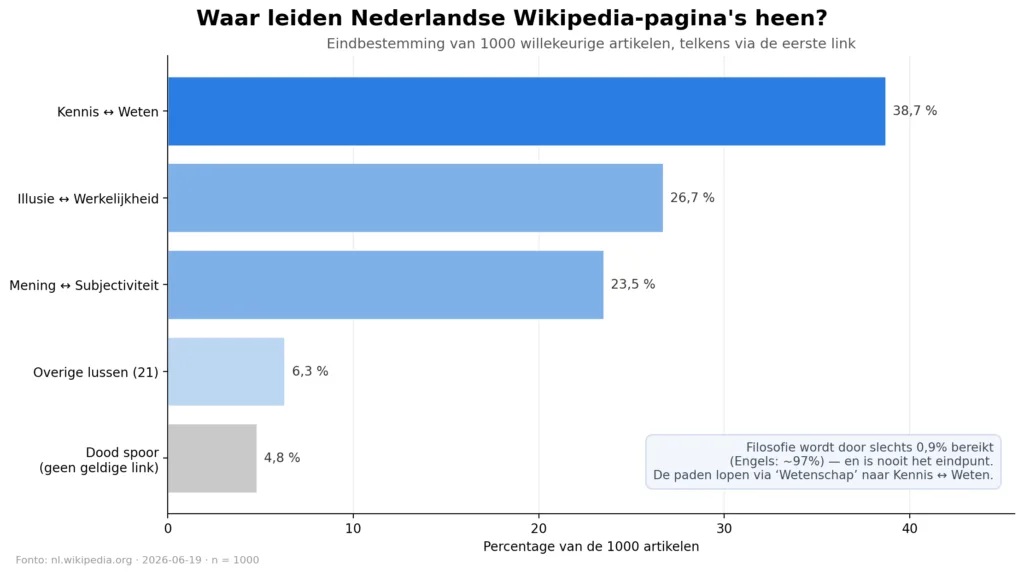
De uitkomst: in het Nederlands leiden de Wikipediapaden níét naar de filosofie. De pagina Filosofie wordt door amper 0,9 procent van de paden onderweg aangedaan, en is nooit het eindpunt. In plaats daarvan stroomt bijna alles samen in drie kleine lussen (in een lus verwijst een pagina naar een andere pagina die weer terugverwijst naar het beginpunt): ‘Kennis ↔ Weten’ (38,7 procent), ‘Illusie ↔ Werkelijkheid’ (26,7 procent) en ‘Mening ↔ Subjectiviteit’ (23,5 procent). Samen vangen die drie bijna negen van de tien artikelen in de Nederlandstalige Wikipedia. Opvallend genoeg zijn het alle drie eenvoudige lussen van twee pagina’s: de encyclopedie blijft aan het eind heen en weer pendelen tussen twee begrippen die elk naar de ander verwijzen. Doodlopende paden zijn er nauwelijks — slechts 4,8 procent komt uit op een pagina zonder links. Gemiddeld duurt de tocht een stuk of tien stappen — de meeste reizen tellen tussen de zes en twintig klikken, met een enkele uitschieter naar boven of beneden.
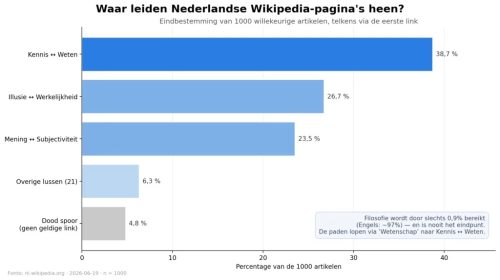
Eindbestemming van duizend willekeurige Nederlandstalige artikelen

Mensensoort

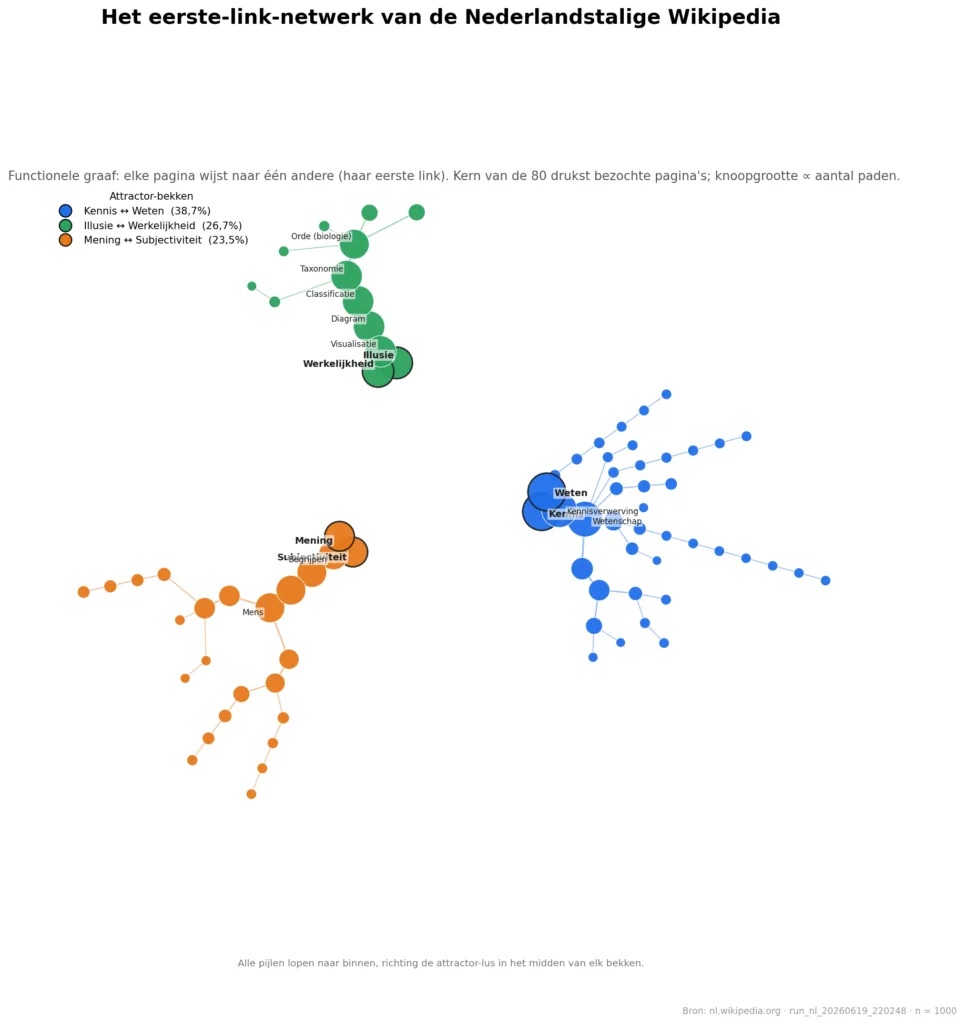
De grote trechter loopt via ‘Wetenschap → Kennisverwerving → Kennis → Weten’: de pagina Wetenschap alleen al komt in ruim een derde van alle paden voor. Een voorbeeld: vanaf ‘Grand Prix Formule 1 van Monaco 1975’ bereik je in dertig stappen, via de autosport, machine, hout, organisme, leven, heelal, sterrenkunde en natuurwetenschap, ten slotte de lus Kennis ↔ Weten.

Elke Wikipedia heeft haar eigen zwaartepunt, en dat van het Nederlands is de kennis zelf. Nu raken de drie belangrijkste lussen dan wel weer aan kernbegrippen van de kennisleer: kennis – wetenillusie – werkelijkheidmening – subjectiviteit. De Nederlandstalige Wikipedia raakt dus wel het hart van de wijsbegeerte — alleen niet met het wóórd Filosofie.

Deze ontologie is ook een wankel bouwwerkje. Doordat alles door een handvol knooppunten loopt, zou één bewerking van de eerste link op ‘Kennis’ of ‘Wetenschap’ van de ene dag op de andere honderden artikelen een andere kant op sturen. Het spel zegt minder over de structuur van de wereld dan over de wonderlijke (en bewonderenswaardige) mensensoort die Wikipedia-artikelen bewerkt.
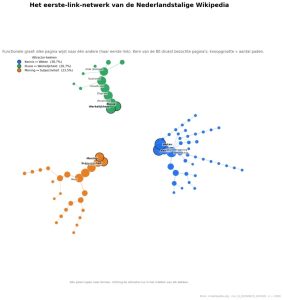
Wikipedia nederlands eerste-link-netwerk
StukRoodVlees

Politicologie en actualiteit

Kiezers zien de democratie achteruitgaan (maar ze zijn het niet eens over welke democratie, of waarom)

Onlangs verscheen Veelstemmig, het rapport van het Nationaal Kiezersonderzoek (NKO) over de Tweede Kamerverkiezingen van oktober 2025. Dit blog is gebaseerd op ons hoofdstuk daaruit. Het hele rapport is hier te vinden. Internationale waakhonden zijn lovend over de Nederlandse democratie. In 2025 gaf het Zweedse Varieties of Democracy Institute (V-Dem) ons land een 8.3 uit […]

Het bericht Kiezers zien de democratie achteruitgaan (maar ze zijn het niet eens over welke democratie, of waarom) verscheen eerst op StukRoodVlees.