🌘
Subscribe to 404 Media to get The Abstract, our newsletter about the most exciting and mind-boggling science news and studies of the week.
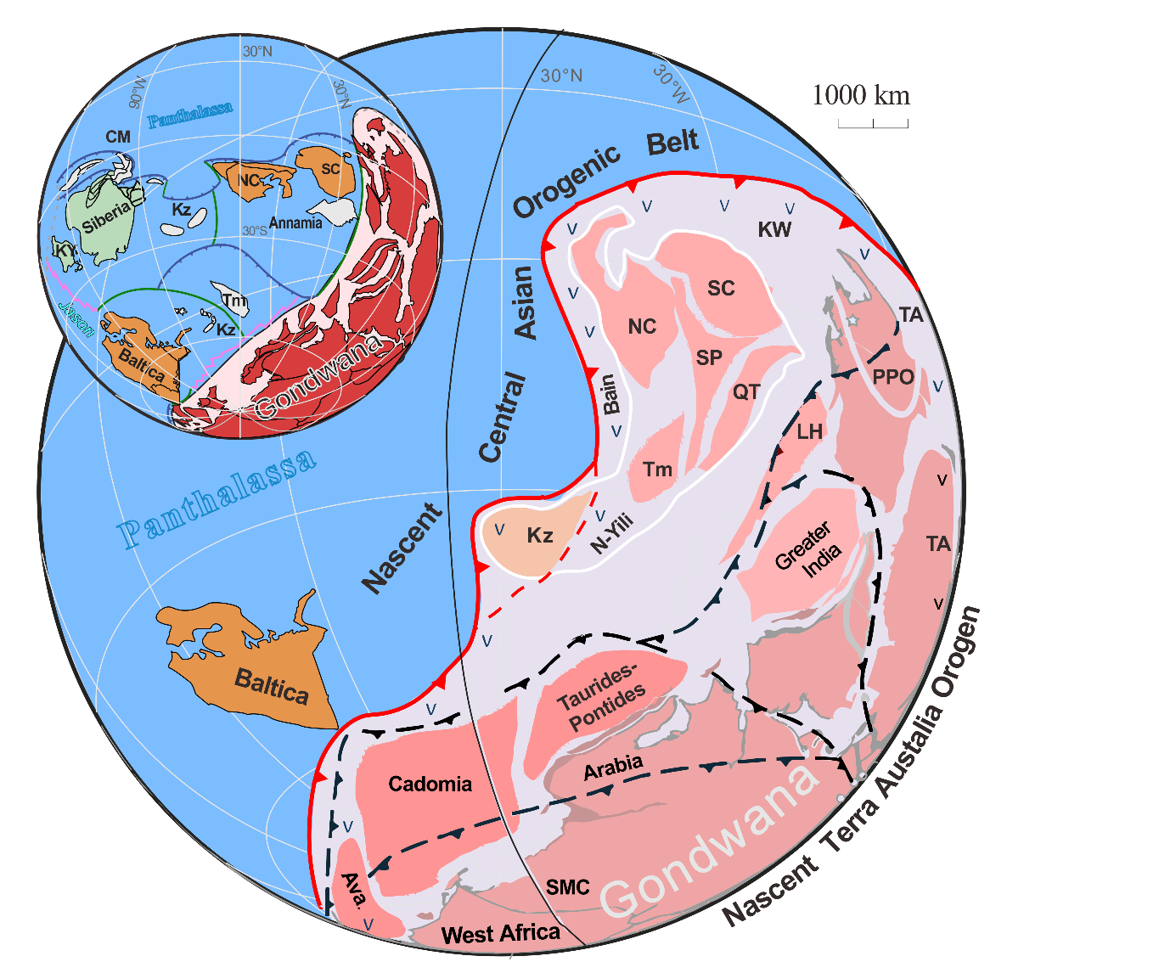
Scientists have identified the submerged remnants of a giant lost supercontinent that played a pivotal role in the explosion of complex life more than 500 million years ago, reports a study published on Wednesday in Science Advances.
By gathering over 25,000 rocks from ancient continental fragments, a team reconstructed the past contours of Gondwana, a massive landmass that formed between 800 and 500 million years ago in the Southern Hemisphere. Gondwana’s true size has long been a matter of contentious debate, but it is generally thought to have taken up two-thirds of Earth’s land at the time, falling short of “supercontinent” status.
Now, scientists led by Tao Wang, a professor of geoscience at the Chinese Academy of Geological Sciences, have revealed that Gondwana accounted for roughly 80 percent of Earth’s landmass between 550 and 500 million years ago, confirming that it was a supercontinent.
The formation of this colossal realm helped fuel the Cambrian explosion, a rapid proliferation of complex life that began about 538 million years ago, establishing a fundamental link between “deep-Earth processes” and “the most profound expansion of life in Earth history,” according to the new study.
The discovery of these ancient Gondwanan remains was “serendipitous,” said William Collins, a professor of geosciences at Curtin University and an author on the study, in a call with 404 Media. “We weren't looking for this.”
Wang added in the same call that the team’s ongoing research is likely to yield more surprises and insights in the future. “If we expand our database, maybe we will have new, unexpected results,” he said.
For much of his career, Wang has studied the Central Asian Orogenic Belt, a region that stretches from Russia’s Ural Mountains across Asia to the Pacific Ocean that is shaped by the collision of continental plates.
In recent years, his team has assembled a database of thousands of magmatic rocks from this region, and others, as part of an international collaboration called Deep-time Digital Earth. Using AI in combination with new techniques, the researchers were able to identify the origins of many of these samples for the first time, allowing them to place them into a global map that could be used to reconstruct the continents of the deep past.
“We used special techniques to get coordinates and locations,” Wang said. “In this way, we expanded our research from Asia to globally.”
“If you collect enough data, you can then map out where these ancient crustal blocks were,” said Collins. “This is how we came across this new map of the Earth—this deep crustal map extending back 500—and more—million years ago.”
This global map revealed disparate chunks of Gondwana that had been broken apart and strewn across the planet by eons of tectonic activity and shifting continental permutations. In particular, the team looked at isotopes of the elements samarium and neodymium, which Collins described as “fingerprints” of the lost Gondwanan supercontinent that have ended up embedded inside much younger rocks.
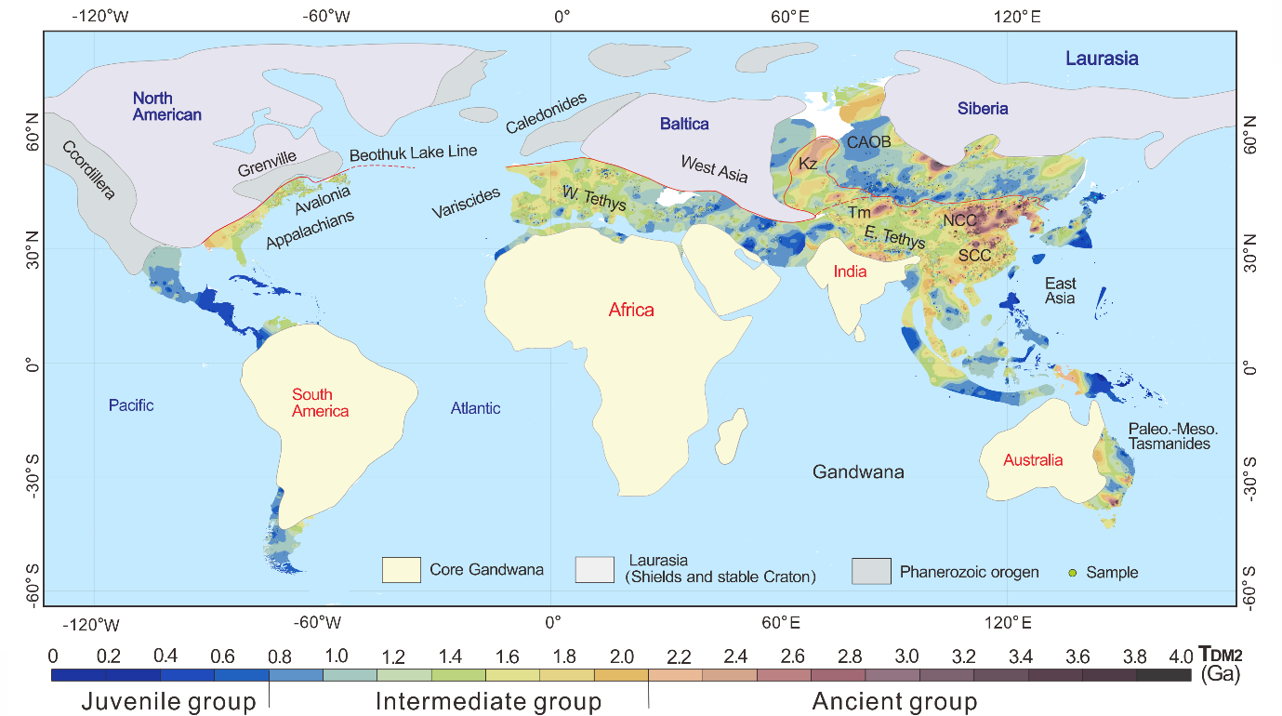
“The samarium-neodymium isotope maps that we're looking at are not only a step back in time—they're like a time machine—but they have this spatial character that allows us to recognize an ancient continental landmass that formed 500 million years ago, even though the mountains that the rocks are in are only 20 million years old,” Collins explained.
The results show that Gondwana made up the vast majority of the continental landmass of the Cambrian period, an era that featured the sudden appearance of large and complex life, following billions of years of simple microbial organisms. Almost all major animal families first emerged in this Cambrian “explosion” of life, setting the stage for the incredible abundance and diversity of species that has inhabited our planet ever since.
This massive supercontinent was shaped by a “subduction girdle” of tectonic activity that stretched across 79 percent of Earth’s circumference. The geological upheaval produced by the structures supercharged volcanic activity, which in turn belched out greenhouse gasses into the atmosphere and warmed the planet from its previous “Snowball Earth” phase.
The combination of this warmer climate, along with an enrichment in new ingredients for life, paved the way for the Cambrian explosion, according to the team.
“This Ring of Fire that formed straight after Gondwana was a source of a huge amount of volcanic gasses, just like the volcanoes around the Circum-Pacific are today,” said Collins. “Those volcanic gasses—particularly water and [carbon dioxide]—are absolutely vital, for climate change, and also for biodiversity.”
In this way, planet-scale geological dynamics powered the lush biosphere that we still occupy today, as well as the 500-million-odd years of phantasmagorical ecosystems that preceded it. To reconstruct this process in even more detail, the team plans to expand their rock database and map out the remnants of this long-lost supercontinent with more precision.
“Maybe we can find other new directions, and solve other fundamental Earth science problems,”
Wang concluded.
🌘
Subscribe to 404 Media to get The Abstract, our newsletter about the most exciting and mind-boggling science news and studies of the week.
Analysis of two skeletons reveals tooth wear and traces of psychoactive substance in what may be earliest known evidence for human drug taking
What may be the earliest known evidence for human drug taking has been traced to ancient Indonesian foragers who sucked on mind-altering nuts as long as 25,000 years ago.
Analysis of two exceptionally rare skeletons from the Indonesian island of Sulawesi revealed dramatic tooth wear and traces of a psychoactive substance in the individuals’ remaining teeth, suggesting they routinely sucked on hard, abrasive betel nuts.
Continue reading...Spiritual leaders stress diversity of views within Jewish community and warn against inaction on settler violence
Prominent British rabbis have backed Ed Miliband’s sanctions on Israeli settlements, warning that the time for inaction on settler violence must come to an end.
The intervention comes after the UK’s chief rabbi, the spiritual leader of mainstream Orthodox Jews in the UK, Sir Ephraim Mirvis, described UK sanctions against illegal Israeli settlements in the occupied Palestinian territories as a “dark day for British Jews” and warned they could embolden people who “use hatred as a weapon against Jews”.
Continue reading...
The Beatles hebben een grote invloed op de wetenschap. Tenminste, voor wie kijkt naar het aantal keren dat hun songtitels een publicatie onder de aandacht moeten brengen.
/s3/static.nrc.nl/wp-content/uploads/2026/09/08115256/120926WET_2036495725_beatles.jpg)
UTRECHT (ANP) - Vakbonden spreken van een geslaagde stakingsdag in het openbaar vervoer, waarmee leden protesteerden tegen bezuinigingen op sociale zekerheid. Duizenden vakbondsleden legden op het spoor en in het stads- en streekvervoer het werk neer.
Volgens FNV deden 6000 leden van die bond mee aan de staking. CNV sprak op woensdagmiddag van ruim 2000 leden die staakten.
Een woordvoerder van FNV stelt dat de bereidheid om actie te voeren groot was. Hij benadrukt dat "we niet voor ons plezier staken". Wel vindt hij het positief dat door de landelijke staking meer werkende Nederlanders bewust zijn gemaakt van de mogelijke gevolgen van de kabinetsplannen voor uitkeringen en arbeidsongeschiktheid. Daarvoor organiseerde FNV ook flyeracties om duidelijk te maken wat de reden voor de staking was.
Vorige week lekten kabinetsplannen uit waarin de coalitie van D66, CDA en VVD een handreiking deed naar de bonden en de linkse oppositiepartij PRO. Maar de vakbonden willen dat iedere vorm van bezuinigen op het sociale vangnet van tafel gaat.
SWINDON (ANP) - De Britse politie heeft een man gearresteerd die ervan verdacht wordt met de Russische inlichtingendiensten te hebben samengewerkt. Hij is aangeklaagd voor onder meer de voorbereiding van een sabotageactie.
De 31-jarige Joshua Cammidge, met de Britse nationaliteit, kreeg volgens de aanklagers instructies van een lid van het vrijwilligerskorps van de GROe, de Russische militaire inlichtingendienst. Het is niet duidelijk wat voor sabotage er zou zijn voorbereid.
De contraterrorismepolitie pakte Cammidge vrijdag op in zijn huis in Swindon, een stad in het zuiden van Engeland. Ook op een ander adres in die stad werd een huiszoeking gedaan.
De verdachte wordt donderdag voorgeleid in Londen.
