404 Media

404 Media is an independent media company founded by technology journalists Jason Koebler, Emanuel Maiberg, Samantha Cole, and Joseph Cox.

The FBI Wants to Buy Nationwide Access to License Plate Readers

The FBI Wants to Buy Nationwide Access to License Plate Readers

The FBI wants to buy access to automated license plate readers (ALPRs) nationwide, which would likely allow the agency to track the movements of vehicles—and by extension people—across the country without a warrant, according to FBI procurement records reviewed by 404 Media.

The documents show that ALPRs continue to be a sought-after tool for law enforcement, not just for local police and individual communities, but federal agencies too. The news also comes as protests and pushback against ALPRs have spread around the country.

💡
Do you work at Flock or Motorola? I would love to hear from you. Using a non-work device, you can message me securely on Signal at joseph.404 or send me an email at joseph@404media.co.

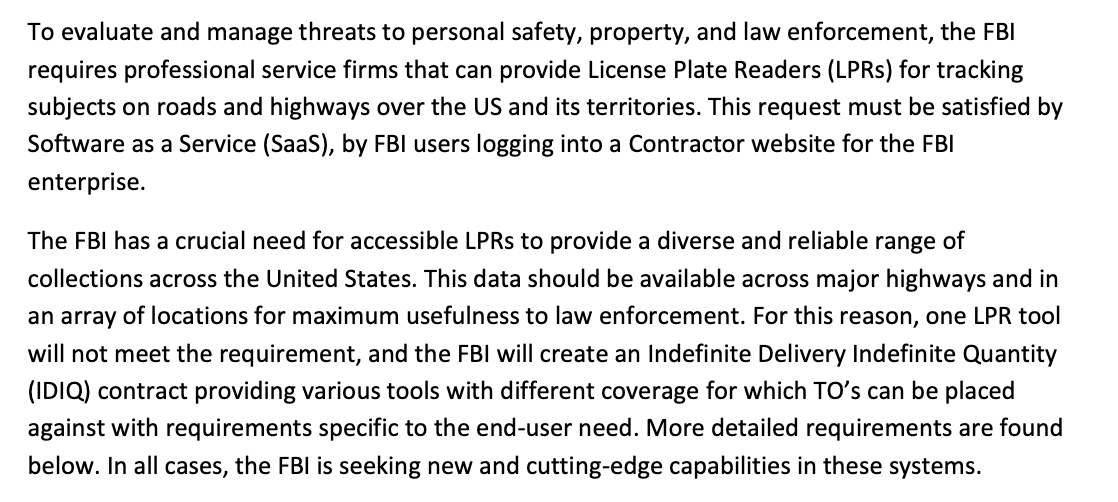
“The FBI has a crucial need for accessible LPRs to provide a diverse and reliable range of collections across the United States. This data should be available across major highways and in an array of locations for maximum usefulness to law enforcement,” a statement of work, which describes what data the FBI is seeking access to, reads.

ALPR cameras generally work by constantly scanning the color, brand, model, and license plate of vehicles that drive by. This creates a timestamped record of where a particular vehicle was at a specific time that law enforcement can then query, effectively letting them see exactly where someone drove across time. The technology has existed for decades, but has become more pervasive in recent years.

The FBI says it is looking for a vendor that will let it log into a Software-as-a-Service system and then query the collected ALPR data with license plate information, a description of the vehicle, a time or date, and geolocation information.

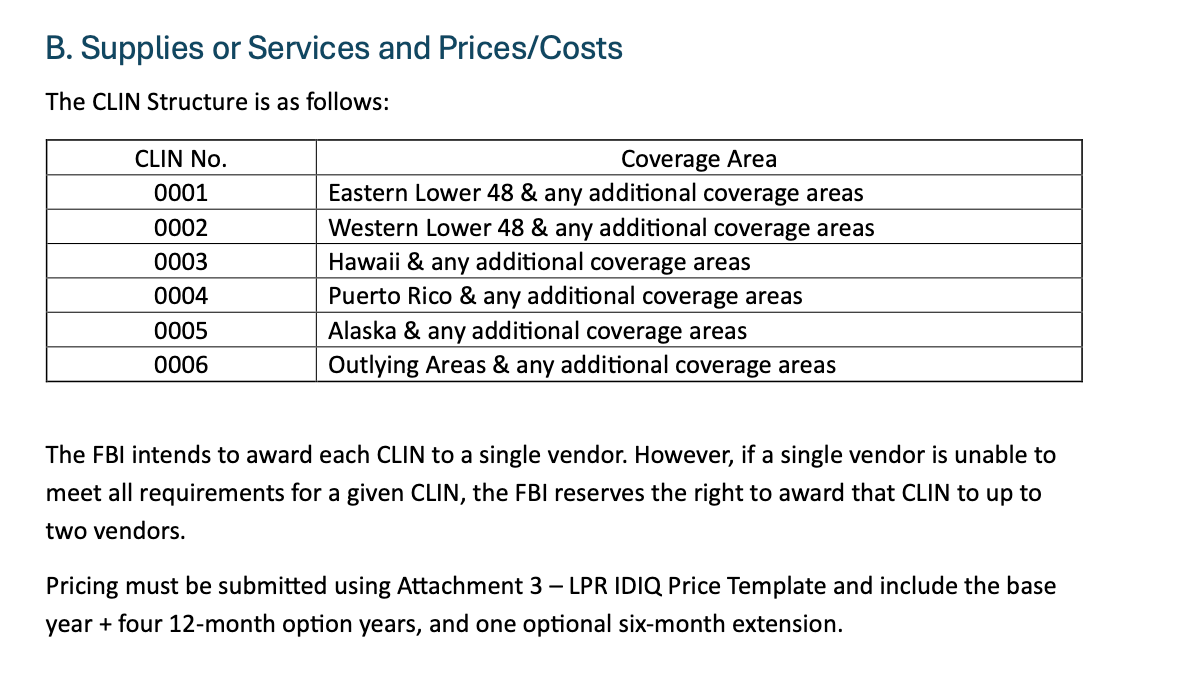
The FBI says it is looking for ALPR coverage in the following areas: Eastern 48 (East of the Mississippi River); Western 48 (West of the Mississippi River); Hawaii; Puerto Rico; Alaska; and outlying areas such as Guam, the U.S. Virgin Islands, or Tribal Territories. In effect, the FBI is looking for ALPR data nationwide and even beyond. An attached price template indicates the FBI is willing to pay $6 million for each of those broad areas, bringing the total to $36 million.

The FBI says it intends to award the contract to a single vendor, but if any such vendor is unable to fulfill all of the requirements, the agency may award the contract to up to two vendors. The contract is specifically for the FBI’s Directorate of Intelligence, which oversees the agency’s intelligence mission. The FBI is not only a law enforcement agency, but also part of the Intelligence Community.

There are a limited number of companies that might be able to provide the sort of data the FBI is seeking. One of those is Flock, whose ALPR cameras are stationed in communities all across the country. According to data 404 Media and researchers have obtained through public records requests, Flock has at least 80,000 cameras connected to its national lookup tool. At one point, Homeland Security Investigations (HSI), a section of Immigration and Customs Enforcement (ICE); the Secret Service, and the Navy’s criminal investigation arm all had access to Flock’s nationwide network as part of a pilot program. As 404 Media revealed, local police have performed lookups in the Flock nationwide database on behalf of ICE.

The other is Motorola Solutions, which acquired Vigilant Solutions. Motorola has a massive database of ALPR information built with cameras installed in police officer’s roaming vehicles. An arm of the company that sells to private industry has essentially outsourced image collection to repo men. In 2019, I reported on that part of the business, called Digital Recognition Network (DRN), and was shown how powerful its tracking capabilities can be. 404 Media reported last year that ICE recently invited staff to demos of a Motorola app that let officers scan a license plate and add it to a database of billions of records that show where else that vehicle has been spotted.

Josh Thomas, chief communications officer at Flock, told 404 Media in an email “We’re not going to speculate on prospective deals. But it’s worth noting that we already work with several federal agencies, all of whom are subject to the same obligations, constraints, and transparency mechanisms that apply to every other Flock customer. We also rebuilt our product from the ground up, starting last year, to ensure all local customers could trust that they can use Flock in full compliance with local and state laws. A big part of that is our Audit Assistance tool.”

Neither Motorola nor the FBI responded to a request for comment.


Tired Tires

Thomas Hawk posted a photo:

Tired Tires

Found Slide -- Ira Richolson Collection

Thomas Hawk posted a photo:

Found Slide -- Ira Richolson Collection

52eme Festival International du Film Cannes 99

Wel.nl

Minder lezen, Meer weten.

Amerikaanse arts loopt ebola op in Congo

Een Amerikaanse arts die werkt als zendeling in Congo, is positief getest op ebola nadat hij patiënten had behandeld in een lokaal ziekenhuis. Dat meldt Fox News op gezag van de christelijke hulporganisatie Serge. Volgens die Amerikaanse nieuwszender hebben twee andere Amerikaanse zendelingen ter plaatse, onder wie de vrouw van de besmette arts, geen symptomen. Ook zij werkten met patiënten. Hoe het de arts vergaat, wordt niet gemeld.

Het zou gaan om de Bundibugyo-variant, die recentelijk uitbrak in Congo en al aan meer dan honderd mensen het leven kostte. Van een kleine vierhonderd anderen wordt vermoed dat zij het virus ook hebben opgelopen, meldde de BBC eerder op maandag.

Voor de Bundibugyo-variant van ebola is geen vaccin voorhanden. Behandeling van de gevolgen van een besmetting is dan ook hoofdzakelijk "ondersteunend", zo schrijft het Amerikaanse Center for Disease Control and Prevention (CDC). Desgevraagd bevestigt die instantie tegenover persbureau Reuters dat de Amerikaan besmet is geraakt in Congo. Er zou worden gewerkt om hem over te brengen naar Duitsland voor behandeling. De CDC benadrukt dat het gevaar van de ebolavariant voor de VS laag blijft.


De rijkste kat ter wereld blijkt helemaal niet zo rijk

Dat Karl Lagerfeld zijn kat Choupette op handen droeg, wisten we al: ze at van porselein, vloog privéjet, had twee dienstmeiden en werd zijn “enige grote liefde” genoemd. Maar de hardnekkige claim dat Choupette na zijn dood een miljoenenvermogen erfde, blijkt vooral een sprookje dat goed past bij onze obsessie met glamour en dierenverhalen.

Mythe van de miljoenenkat

Na Lagerfelds overlijden in 2019 meldden media wereldwijd dat Choupette “tot 300 miljoen euro” zou erven, en daarmee “de rijkste kat ter wereld” werd. Britse kranten presenteerden het als feit dat er minstens anderhalf miljoen apart stond om haar luxeleventje voort te zetten.

De werkelijkheid is veel prozaïscher: onder Frans recht kan een dier helemaal geen erfenis bezitten en zelfs Choupettes agent bevestigt dat er geen kat met eigen bankrekening bestaat. De bedragen waarover werd gespeculeerd, hadden bovendien meer met Lagerfelds naam en werk dan met de waarde van een katten‑influencer te maken.

Wie betaalt nu voor Choupette?

Choupette woont tegenwoordig in een Parijse flat bij Lagerfelds voormalige huishoudster Françoise Caote, die haar al jaren verzorgde. De beroemde kattenmaaltijden, het eigen kamertje op shoots en het maximum van twee uur werktijd per opdracht zijn gebleven, maar het beeld van een rentenierende kat klopt niet.

Caote zegt dat zij “absoluut niets” uit de erfenis heeft ontvangen en dat ze zelfs dure advocaten moet betalen om te proberen Lagerfelds wensen voor Choupette juridisch af te dwingen. Intussen werkt ze parttime bij om de kat te onderhouden, terwijl Choupette nog wat inkomsten genereert met reclames voor luxe kattenaccessoires en af en toe een modieuze campagne.

Een kat als merk

Choupette is al jaren meer merk dan huisdier: ze had boeken, campagnes, een eigen agent en nu zelfs een reeks schilderijen in de stijl van 18e‑eeuwse hofportretten. De Duitse schilder Max Renneisen zet haar neer als moderne versie van de honden van Lodewijk XV, terwijl het silhouet van Lagerfeld als een soort geest boven haar zweeft.

Tegelijk relativeert hij de hype: voor hem is Choupette uiteindelijk gewoon een kat, en alle diva‑projectie komt van mensen die in haar een soort royale persoonlijkheid willen zien. Het is precies die spanning – tussen dier en projectiescherm – die haar verhaal zo fascinerend maakt.

Influencer‑kat met ghostwriter

Zelfs Choupettes online stem blijkt deels fictie. Jarenlang runde een jonge Amerikaanse marketeer, Ashley Tschudin, op eigen houtje het Twitter‑ en Instagramaccount “ChoupettesDiary”, zonder dat Lagerfeld daar inhoudelijk bij betrokken was. Ze verzon de bijtende oneliners over mode, beauty en “mijn maids” en werd zo een van de eerste echte “pet influencers”.

Na Lagerfelds dood wilden de officiële erfgenamen en de nieuwe agent de regie terug en werd de fan‑versie geleidelijk gemarginaliseerd. Tschudin beschrijft het alsof haar stem werd afgepakt, terwijl zij jarenlang gratis had meegebouwd aan de wereldberoemde kattenmythe.

De Met Gala‑blamage

Het meest onthullende moment kwam misschien wel bij de Met Gala van 2023, die volledig in het teken van Lagerfeld stond. Achter de schermen werd gewerkt aan een droombeeld: Kim Kardashian met Choupette op de rode loper, “de beroemdste kat met de beroemdste vrouw ter wereld”.

Maar de kat had er geen zin in. Tijdens een ontmoeting in het Ritz‑hotel in Parijs begon Choupette te sissen en naar Kardashians gezicht uit te halen, zichtbaar gestrest door de setting en het geluid van haar outfit. Uiteindelijk bleef de kat thuis, en verscheen Jared Leto in een pluche Choupette‑kostuum op de trap van het Met – een perfecte metafoor: de fictieve kat op de rode loper, de echte veilig op de bank.


The Guardian

Latest news, sport, business, comment, analysis and reviews from the Guardian, the world's leading liberal voice

The Guardian view on India’s Iran shock: Asia’s neoliberal era starts to fracture | Editorial

Narendra Modi’s austerity appeals reveal how war, energy insecurity and dollar pressures expose the fragility of globalisation

The Indian prime minister’s call for sacrifice last week marks a fundamental shift. He urged the country’s 1.4 billion people to consume less fuel and fertiliser, buy less gold and curb foreign travel as global energy prices surge because of the war in Iran. The message, redolent of the Covid-era restrictions, suggests something larger: a retreat from neoliberal globalisation in Asia and the return of strategic economic management. The Hindu nationalist Narendra Modi waited for key regional elections to finish before pressing for the austerity measures. He was following other Asian states such as the Philippines, Bangladesh and Sri Lanka, which have made similar requests and even demands of their citizens since March.

Mr Modi made an explicit economic argument: reduce energy imports because India must conserve its foreign exchange. About 90% of India’s oil and gas needs come from abroad. When prices spike, the country faces a higher import bill in dollars, inflation and pressure for higher subsidies. Despite India’s recent economic success, it has not built sufficient productive, export or homegrown green-power capacity to reduce its vulnerability. To prevent the rupee crashing in value, India’s central bank reportedly burned through more than $40bn in reserves.

Continue reading...

The Guardian view on a new National Conversation: whether this works will depend on who is listening | Editorial

Asking people how they feel about the places where they live is worthwhile. But will it change anything?

Established in the aftermath of the 2024 riots triggered by the Southport murders, the Independent Commission on Community and Cohesion set itself the task of bridging divides. Set up on a cross‑party basis with Labour and Tory co-chairs (Jon Cruddas and Sir Sajid Javid), the project leans on a “more in common” philosophy of looking for what connects people, particularly in the places where they live. While it takes on board a range of activities and attitudes, the overarching theme is that heightened conflict and reduced contact between social groups are problems that are not taken seriously enough.

A new online survey billed as the National Conversation, which launched this week, is an attempt to build up a picture of how people across the UK feel about these issues. It will harvest information about, for example, whether respondents feel a greater sense of belonging to their local area or to the UK, and whether they are friendly with neighbours.

Continue reading...

VK: Voorpagina

Volkskrant.nl biedt het laatste nieuws, opinie en achtergronden

Soms vrees ik dat we wennen aan de ellende van de wereld

Internationale noodsituatie na ebola-uitbraak: ‘Er bestaat gewoon nog geen vaccin tegen het Bundibugyo-virus’

The Register

Biting the hand that feeds IT — Enterprise Technology News and Analysis

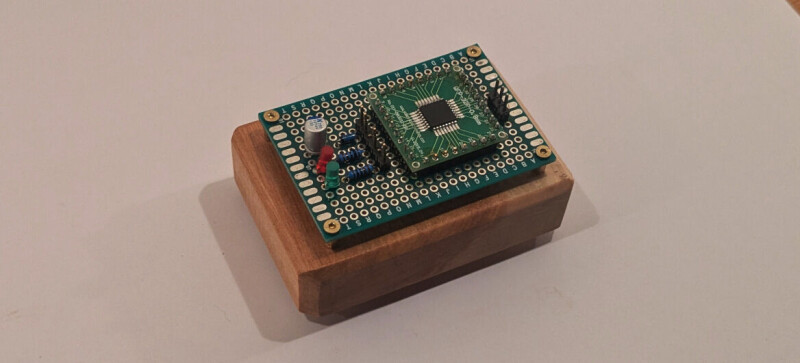
Yes, you can serve a website from a $1 microcontroller

UPDATED Web hosting bills getting too expensive? Maybe you ought to consider serving your site from a one-dollar 8-bit microcontroller. Okay, you won’t exactly be serving up a high-performance, graphic-rich website using this project from European developer and blogger Maurycy Zalewski. The setup is limited to one URL, but hey, it actually works, provided an influx of visitors hasn’t killed the site yet. The bargain-basement chip that serves as the central component of this project is the AVR64DD32, which currently retails from DigiKey for $1.30. It has a single 8-bit AVR core with a blistering 24 MHz max clock speed, 8 KB of static RAM, 64 KB of flash memory, and 256 bytes of EEPROM non-volatile memory for storing a very limited amount of data. Zalewski told The Register in an email that the whole build was free for him, as he had everything on hand, but he estimates the total cost of the thing to run closer to $2 or $3 when accounting for resistors and capacitors, the board the chip is attached to, and the like. Serving a web page from such a limited chip is a task, to say the least, and Maurycyz had to do a lot of legwork to get the thing working. The I/O pins on the AVR max out at 12 MHz, which Zalewski explained meant that it wouldn’t be possible to use Ethernet for the project, as the data flow from even the aged baseline Ethernet connection of 10BASE-T is too fast for the chip to handle. “10BASE-T still runs at 10 megabits/second,” Zalewski wrote. “Worse, it uses Manchester encoding: a zero is sent as ‘10’ and a one as ‘01,’ so 10 megabits of data is actually 20 megabits at the wire.” “The proper solution is to buy a dedicated Ethernet chip from DigiKey, but then I'd be waiting weeks to finish this project,” Zalewski noted. Instead of waiting, he decided to take a different approach by turning to Serial Line Internet Protocol (SLIP), just like the guy who turned a discarded vape into a web server last year. For those unfamiliar with SLIP, it’s a 38-year-old protocol designed to encapsulate IP traffic for transmission over serial lines, and it was widely used to make internet connections in the olden days. SLIP is still supported in modern Linux builds due to its compact size and the fact that it’s often used to connect microcontrollers to the internet. Now, giving the AVR an internet connection didn’t solve the harder problem of actually serving a web page to visitors. Zalewski said the chip could generate response packets by swapping the source and destination addresses on incoming traffic and resetting the packet’s TTL value, but implementing TCP still took several days of work. HTTP handling was simplified by returning a hardcoded response for every request, which works as long as the site only serves a single URL. Here’s that limitation we were talking about: “This works fine as long as there's only a single URL on the site,” Zalewski said. Sorry for those wanting to host more pages from that $1 microcontroller. Lastly, Zalewski said he had to figure out how to get requests from the internet to the microcontroller without spending money on a publicly routed IP address. That was resolved by using WireGuard to connect the microcontroller located at his home to a public-facing machine at a Helsinki datacenter, which then proxied requests to the microcontroller using a local address block. “This means that visitors aren't directly connecting to the MCU's TCP/IP stack... but hey, it's the same setup that the Vape Server uses and no one complained,” Zalewski said. And all without having to buy a vape or root through dumpsters to find an old one. Zalewski told us that the hardware he used for the task was so simple that it only took a few minutes to build the thing itself. The software was another thing altogether, though. "Wiring up the board only took a few minutes, but writing the software took multiple days," Zalewski said. Lucky for those wanting to duplicate or add to his work, the source code and a pre-compiled binary that'll run on an 8-bit microcontroller are included in his blog post. ® Updated at 1854 GMT on 3/18/2026 with more information after we spoke to the developer.