How Sylvester Stallone Rescued the First Rambo Film With a Radical Recut, Cutting It From 3½ Hours to 93 Minutes. “The solution that ended up saving the movie wasn’t much less drastic, producing a 93-minute cut that excised most of Rambo’s dialogue.”

This story was reported with support from the MuckRock foundation.
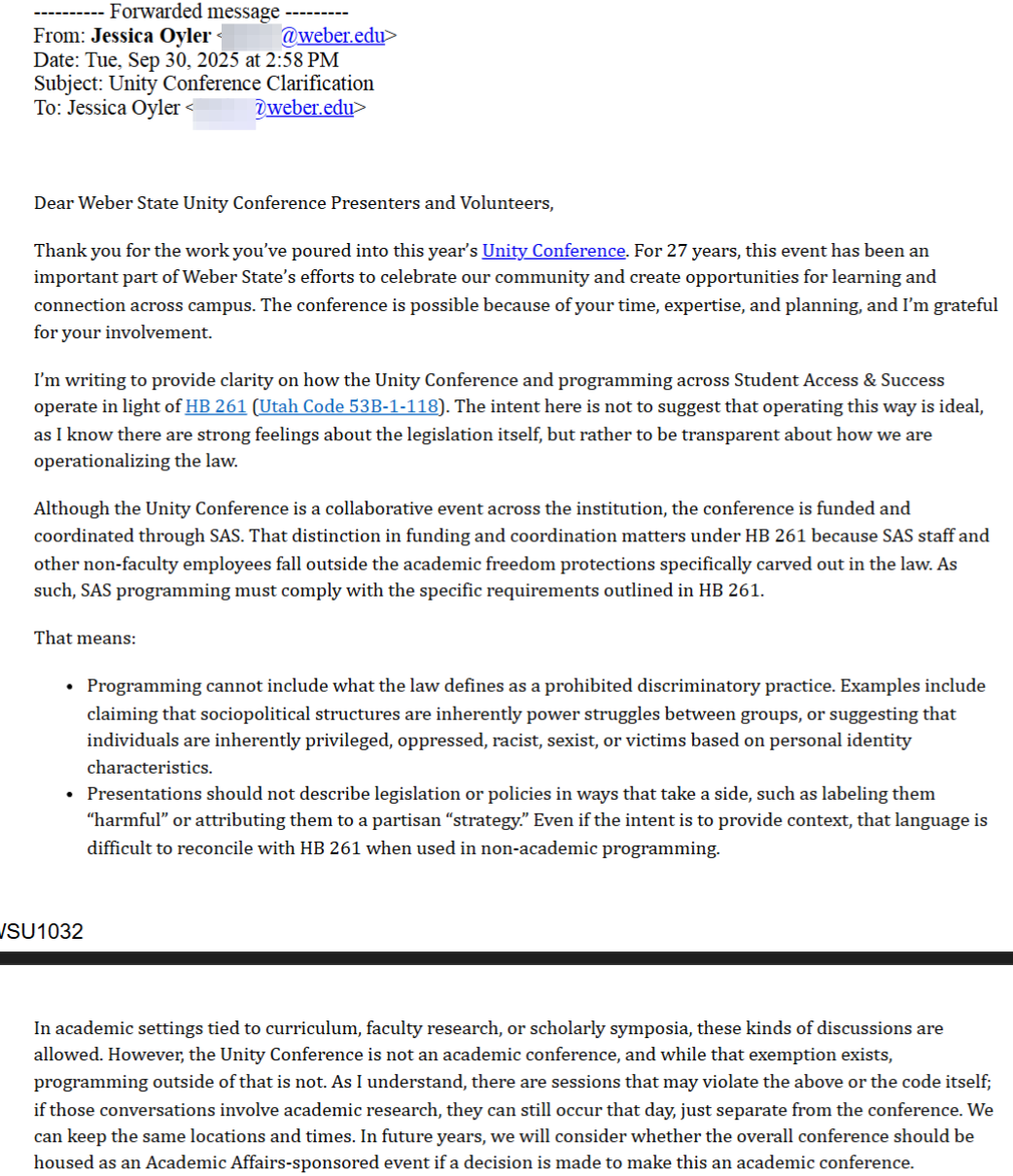
Less than 72 hours before Weber State University in Utah was scheduled to host a conference on censorship, presenters were told not to discuss identity politics, or be removed from the official program agenda. In an email to presenters selected to participate in the 27th Annual Unity Conference, titled “Redacted: Navigating the Complexities of Censorship,” then-Vice President of Student Access & Success Jessica Oyler told participants that it wasn’t a “real” academic conference; therefore, their statements and materials that “take a side” on legislation or policies wouldn’t be protected by academic freedom under a particular state law.
Utah’s HB 261—the state law in question—is one of many enacted to discourage public colleges and schools from using Diversity, Equity, and Inclusion (DEI) frameworks to inform admission and employment decisions, or risk losing future funding opportunities from the state. Dozens of similar laws have been implemented in states like Texas, Florida, Alabama, and Iowa in recent years. While these laws frequently make funding a central target, prohibitions on college classroom instruction are growing more frequent.
Proponents of free speech, academic freedom, and civil rights have criticized these laws, arguing that they force the institutions that have financially benefitted from implementing DEI initiatives and scholarly contributions from researchers to make concessions that keep the university funded at the expense of its reputation. Case in point, Weber State’s censorship conference.
404 Media has obtained documents via a Freedom of Information Act request that offer more insight into the university’s rationale, the presenters’ responses and what’s happened since.
Oyler tried to articulate to presenters that it wasn’t a “real” conference because it had been funded by the university’s student affairs division. Apparently, under Utah’s HB 261, this made the conference appear academically illegitimate, because under this law—and the university’s interpretation of it—academic freedom isn’t assured for students. Nor is it an assurance for university staff, or researchers, regardless of institutional affiliation, when programs aren’t funded through faculty affairs.
Sarah Herrmann, an associate professor of psychological science at Weber State, says she was encouraged by conference organizers to submit a proposal to present at the conference research she’d conducted with one of her students into the effects of legislation like HB 261 student campus culture. Specifically, how the resulting effects of legislation—like the closure of campus cultural centers—would impact the student experience. Their proposal was accepted, with Herrmann’s student having planned to present their findings at the conference. Then, mere days before the conference, the student received a request from one of the event organizers to remove any mention of “DEI” both as an acronym and spelled out, which was quickly forwarded to Herrmann.
“You can imagine students who were part of the Women's Center or cultural centers seeing their minor canceled,” Herrmann told 404 Media. “It conveys a message about who belongs and who doesn't.”
Herrmann’s student was among the first to officially withdraw from the conference, as it signaled an institutional willingness to dissuade the development of student scholarship—a trend taking hold at institutions in states with these laws in effect. For instance, in April, the Texas Tech University System issued a memo barring all future graduate theses and dissertations on sexual orientation and gender identity once currently enrolled students satisfy pre-determined degree requirements for graduation.
Coincidentally, Weber State is one of the institutions that has closed its campus cultural centers. It’s also one of the institutions that has “suspended” both its Queer Studies and Women’s & General Studies minor, which are both listed as “pending formal discontinuance” on the university’s web pages. university’s website. Rachel Badali, Weber State University’s public relations director told 404 Media in a statement that in order to comply with HB 265—yet another state law, the university came up with a “strategic reinvestment plan.” That plan resulted in the university eliminating more than 30 major, minor, certificate and emphasis programs.
“A major point of this process was to align WSU’s offerings with workforce needs, and market analysis for the state didn’t show a demand for jobs in those areas,” Badali told 404 Media. “There was also limited student demand. Last year’s combined enrollment in queer studies and women and gender studies was less than 50 students, which was about 0.28% of degree-seeking students.”
Richard Price, a professor of political science and philosophy at Weber State who publicly withdrew from the conference’s keynote panel after receiving Oyler’s email, has been involved in a number of the campus’s initiatives aimed at improving access to LGBTQ+ scholarship over the years. I spoke with Price shortly after they’d held their last queer history course of the semester and for the foreseeable future. They told 404 Media these programs received very little funding from the state.
“They were passion projects, closed to pacify legislators who don’t like seeing words like ‘queer,’” Price told 404 Media.
Price says morale among faculty is low, particularly for those in the social sciences and humanities, who also happen to belong to the identity groups being actively marginalized, claiming that earned media for scholarship isn’t being actively promoted by the campus. This is despite the individuals perceived to be at the helm of the censorship conference’s unraveling having left the institution for other opportunities.
“They don't want my research to come up easily in legislator searches,” Price added.
Price isn’t alone in making this claim. However, Weber State’s public relations arm disputes this characterization, with Badali noting that “[w]hen WSU employees are sharing their expertise or making headlines for their great work, it proves that students are learning from the very best in the field.
“That’s something the university continues to support and promote,” she added.
But researchers from other colleges who submitted proposals to the conference weren’t immune from the university’s rigid interpretation of the state’s anti-DEI laws, either. Brianne Kramer, an associate professor in the College of Education and Human Development at Southern Utah University and her colleague also received requests to edit their conference materials for references to “the New Right,” which are literally the first words in the title of a recently published article the presentation was based on.
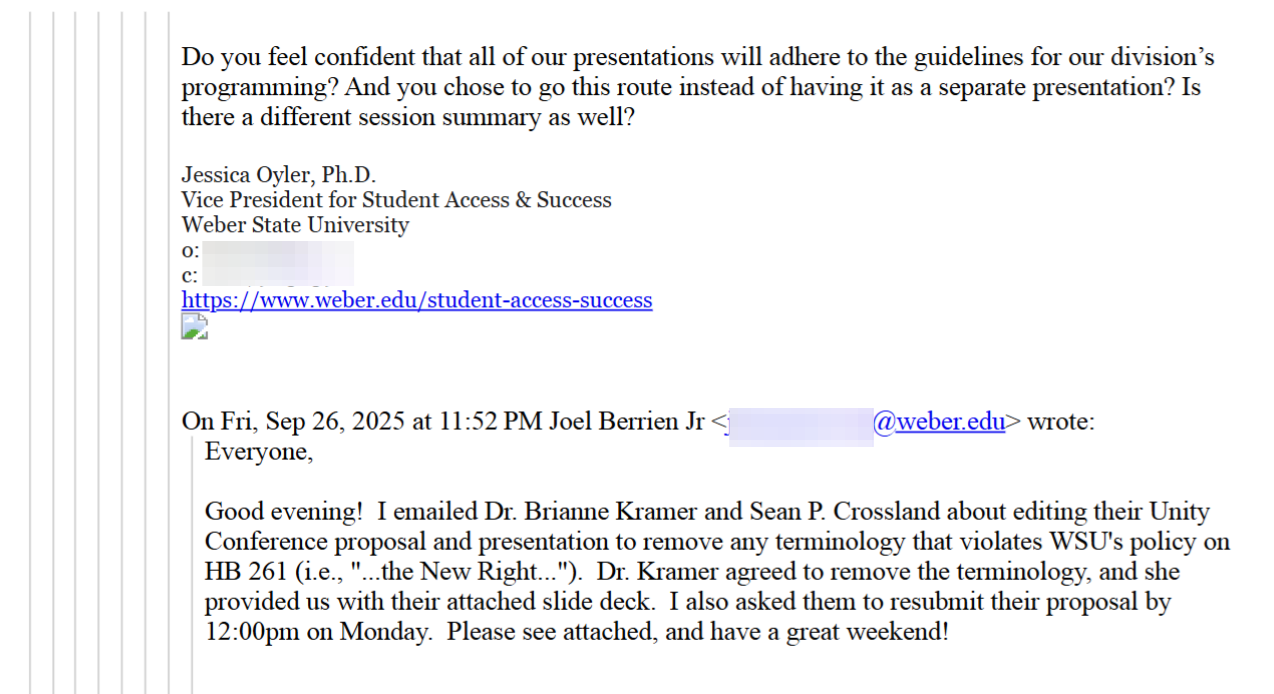
Kramer told 404 Media that she and her colleague, Sean P. Crossland of Utah Valley University were well aware that the university was asking them to censor themselves. However, the university’s request wasn’t their line in the sand. They didn’t expect to be censored during the event itself, and since neither of them are university affiliates, they didn’t have to fear reprisal.
“You can censor my title or the language in my abstract, but unless you gag me or drag me out of the room, I’m going to say what I need to say,” Kramer told 404 Media.
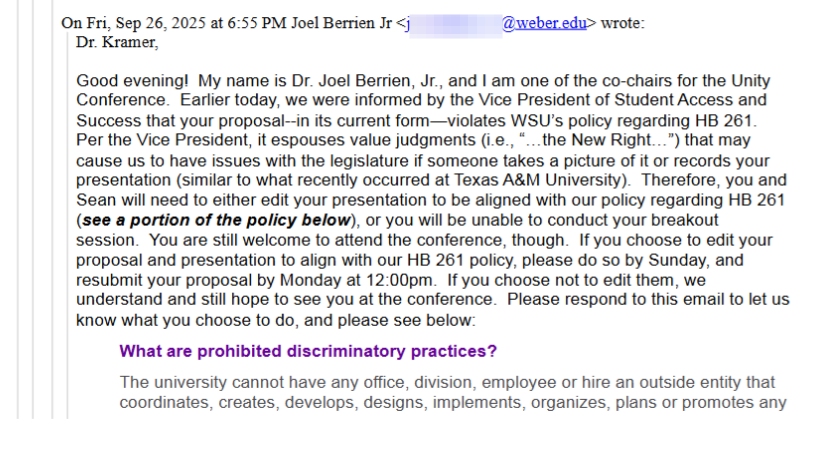
Kramer notes that academic researchers do have to take calculated risks when considering what conferences to present at or attend. This pressure encourages researchers to self-censor, which can be more detrimental than government intervention in part because it becomes so hard to measure the full extent of the problem. Kramer also says that it weakens tenure protections.
“Faculty may struggle to meet promotion and tenure requirements if they can’t publish or present certain types of scholarship,” she added. “This affects tenured and non-tenured faculty, limiting their ability to use their expertise. The consequences extend to students, who miss out on the full education they deserve when faculty self-censor in teaching, scholarship and service. Everyone loses in this scenario—not just faculty, but students and staff as well.”
Many of the initially scheduled presenters affected by Weber State’s rigid read of HB 261 welcomed efforts to reschedule the conference, led by the Wildcat Collective on two separate occasions—the second going better than the first, according to organizers, but never quite measuring up to what the conference was intended to be. Scholars like Kramer in Utah are also encouraged that SB 295 was signed into law in March of this year, amending HB 261 to broaden the scope ever so slightly. Kramer says that while it’s going to take time to return to anything close to the baseline, faculty researchers seem more inclined to mobilize in opposing restrictions to academic freedom in Utah and elsewhere, especially now that the consequences are out on full display.
“You can’t be an activist without hope,” Kramer added. “You have to be hopeful that even if we don’t get to see the big change, that we’re going to see those incremental changes, hopefully, as we move forward.”
Only Alexis Sánchez and Thierry Henry have had more prolific first seasons for Arsenal in the Premier League era
By Opta Analyst
Viktor Gyökeres was at the heart of one of Arsenal’s best attacking displays of the season at the weekend, scoring twice and grabbing an assist as Mikel Arteta’s side dismantled Fulham 3-0 at the Emirates on Saturday.
The Swede’s opener, a close-range tap-in following excellent work down the right from Bukayo Saka, was his 20th goal in all competitions for Arsenal this term. A header on the stroke of half-time effectively sealed the result and took Gyökeres to 21 goals in his debut campaign.
Continue reading...Twitter co-founder Jack Dorsey is backing new version of app called Divine, where content must be made by a human
As a pioneer of the short-form video format, Vine has been credited as one of the most influential – if short-lived – social media platforms.
The app, which allowed users to record a looping six seconds of video, boomed in popularity after its launch in 2013, spawning a plethora of viral comedy sketches and internet memes. It hit 100 million monthly active users at its peak and helped launch the careers of influencers such as Logan Paul.
Continue reading...
In veel staten openen Amerikaanse banken de ene na de andere fysieke vestiging. Potentiële klanten willen dat er „iemand is waar ze naartoe kunnen”, luidt de gedachte achter de bankenboom.
/s3/static.nrc.nl/wp-content/uploads/2026/05/04151520/040526ECO_2033372323_chaseDRAGEND.jpg)


The Independent reports that "more than a third of children in the UK have found a way around age verification measures" for social media sites and other online platforms. And new research from online safety organisation Internet Matters "suggests one in six parents have helped their child to get past age verification checks, with children reporting 'tricking' platforms into thinking they are older. "
Parents also said they had caught their children drawing on facial hair in a bid to evade the technology. One mother said: "I did catch my son using an eyebrow pencil to draw a moustache on his face, and it verified him as 15 years old"... From a sample of 1,000 UK children, 46% said they believed age checks are easy to bypass, while 32% admitted to having done so.
49% of the children surveyed said they'd still encountered harmful content, according to the online safety activists. The group called the figure "unacceptable," and complained that age verification measures "are often ineffective in practice or easy to bypass."


Parents also said they had caught their children drawing on facial hair in a bid to evade the technology. One mother said: "I did catch my son using an eyebrow pencil to draw a moustache on his face, and it verified him as 15 years old"... From a sample of 1,000 UK children, 46% said they believed age checks are easy to bypass, while 32% admitted to having done so.
49% of the children surveyed said they'd still encountered harmful content, according to the online safety activists. The group called the figure "unacceptable," and complained that age verification measures "are often ineffective in practice or easy to bypass."
Read more of this story at Slashdot.
NEW YORK (ANP) - eBay behoorde maandag tot de sterkste stijgers op de beurzen in New York. De Amerikaanse videogameketen GameStop heeft een bod uitgebracht op de onlinemarktplaats van bijna 56 miljard dollar (bijna 48 miljard euro). Het veel kleinere GameStop wil van eBay een concurrent maken voor webwinkelconcern Amazon. eBay heeft het ongevraagde overnamebod van GameStop inmiddels bevestigd.
Het aandeel eBay steeg 4,7 procent. Het bod vertegenwoordigt een premie van ongeveer 20 procent ten opzichte van de slotkoers van vrijdag. GameStop daalde ongeveer 5 procent. Topman Ryan Cohen van GameStop zei tegen zakenkrant The Wall Street Journal dat hij niet zal aarzelen om aandeelhouders van eBay rechtstreeks te benaderen met een vijandig bod als het management van eBay zijn bod afwijst.
De algehele stemming op Wall Street was voorzichtig na de sterke opmars in april. De Dow-Jonesindex noteerde kort na opening van de markt 0,4 procent lager op 49.335 punten en de brede S&P 500-index daalde 0,1 procent tot 7220 punten.
BRUSSEL (ANP) - Minister Eelco Heinen (Financiën) noemt het belangrijk dat de handelsdeal tussen de Verenigde Staten en de EU wordt uitgevoerd. Hij reageert daarmee op de 25 procent importheffing op auto's die de Amerikaanse president Donald Trump vrijdag aankondigde.
"Ik denk dat iedereen dit helemaal zat is, dit wapengekletter", zei Heinen voorafgaand aan overleg met de ministers van Financiën van de eurolanden. "Het helpt allemaal niet als we de hele tijd op elkaar reageren of via X allemaal stoere taal uitslaan. Er wordt heel hard gewerkt aan een deal en ik ben ook gewoon positief over dat dit tot een goed einde kan komen."
Voorzitter van de Eurogroep Kyriakos Pierrakakis zei eerder dat alle opties nog op tafel liggen als reactie op Trump. Heinen wilde niet zeggen over welke opties dat gaat. "Alles wat ik hierover zeg, helpt niet om zo'n deal nu af te ronden."
Volgens Trump houdt de EU zich niet aan de handelsdeal die vorige zomer werd overeengekomen, wat door Brussel wordt ontkend.