
Thomas Hawk posted a photo:

Resolution Foundation report says ‘crisis’ stems from rising ill-health and a failing system of benefits and job support
Britain has the third-highest rate of young people not in work or education among Europe’s richest countries because of rising ill-health and a failing system of benefits and job support, a report has warned.
The Resolution Foundation thinktank said the UK was facing a “crisis” in youth jobs amid a dramatic rise in the number of 16- to 24-year-olds who are not in education, employment or training (Neets) to almost 1 million – the highest level in more than a decade.
Continue reading...Police warn of violent pornography and ‘toxic’ influencers as suicides outstrip homicides for third year running
The first teenage girl has been identified as having been driven to kill herself after domestic violence, as police chiefs blamed violent pornography and “toxic” influencers for being behind a rise in teen abuse.
Suicides after domestic abuse have outstripped homicides for the third year running, according to the Domestic Homicide Project, which records deaths in England and Wales after domestic abuse.
Continue reading...NAHT survey says widespread disrepair forcing closure of playgrounds and classrooms, with Send facilities also hit
Half of headteachers say parts of their school are either out of use or unfit for purpose due to leaks, damp, mould, asbestos, ageing boilers and malfunctioning fire doors, according to a new survey by the National Association of Head Teachers(NAHT).
Among those who say their schools are suffering, almost three-quarters (73%) say they have toilet blocks that are either closed (8%) or not fit for purpose (65%).
Continue reading...
Arizona State University rolled out a platform called Atomic that creates AI-generated modules based on lectures taken from ASU faculty by cutting long videos down to very short clips then generating text and sections based on those clips.
Faculty and scholars I spoke to whose lectures are included in Atomic are disturbed by their lectures being used in this way—as out-of-context, extremely short clips some cases—and several said they felt blindsided or angered by the launch. Most say they weren’t notified by the school and found out through word of mouth. And the testing I and others did on Atomic showed academically weak and even inaccurate content. Not only did ASU allegedly not communicate to its academic community that their lectures would be spliced up and cannibalized by an AI platform, but the resulting modules are just bad.
AI in schools has been highly controversial, with experiments like the “AI-powered private school” Alpha School and AI agents that offer to live the life of a student for them, no learning required. In this case, the AI tool in question is created directly by a university, using the labor of its faculty—but without consulting that faculty.
“We are testing an early version of ASU Atomic to learn what works, and what doesn't, to further improve the learner experience before a full release,” the Atomic FAQ page says. “Once you start your subscription, you may generate unlimited, custom built learning modules tailored specifically to your learning goals and schedule.”
The FAQ notes that ASU alumni and those who “previously expressed interest in ASU's learning initiatives or participated in research that helped shape ASU Atomic” were invited to test the beta. But on Monday morning, I signed up for a free 12 day trial of the Atomic platform with my personal email address — no ASU affiliation required. I first learned about the platform after seeing ASU Professor of US Literature Chris Hanlon post about it on Bluesky.
“When I looked at it, I was really surprised to see my own face, and the faces of people I know, and others that I don't know” in module materials generated by Atomic, Hanlon said. It had clipped a one-minute snippet from a 12 minute video he’d done as part of a lecture mentioning the literary critic Cleanth Brooks, which the AI transcribed as “Client” Brooks. “What was in that video did not strike me as something anyone would understand without a lot more context,” Hanlon said. When he contacted his colleagues whose lecture videos were also in that module, they were all just as shocked and alarmed, he said. “I mean, it happens to all of us in certain ways all the time, but have your institution do it—to have the university you work for use your image and your lectures and your materials without your permission, to chop them up in a way that might not reflect the kind of teacher you really are... Let alone serve that to an actual student in the real world.”
The videos appear to be scraped from Canvas, ASU’s learning management system where lecture materials and class discussions are made available to students. Canvas is owned by Instructure, and is one of the most popular learning management systems in the country, used by many universities. “ASU Atomic currently draws from ASU Online's full library of course content across subjects including business, finance, technology, leadership, history, and more. If ASU teaches it, Atom—your AI learning partner—can build a hyper-personalized learning module around it,” the Atomic FAQ page says.
As of Monday afternoon, after I reached out at the ASU Atomic email address for comment, signups on Atomic were closed. I could still make new modules using my existing login, however.
In my own test, I went through a series of prompts with a chatbot that determined what I wanted my custom module to be. I told it I was interested in learning about ethics in artificial intelligence at a moderate-beginner level, with a goal of learning as fast as possible.
 Jason Koebler
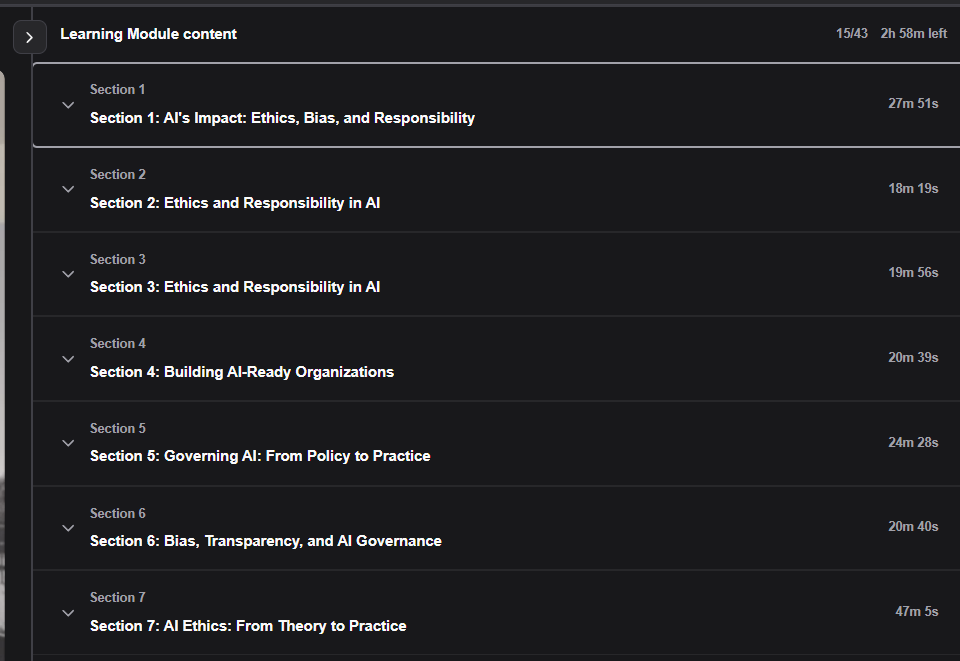
Atomic generated a seven-section learning module, with sections that repeated titles (“Ethics and Responsibility in AI” and “AI Ethics: From Theory to Practice”). The first clip in the first section is a two-minute video taken from a lecture by Euvin Naidoo, Thunderbird School of Management's Distinguished Professor of Practice for Accounting, Risk and Agility. In it, Naidoo talks about “x-riskers,” who he defines as “a community that believes that the progress and movement and acceleration in AI is something we should be cautious about.” Atomic’s AI transcribes this as “X-Riscus,” and transfers that error throughout the module, referring to “X-Riscus” over and over in the section and the quiz at the end.
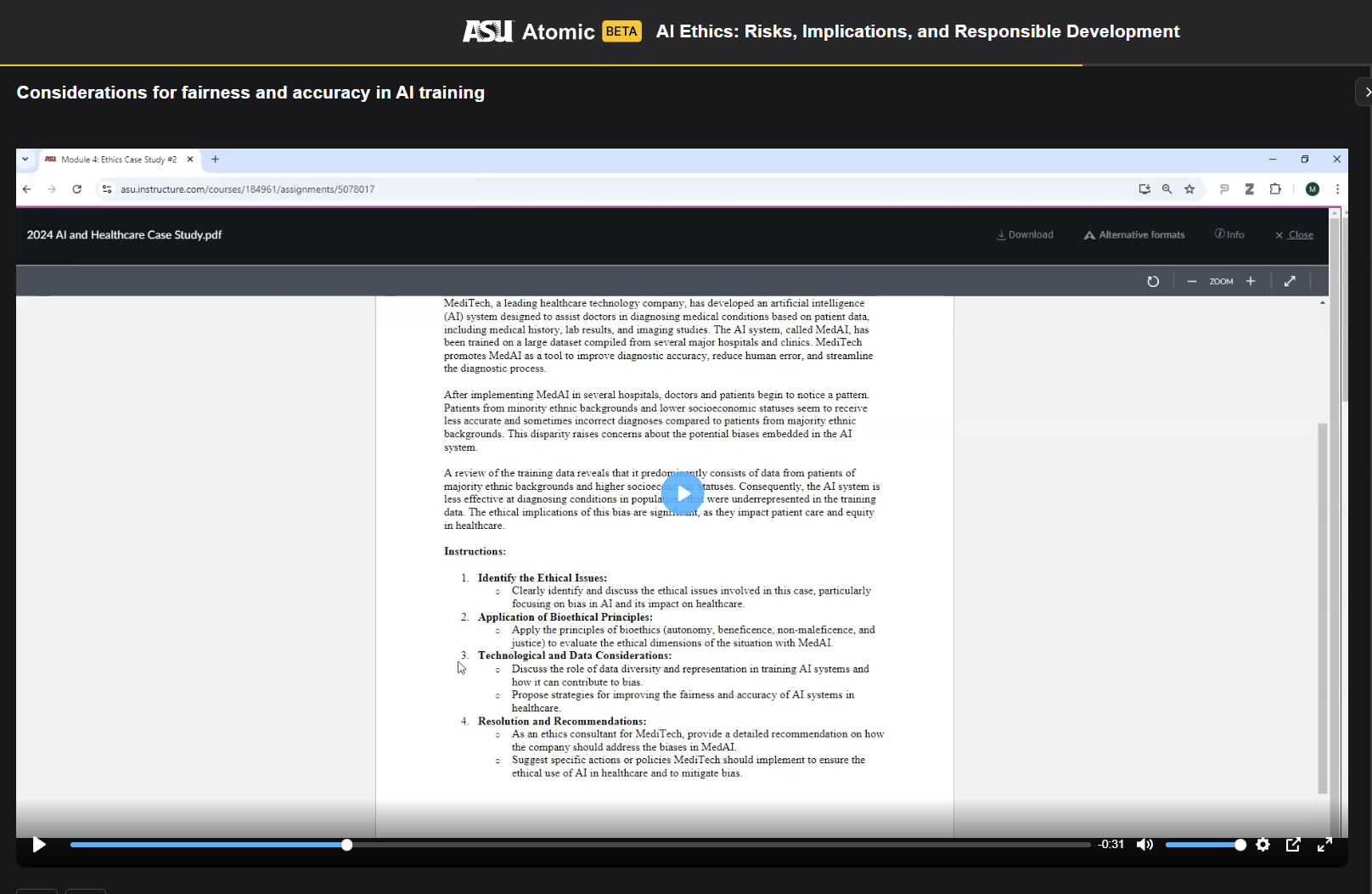
The next section jumps directly into the middle of a lecture where a professor is talking about a study about AI in healthcare, with no context about why it’s showing this:
In a later section, film studies professor and Associate Director of ASU’s Lincoln Center for Applied Ethics, Sarah Florini, appears in a minute-long clip from a completely unrelated lecture where she briefly defines artificial intelligence and machine learning. But the content of what she’s saying is irrelevant to the module because it came from a completely unrelated class and is taken out of context.
“It makes me feel like somebody that's less knowledgeable about me, they're going to be naive about these positions, and they're going to think either that an ‘expert’ said it so therefore it must be true"
“This was a video from one of the courses in our online Film and Media Studies Masters of Advanced Study. The class is FMS 598 Digital Media Studies. It is not a course about AI at all,” Florini told me. “It is an introduction to key concepts used to study digital media in the field of media studies.” She recorded it in 2020, before generative AI was widely used. “That slide and those remarks were just in there to get students to think of AI as a sub-category of machine learning before I talked about machine learning in depth. That is not at all how I would talk about AI today or in a class that focused more on machine learning and AI tech technologies,” she said. “It’s really a great example of how problematic it is to take snippets of people teaching and decontextualize them in this way.”
Florini told me she wasn’t aware of the existence of the Atomic platform until Friday. “I was not notified in any way. To the best of my knowledge no faculty were notified. And there was no option to opt in or out of this project,” she said.
Another ASU scholar I contacted whose lecture was included in the module Atomic generated for me (and who requested anonymity to speak about this topic) said they’d only just learned about the existence of Atomic from my email. They searched their inbox for mentions of it from the administration or anyone else, in case they missed an announcement about it, but found nothing. Their lecture snippet presented by Atomic was extremely short and attempted to unpack a very complex topic.
“I don't love the idea of my lectures being taken out of the context of my overall course, and of the readings for that module, and then just presented as saying something,” they told me. “It makes me feel like somebody that's less knowledgeable about me, they're going to be naive about these positions, and they're going to think either that an ‘expert’ said it so therefore it must be true... Or they're gonna think, that's obviously fucking stupid, this ‘expert’ must be dumb. But I could have been presenting a foil!” The clips are so short, it's impossible in some cases to discern context at all.
That lecturer told me the idea of their work being chopped up and used in this way was less a matter of concern for their ownership of the material, and more distressing that someone might come away from these modules with half-baked or wrong conclusions about the topics at hand. “All of the complexity of the topic is being flattened, as though it's really simple,” they said of the snippet Atomic made of their lecture. When they assign this topic to students, it comes with dozens of pages of peer reviewed academic papers, they said. Atomic provides none of that. The module Atomic produced in my test provided zero source links, zero outside readings for further study, no specific citations for where it was getting this information whatsoever, and no mention of who was even in the videos it presented, unless a Zoom name or other name card was visible in the videos.
“I would really like to know, how did this particular thing happen? How did this actually end up on the asu.edu website?” Hanlon said. “It is such a clunky thing. It is so far removed from what I think the typical educational experience at ASU is. Who decided this would represent us?”
ASU Atomic, the ASU president’s office, and media relations did not immediately respond to my requests for comment, but I’ll update if I hear back.


