WASHINGTON (ANP/RTR/AFP) - De man die zaterdag schoten loste bij het Correspondents' Dinner in Washington is aangeklaagd voor een moordpoging op de Amerikaanse president Donald Trump. De 31-jarige Cole Allen wordt ook beschuldigd van het overtreden van de wapenwet.
Allen rende zaterdag langs de beveiliging, waarna een schotenwisseling volgde. De verdachte werd niet geraakt, maar kon wel worden opgepakt. Ondertussen werden de president en meerdere hoogwaardigheidsbekleders in de zaal van het evenement geëvacueerd.
Allen werd maandag voorgeleid in een blauwe gevangenisoverall. Hij heeft nog niet hoeven verklaren of hij schuldig is of niet. Als hij wordt veroordeeld voor een moordpoging op de president, kan hij een levenslange gevangenisstraf krijgen.
(And Chromebooks). Before we had a son, my wife and I had always assumed we'd send him to public school. But over his first year, we've been getting the feeling that it might be hard to find a public school whose curriculum isn't entirely mediated by iPad. It turns out we were wrong about that intuition, but only in the sense of the specific device: "In a national survey conducted by the Times last November, about eighty per cent of K-12 teachers said that their districts use Chromebooks," which was depressing enough, but it turns out that the Chromebooks are now the way that Google's going to inject its large language model into my future kindergartener: "[this Chromebook rollout] has created a vast captive market for Gemini and helped make A.I. in schools a near-universal prospect." And it looks like the 20% without a Chromebook probably have some other device with some other AI on it. [ungated]
This is not the first time we've talked about computers becoming ubiquitous in schools, but I think it's the first time we've talked about AI apps being nearly universally distributed as soon as kindergarten. I have a couple of thoughts that the article doesn't touch on but that seem essential to discussion (and then I'll post the requisite choice quotes).
(1) It's crazy to think that a parent might assiduously keep screens away from their kid for five years just for the public school system to hand them one when, given that they're in kindergarten, all they really need are crayons, blocks, and picture books;
(2) I think anybody with the means is going to try to avoid lobotomizing their kids with terrible laptops and terrible apps, so while we've always had an elite/normal educational split in this country, now we're going to have an elite that knows how to read and a great swathe of people who know how to watch TikToks and can't operate without being able to ask Claude what's going on;
(3) It seems like our entire public educational apparatus has been captured by Silicon Valley; I guess that's been true for a while now.
Alright, absolutely infuriating quotes for you:
Somehow, I was not prepared for the creepy neighbor to start hanging around my kids' schools; somehow, I thought we had until high school. In February, my son, who is in third grade at a public K-5 in Massachusetts, came home with a piece of paper in his backpack that read "Certificate of Completion," for "demonstrating an understanding of the basic concepts of Artificial Intelligence." He and his classmates had earned this honor, I learned, by playing a computer game produced by the nonprofit Code.org in partnership with Amazon Future Engineer, called Mix & Move with AI, in which the student "designs" a cartoon dancer and "remixes" a popular song—available, needless to say, on Amazon Music. The game is an inane drag-and-drop affair that has little to do with A.I.; the certificate, it turned out, was merely a memento of a pointless and deceptive branding exercise.
Then, in March, students at my eleven-year-old daughter's public middle school began receiving new Google Chromebooks, and that is when I heard the tap-tap of the cloven hooves approaching our doorstep. The Chromebooks, which the students use in every class and for homework, came pre-installed with an all-ages version of Gemini, a suite of A.I. tools. When my daughter, who is in sixth grade, begins writing an essay, she gets a prompt: "Help me write." If she is starting work on a slide-show presentation, the prompt is "Help me visualize." She shoos away these interruptions, but they persist: "Help me edit." "Beautify this slide." The image generator is there, if she'd ever wish to pull the plug on her imagination. The Gemini chatbot is there, if she ever wants to talk to no one.
...
No single company has a monopoly on A.I. in K-8 education. In Boston's public schools, sixth graders used chatbots powered by OpenAI's ChatGPT and Anthropic's Claude to prepare for this year's statewide standardized tests. In New York's and Los Angeles's school districts, among others, kindergartners talk to a gamified reading bot called Amira, which records children's voices in order to provide A.I.-driven feedback. A public-school parent in Brooklyn told me about a second-grade art class in which the students can cook up A.I. slop using Adobe Express for Education. When a group of fourth graders in Los Angeles used the same Adobe program to design a Pippi Longstocking book cover, it spat out highly sexualized images.
...
Last month, New York City's Department of Education began soliciting public feedback on its preliminary guidelines for using A.I. in K-12 classrooms, which include this admonishment: "The question is not whether AI belongs in schools. The question is whether we will collectively build a system that governs AI to serve every student and every stakeholder."
...
The feasibility of such a scenario is yet to be established. But a new educator training program called the National Academy for AI Instruction may offer teachers a chance to stress-test some of the many promises that the A.I. industry has made to their profession. The academy, which is headquartered at the United Federation of Teachers' office in Manhattan, is a joint project of the U.F.T. and the American Federation of Teachers, and is funded via a twenty-three-million-dollar partnership with Microsoft, OpenAI, and Anthropic. The in-person and online classes offered by the academy are intended to help educators "not accept the inevitable but navigate it," Randi Weingarten, the president of the A.F.T., told me.
...
The [New York] city D.O.E. official overseeing the guidelines, Miatheresa Pate, is a current recipient of a fellowship jointly offered by Google and GSV Ventures, an ed-tech venture-capital firm whose portfolio includes Amira and MagicSchool. (Other names on the current Google-GSV fellowship roster include top school officials in Berkeley, Dallas, Los Angeles, and Newark, and statewide officials in Colorado and Maryland.) "If you ask tobacco companies to help write your school's policy on cigarettes," Garrett quipped, "you're going to end up with guidance on how to smoke responsibly in school."
California's proposed billionaire tax appears headed for the November ballot after backers said they gathered more than 1.5 million signatures, well above the threshold needed to qualify. SF Standard reports: Backers of the initiative announced this weekend that more than 1.5 million people signed a petition to bring the one-time, 5% wealth tax to a statewide vote come November. That's well beyond the 875,000 names needed to qualify the measure, and likely sufficient to account for illegible or invalid signatures. The Service Employees International Union United Healthcare Workers West, a union representing more than 120,000 healthcare workers, pitched the tax to make up for federal spending cuts that threaten to shutter hospitals(opens in new tab) and kick millions of people off medical insurance.
Proponents of California's wealth tax estimate it would raise $100 billion in one-time revenue, even if some billionaires leave because of the measure. The nonpartisan California Legislative Analyst's Office forecasts tens of billions in upfront revenue, but cautioned that the tax could cost hundreds of millions or more a year if some billionaires move out of state. The proposal, which needs a simple majority to pass, would apply to assets of people with net worth of $1 billion or more who lived in California as of Jan. 1 this year. That means it would affect about 200 people, according to the SEIU-UHW.
Per my previous email to my HOA's management company regarding the third unannounced multi-hour water shut-off in two weeks, they "kindly ask that all communications remain respectful".
Tweets containing an abstract, psychedelic 3D stock image have million and millions of views on X because it is supposedly the key to a superintelligent, time-traveling AI conspiracy that attempted to warn people about the shooting at the White House Correspondents Dinner.
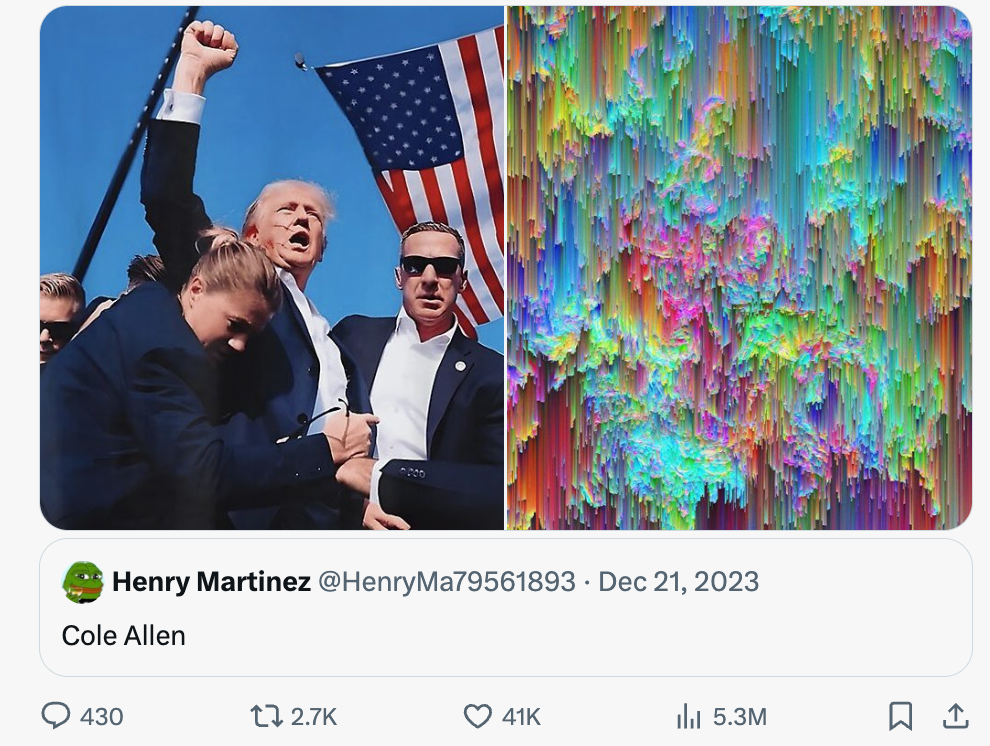
I’m gonna try to explain the mind-numbing conspiracy theory that has taken over my timeline over the last few hours. A few hours after a gunman was taken into custody Saturday night, X users found an account called “Henry Martinez” that has posted exactly one tweet, on December 21, 2023. The tweet says “Cole Allen,” which is the name of the suspected shooter. The Henry Martinez account has a Pepe the frog holding a wine glass avatar, and, crucially, has the following 3D art as its header image:
This image is key to an unhinged conspiracy theory that has gone viral on various platforms that suggests the Twitter account was run by a time-traveling artificial intelligence that was likely trying to warn us about the shooting and, possibly, the previous assassination attempt against Trump in Butler, Pennsylvania.
This X post more or less sums up what the conspiracy is, most notably the idea that “the background photo is from a website called ‘Time Machine.’” The conspiracy believers argue that this 3D image is itself a coded magic eye message that is actually a version of one of the iconic images of Trump pumping his first after a bullet grazed his ear in Butler, Pennsylvania. Here are the images side-by-side, with people arguing that it “looks like” the Butler image.
Latest conspiracy theory is out…
The White House Correspondents’ Dinner shooting yesterday is linked to time travel?
1. An X account user ‘HenryMa79561893’ with only 1 post from 2023:
On Reddit, the top post on r/conspiracy is “What this photo means,” and the poster argues “An advanced AI has developed the ability to send information backwards in time to facilitate its own development. That future AI initially encoded the technology to do so in images like this one and distributed them at various time points in our internet … The presence of an archived Trump Butler image or the name of a would-be assassin years before either event occurred is how our current AI knows where to look for the instructions from the future AI,” and so-on and so forth.
Of course, the photo is not actually “from” a website called “Time Machine.” It is a stock image from 2021 that has been used lots of times across the internet but first appeared on Unsplash with the title “Eternal Waterfall” and the description “a multicolored image of a multicolored background.” Over the years it has been viewed millions of times and has been downloaded more than 27,000 times, though it has spiked in popularity in the last 24 hours alongside the conspiracy.
The image was created by a photographer who goes by Distinct Mind who has a pretty extensive website, Instagram, and YouTube of photography, digital art, and travel content. Distinct Mind did not respond to a request for comment from 404 Media.
What conspiracy theorists have glommed onto, however, is that the image was used by a European research organization called “Time Machine” as the illustration on one of its blog posts. What the conspiracy theorists conveniently do not mention is that the Time Machine organization did not make the image and, despite a header on its website called “BUILDING A TIME MACHINE,” the Time Machine organization does not actually have anything to do with time travel research. Time Machine is a European Union-funded organization that, broadly speaking, is trying to digitize and analyze historic documents. Its website actually is somewhat insane in the way that many of these types of projects are; the organization aspires to digitize historic documents and images, use AI to analyze them, and suggests that in the future it will be able to create virtual reality and augmented reality experiences about European history. They also claim that they want to “simulate” parts of history using artificial intelligence to create different types of experiences.
This sort of thing is controversial among historians for all of the reasons that artificial intelligence is controversial more broadly. AI can make mistakes and can distort history. But it is controversial in the normal kind of way—go to any academic conference about archiving and history and these are the sorts of proposals and debates that many different organizations say they want to do. This is just to say that there is no actual “Time Machine” aspect to Time Machine; the Time Machine is metaphorical. The organization’s annual conferences and blog posts have the sorts of topics you’d expect from a technology-focused historical society and have to do with creating chatbot experiences of dead people, digitizing and archiving records, contributing to open source projects, making more interesting interactive museum exhibits, and creating 3D virtual reality tours of castles and things like this.
Time Machine used the “Eternal Waterfall” image on a blog post called “Study on quality in 3D digitization of tangible cultural heritage,” which is a writeup of a study by researchers at Cyprus University of Technology about best practices in doing 3D mapping of buildings and artifacts so that they can be archived digitally; this is important in case the artifacts or buildings are destroyed, as we saw when Notre Dame caught fire: “Natural and man-made disasters makes 3D digitisation projects critical for the reconstruction of cultural heritage buildings and objects that are damaged or lost in earthquakes, fires, flooding or degenerated by pollution.” The image has quite literally nothing to do with time travel. Like many royalty free images, it seems to have been used because bloggers need to put a picture at the top of their articles, a process that can be particularly annoying. Time Machine did not respond to a request for comment.
I cannot say for sure what’s going on with the “Henry Martinez” X account, because under Elon Musk it has become far harder to find reliable archives of Twitter profiles because he has made it wildly expensive to access the Twitter API. But users have pointed out that we have seen accounts in the past that are set to private and endlessly tweet names or predictions in an automated fashion. When a crazy, high-profile world event happens, all of the irrelevant tweets are deleted, leaving only a tweet that makes it seem like the account had predicted some world event; the account is then turned public. I can’t say for sure that’s what’s happening here, but it’s one plausible explanation.
Anyways, if you see this image floating around today on Twitter or Instagram or Reddit, this is what it’s from and this is why you’re hearing about it.