
Looksmaxxing-influencers doen alles om er zo goed en mannelijk mogelijk uit te zien. Populair zijn injecties met peptiden, die de huid zouden verbeteren – al zijn die niet zonder risico. „Hoe beter je eruit ziet, hoe beter je levenskwaliteit is.”
/s3/static.nrc.nl/wp-content/uploads/2026/04/08131244/170426WEE_2032255126_looksmaxx4.jpg)
Looksmaxxing-influencers doen alles om er zo goed en mannelijk mogelijk uit te zien. Populair zijn injecties met peptiden, die de huid zouden verbeteren – al zijn die niet zonder risico. „Hoe beter je eruit ziet, hoe beter je levenskwaliteit is.”
AMSTERDAM (ANP) - Krispy Kreme, een grote rivaal van donutketen Dunkin', komt naar Nederland. Het Amerikaanse bedrijf heeft een franchisedeal gesloten met ondernemer Roberto Fava die eerder jarenlang Dunkin' in Nederland leidde. "Het is echt of ik een transfer maak van Ajax naar PSV, of van Burger King naar McDonald's", zegt hij zelf over zijn overstap.
Het is de bedoeling dat het eerste filiaal in november of december opent. Dit moet zowel een verkooppunt als een productielocatie worden, waardoor gasten kunnen zien hoe de donuts worden gemaakt. Waar deze vestiging precies komt, kan Fava nog niet zeggen. Uiteindelijk denkt de ondernemer in vijf jaar ongeveer dertig winkels in Nederland te openen.
Bij Dunkin' werkte Fava altijd met een compagnon. Naar eigen zeggen wilde hij altijd nog zoiets voor zichzelf doen. Toen hij een aanbieding kreeg van Krispy Kreme, liet hij die kans dus niet schieten. Sinds Dunkin' in Nederland in 2024 een doorstart maakte, is Fava ook al niet meer bij dat bedrijf betrokken.
BRUSSEL (ANP) - De Europese Commissie heeft de leeftijdverificatie-app die het deze week presenteerde bijgewerkt, nadat er online meldingen waren gedaan dat de app te hacken was. Dat laat een woordvoerder van de Commissie weten.
Voorzitter van de Commissie Ursula von der Leyen zei woensdag dat de app om leeftijden te verifiëren voor de gebruikers van websites en apps "klaar voor gebruik" was. Hoewel de app nog niet te downloaden is voor burgers, is de code ervan wel publiek beschikbaar gemaakt op ontwikkelaarsplatform GitHub. Op X melden mensen die de code bestudeerden dat het mogelijk was de app te hacken en je meerderjarig voor te doen zonder verificatie.
De Commissie zegt dat een nieuwe versie van de app vrijdag zal worden uitgebracht. "Ik kan op dit moment niet uitsluiten of voorspellen of verdere updates nodig zullen zijn", aldus de zegsman.
De Commissie blijft erbij dat de app klaar is voor gebruik. Het is aan EU-landen of ze gebruik zullen maken van de EU-verificatieapp.
NEW YORK (ANP) - De olieprijzen gingen bijna 10 procent omlaag na een verklaring van de Iraanse minister van Buitenlandse Zaken Abbas Araghchi over dat de Straat van Hormuz weer is heropend voor de commerciële scheepvaart.
Door die zeestraat gaat een vijfde van de wereldwijde olievervoer. Iran had de Straat van Hormuz vanwege de oorlog vrijwel afgesloten voor olie- en gastankers
Iran opent volgens minister van Buitenlandse Zaken Abbas Araghchi gedurende het bestand de Straat van Hormuz voor alle commerciële scheepvaart. Iran had de straat afgesloten voor schepen van vijandelijke staten.
Er zijn van die kinderen over wie iedereen zegt: “Daar heb je geen kind aan.” Ze doen hun huiswerk zelf, maken geen ruzie, passen zich aan. In chaotische gezinnen zijn dat de kinderen die stilletjes leren: hoe minder ruimte ik inneem, hoe veiliger het hier is.
Van buitenaf lijken ze stoer, zelfstandig en makkelijk. Van binnen raken ze echter langzaam het contact kwijt met hun eigen behoeften. Niemand vraagt hoe het écht met ze gaat, zolang ze maar functioneren. Dat voelt als waardering, maar het is vaak een kind dat onzichtbaar wordt precies op de momenten dat het iemand nodig heeft.
Die strategie nemen ze mee naar hun volwassen leven. Ze hebben vrienden, een relatie, misschien een gezin. Ze zorgen, regelen, lossen problemen op. Iedereen leunt op hen. En toch voelen ze zich op een dieper niveau leeg en eenzaam, op een manier die ze nauwelijks kunnen uitleggen. Want hoe kun je je eenzaam voelen als je leven op papier “goed” is?
Het antwoord ligt in dat oude overlevingspatroon: nooit lastig zijn, nooit teveel zijn, nooit iets nodig hebben. Volwassen worden betekent dan niet alleen een baan en een hypotheek, maar ook langzaam afleren wat je ooit heeft beschermd. Oefenen met zeggen: “Ik trek het niet”, “Ik heb je nodig”, “Ik ben niet altijd de sterke.”


In a converted 18th-century chapel on the grounds of Yorkshire Sculpture Park, a strange form creeps through openings in the architecture. One can imagine its clipper- and knife-footed tendrils scurrying across the floor as it spills from an upper aperture and even slithers around part of the building’s exterior. It’s otherworldly genesis was at the hands of Nicola Turner, known for her monumental, contorted textile installations that often heave and surge from structures and public spaces.
Turner’s solo exhibition, Time’s Scythe, comprises forms made of recycled wool and horsehair, which she hand-stitches inside of mesh to create the bulging, knotted forms. “This is Turner’s first large-scale installation to use pale wool and creates a different energy to her dark sculptures, moving away from their more melancholic character,” the gallery says.

Time’s Scythe continues through September 27 in Wakefield. If you go, check out LR Vandy’s provocative exhibition, Rise, which also continues into September. See more on Turner’s Instagram, and for more twisting, creature-like forms, might also enjoy the work of Kate MccGwire.


Do stories and artists like this matter to you? Become a Colossal Member today and support independent arts publishing for as little as $7 per month. The article A Giant Wool Form by Nicola Turner Heaves and Skitters Through an 18th-Century Chapel appeared first on Colossal.
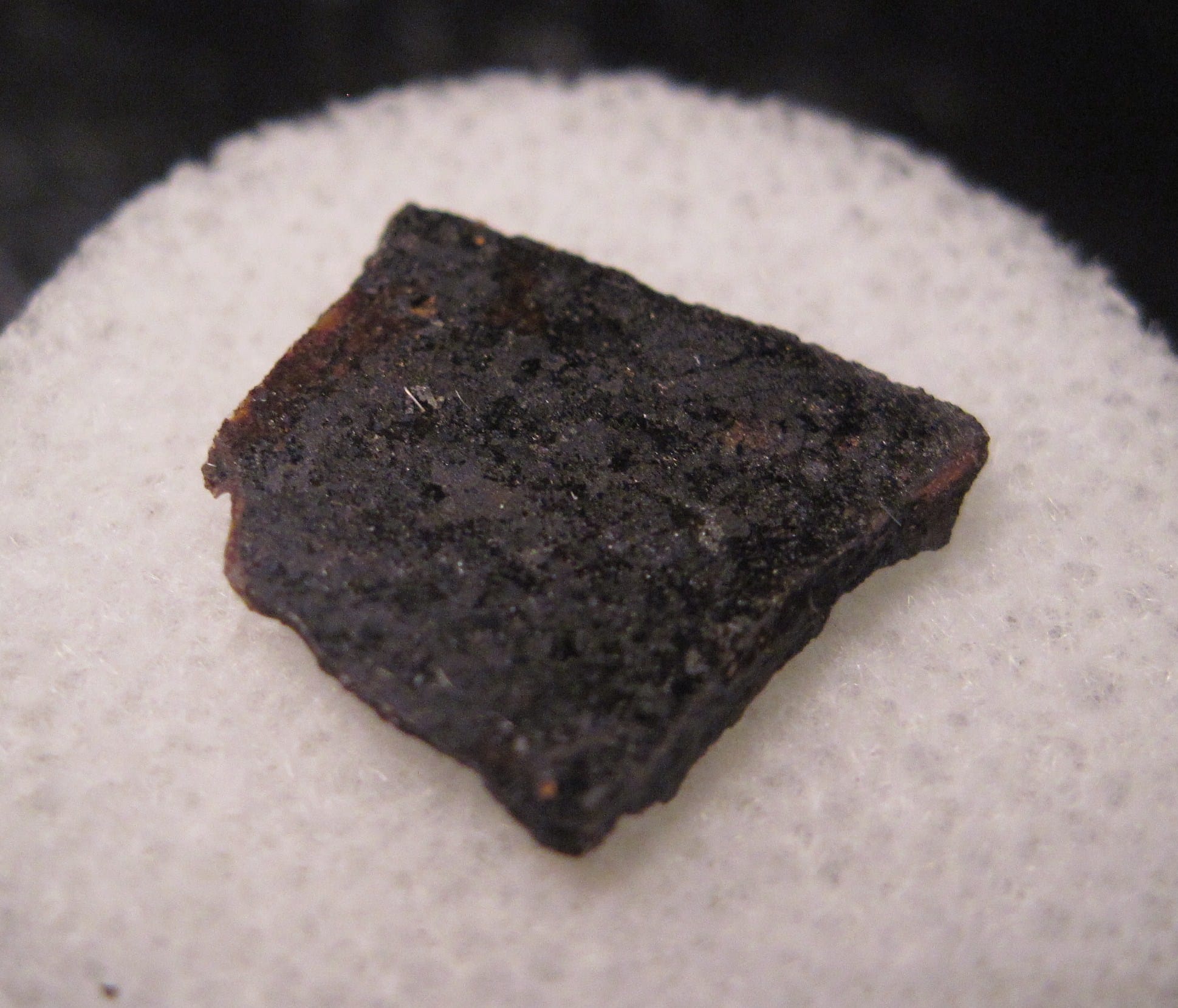
The remnants of a bizarre long-lost world that fell apart before our planet was fully formed are falling to Earth in the form of meteorites, according to a new study in Earth and Planetary Science Letters.
For decades, scientists have puzzled over the origin of angrites, a rare class of about 70 meteorites with unique volcanic compositions that suggest they were forged in a large ancient object with differentiated layers, including a metallic core and a magma ocean.
Scientists have long assumed that this object, the so-called angrite parent body (APB), was roughly a few hundred miles across, similar in size to the asteroid 4 Vesta. But researchers recently raised the tantalizing possibility that the APB might have been much larger, perhaps on the scale of Earth’s moon.
Now, a team led by Aaron Bell, an experimental petrologist and an assistant research professor at the University of Colorado, Boulder, has discovered “the first unequivocal evidence supporting the large angrite parent body hypothesis, which posits that the angrites are samples derived from a protoplanet that was catastrophically disrupted during the earliest evolutionary stages of the inner solar system,” according to the new study.
“It probably got destroyed in the early solar system, so [angrites] are remnants of a lost protoplanet,” Bell said in a call with 404 Media. “A few pieces broke off and are now in the asteroid belt, and a few of them have come to Earth, and we’ve picked them up.”
Angrites date back about 4.56 billion years, making them among the oldest known volcanic rocks. They belong to a class of stony “achondritic” meteorites that contain the crystalized signatures of melted rock, such as basalts, hinting that they originate in larger bodies that underwent some degree of planetary processing and layered differentiation, even if those early planetary embryos never accreted into full planets.
“Angrites are interesting in that they don't have a known parent body,” Bell said. “It's never been definitively identified, and that's one of the mysteries.”
“There are a bunch of arguments about why angrites are so geochemically unusual,” he added. “They're kind of this oddity.”
Most models of early planetary accretion predict that relatively small objects formed within the first few million years of the solar system, which is why the APB was assumed to be an asteroid-sized object, rather than a much larger nascent planet.
While working on a previous study, Bell became interested in an aluminum-rich angrite from Northwest Africa, known as NWA 12,774, which was classified in 2019. The meteorite is one of a handful of unusual primitive angrites that appear to have been crystallized at high pressure within the APB, indicating that it formed deep under the surface and therefore might shed light on the size of this bygone world.
“Even among angrites, there's only four or five that have these primitive compositions,” Bell said, adding that the meteorite had “off-the-charts aluminum content, which is really very unusual.”
Bell and his colleagues developed a geobarometer—a tool that calculates the pressures at which rocks and minerals formed—-that estimated it would take at least 1.7 gigapascals to account for the rock’s special properties. This pressure corresponds to an object with a minimum radius of 620 miles (1,000 kilometers), which is just under the size of Pluto. The APB may even have been as large as the Moon, which has a roughly 1000-mile radius.
“Clearly, within the first few million years of solar system evolution, you could grow planetary embryos that were 1,000-plus kilometers” in radius, Bell said. “We're talking within three million years of the condensation of the first solids in the solar system, so it’s right at the beginning.”
The discovery suggests that the APB may have been a first-generation protoplanet that coalesced and shattered millions of years before the familiar worlds of our solar system took full shape. Judging by the strange properties of angrites, the APB was also on track to be a very different kind of world than Earth and its neighbors, had it survived the chaotic environment of its infancy.
Angrites are “geochemically fundamentally different, and that's why people were interested in the first place—because they were odd,” Bell said. “They don't look like garden-variety
basalts you get from Mars or the Moon or Earth.”
“It's sort of this path not taken—or maybe it was, but we just have a couple pieces of it that tell us something we didn't know,” he concluded. “There were once large bodies that, maybe, didn’t look like the terrestrial planets.”

This is Behind the Blog, where we share our behind-the-scenes thoughts about how a few of our top stories of the week came together. This week, we discuss the Madonna-whore algorithm, reader tips, and jazz.
SAM: Yesterday morning I published a story I started working on weeks ago and only in the last week or so felt enough distance from the topic to be able to articulate it clearly: My year in the wedding planning social media abyss. The piece is a long, more sourced BTB, and I don’t have a ton to add to what’s said in it, but I do want to highlight some of the comments I’ve gotten so far that touch on things the story doesn’t elaborate on.