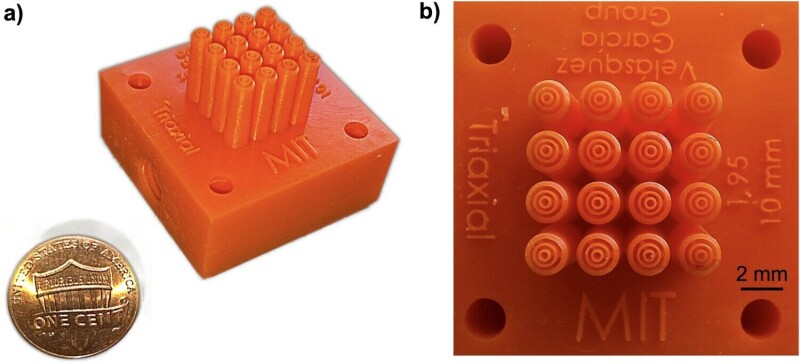
The process for producing triple-layer drug-delivery particles and materials for tissue regeneration could get easier, thanks to a new advance in creating the electrospray nozzles used to make them. A team of MIT researchers has now used a 3D resin printer to output tiny electrospray nozzles without the expensive cleanrooms they normally require. A team led by MIT principal research scientist Dr. Luis Fernando Velásquez-García detailed its work developing tiny arrays of triaxial electrospray emitters in a recent paper. Before jumping into what they actually did, it might be worth explaining exactly what we’re talking about and why it’s such a potential breakthrough. Electrospraying is a process that relies on tiny nozzles - we’re talking fractions of a millimeter, here - that are subjected to an electric field to atomize liquids into droplets smaller than what can be achieved through purely physical methods. Electrospraying can be done with lots of different liquid materials, and has a variety of uses, from ionizing liquids for mass spectrometry, to space propulsion. Such cutting-edge applications traditionally require expensive equipment, and electrospray nozzles have classically been no different. “Despite electrospray’s versatility, its applicability has been limited by scalability issues caused by challenges in fabricating with high precision and at a low cost arrays of miniaturised emitters that operate uniformly in parallel,” the paper explains. Fabrication of such miniaturized, high-precision emitter arrays is done in semiconductor-level cleanrooms, which Velásquez-García told The Register can take months to make at quite a high cost. Velásquez-García’s team isn’t just working on any old electrospray nozzle array, though: They’re working on triaxial electrospray emitters that are specifically designed to create three-layered microdroplets made of a trio of liquids that don’t mix. “There are no coaxial electrospray arrays or triaxial electrospray emitters made in the semiconductor cleanroom—they just don't exist because of the huge complexity of their design,” Velásquez-García told us in response to questions. Getting the level of precision and complexity that Velásquez-García and his team needed required an advanced 3D resin printer from Asiga with a 27 µm pixel size. It’s no wonder such precise printing was needed when you look at the design of the final product and all the intricate channels necessary to spray three different materials into such tiny droplets. Tiny design, big potential Velásquez-García and his colleagues produced a working version of their emitter array that contained 16 nozzles in a space that’s just one square centimeter, but there’s no reason to stop there. “The design is modular, so you can tile it and produce very large arrays,” Velásquez-García told us. Were one to tile his design to a square foot in size, it would have around 15,000 emitters, for example. “The key issue is that we demonstrated that we attained emitter densities of 16 emitters per square centimeter,” the MIT researcher added. “It cannot be denser because the bottleneck is the resolution of the 3D printers.” Once that engineering limit is overcome, however, the things could be incredibly dense, provided their intricate network of microchannels can be maintained. As it stands now, Velásquez-García said his team’s innovation could be readily commercialized, as the researchers believe they’ve cracked a key problem in cleanroom-free electrospray array construction. “The ‘secret sauce’ is the designs of the tube network and the support structures,” Velásquez-García explained. So, what can one do with triaxial electrospray arrays? Lots of things that’d benefit from cheaper, quickly-produced equipment to make manufacturing them less costly. There are three-layer drug-delivery particles, for instance, that could dispense medicines to specific parts of the digestive tract, self-healing materials, and even artificial cells designed to aid tissue regeneration. “The outer layer can be a protection layer that dissolves, the middle layer can contain a medicine that promotes tissue growth and regeneration, and the core layer can contain an antibiotic to protect the new tissue,” Velásquez-García told us of the potential application. “There is great flexibility on the materials that you use to create the three layers and tailor their application.” Velásquez-García said that the practicality of commercializing his design comes down to material choices, as the resin feedstock used to create the nozzles may vary significantly based on the chemical composition of the material an interested partner would want to use. MIT employees aren't allowed to form their own startups to commercialize university research, but can advise those who license it, which Velásquez-García said he’s ready to do when asked. “If anybody wants to commercialize it, they should contact us and we will work with them,” the MIT researcher told us. ®

/s3/static.nrc.nl/wp-content/uploads/2026/06/09192751/090626BIN_2034313492_.jpg)
/s3/static.nrc.nl/wp-content/uploads/2026/06/09190543/090626ECO_2033909988_7.jpg)

