Sargasso

Hopeloos Genuanceerd

SLAPP-zaak van “gendercriticus” Caroline Franssen tegen activist Tijn De Jong

Het conflict tussen de non-binaire Tijn de Jong en zelfverklaard “gendercriticus” Caroline Franssen begint bij een LinkedIn bericht van De Jong. Daarin deelt Tijn de Jong screenshots van openbare X-uitingen van Caroline Franssen waarin zij trans vrouwen neerzet als  “gevaarlijke, perverse mannen”, en ouders van transkinderen hebben volgens haar “een vorm van Munchhausen by proxy”.
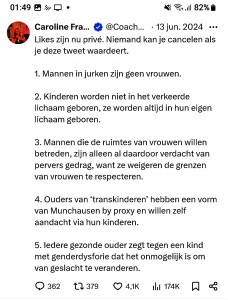

In diens LinkedIn-post vestigde De Jong aandacht op deze transfobe uitspraken en vraagt aan gedeelde connecties of zij zich bewust zijn van Caroline Franssens standpunten. Franssen is namelijk coach geweest van onder anderen psychologen, begeleidde ook relaties en individuen. Nu leidt zij coaches op, is therapeut, en een lunatic die iedere wetenschap negeert. Zij is ook onwetend over de positie van mensen van kleur.
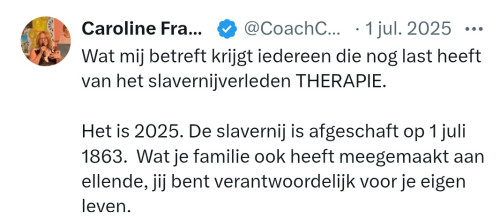
Franssen negeert daarbij dat haar eigen strijd, gelijke rechten voor vrouwen ook nog niet gestreden is, en consequenties heeft in het hier en nu. Voor trans en cisvrouwen.

En deze X signaleert 1 cellige hersen activiteit. Ze had ook Ingrid kunnen heten, van Henk. Ze is af en toe te gast bij ON.
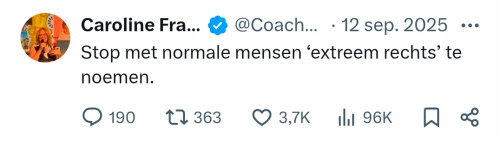
Franssen ziet het fotograferen en delen van haar X berichten als een aanval op haar persoon en werk als zelfstandig coach. Zij stelt dat het delen van haar uitingen kan leiden naar reputatieschade en mogelijk verlies van cliënten. Wat uiteraard vreemd is want zij deelt diezelfde berichten met duizenden mensen op X. Franssen eist dat De Jong haar berichten van diens LinkedIn-account verwijdert. De Jong weigert. Franssen spant dan een kort geding aan, die zij verliest. De rechter oordeelt dat De Jong kritiek mag hebben op haar publieke uitingen als onderdeel van vrijheid van meningsuiting. Franssen gaat dan in hoger beroep en verliest wederom, ook omdat zij niet aantoonbaar kan maken dat zij professionele schade heeft gehad.


hoger beroep. Deze uitkomst alleen vertelt echter niet het volledige verhaal. Juridische experts en mensenrechtenorganisaties wijzen erop dat sommige rechtszaken niet primair worden aangespannen om te winnen, maar om te intimideren. Zulke procedures staan bekend als Strategic Lawsuits Against Public Participation, oftewel SLAPP-zaken.

Juvenile Whistling kite

bpanneman has added a photo to the pool:

Juvenile Whistling kite

Quite Bright

gecko47 has added a photo to the pool:

Quite Bright

Show-off crab in the Darwin mangrove mud. I'm assuming that it is from the same Fiddler Crab family as its look-alikes in Brisbane.

The Guardian

Latest news, sport, business, comment, analysis and reviews from the Guardian, the world's leading liberal voice

Trump news at a glance: Kennedy Center to close; Epstein case ‘over’, says deputy US attorney general

Trump announces two-year closure of Kennedy Center, citing construction needs – key US politics stories from 1 February 2026

Donald Trump, who remains embroiled in tensions surrounding ICE’s presence in Minnesota, as well as scrutiny over the justice department’s latest release of the Jeffrey Epstein files, has made another announcement on Sunday evening: the temporary closure of the John F Kennedy Center in Washington DC.

Trump, who overhauled the center’s leadership at the start of his second term and renamed it to include his own name, described the center as “tired, broken, and dilapidated,” adding that it has been in “bad condition, both financially and structurally for many years”.

Continue reading...

Fatima Bhutto on secrets, lies and surviving coercive control – podcast

The Pakistani writer on enduring an abusive relationship in the public eye, and how she broke free

Fatima Bhutto was born into one of Pakistan’s most famous families. A wealthy and powerful political dynasty, marked by decades of bloody violence. Threats to the family were constant. And so the need to keep secrets became Bhutto’s norm.

Her father, Murtaza Bhutto, was killed in a police shootout outside the family home. She was just 14 years old, her world turned utterly upside down. That sadness and trauma, the sudden and silent disappearances of her childhood, followed her as an adult.

Continue reading...

Slashdot

News for nerds, stuff that matters

What Go Programmers Think of AI

"Most Go developers are now using AI-powered development tools when seeking information (e.g., learning how to use a module) or toiling (e.g., writing repetitive blocks of similar code)." That's one of the conclusions Google's Go team drew from September's big survey of 5,379 Go developers.


But the survey also found that among Go developers using AI-powered tools, "their satisfaction with these tools is middling due, in part, to quality concerns."


Our survey suggests bifurcated adoption — while a majority of respondents (53%) said they use such tools daily, there is also a large group (29%) who do not use these at all, or only used them a few times during the past month. We expected this to negatively correlate with age or development experience, but were unable to find strong evidence supporting this theory except for very new developers: respondents with less than one year of professional development experience (not specific to Go) did report more AI use than every other cohort, but this group only represented 2% of survey respondents. At this time, agentic use of AI-powered tools appears nascent among Go developers, with only 17% of respondents saying this is their primary way of using such tools, though a larger group (40%) are occasionally trying agentic modes of operation...

We also asked about overall satisfaction with AI-powered development tools. A majority (55%) reported being satisfied, but this was heavily weighted towards the "Somewhat satisfied" category (42%) vs. the "Very satisfied" group (13%)... [D]eveloper sentiment towards them remains much softer than towards more established tooling (among Go developers, at least). What is driving this lower rate of satisfaction? In a word: quality. We asked respondents to tell us something good they've accomplished with these tools, as well as something that didn't work out well. A majority said that creating non-functional code was their primary problem with AI developer tools (53%), with 30% lamenting that even working code was of poor quality.

The most frequently cited benefits, conversely, were generating unit tests, writing boilerplate code, enhanced autocompletion, refactoring, and documentation generation. These appear to be cases where code quality is perceived as less critical, tipping the balance in favor of letting AI take the first pass at a task. That said, respondents also told us the AI-generated code in these successful cases still required careful review (and often, corrections), as it can be buggy, insecure, or lack context... [One developer said reviewing AI-generated code was so mentally taxing that it "kills the productivity potential".]

Of all the tasks we asked about, "Writing code" was the most bifurcated, with 66% of respondents already or hoping to soon use AI for this, while 1/4 of respondents didn't want AI involved at all. Open-ended responses suggest developers primarily use this for toilsome, repetitive code, and continue to have concerns about the quality of AI-generated code.


Most respondents also said they "are not currently building AI-powered features into the Go software they work on (78%)," the surveyors report, "with 2/3 reporting that their software does not use AI functionality at all (66%)."

This appears to be a decrease in production-related AI usage year-over-year; in 2024, 59% of respondents were not involved in AI feature work, while 39% indicated some level of involvement. That marks a shift of 14 points away from building AI-powered systems among survey respondents, and may reflect some natural pullback from the early hype around AI-powered applications: it's plausible that lots of folks tried to see what they could do with this technology during its initial rollout, with some proportion deciding against further exploration (at least at this time).

Among respondents who are building AI- or LLM-powered functionality, the most common use case was to create summaries of existing content (45%). Overall, however, there was little difference between most uses, with between 28% — 33% of respondents adding AI functionality to support classification, generation, solution identification, chatbots, and software development.


Read more of this story at Slashdot.

I'll Call You at Four

Thomas Hawk posted a photo:

I'll Call You at Four

Found Kodachrome Slide

Thomas Hawk posted a photo:

Found Kodachrome Slide

date stamped on slide September 1959

Trump sluit Kennedy Center twee jaar voor grote renovatie

De aankondiging komt na maanden van onrust rond het toonaangevende cultuurcentrum in Washington, dat vanwege Trumps verregaande bemoeienis wordt geteisterd door annuleringen en boycots.

2026-113

maeshu has added a photo to the pool:

2026-113

Uchan