Dnipro bore the brunt of the attacks but Odesa and Kharkiv were also targeted in largest onslaught for several days
Russian drone and missile strikes across Ukraine killed at least seven people overnight, including five in the city of Dnipro, Ukrainian local authorities have said.
Reports say that at least 34 people have been injured in the strikes, which lasted “practically all night”, according to the Dnipropetrovsk regional head, Oleksandr Hanzha. The bodies of four people were found in the ruins of a house destroyed in the attacks, and workers continued to search for bodies on Saturday morning.
Hisham Abugharbieh was arrested after standoff with police and charged with killing Zamil Limon and Nahida Bristy
The man who was detained after two Bangladeshi doctoral students went missing from the University of South Florida (USF) has been booked with two counts of murder.
Hisham Abugharbieh faces two counts of premeditated murder in the first degree with a weapon in the deaths of Zamil Limon and Nahida Bristy, the Hillsborough county sheriff’s office announced on Saturday.
She backed the president as he ran millions of dollars in anti-trans ads. Now she’s disappointed her passport has the wrong gender
Thoughts and prayers for Caitlyn Jenner. It seems that it’s starting to dawn on the Olympian and reality TV star that being a rich, white, Maga supporter doesn’t entirely shield her from Donald Trump’s transphobic policies.
What sparked that realization? Was it the millions of dollars spent by the Trump campaign on anti-trans ads during the 2024 election? Was it, perhaps, the fact that one of Trump’s very first acts in his second term, conducted just hours after he took office, was to sign an executive order which stated that government-issued identification documents would be changed to reflect the holder’s “immutable biological classification as either male or female”, defined by a person’s cells at conception – in other words, your passport would reflect the sex you were assigned at birth?
Met het besluit legt staatssecretaris Van der Burg (VVD) een bijna unanieme motie uit de Tweede Kamer naast zich neer. Hij schrijft in antwoord op Kamervragen niet anders te kunnen.
Franse journalisten weten het heel zeker: Paul Seixas is het nieuwe, grote wonderkind van het wielrennen. In de Franse media willen ze niet te hard van stapel lopen, maar klinken er wel al enthousiaste geluiden dat Seixas een perfecte combinatie is van Eddy Merckx, Tadej Pogačar, Bernard Hinault en Jezus Christus.
“Je moet ze niet met elkaar willen vergelijken, dat is lullig voor Merckx”, stelt Marc Martin-Benard van wielerpodcast La lanterne rouge absolue. “Uit respect voor Eddy zullen we nog een tijdje doen alsof hij en Seixas van hetzelfde niveau zijn, totdat Paul uiteindelijk zijn twaalfde grote ronde heeft gewonnen. Daarna kunnen we los qua verslaggeving.”
De Franse journalist Arthur Dufontaine is ook lyrisch, maar plaatst meteen wel een kanttekening bij de vergelijkingen: “Jezus Christus heeft nog nooit de Waalse Pijl gewonnen, dus slaat het nergens op om ze in hetzelfde rijtje te zetten. Tegelijkertijd: ik heb gekkere dingen gezien in het wielrennen.”
bWelcome back to the Abstract! Here are the stories this week that battled rivals, devoured sharks, solved riddles, and left fingerprints in the sky.
First, scientists chronicle the victories of a jousting champion unlike any other in all of history. Then: it turns out that krakens are real, the mystery of the Golden Orb is solved, and the Northern winds are changing.
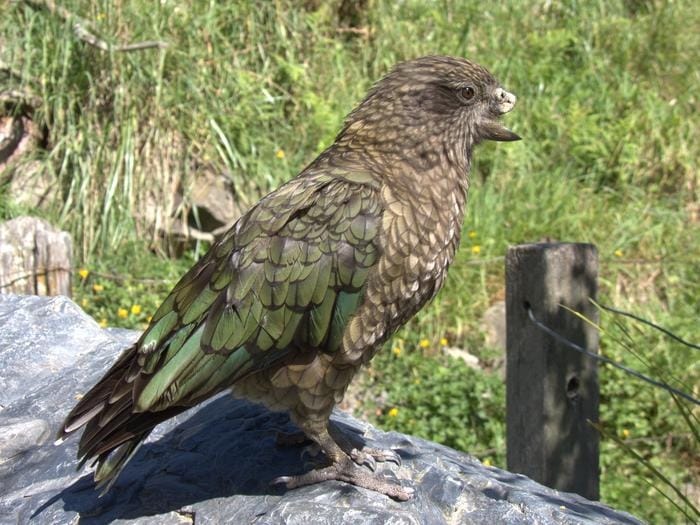
Meet Bruce, a kea parrot that lost the top half of his beak about 12 years ago. Despite his injury, Bruce is the undisputed alpha male of his “circus,” the term for a group of kea. He remains undefeated in dominance battles with rivals, allowing him to live a life of luxury in his long-time home at Willowbank Wildlife Reserve in New Zealand.
Now, Bruce has inspired one of the most delightful questions ever asked in an academic paper: “How does the kea missing his upper beak win every fight and not get stressed?”
The answer is Bruce’s invention of “beak jousting,” a set of moves that has ruffled feathers among his “intact” rivals, allowing him to ascend to the top of the pecking order.
“Bruce deployed his exposed lower beak in jousting thrusts, both at close range, with an extension of his neck, and from afar, with a run or jump that left him overbalanced forward with the force of motion,” said researchers led by Alexander Grabham of the University of Canterbury.
“Bruce has therefore weaponised his disability through behavioural innovation: jousting is a behaviour not observed in other kea, with different motor patterns, that targets a wider range of body parts,” the team said.
In this way, Bruce has maintained his position as the ringleader of the circus, a position that comes with appreciable benefits. The other birds give him dibs at all feeders in the preserve where he eats undisturbed, plus, he is the only male that is groomed by other males as opposed to female mates. He has been observed enjoying these “allopreening” services from his excellently-named male subordinates Taz, Megatron, Joker, and Neo.
Bruce being Bruce. Image: Alex Grabham
“This provides evidence of up-hierarchy allopreening: it was exclusive to the alpha and generally increased in frequency inversely to dominance, with the highest frequency of allopreening done by the lowest-ranking male,” the team said (Taz is bottom of the heap, in case you’re curious). “This is likely a key factor in why Bruce exhibits the lowest stress: allopreening is associated with reduced glucocorticoids.”
Alpha males in other species normally have higher stress levels than their subordinates, but Bruce has found a way to kick back and chill out. Indeed, this isn’t the first time he’s been the subject of scientific fascination; a 2021 study reported Bruce’s use of pebbles as tools of self-care. The fact that he displays such immense behavioral flexibility and resilience “brings into question whether well-intentioned prosthetic assistance for physically impaired animals will always improve positive animal welfare,” according to the study.
“The bird missing his upper beak has rewritten what disability means for behaviourally complex species,” the team concluded.
In other news…
Who left all these fingerprints in the extratropical zone?
Everyone wants to change the world, and well, we did it folks. Scientists have discovered “a human fingerprint” in the atmospheric circulation of the Northern hemisphere during winter, according to a new study.
In other words, the impact of human-driven climate change is measurably causing the structure of Northern jet streams to shift over time, a trend that can be observed across multiple different datasets, and which may be a blind spot in our current climate models.
“We find that the pattern or ‘fingerprint’ of wind changes caused by increased greenhouse gases predicted by the models matches with observed changes and that random variability cannot explain the changes,” said authors Russell Blackport and Michael Sigmond of the Canadian Centre for Climate Modelling and Analysis.
“If the models are underestimating the human-caused response, we expect the circulation trends to continue at a faster rate than models predict,” the team added. “Understanding the cause of these discrepancies will be crucial for obtaining accurate projections of regional climate change.”
While this is not your typical biometric data, we are still leaving figurative prints in the skies. The good news is that at least there are experts and instruments monitoring these shifts—for now.
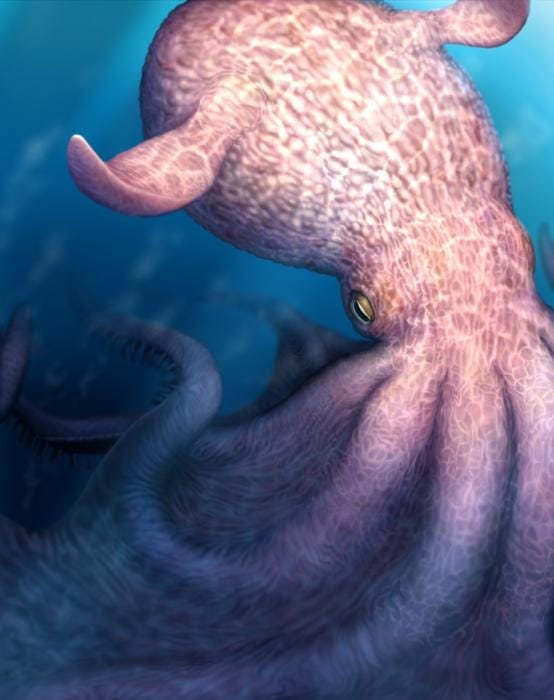
April has been a very octopusian month, featuring new discoveries about octopus sex and octopus imposters. How fitting to round it out with an amazing tale of real-life “krakens”—octopuses that may have exceeded 60-feet in length (!)—that once prowled the Cretaceous seas as apex predators.
“With a calculated total length of ~7 to 19 meters, these octopuses may represent the largest invertebrates thus described, rivaling contemporaneous giant marine reptiles,” said researchers co-led by Shin Ikegami and Yasuhiro Iba of Hokkaido University. “Their position in the food chain, however, has remained completely unknown since direct evidence such as the stomach contents of these giants has not been found to date.”
Concept art of Cretaceous kraken Nanaimoteuthis haggarti. Image: Yohei Utsuki: Department of Earth and Planetary Sciences, Hokkaido University
In the absence of any preserved octopus guts, the team looked at wear-and-tear on jaw fossils of these extinct giants for insights about their diet. The results revealed ample evidence of “a powerful bite” and “dynamic crushing of hard skeletons.” In other words, these krakens may not have only rivaled iconic ocean predators of this age—such as sharks or giant mosasaurs—they may have devoured them as well.
These ancient giants “probably consumed large prey with their long arms and jaws, playing the role of top predators in Cretaceous marine ecosystems,” the team concluded.
I think I have a new idea for a cryptid, in case anyone wants to spin up some lore.
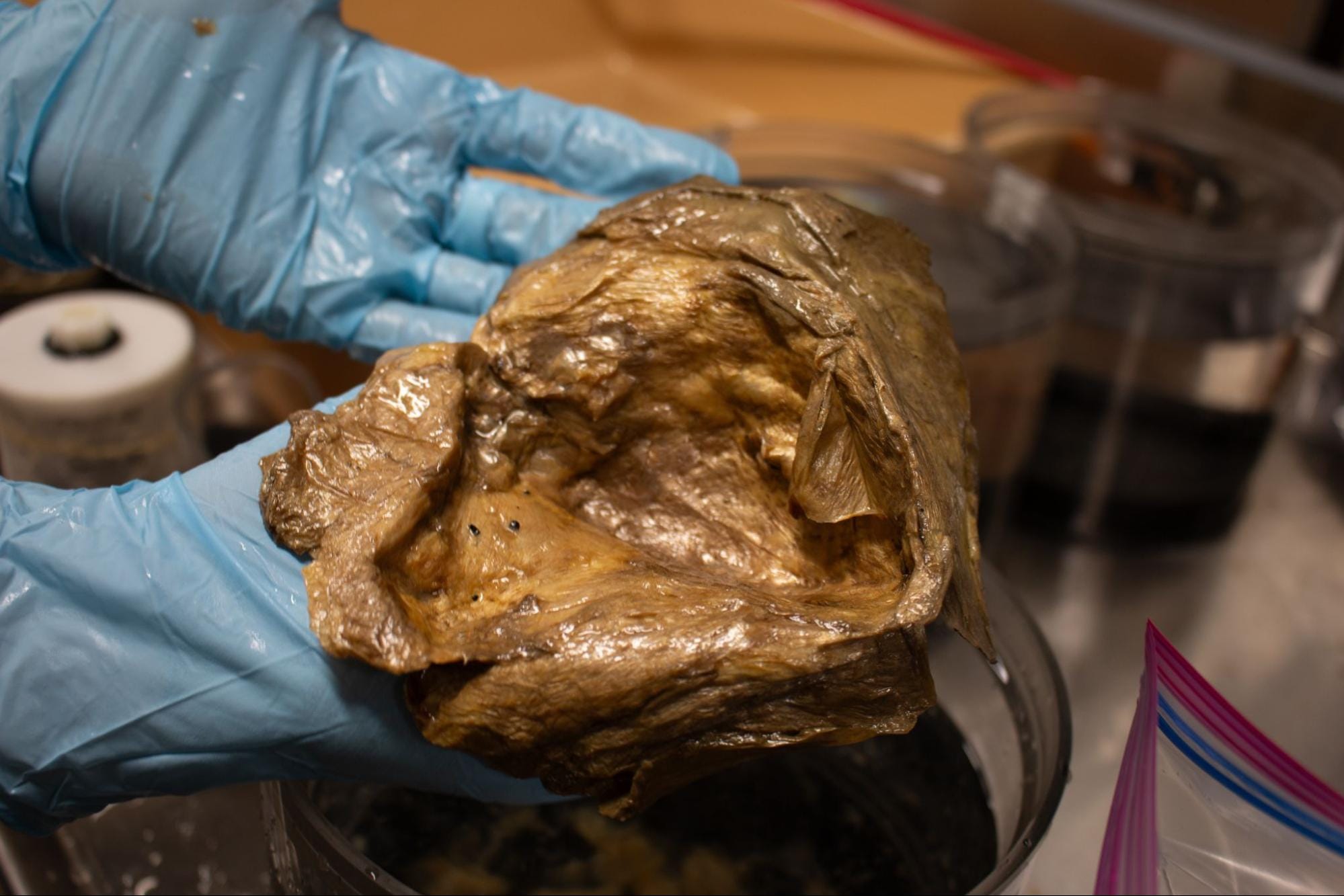
While there are no longer giant krakens prowling the seas (that we know of), the modern ocean is still home to plenty of bizarre creatures. Case in point: The Golden Orb, a strange object of indeterminate origin first glimpsed in 2023 by a robotic submersible more than two miles under Alaskan waters as part of a NOAA expedition with the ship Okeanos Explorer.
This orb completely baffled the scientific community. Was it an egg mass? A dead sponge? A biofilm? Theories abounded. But now, scientists think they have finally solved the riddle after a thorough lab analysis, according to a new preprint study that has not yet been peer-reviewed.
The verdict is that the orb is a clump of dead cells from the deep-sea anemone Relicanthus daphneae—put another way, these are basically gilded toe-nails.
“During the course of Okeanos Explorer expeditions, it is not uncommon that encountered organisms are not immediately recognized,” said researchers led by Steven Auscavitch of Smithsonian Institution's National Museum of Natural History. ”However, sometimes real mysteries exist and imagery alone only raises questions. Such is the case of the Golden Orb.”
“Fortunately, the specimen was collected using a suction sampler…and we have determined that the Golden Orb is the organic remnant of Relicanthus daphneae,” the team concluded.
Like the old saying goes, one anemone’s trash is a laboratory’s treasure.

/s3/static.nrc.nl/wp-content/uploads/2026/04/25122452/250426ECO_2033295056_Malaria.jpg)
/s3/static.nrc.nl/wp-content/uploads/2026/04/25142033/250426ECO_2033295624_Solvinity.jpg)
/s3/static.nrc.nl/wp-content/uploads/2026/04/24100124/260426OPI_2033257722_military.jpg)