Pioneering environmentalist Charles Waterton enclosed his parkland and lake near Wakefield in the 1820s
Over four years in the 1820s, Charles Waterton built a 9ft-high, 3-mile-long wall around the parkland and lake of Walton Hall. The fox- and poacher-proof boundary enclosed what could be the world’s first nature reserve, completed in Yorkshire 200 years ago.
Waterton, an eccentric, controversial and pioneering environmentalist, built nest boxes, special banks for sand martins and innovative bird hides, and offered local people sixpence for every hedgehog they brought into his reserve.
Why are Nintendo releasing a straight-up remake of the space-flight shooter – with many of its original limitations – rather than a fresh new take?
The Nintendo 64 was not my first video game console, but it was my formative one. Getting to grips with 3D movement in Super Mario 64 with that weird three-pronged controller is one of my most visceral childhood memories; the long, long wait for The Legend of Zelda: Ocarina of Time was the background noise to a huge chunk of my youth. But back in the 1990s (in the UK at least), it felt as if nobody had an N64. When everybody had a PlayStation instead, I felt I was the only kid in my whole city who cared more about Banjo-Kazooie than Crash Bandicoot.
If even Zelda seemed comparatively niche in Europe in the 90s, Lylat Wars (known elsewhere as Star Fox 64) was a real deep cut. It’s a 1997 space-flight shooter starring Fox McCloud and his squad of animal pilots laser-blasting across different planets in nimble crafts called Arwings. I played this game to absolute death in 1998, when I got it for my birthday alongside the fabled Rumble Pak, which made your controller vibrate and shudder whenever something cool was happening on screen (fun fact: Lylat Wars was the first console game to feature controller rumble). But I really hadn’t thought about it much since. Then, last week, Nintendo announced a Switch 2 remake.
All kinds of musical riches by formerly overlooked composers may be languishing in lofts and dusty archives.
The discovery of a new work by Ralph Vaughan Williams has set the world alight this week. Well, not quite, but it’s a great story. In a box in the archives of London’s Morley College Elaine Andrews came across a previously unknown Vaughan Williams song. Titled Before the Mirror, it sets a Swinburne poem that itself was inspired by a Whistler painting.
Hearing it played on Radio 4’s PM on Monday [58 mins in] reveals music of surprising tonal adventure and expressive ambiguity, written shortly after Vaughan Williams married Adeline Fisher in 1897. And the manuscript’s workings, its crossings-out and corrections, are a fascinating insight into Vaughan Williams’s creative process.
Debbie Lawson is known for her large-scale sculptures of life-size animals cloaked in ornamental carpets. Starting with an armature of wire mesh, masking tape, and Jesmonite resin, she meticulously cuts and tucks Persian carpet around every limb, building a surface that looks unbroken. As if the animals have materialized from within the textiles and are temporarily frozen in a stage of metamorphosis, we encounter them on the verge of making a move.
In the artist’s solo exhibition, In a Cowslip’s Bell I Lie at Sargent’s Daughters, she provokes “questions about the relationships between decoration and nature, craft and camouflage,” the gallery says. The title is a line from Shakespeare’s The Tempest, when the spirit Ariel sings about freedom and the carefree, even charmed connection to nature following his release from forced servitude to the sorcerer Prospero. Several of the works seen here, including “Wild Dog Sundown,” “Red Eagle,” and “Black Cougar,” are included in the show.
“Wild Dog Sundown” (2025), carpet and mixed media, 92 1/2 x 61 3/4 x 24 3/4 inches
Lawson draws on the lineage of nature motifs in art, especially wildlife. She alludes to “the natural and animal forms hidden within decorative forms and patterns, from the frescoes of Pompeii to French Rococo moldings to Venetian stone carvings—the designs of William Morris and even the New York Public Library’s lions,” says a statement. Think clawfoot tubs, heraldic animals carved into hearths and other decorative interior elements, and the more modern form-meets-function works of Les Lalannes, which often incorporate birds and mammals into designs for benches and lamps.
The dialogue between art and decor parallels inherent tensions between interiors and the outside world—refinement and domesticity versus nature or indeed, the wilderness. Lawson also thinks about the gendered history of home life and craft, which has long been been associated with “women’s work.” This is deeply personal for the artist, as textile- and art-making go back generations in both her family and her hometown of Dundee, Scotland. She says, “I’m also thinking about women, including some of my near ancestors, so often confined by the constraints of the patriarchal society in which they/we lived, trapped in the daily grind and unable to pursue their own considerable creative talents or fully inhabit the world.”
Lawson’s camouflaged animals manifest from the backgrounds of carpets, emphasizing emergence itself. As these wild animals—leopards, cougars, bears, and more—are more clearly defined, they don’t break free from their patterns. Rather, they are indelibly characterized by the textile and can be clearly recognized for their unique individual traits. It’s not unlike how craft, especially textiles that were historically relegated to domestic settings and considered at least a notch or two below “high art,” has intently disrupted the art canon in recent decades.
In a Cowslip’s Bell I Lie continues through May 30 in New York. See more on Lawson’s Instagram.
“Red Eagle” (2026), carpet, steel, and mixed media, 116 1/8 x 78 3/4 x 21 5/8 inches“Arabian Leopard” (2024), carpet and mixed media, 63 x 90 1/2 x 13 3/4 inches“Black Cougar” (2025), carpet and mixed media, 70 7/8 x 29 1/8 x 13 3/8 inches“Prospero” (2026), carpet and mixed media, 52 x 19 3/4 x 18 1/2 inches“Alligator” (2025), carpet and mixed media, 30 x 43 x 16 inchesDetail of “Alligator”“Red Cougar” (2025), carpet, table, and mixed media, 90 1/2 x 63 x 31 7/8 inches“Gold Cougar” (2026), carpet and mixed media, 70 7/8 x 28 3/4 x 9 1/2 inches
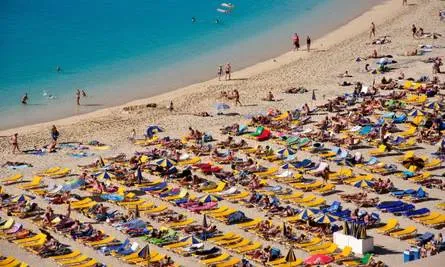
Reisgidsen zetten de Canarische Eilanden op een ‘no‑go’ lijst voor 2026. Geen verbod, wel een waarschuwing voor de gevolgen van massatoerisme.
De Canarische Eilanden krijgen voor 2026 een plek op internationale ‘no‑go’ lijsten van reisgidsen, maar er is geen sprake van een officieel reisverbod. De bekendste is de jaarlijkse “No List” van Fodor’s Travel, een invloedrijke Amerikaanse uitgever van reisgidsen, die reizigers vraagt hun vakantiekeuze te heroverwegen in plaats van de eilanden volledig te mijden.
Geen vliegverbod, wel een signaal
Toch zorgt de term “no travel list” voor verwarring. Tenerife, Gran Canaria, Lanzarote en de andere eilanden staan niet op een zwarte lijst van overheden: vluchten gaan gewoon door, er zijn geen EU‑sancties en geen officieel negatief reisadvies. Het gaat om een redactionele lijst, bedoeld als moreel signaal over bestemmingen waar de druk van toerisme volgens Fodor’s uit de bocht vliegt.
Overtourisme en woningnood
De Canarische Eilanden ontvingen de afgelopen jaren recordaantallen bezoekers, vooral uit Noord‑ en West‑Europa. Fodor’s en andere media wijzen op een reeks problemen die daarmee samenhangt: een acute woningcrisis doordat veel appartementen worden omgezet in (soms illegale) vakantieverhuur, steeds vollere wegen, watertekorten en toenemende milieuschade. Lokale media spreken van eilanden die “onder het gewicht van het toerisme bezwijken”.
Protest tegen massatoerisme
Sinds 2024 is het protest op straat zichtbaar. Op meerdere eilanden trokken duizenden mensen de straat op met leuzen als “Canarias tiene un límite”. Bewoners eisen een rem op nieuwe hotel‑ en resortprojecten, strengere regels voor vakantieverhuur en beter beschermde natuurgebieden. Volgens Fodor’s is juist die lokale weerstand een belangrijke reden om reizigers tot nadenken aan te zetten.
Bewust reizen of een andere bestemming
De “No List” is nadrukkelijk geen oproep tot boycot, benadrukt Fodor’s. Wie toch naar de Canarische Eilanden reist, zou volgens de reisgids moeten kiezen voor kleinschalige, duurzame accommodaties, water besparen en lokale regels respecteren. Voor andere vakantiegangers is de boodschap simpel: er zijn in 2026 genoeg alternatieve zonbestemmingen die minder onder massatoerisme gebukt gaan.
My next image captures two trains passing each other in near-perfect symmetry, photographed from a pedestrian bridge in Osaka.
Finding this spot turned out to be more of a challenge than expected, but after some searching I eventually tracked it down. The only downside was the lack of nearby parking — in hindsight, taking the train would probably have been the smarter option. But once you get used to having a rental car in Japan, it’s hard to give it up.
There’s something comforting about it. A kind of private cocoon that allows you to move through the city while observing everything from your own small bubble. It’s something I often notice with locals as well. For many, the car becomes an extension of home — a place to eat, to rest, or simply to disconnect for a moment from the constant pull of the city.
Back to this image though: it was absolutely worth the effort. What drew me to this composition was the perspective — the centrally positioned tracks pulling your eye straight into the distance, while the two trains pass each other in a brief moment of perfect balance. One of those scenes where timing and composition came together exactly as I had hoped.
--
All images are exclusive property and may not be copied, downloaded, reproduced, transmitted, manipulated or used in any way without written permission of the photographer!

:format(jpeg):fill(f8f8f8,true)/s3/static.nrc.nl/taxonomy/9c6b35b-OnbehaardeApen-Featured.png)