The Guardian

Latest news, sport, business, comment, analysis and reviews from the Guardian, the world's leading liberal voice

The Guardian view on India’s Iran shock: Asia’s neoliberal era starts to fracture | Editorial

Narendra Modi’s austerity appeals reveal how war, energy insecurity and dollar pressures expose the fragility of globalisation

The Indian prime minister’s call for sacrifice last week marks a fundamental shift. He urged the country’s 1.4 billion people to consume less fuel and fertiliser, buy less gold and curb foreign travel as global energy prices surge because of the war in Iran. The message, redolent of the Covid-era restrictions, suggests something larger: a retreat from neoliberal globalisation in Asia and the return of strategic economic management. The Hindu nationalist Narendra Modi waited for key regional elections to finish before pressing for the austerity measures. He was following other Asian states such as the Philippines, Bangladesh and Sri Lanka, which have made similar requests and even demands of their citizens since March.

Mr Modi made an explicit economic argument: reduce energy imports because India must conserve its foreign exchange. About 90% of India’s oil and gas needs come from abroad. When prices spike, the country faces a higher import bill in dollars, inflation and pressure for higher subsidies. Despite India’s recent economic success, it has not built sufficient productive, export or homegrown green-power capacity to reduce its vulnerability. To prevent the rupee crashing in value, India’s central bank reportedly burned through more than $40bn in reserves.

Continue reading...

The Guardian view on a new National Conversation: whether this works will depend on who is listening | Editorial

Asking people how they feel about the places where they live is worthwhile. But will it change anything?

Established in the aftermath of the 2024 riots triggered by the Southport murders, the Independent Commission on Community and Cohesion set itself the task of bridging divides. Set up on a cross‑party basis with Labour and Tory co-chairs (Jon Cruddas and Sir Sajid Javid), the project leans on a “more in common” philosophy of looking for what connects people, particularly in the places where they live. While it takes on board a range of activities and attitudes, the overarching theme is that heightened conflict and reduced contact between social groups are problems that are not taken seriously enough.

A new online survey billed as the National Conversation, which launched this week, is an attempt to build up a picture of how people across the UK feel about these issues. It will harvest information about, for example, whether respondents feel a greater sense of belonging to their local area or to the UK, and whether they are friendly with neighbours.

Continue reading...

VK: Voorpagina

Volkskrant.nl biedt het laatste nieuws, opinie en achtergronden

Soms vrees ik dat we wennen aan de ellende van de wereld

Internationale noodsituatie na ebola-uitbraak: ‘Er bestaat gewoon nog geen vaccin tegen het Bundibugyo-virus’

Twee advocaten willen Ridouan T. bijstaan in hoger beroep Marengo-proces, als ze genoeg leestijd krijgen

Wat kan de paus goed Engels, voor een paus dan

De schuld voor het falende asielbeleid ligt vooral bij radicaal-rechts

The Register

Biting the hand that feeds IT — Enterprise Technology News and Analysis

Yes, you can serve a website from a $1 microcontroller

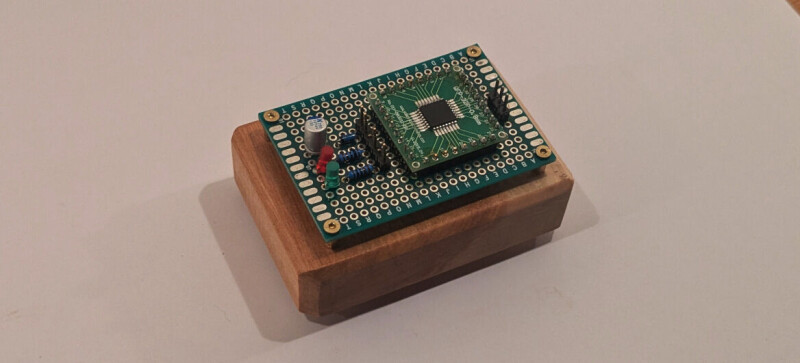
UPDATED Web hosting bills getting too expensive? Maybe you ought to consider serving your site from a one-dollar 8-bit microcontroller. Okay, you won’t exactly be serving up a high-performance, graphic-rich website using this project from European developer and blogger Maurycy Zalewski. The setup is limited to one URL, but hey, it actually works, provided an influx of visitors hasn’t killed the site yet. The bargain-basement chip that serves as the central component of this project is the AVR64DD32, which currently retails from DigiKey for $1.30. It has a single 8-bit AVR core with a blistering 24 MHz max clock speed, 8 KB of static RAM, 64 KB of flash memory, and 256 bytes of EEPROM non-volatile memory for storing a very limited amount of data. Zalewski told The Register in an email that the whole build was free for him, as he had everything on hand, but he estimates the total cost of the thing to run closer to $2 or $3 when accounting for resistors and capacitors, the board the chip is attached to, and the like. Serving a web page from such a limited chip is a task, to say the least, and Maurycyz had to do a lot of legwork to get the thing working. The I/O pins on the AVR max out at 12 MHz, which Zalewski explained meant that it wouldn’t be possible to use Ethernet for the project, as the data flow from even the aged baseline Ethernet connection of 10BASE-T is too fast for the chip to handle. “10BASE-T still runs at 10 megabits/second,” Zalewski wrote. “Worse, it uses Manchester encoding: a zero is sent as ‘10’ and a one as ‘01,’ so 10 megabits of data is actually 20 megabits at the wire.” “The proper solution is to buy a dedicated Ethernet chip from DigiKey, but then I'd be waiting weeks to finish this project,” Zalewski noted. Instead of waiting, he decided to take a different approach by turning to Serial Line Internet Protocol (SLIP), just like the guy who turned a discarded vape into a web server last year. For those unfamiliar with SLIP, it’s a 38-year-old protocol designed to encapsulate IP traffic for transmission over serial lines, and it was widely used to make internet connections in the olden days. SLIP is still supported in modern Linux builds due to its compact size and the fact that it’s often used to connect microcontrollers to the internet. Now, giving the AVR an internet connection didn’t solve the harder problem of actually serving a web page to visitors. Zalewski said the chip could generate response packets by swapping the source and destination addresses on incoming traffic and resetting the packet’s TTL value, but implementing TCP still took several days of work. HTTP handling was simplified by returning a hardcoded response for every request, which works as long as the site only serves a single URL. Here’s that limitation we were talking about: “This works fine as long as there's only a single URL on the site,” Zalewski said. Sorry for those wanting to host more pages from that $1 microcontroller. Lastly, Zalewski said he had to figure out how to get requests from the internet to the microcontroller without spending money on a publicly routed IP address. That was resolved by using WireGuard to connect the microcontroller located at his home to a public-facing machine at a Helsinki datacenter, which then proxied requests to the microcontroller using a local address block. “This means that visitors aren't directly connecting to the MCU's TCP/IP stack... but hey, it's the same setup that the Vape Server uses and no one complained,” Zalewski said. And all without having to buy a vape or root through dumpsters to find an old one. Zalewski told us that the hardware he used for the task was so simple that it only took a few minutes to build the thing itself. The software was another thing altogether, though. "Wiring up the board only took a few minutes, but writing the software took multiple days," Zalewski said. Lucky for those wanting to duplicate or add to his work, the source code and a pre-compiled binary that'll run on an 8-bit microcontroller are included in his blog post. ® Updated at 1854 GMT on 3/18/2026 with more information after we spoke to the developer.

Rijnmond - Nieuws

Het laatste nieuws van vandaag over Rotterdam, Feyenoord, het verkeer en het weer in de regio Rijnmond

Steenrijke Rotterdammer bouwt gigantisch safaripark in Zuid-Afrika: 'Anderhalve keer groter dan Rotterdam'

Michel Perridon, een van de bekendste en rijkste ondernemers die Rotterdam kent, heeft zijn zinnen gezet op een gloednieuw avontuur. Niet in onze regio, maar in de Zuid-Afrikaanse wildernis: Perridons nieuwste project is een gigantisch safaripark.

Rotterdamse ondernemer bouwt gigantisch safaripark in Zuid-Afrika: 'Anderhalve keer groter dan Rotterdam'

Michel Perridon, een van de bekendste en rijkste ondernemers die Rotterdam kent, heeft zijn zinnen gezet op een gloednieuw avontuur. Niet in onze regio, maar in de Zuid-Afrikaanse wildernis: Perridons nieuwste project is een gigantisch safaripark.