🌘
Subscribe to 404 Media to get The Abstract, our newsletter about the most exciting and mind-boggling science news and studies of the week. 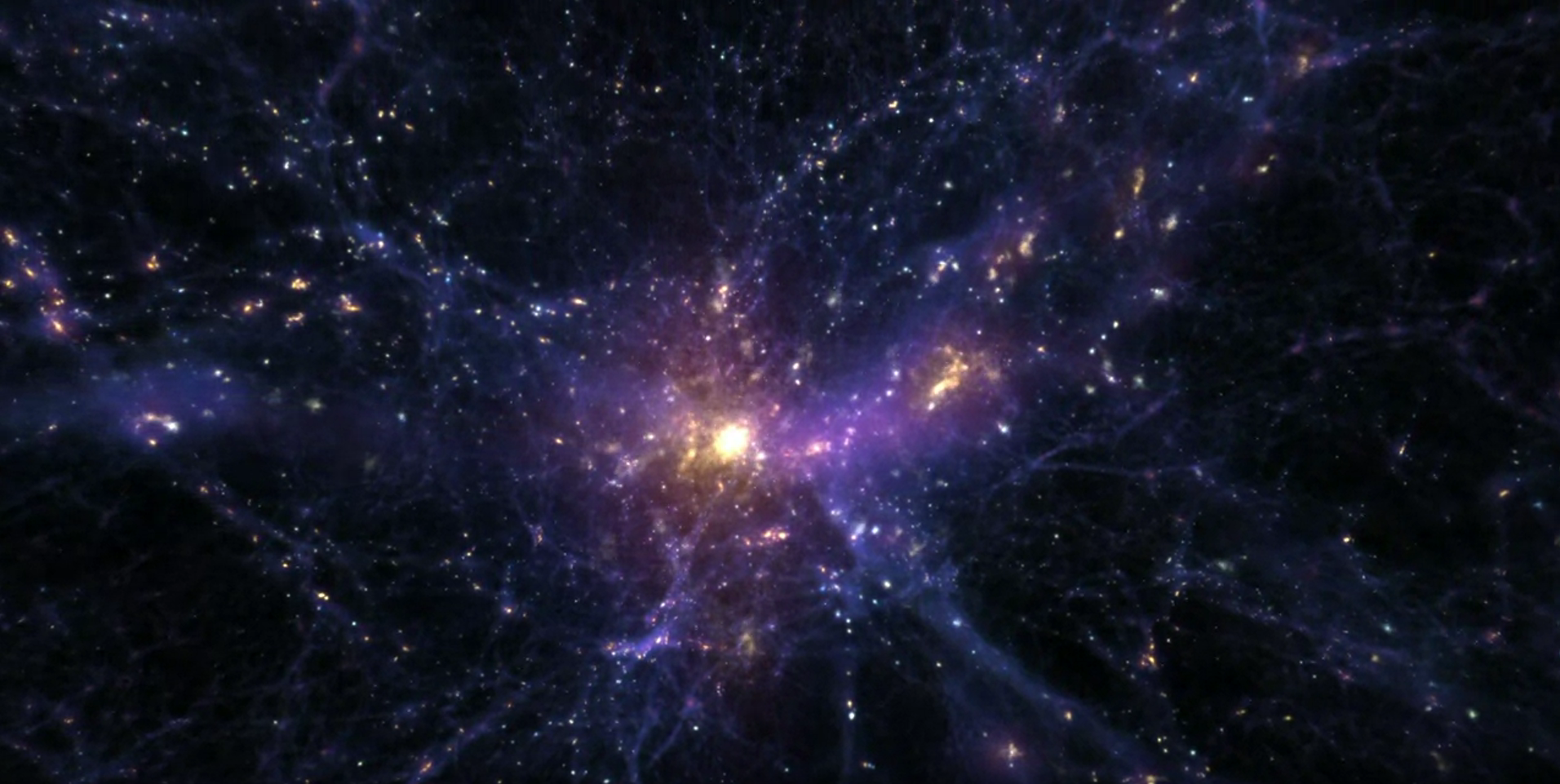
Scientists have discovered new evidence that the cosmic structures connecting the universe are much larger than previously predicted—persisting over billions of light years—a finding that challenges a core tenet of cosmology and hints at the possibility of new physics, according to a study published on Wednesday in Nature.
The standard model of cosmology, a well-corroborated framework for understanding the universe that is also known as the Lambda cold dark matter (ΛCDM) model, predicts that the large-scale structure of space looks the same in all areas (homogeneity) and in all directions (isotropy). While there is variation in the distribution of matter on small scales, such as thousands or millions of light years, these distinctions should smooth out into a uniform pattern on the scale of the cosmic web, which is a network of large-scale structures made of dark matter, gas, and galaxies that stretches across the universe.
But in recent years, new observational data has started to hint that galaxies cluster in “preferred directions,” forming distinct structures known as “anisotropies” that are not uniform, even across vast distances. Now, a pair of physicists has discovered that these distinct directions and patterns persist even to the scale of a gigaparsec, which is a unit equal to 3.26 billion light years, possibly signalling “the need for a shift in modern cosmology,” according to their new study.
“The structures observed in the real Universe are significantly larger and more persistent than those formed in state-of-the-art simulations based on the standard model of cosmology,” said authors Francesco Sylos Labini of the Enrico Fermi Research Center in Rome, Italy, and Marco Galoppo of the University of Canterbury in Christchurch, New Zealand, in an email exchange with 404 Media.
“The key advance of our analysis is that it allows this difference to be quantified,” they added. “By measuring the spatial extent and coherence of the observed structures and comparing them directly with theoretical predictions, we found that the discrepancy is statistically highly significant. In other words, the largest structures in the real Universe appear to be substantially larger than expected in standard models of galaxy formation.”
According to existing models, the cosmic web emerged from small density fluctuations in the early universe and gradually developed into large-scale filaments and nodes made of dark matter that gravitationally attract gas, galaxies, and other forms of matter.
Last year, the Dark Energy Spectroscopic Instrument (DESI), a major astronomical survey based in Arizona, released the largest high-resolution 3D map of the universe, which has revolutionized cosmology and allowed scientists to test those theories against observational data.
Labini and Galoppo analyzed the DESI release with statistical tools, including the Angular Distribution of Pairwise Distances (ADPD), which is especially effective for detecting and characterizing large-scale anisotropies in DESI’s dataset.
“The idea was to try to really test whether the idea that isotropies reached very large scales is now supported by data,” said Galoppo in a follow-up call. “Even just five or ten years ago, we didn't really have the data to test on gigaparsec scales. But now, we had a chance, so we decided to take it.”
“What we are able to do is to characterize how large are the largest structures inside this sample” of DESI observations, added Labini in the call.
The results revealed that even in DESI’s super-zoomed-out observations, large-scale structures create preferred directions of galaxy distribution, as opposed to an overall isotropic pattern. This contrasts with expectations derived from the cosmic microwave background, the oldest light in the universe, which suggests that directional correlations should fade rapidly at large scales.
“In the standard model, it's not that there aren’t structures,” said Galoppo in the call. “It is just that they are supposed to be smaller and less persistent than what we found. That's the crux of the matter.”
To that end, DESI is expected to release a new batch of observations within a year, and similar datasets will also be forthcoming from Europe’s Euclid space telescope and the Vera C. Rubin Observatory in Chile in the near term. These new and improved views of the universe will help scientists grapple with just how vast these large-scale structures are, and what that means for our understanding of our cosmic surroundings.
“At present, there is no simple or widely accepted modification of the ΛCDM framework that naturally explains structures of this size while remaining consistent with the observed uniformity of the cosmic microwave background,” Labini and Galoppo wrote over email. “That is precisely why these observations are so interesting: they point to a potentially important gap between theory and observation that deserves further investigation.”
“If future surveys continue to find coherent directional structures on even larger scales, the implications for cosmology would be profound,” they concluded.

/s3/static.nrc.nl/wp-content/uploads/2026/06/24161414/240626VER_2034730561_gothberg.jpg)