US president contested judge’s order to release money after Carroll’s 2023 sexual abuse and defamation trial against him
A Manhattan federal appeals court late on Wednesday rejected Donald Trump’s latest bid to delaythe payment of more than $5m to E Jean Carroll following her successful 2023 sexual abuse and defamation trial against him.
The US court of appeals for the second circuit made its decision hours after Trump filed paperwork fighting Manhattan federal court judge Lewis Kaplan’s order releasing this money – which has been held in a court-controlled account since June 2023. Trump denies all wrongdoing.
Prominent economists including Jim O’Neill, an ally of Andy Burnham, are urging the MP for Makerfield to pursue radical tax and spending reform to “unlock the gridlock that plagues the country” when he is confirmed as prime minister.
O’Neill joins Jonathan Portes, an economics professor at King’s College London, and Danny Sriskandarajah, the chief executive of the New Economics Foundation, in calling for bold action in an open letter.
A visual identity inspired by the physical act of analog writing, where the letter, chance, and imperfection become the foundation of a contemporary visual language for literature.
Microsoft has quietly fixed the “RoguePlanet” zero-day in Microsoft Defender, closing the latest hole exposed by security researcher Nightmare Eclipse after months of public sparring over the company's handling of vulnerability reports. The vulnerability, tracked as CVE-2026-50656, was addressed through an update to the Microsoft Malware Protection Engine rather than via its monthly Patch Tuesday bundle. Microsoft said customers should ensure they're running the latest engine version to receive the fix. The flaw first surfaced in June when Nightmare Eclipse published both technical details and proof-of-concept exploit code, claiming RoguePlanet worked against fully patched Windows 10 and Windows 11 systems. According to the researcher, the bug exploits a race condition in Microsoft Defender to spawn a command prompt with SYSTEM privileges, granting an attacker complete control of the local machine if the timing is right. "The exploit is a race condition, so it's a hit or miss," Nightmare Eclipse wrote at the time. "I have managed to get a 100 percent success rate on some machines while it struggled to work on others." The researcher also claimed the exploit worked regardless of whether Defender's real-time protection was enabled. When The Register first covered RoguePlanet in June, Microsoft would only say it was investigating the claims. That probe has now ended with a fix, although Redmond hasn't publicly explained what changed under the hood or whether the bug had been exploited outside of proof-of-concept demonstrations. RoguePlanet became the seventh Windows zero-day publicly disclosed by Nightmare Eclipse since April as part of an increasingly acrimonious campaign against Microsoft's vulnerability disclosure and bug bounty programs. The researcher, who claims to be a former Microsoft employee, has repeatedly accused the company of ignoring reports, deleting accounts used for submissions, and treating independent researchers with contempt. After Microsoft initially warned that publishing exploit code could carry legal consequences, security researchers pushed back hard enough that the company issued a clarification saying it had no intention of pursuing action against people conducting or publishing legitimate security research. Nightmare Eclipse, meanwhile, alleged that Microsoft removed repositories hosting the RoguePlanet proof-of-concept from GitHub and GitLab before relocating the exploit to a self-hosted repository. With CVE-2026-50656 now patched, Microsoft has closed every public zero-day Nightmare Eclipse disclosed earlier this year. Whether that also closes the increasingly bitter chapter between Redmond and one of its most prolific bug hunters is another question entirely. ®
Romelu Lukaku ging na een door blessures getekend seizoen toch mee met de Belgische WK-selectie, en hielp de ploeg nu al driemaal aan een zege. „Weinig spelers kunnen kreupel én zo bepalend zijn.”
Het zou natuurlijk kunnen hè, dat de vrouw die Graham Platner ervan beschuldigd haar in 2021 te hebben verkracht al wist dat hij later de politiek in zou gaan en dus haar nieuwe vriend, een gewone vriend en haar therapeut vast in vertrouwen nam om wat valse beschuldigingen de wereld in te slingeren, maar Platner wist toen zelf nog helemaal niet dat hij zich ooit verkiesbaar zou stellen, dus die kans is klein. Bovendien meldden zich inmiddels meerdere vrouwen die ooit met hem gedatet hebben, en de beschuldigingen waarachtig achten. Dat weerhoudt Platner er niet van eerst met die indrukwekkende zeehonden-snor van hem een konijnenhol in te duiken, en vervolgens in ruim elf minuten verslag te doen van wat hij daar aantreft. Het establishment wil hem kaltstellen, het is allemaal één groot complot, het echte slachtoffer is Graham Platner, en daarmee het volk, dat vanzelfsprekend op Graham Platner zou stemmen. Ze zitten achter u aan, Graham Platner stond alleen maar in de weg!
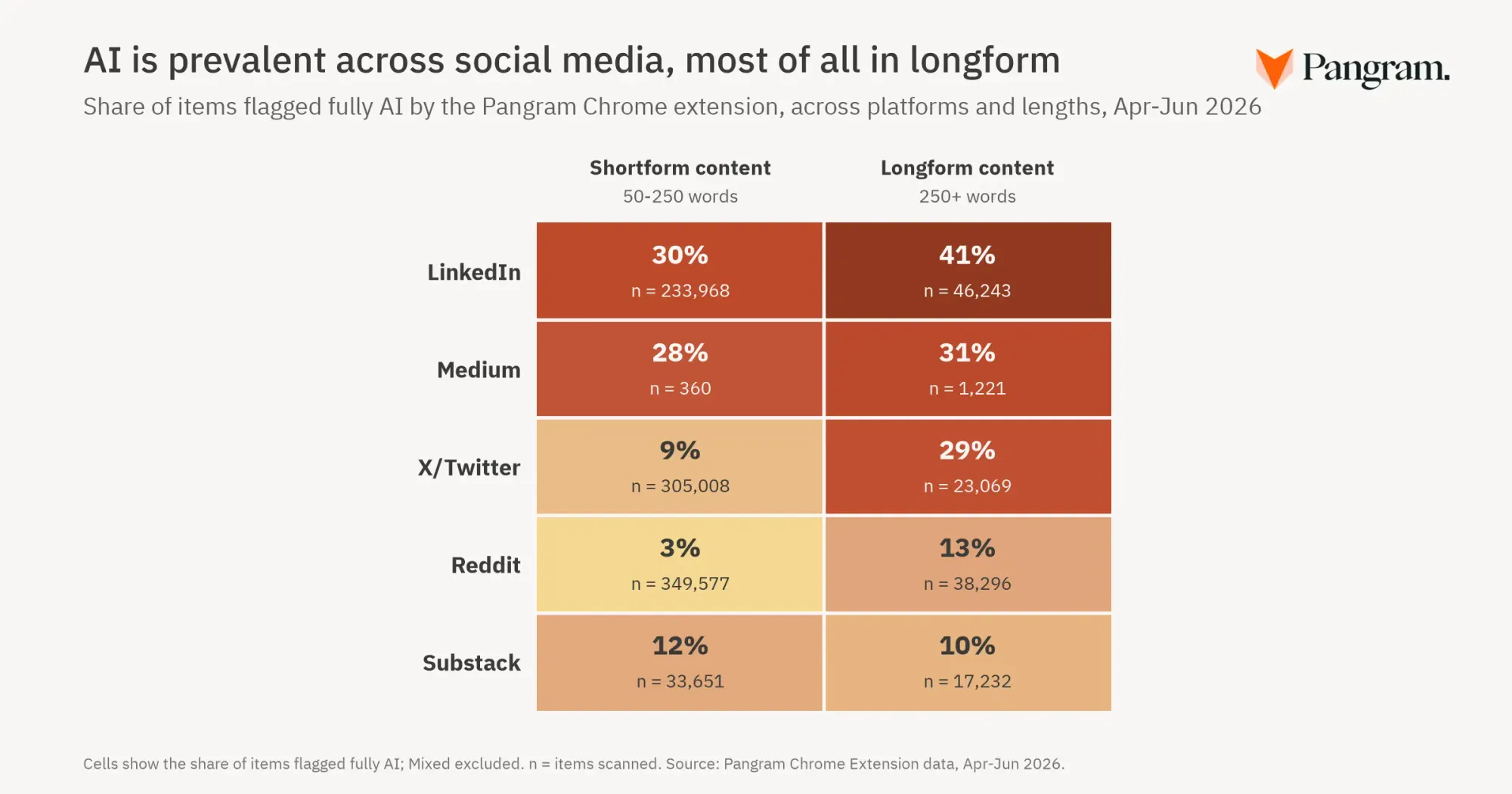
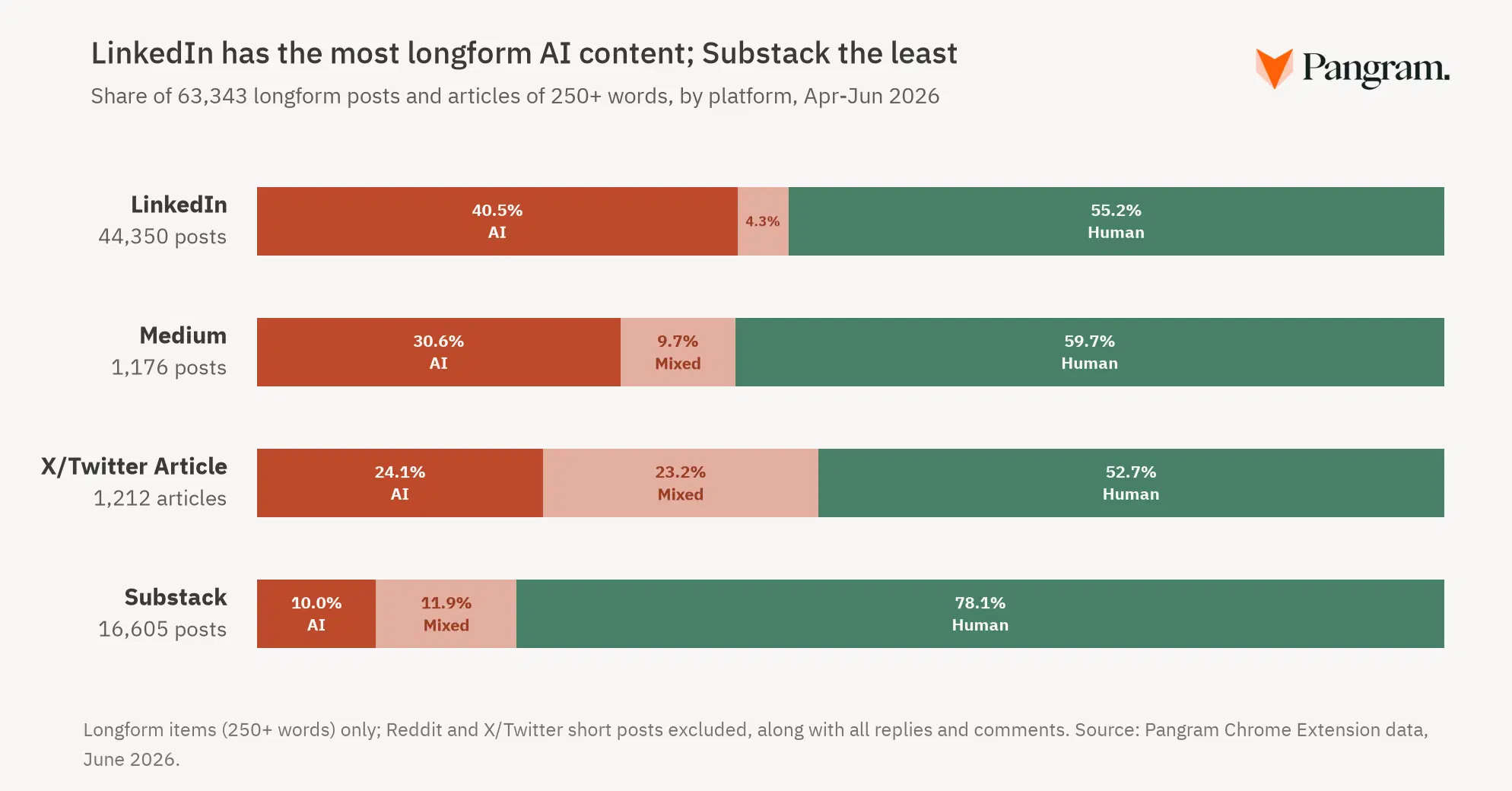
A shocking amount of the content that users encounter on popular social media websites is likely AI generated, according to data from a company that detects AI writing. As much as 41 percent of longform written content seen by users on LinkedIn is likely to be fully AI-generated and roughly a third of longer posts on X are AI-generated; roughly one-in-ten longer Reddit and Substack posts are AI, according to the data.
The data was collected using a Chrome extension from Pangram, a company that detects AI-generated writing. Pangram’s Chrome extension scans writing that users encounter while browsing and determines if any given post is likely AI-generated or likely human written. Because Pangram works passively in the background while a user is browsing the internet, it only scans posts that its users actually see. This helps answer the question of whether AI slop is actually poisoning the internet that humans actually use, versus polluting the internet more broadly. The answer is unequivocal: AI slop writing is not just sequestered off on unpopular automated SEO farms or spam sites that no one reads; humans are regularly wading through AI dreck on hugely popular sites.
“This isn’t something that had really been studied before—how much AI content people are actually seeing,” Max Spero, the CEO of Pangram, told me in a phone interview. “AI content is a tax on readers’ time.”
(Pangram formerly advertised on 404 Media. I am covering this data because I have written many articles about how AI-generated content is taking over social media and is brute forcing social media algorithms, and I have not seen other data that attempts to measure the actual popularity of slop.)
For this research, Pangram specifically asked users of its Chrome extension to opt-in to share Pangram browsing results with the company. The company analyzed roughly a million posts that its users organically scroll through across LinkedIn, Medium, X, Reddit, and Substack over a two-month period. Pangram found that, universally, longer posts on all platforms are more likely to be AI-generated than shorter posts. The company split the content it analyzed into “shortform” (between 50 and 250 words) and “longform” (longer than 250 words).
The data suggests, perhaps unsurprisingly, that a huge portion of longform posts on LinkedIn and X’s new article format are fully AI-generated or AI-assisted (meaning drafted, edited, or rewritten by AI with some human elements). Forty percent of longform LinkedIn posts analyzed in the data were fully AI-written; a quarter of X articles were fully AI written, but another 23 percent of X articles were AI-assisted, the company said. It intuitively makes sense that longer form content is more likely to be AI-generated, because people usually won’t bother to AI-generate a few word response or a pithy comment on a quote tweet, for example. AI is also famously verbose, meaning AI-generated content is more likely to show up in longer posts.
“Our data shows that AI-generated content is a problem across all platforms, and it is hitting longform content especially hard,” the company wrote in a blog post. “Contrary to what one might expect, people are overwhelmingly willing to use AI to speak on their behalf in professional settings that are associated with their real identity, and less likely to use it on casual and anonymous platforms.”
The study also found that top-level posts on LinkedIn and Reddit are far more likely to be AI-generated than the comments underneath an original post.
I have been using the Pangram Chrome extension for several months now, after interviewing Spero for an article I wrote called “Your AI Use Is Breaking My Brain.” In that article, I wrote about the cognitive weight of the constant assessments I am doing when I’m browsing the internet, trying to determine whether a piece of writing is AI-generated or not. After writing that article, I decided to try the Pangram Chrome extension to see whether its assessments of likely AI-generated writing aligned with my own brain’s assessments. After using the extension for nearly two months, my experience has largely aligned with what Pangram’s data suggests: Many of the longform articles I see on X are obviously AI generated, and are detected by Pangram as such. A huge amount of the LinkedIn posts I see are obviously AI-generated.
Because of the way the study worked, by passively detecting AI generated content that people see in their normal browsing, the data is potentially more useful than other studies that have sought to estimate the raw percentage of AI-generated content on the internet, but not whether anyone was actually seeing that content. These prior studies, which found that as many as a third of new sites are AI, allowed for the possibility that AI-generated content was flooding the internet but that it was of such a low quality that actual people may not have been seeing it.
The Pangram data raises questions about what platforms are doing to promote or disincentivize AI slop. LinkedIn, for example, had for years built AI writing tools into its platform meaning that it has been incredibly easy to post AI-generated content on the platform and that AI-generated content became incredibly common on the platform. In May, the company announced that it is trying to disincentivize AI content in the name of “keeping conversations real,” and the AI writing assistant is no longer built into the post button. Reddit, meanwhile, has become a vector for companies trying to game LLM tools by promoting their products on the site because AI search tools often scrape Reddit. But Reddit’s moderators are also overwhelmingly anti AI, and the company has worked to delete AI-generated posts and ban accounts that spam. On Monday, Reddit published a blog post saying that “in the age of AI, spam, bot activity, and inauthentic content are top of mind for people who love Reddit (and humans).” In the last few weeks, Reddit launched an ad campaign called “people are best” specifically highlighting that its users are human. A Reddit spokesperson referred us to the blog post when asked for comment.
As we have reported before, no AI detector is 100 percent foolproof, and Pangram certainly has both false positives (human content detected as AI) and false negatives (AI content detected as human). Spero said that the company is constantly working on minimizing both, and that it estimates its false positive rate at roughly one in 10,000. He said he believes the Pangram data is likely a “lower bound” and that the actual problem is likely worse, because people who are willing to install AI detectors on their browsers are likely trying to avoid AI-generated content.
“I think the data generalizes out [to non Pangram users], but that it’s a lower bound on AI content because someone with the Pangram extension probably cares more about seeing AI content than the average person and would be more likely to block or mute AI posters,” he said.
A LinkedIn spokesperson told 404 Media in a statement that “Professionals come to LinkedIn to hear from real people and their unique insights and perspectives. We actively work to reduce low quality, automated or generic content, and while AI can be used to beat the blank page problem, our focus is on surfacing professional conversations that help people advance their careers.”
Substack and X did not respond to a request for comment.
BRUSSEL (ANP) - Op verzoek van de EU-lidstaten heeft de Europese Commissie een lijst met opties opgesteld voor handelsrestricties op producten uit de door Israël bezette gebieden op de Westelijke Jordaanoever. Dat bevestigt een woordvoerder van de Europese Commissie donderdag. De opties worden maandag besproken op een vergadering van de EU-ministers van Buitenlandse Zaken in Brussel.
De commissiewoordvoerder wilde er verder niet veel over kwijt. Het gaat volgens hem onder meer om mogelijkheden om de invoer van goederen uit deze illegale nederzettingen te beperken of te verbieden "met het oog op een eventuele verslechtering van de situatie".
Een van de opties is de verplichting van een exportvergunning voor bedrijven die goederen uit Israëlische nederzettingen importeren, meldt Euronews. Een tweede is een dusdanige verhoging van de invoertarieven om zo de invoer van goederen uit nederzettingen onbetaalbaar te maken.


/s3/static.nrc.nl/wp-content/uploads/2026/07/09100843/090726SPO_2035085056_3.jpg)