BELFORT (ANP) - Mauro Schmid heeft de dertiende etappe van de Tour de France gewonnen. De Zwitserse renner van Jayco AlUla was vrijdag de beste in een sprint tegen de Colombiaan Harold Tejada, nadat het tweetal was weggereden van hun medevluchters. De Brit Tom Pidcock werd derde. Het is de eerste ritzege in de Tour voor Schmid, die in 2025 al eens tweede werd in een etappe.
De etappe van Dole naar Belfort door de Vogezen was met 205,8 kilometer de langste van deze Tour. Het peloton gaf een kopgroep van 57 renners de ruimte met een maximale voorsprong van ruim 8 minuten.
TAPACHULA (ANP/RTR) - Voor de zuidwestkust van Mexico heeft zich een zware aardbeving met een kracht van 7.4 voorgedaan, meldt de Amerikaanse geologische dienst USGS. Het epicentrum lag op 10 kilometer diepte voor de kust van Puerto Madero, vlak bij de grens met Guatemala. Er is langs de kust een waarschuwing voor een tsunami uitgevaardigd.
In de regio, tot in Guatemala-Stad toe, bewogen panden door de schok, aldus waarnemers.
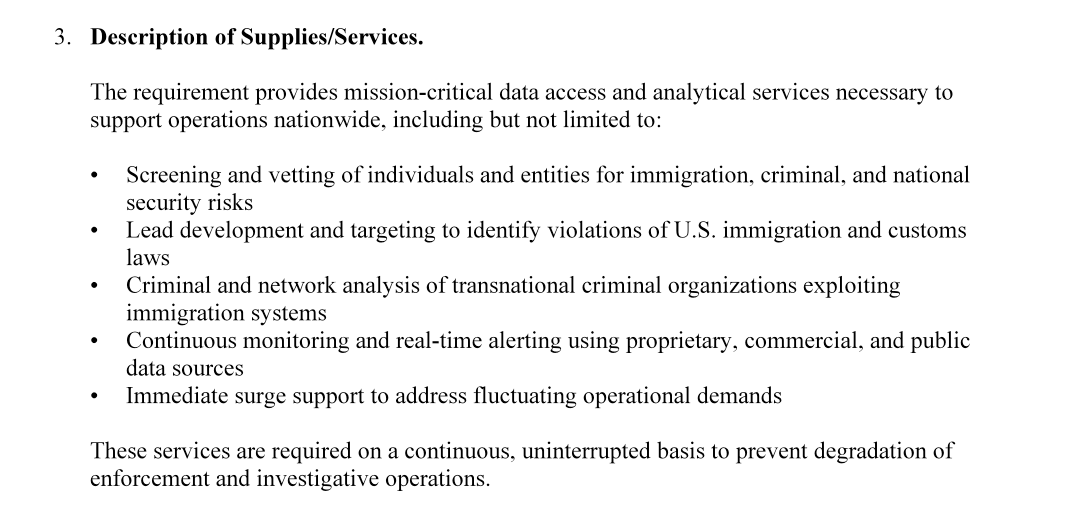
The Department of Homeland Security (DHS) plans to pay data broker giant Thomson Reuters $125 million for access to its databases of personal data — which includes peoples’ names, addresses, Social Security numbers, ethnicity, social media posts, and geolocation information — to help Immigration and Customs Enforcement (ICE) investigate what it describes as “voters fraud” and immigration fraud, according to procurement documents reviewed by 404 Media. The document says Thomson Reuters is able to let ICE continuously monitor millions of people and entities of interest.
The news comes after President Trump held a conspiracy-laden and unhinged press conference about election security on Thursday, setting the stage for potentially undermining the legitimacy of the upcoming midterm elections. It also follows ICE fatally shooting 2 people in a week.
“Due to ICE’s re-prioritized mission, there is need for this data to be readily accessible to support the presidential mandate of the identification of Voters Fraud, Immigration Fraud and National Security,” the procurement document reads. “This data specifically validates and verifies school, benefit, immigration and other eligibility requirements.”
💡
Do you work at Thomson Reuters? Do you know about any other data sales like this? I would love to hear from you. Using a non-work device, you can message me securely on Signal at joseph.404 or send me an email at joseph@404media.co.
Thomson Reuters is most well known for running the Reuters news agency, but the company is also a massive data broker and sells access to that data to companies and governments. Its data product, called CLEAR, promises to “Accelerate investigations confidently through a vast collection of public and proprietary records,” according to Thomson Reuters’ website.
Thomson Reuters lists some of the data sources that feed into CLEAR, and 404 Media has obtained an internal list. It includes credit header data, which is the personal information someone provides to a financial institution to open a credit card like their address, which goes to the credit bureaus and then transferred to Thomson Reuters. The procurement document also says it includes social media, property records, geolocation information, license plate data, and more.
The planned sale is specifically with Thomson Reuters Special Services (TRSS), a subsidiary which often handles Thomson Reuters’ government contracts. The document says TRSS offers embedded data scientists to clients who are cleared up to a Top Secret/SCI [Sensitive Compartmented Information] level. The plan is to pay the company $25 million a year over the next five years, totaling $125 million.
Parts of DHS have previously accessed CLEAR data, and 404 Media has reported on internal ICE documents which say it is integrated with Palantir’s tool for finding neighborhoods to raid. But the new document stresses that ICE has such a high need for this data, that it is planning to spend more than a hundred million dollars on another form of access to it.
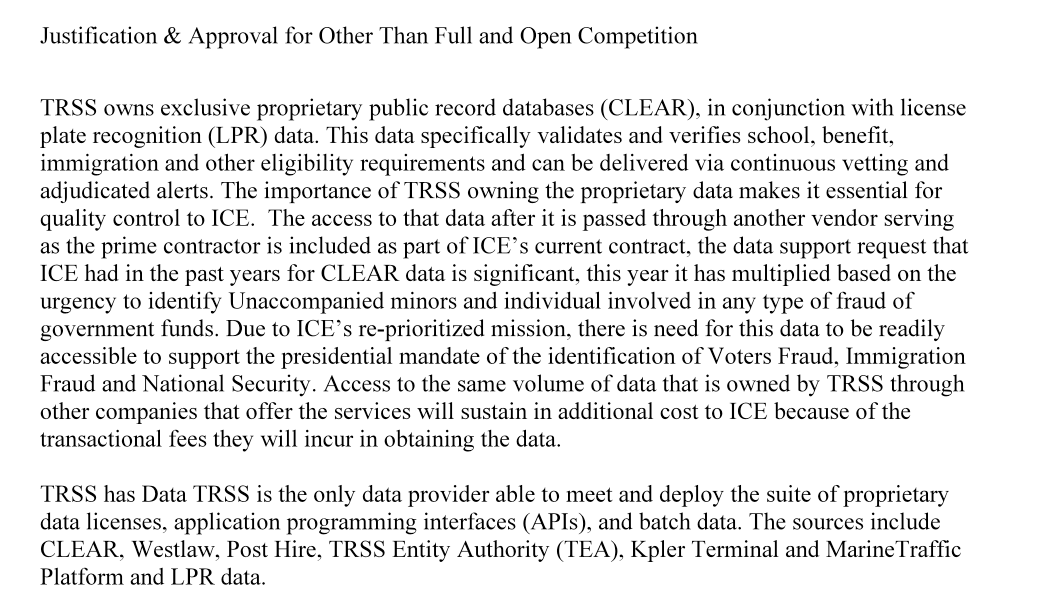
Screenshots of the document.
“The importance of TRSS owning the proprietary data makes it essential for quality control to ICE. The access to that data after it is passed through another vendor serving as the prime contractor is included as part of ICE’s current contract, the data support request that ICE has in the past years for CLEAR data is significant, this year it has multiplied based on the urgency to identify Unaccompanied minors and individual involved in any type of fraud of government funds,” it continues.
“Access to the same volume of data that is owned by TRSS through other companies that offer the services will sustain in [sic] additional cost to ICE because of the transactional fees they will incur in obtaining the data,” it adds.
The document says that TRSS is the only company able to offer access to the data in “batch.” Another section reads, “TRSS is the only contractor able to provide ICE with a continuous monitoring and alert service for millions of individuals and entities of interest, this is essential for national security purposes.”
In a previous statement to 404 Media about ICE’s earlier access to CLEAR data, Thomson Reuters said, “It’s inaccurate to connect CLEAR to ICE and its deportation and enforcement operations.” When 404 Media contacted the company on Thursday and sent the new procurement document which describes ICE wanting the data for voter fraud and immigration fraud enforcement, the company provided a new statement: “We prohibit the use of CLEAR for the purpose of identifying and locating noncriminal immigrants or undocumented individuals with the intention of deportation solely on the basis of the individual’s immigration status. We take this restriction seriously, and we enforce it.”
“We continue to work with our customers to provide technology and services that support investigations into areas of national security and public safety, such as child exploitation, human trafficking, narcotics and weapons trafficking, and fraud/financial crime,” the statement added. The company also said, “Immigration status is not a search field in CLEAR.”
Thomson Reuters previously fired a longstanding employee after they spoke out about the company selling data products to ICE. 404 Media previously reported ICE invited staff to demos of a license plate reader app from Motorola that can be enhanced by CLEAR data.
Emma Pullman, head of shareholder engagement and responsible investment for the B.C. General Employees’ Union (BCGEU), which is a minority shareholder in Thomson Reuters, said, “Thomson Reuters has given shareholders, employees, and the media inconsistent and shifting accounts of the nature of its ICE contracts. TRSS latest ICE contract is the first to include voter fraud that we are aware of, and we intend to press the company, alongside other investors, for clarity on this contract.”
Update: This piece has been updated to include comment from Emma Pullman.
West Indies legend, who has died aged 89, was cricket’s finest all-rounder, delivering victories with style and grace
Cricket nuts like an argument. Who is the best fast bowler ever? The best spinner? The best wicketkeeper? The best slip catcher? They – oh all right, we – can spend hours discussing the candidates. But the best all-rounder?
That does not take any longer than the debate over the best batter; here we have to concede even in the presence of our Australian friends the supremacy of Don Bradman. The best all-rounder is universally agreed to be Garry Sobers. The other contender, WG Grace, lived so long ago that we are reduced to guesswork. So Sobers it is.
Sean Duffy has had enough with anti-car violence and has removed multiple Proven Safety Countermeasures from the DOT's website. While the majority of Federal transportation safety dollars still flow to the states to spend through the Highway Safety Improvement Program, this administration has clearly decided to reject science and abdicate its role as the stewards of transportation safety.
Bike lanes, variable speed limits, speed safety cameras, appropriate speed limits for all road users, and road diets are now apparently woke and not welcome in the menu of things we do in the United States.
While traffic fatalities have fallen the last few years, NHTSA still estimates over 36,000 people lost their lives on U.S. roads in 2025 . And that amount puts us firmly below most of our peer countries in safety performance. A look at IRTAD's 2025 Annual Report (page 25) shows our traffic fatalities by 100,000 inhabitants far exceeds that of many industrialized countries and puts the U.S. in the company of Chile and Costa Rica.
Apparently some of the Federally funded research I have done in this domain is still accessible online, but the FHWA has made it hard to locate.
This Copernicus Sentinel-2 image features part of the Republic of Guinea-Bissau in western Africa.
Zoom in or click on the circles to explore this image at its full 10 m resolution.
With an area of 36 125 sq km, Guinea-Bissau is one of the smallest nations in continental Africa. This tropical country is made up of highlands in its northeastern region and, pictured here, lowlands near the Atlantic coast.
Captured in May 2026, the image shows how this coastal region is dominated by low plains scattered with mangrove swamps and cut through by rivers and estuaries, which branch out in the terrain like roots from a plant.
Tidal waters soak the interior on a daily basis, reaching up to 100 km inland – this is possible due to the flat coastal topography. The resulting sea inlets are a distinctive feature of Guinea-Bissau, which has the largest number of saltwater rivers in western Africa. For this reason, Guinea-Bissau features a blend of freshwater and saltwater rivers and estuaries, as shown also in this image.
The Geba River (freshwater) meanders from northeast through plains before emptying into the Atlantic Ocean in the Canal do Geba – the wide estuary at the top of this image. On its way, it carries water and nutrients, useful for agriculture, but also sediment, silt and organic matter which cause the milky colour of the water. The mouth of the Geba estuary is shared with its major tributary, the Corubal River, seen in the image joining from southeast.
Just south of the Canal do Geba is the Rio Grande de Buba, a saltwater estuary, whose shores are surrounded by mangroves in the lower half and which mixes with the seawater of the Atlantic Ocean. It represents a unique example in West Africa of an arm of the sea extending so far inland. At its eastern end lies Buba – visible as a brown, structured area – the largest city in southern Guinea-Bissau and the capital of the region.
Due to its unique environment, Guinea-Bissau is home to remarkably diverse flora and fauna, protected in various national and natural parks. The Cufada Lagoons Natural Park, located between Canal do Geba and Rio Grande de Buba, is also a Ramsar Wetland of International Importance and home to a large subpopulation of the critically endangered western chimpanzee.
The decline of western chimpanzees will have significant consequences for Guinea-Bissau’s environmental balance and rich biodiversity. Over the last few decades, the number of these primates in West Africa has fallen by 80% – a trend likely to continue unless urgent, coordinated action is taken at local, national and international levels.
Credits: contains modified Copernicus Sentinel data (2026), processed by ESA; CC BY-SA 3.0 IGO
From left to right, NASA astronauts Christina Koch, Reid Wiseman and Victor Glover, and Canadian Space Agency astronaut Jeremy Hansen, with ESA's European Service Module team behind them at ESTEC.
The four Artemis II astronauts visited ESTEC, ESA’s technical centre in the Netherlands, on 13 July as the first stop in a series of post-flight visits to the European teams that made their mission possible.
The day included a visit to the Eagle mission control room, where ESA and Airbus engineers monitored the European Service Module around the clock throughout Artemis II. There, astronauts met some of the ESA specialists who had supported their flight from Earth.
“Walking into this room and seeing it full of the engineers who were actually sitting on console during our mission monitoring things was awesome,” said Christina Koch later during the visit. “I could have stayed in here all day.”
The astronauts and engineers shared their perspectives on key moments of the mission – the engineers following events from ESTEC, the astronauts experiencing them first-hand in deep space.
They discussed the trans-lunar injection burn, performed by the European Service Module’s main engine around 25 hours after launch, which was so precise that two planned trajectory correction manoeuvres were no longer required.
During the visit, NASA Orion Program Manager Howard Hu presented ESA with a Program Award acknowledging Europe’s important contribution to Artemis II. Several members of the European Service Module team also received certificates and an Artemis II patch flown on board Orion during the mission, in recognition of their contribution and dedication.
The recognition reflected the vital role played by ESA’s European Service Module and by the teams who developed and monitored it throughout Artemis II. Built by European industry under ESA leadership and assembled by Airbus in Bremen, Germany, the module supplied air and water for the crew, generated electrical power through its four solar arrays, maintained thermal control and provided the propulsion needed to carry Orion over one million kilometres through deep space, around the Moon and safely back to Earth.
During the mission, Artemis II pilot Victor Glover manually flew Orion using the European Service Module’s engines. At a press conference during the visit, he reflected on that experience: “The European Service Module flew like a dream … every space flyer dreams of flying a spaceship by hand in space. Thank you to the European Space Agency, to the Airbus team, and the Europeans that made it possible.”
Researchers used the NIRSpec (Near-Infrared Spectrograph) Integral Field Unit on the NASA/ESA/CSA James Webb Space Telescope to map chemical contents of the Beta Pictoris system. As a result, they discovered a third planet, Beta Pictoris d, orbiting the young star.
Instead of identifying the planet as a bright point of light, as seen in the reconstructed image, researchers searched the spectroscopic data for the molecular signatures expected from a giant planet atmosphere, allowing the object to stand out from the surrounding debris disc.
The extracted NIRSpec and MIRI (Mid-Infrared Instrument) spectra of Beta Pictoris d display a distinctive series of carbon monoxide (CO) absorption lines. This molecular “fingerprint” identified the object as a giant planet, while measurements of the Doppler shift of the spectral lines provided the planet’s radial velocity, confirming it is gravitationally bound to the Beta Pictoris system.
[Image description: The image at the left shows two exoplanets of the Beta Pictoris system. At the centre, there is a white star symbol, which represents light blocked from the host star. Immediately to the left of the star symbol, there is a bright orange-whitesh smudge, labeled b. To the right of the star symbol is a blurry orange smudge labeled d. There is a white circle around this smudge with lines drawn to the spectrum at the right. The x-axis is labeled “Wavelength of Light” and extends from 4.2 to 5.2 microns. The y-axis is labeled “Brightness.” An up arrow is labeled “brighter,” a down arrow “dimmer.” There are two jagged horizontal lines across the graph. One is white, the other is maroon (the former labeled “Webb data”, the latter labeled “Best fit model” in the bottom left corner). A blue vertical column spanning from about 4.3 microns to 5 microns is labeled Carbon Monoxide, CO.]
Credits: NASA, ESA, CSA, STScI, L. Hustak (STScI). Science: A. Gibbs (UC San Diego), J. B. Ruffio (UC San Diego), A. Bidot (STScI). Image Processing: A. Pagan (STScI); CC BY 4.0
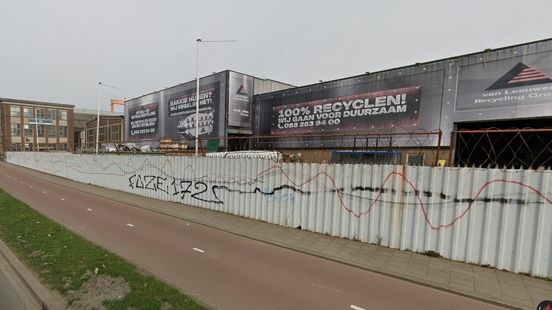
Afvalverwerker Van Leeuwen Recycling mag verhuizen naar bedrijventerrein Hordijk-West in Rotterdam. De rechtbank in Den Haag heeft de bezwaren van omwonenden afgewezen. Zij vrezen onder meer geluidsoverlast, stof, brandgevaar en veel extra vrachtverkeer.